Posted in M.Zane McClellan, poem, Poems/Poetry, poetry, Poets/Writers, The BeZine

Unfolding

unfolding
Image courtesy of Pixabay.com. Public domain, license cc0

Something about the weight of it.
It settles so well in my hands,
appealing to my sense of touch.
The warmth of the cover,
crisp edges sliding across my thumb
as I fan.
The soft scraping sound of the sheets,
like a tree branch brushing against the window,
playing hide and seek with the moon
casting shadows on my equilibrium
as they are cast across the room.
As I am enchanted
by the bending of the spine,
the unfolding of wings as a butterfly.
That which was cocooned
in another’s chrysalis mind
transformed
to take flight in the
infinite sky,
this imagination of mine.

– M. Zane McClellan

Copyright © 2016,  All rights reserved

Editorial Note: Today we introduce a new member of our core team, M. Zane McClellan. He grew up in New York where he attended Adelphi University and was the first African-American to play lacrosse and serve as the Freshman Class President. He studied Psychology before joining the Marine Corps. McClellan recently initiated an international collaborative poem called, Poets for Peace, and is working on his debut novel, a fantasy. To read more of M. Zane McClellan’s poetry, please see, The Poetry Channel. J.D.

Posted in Humor, Poems/Poetry

‘Twas All Hallows’ Eve

Thanks to my friend M. for the terrace decor.

after Clement Clarke Moore‘sTwas the Night Before Christmas …

‘Twas All Hallows’ Eve, and all through the house
Every creature was stirring, even our pet mouse
Oh the pumpkins were carved with very great care
In the hope that trick-or-treaters soon would be there
The children were agitated, not one in her bed
As visions of sweet treats danced in their heads
Dad and I in our costumes and me with my cap
Had settled by the door listening for the first rap
When out on the lawn there arose such a clatter
We sprang to our feet to check on the matter
We threw open our door to offer sweet stash
While witches flew by, all glitter and flash
And the moon on the rise and the dark ground below
Gave lustre and bluster to ghosts on the go
And then what to our startled eyes should appear,
But a miniature ballerina among goblins, one bear
Now, Alice! Now Ernie! Now Jimmy! Now Chris!
Come little Tony, big Brandy and Trish
To the top of the stairs, don’t any one fall …
Now dash away dash away dash away all

On behalf of The Bardo Group Beguines

Happy Halloween to all who celebrate!

And that’s it for our contribution to Halloween this year! Wishing you many sweets and no cavities. 

©2010, poem and photograph, Jamie Dedes, All rights reserved

Posted in 100,000 Poets, Musicians, Artists and Activists for Change, Environment/Deep Ecology/Climate Change, Jamie Dedes, Nature, poetry

the smell of wood, the scorch of fire … and a writing prompt to help you prepare for 100TPC

stumpsthis rough-barked sequoia stump, sitting in majesty
in its coastal home, victim of wildfire, burned down
to its gnarly roots, its nicks, holes and char, eons
of scars, life seemingly cut off, goddess snake alive
inside the concentric circles, the smell of wood and
scorch of fire, at the verge of our infinity, in its truth ~

pristine

rugged

pulsing

haunted by the geometry of limbs, the calculus of green,
the algebraic eloquence of a world within a world  ~

So present.

So essential.

So primal.

it sings to itself in the marrow of our bones

– Jamie Dedes

WRITING PROMPT

In preparation for The BeZine 100,000 Poets (and Friends) for Change

Saturday, Sept. 24, 2016

Theme: Environment/Environmental Injustice

This poem was originally written in 2014 for Wilderness Week. There were then and are now a number of fires raging in the western United States. Wildfires are a natural occurrence but since the 1980s they’ve been increasing due to human-caused climate change. According to the Union of Concerned Scientists . . .

Wildfires in the western United States have been . . . occurring nearly four times more often, burning more than six times the land area, and lasting almost five times as long (comparisons are between 1970-1986 and 1986-2003) ….. many of the areas that have seen these increases—such as Yosemite National Park and the Northern Rockies—are protected from or relatively unaffected by human land-use and behaviors. This suggests that climate change is a major factor driving the increase in wildfires.” MORE

We tend to look at these fires in terms of the expense incurred fighting them and the cost of lives, homes, habitat, wild life and so forth. However, there’s one consideration we may tend to forget: Nature teaches us, comforts us, feeds us and is the ebb and flow of our spiritual and physical lives. The loss – the environmental injustice – is profound on more than a material level. This is what the smell of wood, the scorch of fire seeks to illustrate. “Nature” is who we are. Nature is us.

Write a poem or creative nonfiction piece on what the natural environment means to you and perhaps the sense of loss you feel as you note plants, animals, insects and wilderness that you’ve seen damaged or destroyed by climate, industry, overpopulation and whatever else has effected the area in which you live.

© 2014, poem, Jamie Dedes (The Poet by Day), All rights reservedPhoto credit ~Bay Nature.org: “The Bay Nature Institute, based in Berkeley, California, is dedicated to educating the people of the San Francisco Bay Area about, and celebrating the beauty of, the surrounding natural world. We do so with the aim of inspiring residents to explore and preserve the diverse and unique natural heritage of the region, and of nurturing productive relationships among the many organizations and individuals working towards these same goals.” Read more HERE.

You are invited to join The Bardo Group Beguines at The BeZine blog on Saturday, September 24 for 100,000 Poets (and friends) for Change.  Below is a list of more features to provide you with information. We hope you’ll join us.

RELATED:

Posted in General Interest, The BeZine Table of Contents, TheBeZine

July 2016, Vol.2/Issue 10; Faith in Things Seen and Unseen

If the doors of perception were cleansed every thing would appear to man as it is, infinite.
For man has closed himself up, till he sees all things thro’ narrow chinks of his cavern.
The Marriage of Heaven and Hell, William Blake

Faith! In the discussions here you won’t find consistent perspective or theology. You will find faith explored in its many manifestations, religious and otherwise. You’ll find it both shaken and unshakable and in things of the spirit, in nature and humanity, in intuition and in self and family. Unity here is not in things creedal but in the shared values of peace, sustainability and social justice and for many of us – implicitly – in ultimate salvation through artistic expression.

Unitarian Universalist Minister, Rev. Ben Meyers, starts us with an appeal to religions to give their prayers and vigils legs, to befriend one another into the groundswell of local social justice initiatives that ultimately help to inform and bolster global efforts toward equity, justice and peace.This couldn’t be more appropriate as The BeZine “went to press” amid news reports of yet more violence.

You will find our usual diversity represented: skepticism and atheism, the three Abrahamic traditions, shamanism, and the mystical perspectives of Buddhism, Hinduism and Sufism.

Our special selection of lead features and poems are by: shamanic practitioner and psychotherapist, Michael Watson; resident skeptic, James R. Cowles; the always engaging and level-headed analyst, Priscilla Galasso; the fallen altar boy, poet Joe Hesch; professional story-teller and photographer, Naomi Baltuck; our renaissance man in Sheffield, John Anstie; and university librarian, poet and artist, Corina Ravenscraft, on the ultimate triumph of the Universe.

Speaking from positions of their unshakable religious faith are: Algerian poet, Imen Benyoub, on the spiritual joys and family and community connection she finds in the holy tradition of Ramadan; Catholic Theologian, Fr. Daniel S Sormani, theology professor at Ateneo de Manila University, warmly writes about lessons learned from the homely life of the Blessed Virgin Mary; and our gentle Italian literary contributor, Mendes Biondo, tells of inspiration from the Bishop of Hippo Regius (current Annaba, Algeria), St. Augustine. Imen and Mendes are our two student contributors.

Two of our contributors allude to child sexual abuse but a third, Terri Muuss, addresses it head-on and in depth. These are experiences that may strengthen faith in self, though that doesn’t come without pain and work. Terri is featured this month in our popular “Getting to Know You” section.

Our July poetry collection covers matters spiritual, emotional and environmental with excerpts from published collections by Zine regulars: Matt Pasca, Terri Muuss, Myra Schneider, Silva Merjanian and Michael Dickel, contributing editor to The BeZine. With joy we welcome back two lights: German poet, photographer and educator, Dr. Aprilia Zank and English poet, Patricia Leighton.

New to our pages in this issue are:

  • Connie Spearing  who writes of finally “seeing” her Irish grandmother with the accidental discovery of her family’s history during and after World War 1.
  • Sandra Renew’s s poetry expresses her opinions on the state of the world. She wonders who sleeps at night? Who is lucky enough to live in safety and peace?
  • Anca Mihaela Bruma, citizen of world, educated in Rumania, is a poet who writes spiritual autobiography. Anca wanted to incorporate some lovely music and art into her posts. Due to copyrights in one case  (Dorina Costras’ art) and technical incompetence (mine) in the other, we are unable to share Dorina’s paintings or Anca’s soundcloud recordings. However you can view Dorina’s work HERE. You can listen to Anca on soundcloud HERE.

****

One last word: DON’T FORGET TO SAVE THE DATE Saturday, 24 September 2016 is The BeZine’s 100,000 Poets for Change, an event which we host virtually.  This event is part of an  important annual arts initiative for global solidarity and peace, social justice and sustainability. Reader participation is invited and encouraged. This is a good time to share your work in the service of a worthy cause.  As is our tradition, all submissions will be archived here and at Standford University. Instructions for participation will be provided on our blog that day with Michael Dickel serving as Master of Ceremonies.  Between Michael and me, the event will run from morning in Israel to midnight in California. The theme this year is Environment/Environmental Justice. More detail HERE.

****

Now, come friends.  Read.  Nourish yourselves at our table …

In the spirit of peace, love and community
and on behalf of The Bardo Group Beguines,
Jamie Dedes
Founding and Managing Editor
The BeZine

EDITORIAL

The World in Vigil, by Rev. Ben Meyers

THEME: FAITH IN ALL THINGS SEEN and UNSEEN

Lead Features

Knowing, Michael Watson
Varieties of Faith – Rational and Religous, James R. Cowles
Faith Means Making Choices, Priscilla Galasso
A Perfect World, Naomi Baltuck
Falling But Willing, Joseph Hesch
The Pine Cone Project, John Anstie
Regarding Faith, Corina Ravenscraft

Essays

A Month of Light, Imen Benyoub
The Blessed Mother: She Reminds Me of Who I Am and Who I Should Be, Fr. Daniel S. Sormani, C.S.Sp.
A Little Story of Faith, Mendes Biondo
NOTIONS OF THE SACRED: Poetry as Spritual Practice, Jamie Dedes
The Grandmother I Didn’t See, Connie Spearing

Speculative Flash Fiction

Moshe’s House in Space, Michael Dickle

Poetry

Rhetoric Introspection, Anca Mihaela Bruma
Our Autumn Spring, Anca Mihaela Bruma
Hindsight, Anca Mihaela Bruma

Unidos en Cristo, a poem in English y en español, Jamie Dedes

Three Poems, Michael Dickel
En Gedi, Michael Dickel
Hybrid: Warm Hunger, Michael Dickel

Lost Behind Clouds in Skies of Blue, Joseph Hesch
Hang in There, Joseph Hesch

And the Village Still Sings for Taha Muhammad Ali, Patricia Leighton

Coverage, Silva Merjanian

Passing, Terri Muuss
What Heals, Terri Muuss

Tanyou (In Search of Quietude), Matt Pasca
Silence, Matt Pasca
Toll, Matt Pasca
When Joy Breaks, Matt Pasca

Bring all those who are led astray out of the desert, Sandra Renew

3 a.m., Myra Schneider

prayer for shadows, Aprilia Zank

GETTING TO KNOW YOU

Terri Muuss, Over Exposed

CONNECT WITH US

IMG_0234Beguine Again, Spiritual Community and Practice

Facebook, The Bardo Group Beguines

Twitter, The Bardo Group Beguines

Access to the biographies of our core team, contributing writers and guest writers is in the blogroll where you can also find links to archived issues of The BeZine (currently in the process of updating), our Mission Statement and Submission Guidelines.

Posted in The BeZine, The BeZine Table of Contents

June 2016, Vol. 2/Issue 9; The Joys of Friendship

June 15, 2016

“Friendship improves happiness, and abates misery, by doubling our joys, and dividing our grief” Marcus Tullius Cicero

Friendship: Such a homely topic and yet where would we be without friends, whether from childhood or new to us in retirement, whether with family, schoolmates, coworkers, online or in the flesh, our friends do indeed double our joys and make our grieving more bearable. Friends may share specific times in our lives or specific values and interests. Each friend is without a doubt among the great treasures of life and living.

This month our contributing writers and our guests explore the wide range of friendships, their observations and notably, their gratitude. From newborn friendships to one that has stood the great test of time and is in its sixtieth year, from friends who share our family life to those who accompany us in retirement, all are savored this month.

Many of our reader-faves are back this month. Writing on theme Contributing Editor Priscilla Galasso, and Contributing Writers John Anstie, Corina Ravenscraft, Naomi Baltuck, Liliana Negoi and Charlie Martin. Frequent guest contributors Imen Benyoub and Aprilia Zank share their world-class poetry.

Poet Maggie MacKay debuted with us last month. We’re delighted to bring another of her poems to you today. We extend a warm welcome to poet Patricia Leighton, new to our pages.

Fathers can be our greatest champions and friends and we celebrate Father’s Day with Juan Felipe Herrera, former poet laureate of the United States. He’s a joy. Don’t miss that feature.

In our “More Light” section: We continue our well-received “Getting to Know You” series this month with interviews of Silva Merjanian, a frequent guest contributor, and Michael Watson, a member of the Bardo team from almost the beginning.

With Michael we also explore the consequences of disability in a special collection of features on illness and disability. You’ll find an inspiring piece there about a heroic friend of mine who, despite being legally blind, continues to ply her passion, fine art photography.

Contributing Writer, Joe Hesch, and Mendes Biondo – Mendes debuted with us last month – share their world class poety.

Among the features included in “More Light” is M.J. Tenerelli’s article about the process of publishing a poetry collection – Grabbing the Apple, An Anthology of New York Women Poets – which just launched a few weeks ago A long-time friend of The Bardo Group Beguines, Dutch nature artist, Paula Kuitenbrouwer, shares the tranquility in her art, “Lotus Plant” and “Lotus Pond and Tortoise.”

Enjoy all and thank you for being the peace.

On behalf of The Bardo Group, Beguines, and in the spirit of peace, love and community,
Jamie Dedes
Founding and Managing Editor

FRIENDSHIP

Features

Friendship and the Serious Introvert, Priscilla Galasso
You Rock, Naomi Baltuck
Musings on Friendship, Corina Ravenscraft
There Are Friends … and there are Friends, John Anstie
Bonds, Liliana Negoi

Poetry

scars and stars, Imen Benyoub
Eyeing the Landscape, Patricia Leighton
Musing on a Sixty-Year Friendship, Maggie MacKay
of lovers and friends, Charles W. Martin
you really didn’t say that, Charles W. Martin
re: your account, Charles W. Martin
photographs, Aprilia Zank

HAPPY FATHER’S DAY

Father’s Day with Juan Felipe Herrera, Performance Artists and former California Poet Laureate

MORE LIGHT

Special Section: Disability

Illness, Disability and Servitude, Michael Watson
Living …. the operative word …. With Disability, Jamie Dedes
Legally Blind Photographer, Wendy Alger, Jamie Dedes

Feature

“Grabbing the Apple” … or, How a Regional Anthology of Women Poets Was Created and Successfully Launced, M. J. Tenerelli

Poetry

In Chorus We Breath, Joseph Hesch
It’s spring, folk!, Mendes Biondo

Art

“Lotus Plant” & “Lotus Pond with Tortoise”, Paula Kuitenbrouwer

Getting to Know You

Silva Merjanian, From War-torn Lebanon to Peace in California
Dreaming the World, An Interview with Michael Watson

IMG_9671CONNECT WITH US

Beguine Again, Spirtual Community and Practice

Facebook, The Bardo Group Beguines

Twitter, The Bardo Group Beguines

Access to the biographies of our core team, contributing writers and guest writers is in the blogroll where you can also find links to archived issues of The BeZine, our Mission Statement and Submission Guidelines.

Posted in Beguine Again, General Interest, Peace & Justice, The BeZine, The BeZine Table of Contents

MAY 2016, Vol.2/Issue 8; Books That Changed Our Lives

May 15, 2016

Books are a uniquely portable magic.
Stephen King, “On Writing: A Memoir of the Craft”

Books are a primary way we get to travel, meet new people, and learn about the world and the human condition outside the narrow confines of our personal concerns, our families and communities. They are indeed magic: they inform, heal, spur us to action, offer new perspectives, new ways of being in the world and – perhaps most important – they open us to the joys and suffering of others.

In this month’s lead feature, Algerian poet, writer, university student and frequent contributor to The BeZine, Imen Benyoub, tells how three important books that focus on war and genocide teach us about “courage, tolerance, love and sacrifice” and bear witness to “how generous and resilient a human spirit can be, even in the darkest times.”

Imen’s feature is suggestive of The BeZine‘s raison d’etre: to come together from different parts of the world, different cultures, races and creeds, to show our soft underbelly, our most human side in the interest of peace. We are here to quietly be ourselves, to share and in so doing to recognize one another as sister and brother, not “other.” If one of us bleeds, we all bleed. Let us not be silent in the face of daily brutalities. Pens, not swords, open minds and hearts and heal our world. This month – as always – our writers represent a diversity of nations, religions (or lack of), ethnicities and cultures. While this is an English language publication, not all of our writers have English as a first language.

Lilianna Negoi and Contributing Editor, Priscilla Galasso, get us started at the beginning, our early childhood reading. Lana Phillips tells the touching story of comfort in reading Red Shoes for Nancy about a girl older than she who was also living with disability. Corina Ravenscraft tells us how two books made a substantive difference in her life and way of being in the world. Michael Watson says in his essay:

Being an avid reader, I have developed a suspicion that, like the Great Weathers, almost any book can change one’s life for good or ill, and that timing has a lot to do with the outcome.

James R. Cowles’ essay, Escaping Into Reality, offers a lot to think about (as his essays always do) and Mendes Biondo (new to our pages) tells us of personal growth and changes in perspective fostered by an encounter with The Cannon of 20th Century Greek poet, Costantino Cavafy.

We move on to poetry by several of our core team members: John Anstie’s profound Looking South (looking back) with Frodo Baggins; Joe Hesch’s well-crafted and honest poems Schwund und Reue (Loss and Regret) and Confessions of Light-reading Poet; Naomi Baltuck combines a poem by Alice Lowe with her signature photo-storytelling; Charlie Martin loves too many books; Liliana Negoi writes movingly and vividly of reading.

We have several newcomers to our pages this month. We are delighted to introduce poets Joshua Medsker, whose poem is included with the themed pieces and, under the More Light section, Miki Byrne, Sakshi Chanana and Maggie Mackay. Please be sure to welcome them with “likes” and comments. Read their bios HERE.

Also under More Light are Naomi Baltuck’s always engaging photo-stories. We close with a charming art piece from Marlyn Exconde and her children.

Enjoy! … and be the peace …

Jamie Dedes, Managing Editor

LEAD FEATURE

Three books. Three cities: Sarajevo, Warsaw, and Lod … stories about music, war, friendship and survival…, Imen Benyoub

THEME FEATURES

Essays and Photo Stories

The First Book That Shaped Me, Lilianna Negoi
Books That Change Lives, Priscilla Galasso
Red Shoes for Nancy, Lana Phillips
Books That Changed My Life, Corina Ravenscraft
Books and Great Weather, Michael Watson
Escaping Into Reality, James R. Cowles
May there be many a summer morning …, Mendes Biondo

Poems

Looking South with Frodo Baggins, John Anstie (essay & poem)
A Merry Literary Christmas, Naomi Baltuck and Alice Lowe
Schwund und Reue, Joseph Hesch
Confessions of a Light-reading Poet, Joseph Hesch
too many loves, Charles W. Martin
The Poetic Books, Joshua Medsker
Night Light, Liliana Negoi

MORE LIGHT

Poetry

Tying Coats on Elephants, Miki Byrne
Drugs on the Street, Miki Byrne
Blood and Money, Miki Byrne
Transience, Sakshi Chanana
Silver and Gold, Maggie Mackay
Anosmia, Maggie Mackay

Photo Stories

A Peace of My Mind, Naomi Baltuck
The Mistery of Life, Naomi Baltick
Lullaby of Life, Naomi Baltick

Art

Magic Is Your Name, Marlyn Exconde and Children

IMG_9671CONNECT WITH US

Beguine Again, Spirtual Community and Practice

Facebook, The Bardo Group Beguines

Twitter, The Bardo Group Beguines

Access to the biographies of our core team contributing writers and guest writers is in the blogroll to your left along with archived issues of The BeZine, our Mission Statement and Submission Guidelines.

Posted in Michael Dickel, Poems/Poetry, Poets/Writers, The BeZine, The BeZine Table of Contents

April 2016, Vol. 2/Issue 7 ~ Celebrating Poetry Month

15 April 2016
Poetry Month

The Waste Land by T. S. Eliot

I. The Burial of the Dead

APRIL is the cruelest month, breeding
Lilacs out of the dead land, mixing
Memory and desire, stirring
Dull roots with spring rain.
Winter kept us warm, covering
Earth in forgetful snow, feeding
A little life with dried tubers.
Summer surprised us, coming over the Starnbergersee
With a shower of rain; we stopped in the colonnade,
And went on in sunlight, into the Hofgarten.
And drank coffee, and talked for an hour.…

A tidal wave of poetry, perhaps.

Michael Dickel, Contributing Editor

While Eliot declares the cruelty of April, April also happens to be National Poetry Month in the United States and Canada. In our online, social media world, it has become an international celebration of poetry as well. To join in this celebration, we in the Bardo Group Beguines dedicate the April issue each year to poetry. Many of us who write regularly for The BeZine are poets, and we usually include poetry. So, for us, it is a happy celebration—nothing cruel about it!

And what a wide-ranging celebration we offer in the 2016 National Poetry Month The BeZine issue! W. B. Yeats is oft quoted as saying, “What can be explained is not poetry.” So I won’t explain. I will tell you that Terri Muuss’ poem, “Thirteen Levels of Heaven,” takes you far and wide in a few grains of sand. “The Other Woman,” Imen Benyoub’s heart-wrenching poem, is not who you think—but in the current global storm of conflict and national political climate, indeed, she is Other. Michael Rothenberg’s “Poem for Mitko” personalizes the news we hear by imagining its impact on our mutual friend, Macedonian poet Mitko Gogov.

What these three featured poems have in common is their ability to take the intimate, the personal, the real moments of every day life, and reflect in and from them larger issues of humanity and life. Each describes very specific, personal scenes. According to Joy Harjo, “It’s possible to understand the world from studying a leaf.” And all of these poems open our eyes wide to the world. Sharon Olds tells an interviewer about poets she admires: “Their spirits and their visions are embodied in their craft. And so is mine.” And so are the spirits and visions of the authors gathered here.

“It may also be the case that any genuine work of art generates new work,” Donald Barthelme tells us in a Paris Review interview. As you read the poems, essays, interviews, and reviews in this month’s issue, I imagine that they will generate new art for you. Whether the art of living, the art of knowing others, or “the Arts,” you will want to do more of it after reading what we offer this month.


Last year, the Second Light Network of Women Poets (SLN) collaborated with The BeZine during April to present poetry from the SLN. In this year’s issue, you can read more about the network in “SECOND LIGHT NETWORK, showcasing the ambitious poetry of ambitious women.”  Jamie Dedes’ essay “POET, TEACHER, INSPIRATION: Dilys Wood and the Latter-day Saphos” also sheds light on Dilys Wood, founder of the SLN. This year, in my dual roles of contributing editor here at The BeZine and associate editor at The Woven Tale Press, I have served as liaison in a new collaboration. The works specifically from the collaboration appear in their own section in the table of contents below.

However, the whole issue represents collaboration—not only between the two publications, but between all of the writers. We work together, as a community. In putting this all together with Jamie Dedes and my Bardo Group Beguines and Woven Tale Press colleagues, I came to realize how many of the poets here I know personally—separately from these two publications. We all come from an organic online writing community. By organic, I mean through no organized effort or special social website.

After years of knowing Michael Rothenberg through email and Facebook, I only finally met him in person this past summer. Terri Muuss and I met at Cornelia Street Café in Greenwich Village, also years ago, where her husband, Matt Pasca (who also has appeared in The BeZine), Adeena Karasick, and I performed one lovely evening. All four of us keep in touch through Facebook now.

I met gary lundy a long time ago and have spent time together, including road trips and as roommates for a few months. However, most of our friendship has been sustained and maintained by email and online connections—dating back to before any of us had heard of Facebook. UK poet Reuven Woolley, Romanian poet Liliana Negoi, Natasha Head, as well as Jamie Dedes and the rest of the Bardo Group Beguines, I only know “virtually.” Until a few months ago, the same was true for The Woven Tale Press publisher and editor-in-chief, Sandra Tyler.

Today, the world of poetry, as with everything else, has transformed under the influences of technology and social media. Last year, I spoke to a graduate-student seminar about social media, poetry, and the latest wave of “democratization of poetry.” That discussion evolved into the foreword of The Art of Being Human, Vol. 14, which you can read in this issue as “(Social) Media(ted) (Democratic) Poetry.”

I won’t try to count how many waves of “democratic” trends in poetry have washed up on the beach. A couple of centuries ago, poets were concerned “just anybody” might write poetry, and they didn’t think that was such a good idea. Some probably still don’t. Free verse and the Beats in the mid-Twentieth Century have been associated with the idea, for better or worse, depending on who made the association.

Today, poetry slams usually involve actual voting, as do many online sites. Self-publishing has become easy and cheap, so anyone could have a book who wants to, now. As a result of all of this, editors—such as those putting together a special poetry issue—serve much more as curators than as the gate-keepers of old. So, we may be in one of the greatest ever waves of “democratic” poetry.

A tidal wave of poetry, perhaps.

Don’t worry. While it will wash over you and change you, you won’t drown. Enjoy the poetry, writing about poetry, and other work presented here for your celebratory pleasure!

“There is something in me maybe someday
to be written; now it is folded, and folded,
and folded, like a note in school.”
― Sharon Olds


Table of Contents

Featured

POEMS

ESSAYS, INTERVIEWS, REVIEWS

WOVEN TALE PRESS COLLABORATION

SECOND LIGHT NETWORK

IMG_9671CONNECT WITH US

Beguine Again, Spirtual Community and Practice

Facebook, The Bardo Group Beguines

Twitter, The Bardo Group Beguines

Access to the biographies of our core team contributing writers and guest writers is in the blogroll to your left along with archived issues of The BeZine, our Mission Statement and Submission Guidelines.

Posted in Poems/Poetry

Where the Wisteria Grows

Pondering Angel
Pondering Angel

At the flower market this morning
I thought of us and our naked lives
Did you notice the star lilies bowing
and giant calyxes unfurling themselves?

A painter’s pallette of color there
fretting in terra-cotta, feral and windblown
A fabulous fusion of scent and form,
forests of nectar-pots on knobby stems,
the stuff of heaven for the anthophilous
In just a day or two, they’ll be gone

I couldn’t help but think that these
yes! … these are our human days
our days to sow or steal our human joys
Another day will inevitably transform us
The moon will stew us in a soffritto
of tulips and night-blooming jasmine

At dawn on the day I decide to die,
we’ll sip oolong at the Tudor Rose,
but I won’t be there, I promise I won’t
You’ll eat orchids to celebrate our love
and our long walks in kempt gardens

Once you picked forget-me-nots –
meant as the soul of our redemption
When their colors fade and leaves wither,
it will be time to look for me …
Look for me where the wisteria grows
With subtle eupony my blue-violet tendrils will
call you, weaving and binding you in love again

” . . . when we look around ourselves, we can recognize ourselves in the non-self elements, like a father looking at his children can see himself in his children, can see his continuation in his children. So he is not attached to the idea that his body is the only thing that is him. He’s more than his body. He is inside of his body but he is also at the same [time] outside of his body in many elements. And if we have the habit of looking like that, we will not be the victim of our attachment to one form of manifestation, and we will be free. And that freedom makes happiness and peace possible.” Thich Nhat Hanh

© 2016, poem, Jamie Dedes (The Poet by Day); Pondering Angel by Barbara Stone of the List of Buddha Lists

Posted in General Interest, Jamie Dedes, Poems/Poetry

a man, a woman, a stick

(1921)

the stick stood in the corner of the kitchen
a constant threat; stoking, as it was meant to,
chronic intimidation

he had a man’s right to deliver his blows
to vent his anger and his self-contempt
to cause suffering for the insufferable

someone had to make it up to him,
his loss-of-face to race, creed and poverty

for her part, eve’s daughter was ripe,
shamed by her intrinsic sinfulness,
worn by her constant pregnancies

her femininity: tired and task-bound,
guilt flowing freely, as all-consuming as lava

[relief, only in death]

and the seventh child was born to die
and the man was demanding his bread

she wrapped the girl in swaddling cloth,
placed her gently by the stove, and
while the newborn made busy with dying,
the woman prepared him his meal

– Jamie Dedes
(2)_Cycle_of_abuse,_power_&_control_issues_in_domestic_abuse_situations

© 2015, poem, Jamie Dedes, All rights reserved; illustration source is the National Center on Domestic and Sexual Violence, the photograph used here is by moggs oceanlane under CC BY 2.o license

Posted in 000 Poets, 100, justice, Michael Dickel, Musicians, Peace & Justice, poem, Poems/Poetry, poetry, Poets/Writers, TheBeZine, Writing

The Poet as Witness: “War Surrounds Us,” an interview with American-Israeli Poet, Michael Dickel

Editors note: The theme for our September issue is poverty. It is part of our 100,000 Poets (and other artists and friends) for Change event (change being peace and sustainability) to be held here as a virtual event on 26 September 2015. Michael Dickel takes the lead on this project and the September issue. Here’s an opportunity to get to know him better. Michael’s vision: “… hope must/ still remain with those who cross/ borders, ignore false lines and divisions/” is consistent with the mission of Bequine Again and The Bardo Group, publishers of The BeZine.  The September issue will post on the 15th. J.D.
5182N5cYeEL._SX355_BO1,204,203,200_“That some of those labelled as enemies
have crossed the lines to offer condolences
at the mourning tents; that the mourning
families spoke to each other as parents
and cried on each others’ shoulders;
that we cried for the children who died
on both sides of the divide; that the
war began anyway; that hope must
still remain with those who cross
borders, ignore false lines and divisions;
that children should be allowed to live;
that we must cry for all children who die”

– Michael Dickel, (Mosquitos) War Surrounds Us

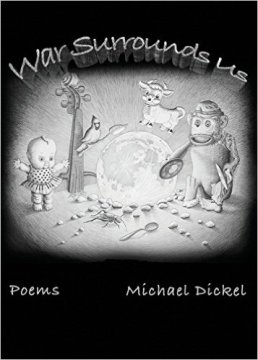
Jerusalem, Summer 2014: Michael Dickel and his family including Moshe (3 years) and Naomi (1 year) hear the air raid sirens, find safety in shelters, and don’t find relief during vacation travels.  In a country smaller than New Jersey, there is no escaping the grumbling wars that encircle. So Michael did what writers and poets do. He bore witness. He picked up his pen and recorded thoughts, feelings, sounds, fears, colors, events and concerns in poetry. The result is his third collection of poems, a chapbook, War Surrounds Us.

While some use poetry to galvanize war, Michael’s poetry is a cry for peace. He watched the provocations between Israel and Hamas that resulted in war in 2014 and he illustrates the insanity.

            And the retaliation
Continues, reptilian and cold,
retaliation the perpetrator
of all massacres.

Though the poems change their pacing and structure, they present a cohesive logical and emotional flow, one that takes you blood and bone into the heart of Michael’s experience as a human being, a poet, a Jew, a father and husband. He touches the humanity in all of us with his record of the tension between summer outings and death tolls, life as usual and the omnipresence of war.  Both thumbs up on this one. Bravo, Michael.

– Jamie Dedes

Poems from War Surrounds Us:
Again
Musical Meditations
The Roses

TLV1 Interview and Poetry Reading

813UAJBTpUL._UX250_

MY INTERVIEW WITH MICHAEL DICKEL:

Jamie: Putting together a poetry collection and ordering the work in a way that enhances the meaning and clarity of poems included is not easy. One of the first things to strike me about the collection as a whole is how it flows, so well in fact that it reads almost like one long poem. I found that quality contributed to the work’s readability. How did you work out the order? Was it consciously ordered or did it arise organically out of the experience of the war?

Michael: I’m very gratified that you noticed this about my book. I hadn’t thought of it quite in that sense, of being one poem, but I like that it reads that way. The sense of a book holding together, a collection of poems having some coherence, is important to me. I don’t think my first book achieved this very well, although it has some flow poem to poem. The whole is not focused, though. My second book has a sense of motion and narrative, from the Midwest where I grew up to arriving and living in Israel, and now being part of the Mid-East. However, War Surrounds Us, my third book, finally has a sense of focus that the other two did not.

Unfortunately, I probably can’t take too much credit for that coherence. Even more unfortunate, a real war raged in Gaza, with rockets also hitting the Jerusalem area, not that far from where I live. As we know now, thousands died, most apparently civilians, many children. Just across the border to the Northeast, diagonally opposite of Gaza, a much larger scale conflict burned and still burns through Syria—with even larger death tolls and even more atrocities over a longer time. These wars had, and still have, a huge impact on me and my family.

During last summer, the summer of 2014, this reality of war surrounding us had all of my attention. And it came out in my writing as obsession with the war, my family, the dissonance between living everyday life and the reality of death and destruction a missile’s throw away. So the topic filled my poems those months, as it did my thoughts. And the poems emerged as events unfolded over time, so a sort of narrative wove into them—not a plot, mind you, not exactly, anyway.

This gives a chronological structure to the book. However, not all of the poems appear in the order I wrote them. I did move some around, seeing connections in a theme or image—if it did not jar the sense of the underlying chronology of the war. Some of the events in our life could move around, and I did move some poems to places where I thought they fit better. I also revised the poems, reading from beginning to end several times, trying to smooth out the flow. A few of the poems I actually wrote or started before this phase of the ongoing conflict broke out—but where they also fit into a pattern, I included them. In the end, I moved and revised intuitively, following my own sense of flow and connection. I’m glad that it seems to have worked for you, as a reader, too.

Jamie: What is the place of the poet and poetry in war? Can poetry, art and literature move us to peace? How and why?

Michael: This is a difficult question. Historically, one place of poets was to call the soldiers to war, to rile them up and denounce the enemy. There is a famous poem from the Hebrew Scriptures. Balaam is called by Balak to curse Jacob and his army. The story sets a talking donkey who sees an angel with a sword and other obstacles in his way, but long story short, he arrives and raises his voice. He is the poet who is supposed to curse the enemy. Instead, he begins, “How beautiful your tents, O Jacob…” and recites a poem that is now part of the Jewish liturgy. This is not necessarily a peace poem, but it shows words and their power to curse of bless. I think the place of the poet is to bless and, rather than curse, to witness with clear sight.

There is a long history of poet as witness and observer. Czeslaw Milosz in The Witness of Poetry and Carolyn Forché, following him, in her books Against Forgetting: Twentieth Century Poetry of Witness and Poetry of Witness, which goes back to the 16th Century, argue that the poet’s role is to observe and bear witness to the world—to the darkness, the atrocities, genocide, war… Forché quotes Bertolt Brecht: “In these dark times, will there also be singing? / Yes, there will be singing. / About the dark times.” I think that is what we do as poets. That’s what I hope that War Surrounds Us does at its best, albeit as much a witnessing of my own family and context as of the Other. Then, as feminist theory has taught me, the personal is political, the political personal.

A1oKsOxRrJL._UY200_Can art and literature move us to peace? I don’t know. I hope it can move us to see more clearly, to feel more acutely, and to embrace our humanity and the humanity of others. Perhaps that will move us toward peace. There is so much to do, and it is as the rabbinic wisdom says about healing creation: it may not be ours to see the work completed, but that does not free us from the responsibility to do the work. As poets, we make a contribution. I hope the songs about the dark times will also be blessings for us all.

Jamie: Tell us about your life as a poet. When did you start and how did you pursue the path? How do you carve out time for it in a life that includes work, children and community responsibilities. You live on a kibbutz, I think.

Michael: Well, starting at the end, no, I don’t live on a kibbutz, I live in Jerusalem (the pre-1967 side of the Green Line). I do teach English at a college that was started by the Kibbutz Movement as a teacher’s college in the 1960s, now Kibbutzim College of Education, Arts and Technology. That appears in my email signature and confuses some people outside of Israel, who think I teach as part of living at a kibbutz. I’m actually more like adjunct faculty, but no one at the college works directly for a kibbutz as far as I know, and the college is open to anybody who qualifies.

While I only have a short day, from when the kids of my current family go to pre-school until I pick them up, I also usually only teach part-time. Some semesters I teach full-time or even more, but usually not. And, many of my courses in the past couple of years have been online, meeting only a few times during the semester. This helps.

My wife works full-time in high tech, which allows us to survive on my irregular, adjunct pay. She also has some flexibility, which allows her to usually be free to pick up the kids as needed around my teaching schedule, and we have on occasion hired someone to help with the kids so I could teach, not so much for my writing. But that has allowed writing time on other days.

Mostly, I write during those few hours when the kids are at pre-school, after the kids have gone to bed, or even later, after my wife has also gone to bed. If I’m working on a deadline or a large project, such as some of the freelance work I do for film production companies, I write after my wife gets home from work even if the kids are still awake. Usually, though, I write when I find time, and I find time when I don’t have other obligations.

Perhaps of relevance to this book, the writing took over. I was late in getting papers back to students and delayed other obligations and deadlines, even canceling a couple of other projects—although it was not just the writing, but the whole experience of the war, dealing with it and wanting to be very present with my children. As the poems relate, we went to the Galilee, in the North, for a month, a vacation we have taken before. Last summer, though, it had extra urgency because of the war. Unfortunately, during an outing picking apples in the Golan Heights, we heard artillery across the border in Syria, and that’s when I wrote the title poem of the book, “War Surrounds Us.”

The summer before, on that same month-long getaway, I wrote a lot of flash fiction, which makes up most of my next book, which should come out by the end of the year. I wrote during both summers when the kids were napping or after their bedtime, mostly. The place we stay in, a friend’s house (he travels every summer), has a lovely courtyard, and after the children went to bed, Aviva and I would sit out in it, usually with a glass of wine. She would read or work online and I would write on my laptop into the night. It was lovely and romantic.

I have to say that I almost don’t remember a time when I didn’t write poetry or stories. I recall trying to stop on a few occasions, either to work in some other aspect of my life, or when I did a different kind of writing, such as for my dissertation (which devolved into creative writing for more than half of it). But really, going back into my early years, I wrote stories or poems of some sort—influenced I suppose by A. A. Milne, Sol Silverstein, Kenneth Grahame and, later, Mark Twain and even Shakespeare. I had books of Roman and Greek myths, the Lambs’ bowdlerized Shakespeare for children, and some Arthurian tales as a child, not to mention shelves of Golden Books. Later, I read Madeleine L’Engle and a lot of science fiction. And everything I read made me also want to write.

I owe the earliest of my poems that I can remember to exercises from grade school teachers, one in 3rd grade, maybe 4th, the other in 6th grade. However, I’m sure that I wrote stories and possibly “poems” earlier. My first sense that I could become a poet arrived via a junior high school teacher, who encouraged me to submit some poetry to a school contest. I tied for first place.

So, I started writing forever ago. By the time of the junior high contest, I had read e e cummings, Emily Dickinson, some Whitman. By 9th grade, I discovered the Beats through a recording of Ginsberg reading “Kaddish” and other poems. Hearing him read the poems, then reading them myself, changed everything.

Alongside this development, one of my brothers brought Dylan records home that I listened to. All three of my brothers, with my parents’ tacit approval, played folk music and protest music in the form of songs of Woody Guthrie; The Weavers; Joan Baez; Peter, Paul and Mary; in addition to Dylan. These influenced both my writing and my world view. The same year that I came across Ginsberg’s work, I was involved in anti-war activity in my high school. That spring, four students were shot at Kent State. In another way, that changed everything, too.

Writing, activism, and politics, for me have always been interwoven. I also heard that year about “The Woman’s Movement,” which today we call Feminism. Later, much later, I would read and take to heart the idea of the personal being political, the body being political. I think my poems, even the most personal, always have a political and theoretical lens. And the most philosophical or political or theoretical, also have a personal lens. I don’t think that we can help but do that, but I try to be aware of the various lenses, of using their different foci deliberately as part of my craft. I’m not sure that is the current trend, and much of my work doesn’t fit well in spoken word or slam settings (some of it fits). However, this is my poetry and poetics—and they arise from a specific cultural context, the complexity of which I could not begin to convey in less than a lifetime of writing.

My development from those awakening moments looked like this: I read. I wrote. I shared my work with other people who wrote. Sometimes I talked with others about writing. My first degree in college was in psychology, not English, because I naively thought that psych would help me understand the human condition and that English would “ruin” – suppress – my writing voice. However, I took a lot of literature courses and my study abroad term focused entirely on literature.

After college, I had a career as a counselor working with runaways, with street teens, with children undergoing in-patient psych evaluations, and in a crisis intervention and suicide prevention center—a career that taught me a lot about politics, gender, race, and justice. I continued to write, often about some of the most disturbing realities that I encountered, but not well.

I had been out of college nearly a decade when I took some courses in creative writing at the University of Minnesota, at the suggestion of some friends in a writing group who had also taken some. One of the professors encouraged me to apply to the Creative Writing Program, where I was accepted. The acceptance was a poignant moment—I was out of state at my father’s burial. My now ex-wife remained back with our then 2 year-old daughter. She saw the letter in the mail, so called and read it to me. It was also my 32nd birthday. So many emotions all at the same time. Mostly, I remember wishing I could have told my father—from when he first heard that I’d applied, every phone call we had included his asking if I had heard yet if I had been accepted. It was the most direct way he had of saying he was proud.

IMG_1250

Jamie: Tell us a little about 100,000 Poets for Change (100TPC) in Israel and how people can get in touch with you if they want to participate this year. Are you able to manage a mix of Arabs and Jews?

Michael: The thing about 100TPC is that it’s pretty loose, as an organization, and very anarchic in governance. Which is to say, I’m not sure there is something I could call 100TPC in Israel. There’s a wonderful poet in Haifa who does some events, I don’t think every year. She is very active in peace activism and poetry. There’s an Israeli mentor of mine, Karen Alkalay-Gut, who has organized 100TPC events in Tel Aviv since the first year. For the past two years, I organized a poetry reading in Jerusalem. The first one was small, a few people I knew and cajoled into reading. The second one was much larger, over 25 poets. We had one Arab writer, who writes in English, at the second reading. Her poetry is powerful and personal, written as an Arab woman, a mother, and an Israeli. An Arab musician was going to join us, but he had a conflict arise with a paying gig. It is difficult to manage the practical, political, and social barriers, but people do it here. I am just learning a bit how to do this now.

For this year, I am working with two other organizations—the Lindberg Peace Foundation, which has held annual Poetry for Peace events. This year will be the 40th anniversary (yartzheit, in Hebrew) of Miriam Lindberg’s tragic death at the age of 18. She wrote poetry, was a peace activist, and also an environmental activist. Her mother was a poet and professor, and passed away a few years ago. Joining us in planning the Jerusalem event will be the Interfaith Center for Sustainable Development. Their mission as I understand it is to develop interfaith leadership for common goals related to eco-justice that would also provide a model for solving the Middle East conflicts.

The Jerusalem events won’t be the same date as the national event (26 September)—our dates will be 15–16 October, to honor the 40th anniversary of Miriam Lindberg’s death. Dorit Weissman, a Hebrew-language poet and playwright, also has become part of 100TPC this year, and she and I are having a smaller reading on 8 October with other poets.

We are just setting up a Facebook page for organizing with the three groups, 100TPC, the foundation, and the center. People could look for me on FB and send me a chat message there to be in touch. I hope that we will have the events posted on FB in the next few weeks, but we are still working on the details. The devil is always in the details, as the saying goes.

Michael will host The BeZine‘s virtual 100TPC this 26 September 2015.

Be the peace.

© 2015, book review, Jamie Dedes, All rights reserved; words, poetry, photographs of Michael, Michael Dickel, All rights reserved; cover illustration, The Evolution of Music, by Jerry Ingeman, All rights reserved

Posted in Contributing Writer

This is not a poem

Editor’s Note:  The gremlins are hard at work behind the scenes preparing the July issue of The BeZine – to be published on the fifteenth.  Meanwhile we present a poem by Michael Dickel, for your Sunday reading pleasure.  

Michael Dickel shared poetry from his newly published chapbook, War Surrounds Us (Is A Rose Press), in the last two issues of The BeZineWe welcome Michael today as a new member of our core team.

This is not a poem

(cubist poem in entangled form)

Fake Sunset Music Digital art ©2015 Michael Dickel Fake Sunset Music
Digital art ©2015 Michael Dickel

i

This is not a poem; it’s a fake.
Someone else’s words, images, metaphors
creeping on cat’s feet into my mind,
clawing their way to the top of my consciousness
as though they were mine, mined
from some experience unique at once,
universal twice, useless thrice.
This is not a poem. It is a fake:

a book of chords, some sketch of the words,
a chorus. Fake the melody, fake the rhythm
fake the music of sensory language
abstracted to censor sexual pleasure
of the mind. Or something like that.
Or nothing like that. Or nothing.

Fake spring flower sunset Digital art ©2015 Michael Dickel Fake Sunset Flower
Digital art ©2015 Michael Dickel

ii

This someone: creeping, clawing as though from a universal.
This—a book, a chorus, fake, abstracted of the mind or nothing—
is not, else is, on cat’s feet, their way. They were mine, some experience
twice useless, not a poem of chords. Fake, the music to censor or something like that.
It’s a fake: words into my mind, to the top, mined, unique. Thrice: it is a fake.
Some sketch, the melody, sensory language, sexual pleasure: like that. Or nothing.
Images of my consciousness at once sketch, fake the rhythm. Metaphors.

Fake music flower sunset Digital art ©2015 Michael Dickel Fake Sunset Flower Music
Digital art ©2015 Michael Dickel

iii

This is not a poem; it’s a fake:
A book of chords, some sketch of the words,

someone else’s words, images, metaphors,
a chorus. Fake the melody, fake the rhythm

creeping on cat’s feet into my mind,
fake the music of sensory language

clawing its way to the top of my consciousness,
abstracted to censor sexual pleasures

as though they were mine, mined
of the mind. Or something like that.

From some experience, unique at once,
or nothing like that. Or nothing.

Universal twice, useless thrice.
This is not a poem. It is a fake.


This poem originally appeared in Drash Pit, April 2013


Dust Storm Sunset Digital image ©2015 Michael Dickel Dust Storm Sunset
Photo ©2015 Michael Dickel

Posted in General Interest, The B Zine, The BeZine Table of Contents

The BeZine, May 2015, Vol. 1, Issue 7

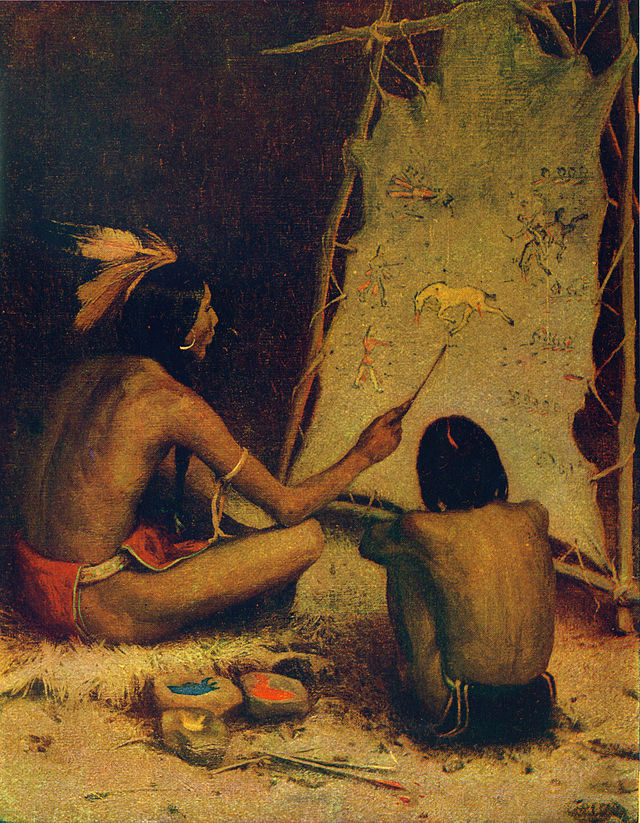
640px-The_Historian_(The_How_and_Why_Library)Storytelling: It’s a means by which we are entertained but also by which we explore meaning and develop our internal fortitude, our moral fiber, values and identity … At least that was the purpose before storytelling was so grossly co-opted by marketing with its push to accumulation and self-aggrandizement. This month in our lead feature, Healing Stories, Michael Watson, therapist and Native American shaman, explores the power of storytelling to heal in the context of tradition and of therapy.

Our resident professional storyteller, Naomi Baltuck, gifts us with four photo stories, small gems that will make you smile and laugh and remind you of what really matters in life.

The poem, Mourning Brooch, reflects on the power of memory when it evolves into story. John Anstie‘s poem is a love story for his grandson. How many of us have told our children or grandchildren stories about their birth, it’s meaning to us, and what we want to leave them as legacy? Turtle Speaks explores meaning in Native American stories about Turtle. Charlie Martin, Joe Hesch and Myra Schneider use poetry to tell their stories or those of others. For Charlie it’s all about social conscience, compassion and justice. For Joe Hesch it’s often about nature and history. For Myra it’s about the different ways that both fine art and everyday things move her … and by extension, us.

Señora Ortega’s Frijoles is a short story about dichos (sayings), which are used to pass tradition and values from one generation to the next … just like storytelling.

Silva Merjanian shares four poems from her second collection, Rumor (Cold River Press).  We introduced Silva here last month.  Silva’s poems tell us the stories of war – not simply a reaction to the news of war as in my own The Doves Have Flown – but her experience of war.

We shared in the last issue that Silva and her publisher are donating all profits from the sale of Rumor to the Syrian Armenian Relief Fund.  As I was preparing this intro I learned that thus far they have raised $1,397.73.  Well and kindly done, Silva.

The use of poetry to raise funds for worthy causes is not new to our contributors and readers.  John Anstie and the Grass Roots Poetry Group donate the funds from Petrichor Rising to UNICEF.  Therein lies another story featured this month: “Petrichor Rising” … or how the Twitterverse birthed friendships that in turn birthed a poetry collection …

With a nod toward spring in the Western Hemisphere, Corina Ravenscraft serves up a charming soupçon of gardening advice, a small treasury of hints to help you garden with simplicity, patience, and compassion.  It’s all about balance, whether you are caring for plants or for your own spirit.

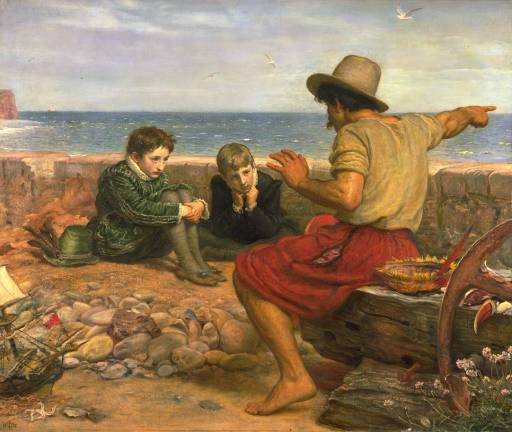
Millais_Boyhood_of_RaleighAs you go through your days, do your work and practice your art, we hope you keep in mind the meaning and value of the stories you hear and read and of your own story as it unfolds. We hope you’ll share your stories in the comment sections here or via books or blogs or at gatherings of family and friends.

Enjoy this issue.  Be sure to “like” and comment to let contributors know what you think and that you value their hard work and their contributions. The BeZine is entirely a volunteer effort, a gift of love. (Our mission statement is HERE.) Any ads you see are not our own.  They are WordPress ads used to defray their cost of hosting blogs and websites.

Be the peace.

Thanks for visiting us.
Jamie Dedes

Illustrations: Header via Wikipedia under CC BY-SA 2.0 license, A very fine par dated 1938 A.D. The epic of Pabuji is an oral epic in the Rajasthani language that tells of the deeds of the folk hero-deity Pabuji, who lived in the 14th century.; photo #1 (public domain) via The How and Why Library, E. Irving Couse, A. N. A.; The Historian; The Indian Artist is painting in sign language, on buckskin, the story of a battle with American Soldiers;  photo #2 (public domain) via Wikipedia, The Boyhood of Raleigh by Sir John Everett Millais, oil on canvas, 1870. A seafarer tells the young Sir Walter Raleigh and his brother the story of what happened out at sea.

Core Team and Guest Contributor Biographies

TABLE OF CONTENTS

Lead Feature

Healing Stories by Michael Watson, M.A., Ph.D., LCMHC

Photo Stories

Survival Stories by Naomi Baltuck
The Inside Story by Naomi Baltuck
To See the World by Naomi Baltuck
Rather Than Curse the Darkness by Naomi Baltuck

Fiction

 Señora Ortega’s Frijoles by Jamie Dedes

Poetry

An Apology from Your Grandfather by John Anstie

The Mourning Brooch by Jamie Dedes
Turtle Speaks by Jamie Dedes
The Doves Have Flown by Jamie Dedes

The Discovery of Grass by Joseph Hesch
In Audience with the Queen by Joseph Hesch

dance to life’s music by Charles W. Martin
no translation necessary by Charles W. Martin
honey … I swear this is for the birds … by Charles W. Martin

Beirut by Silva Merjanian
Collateral Damage by Silva Merjanian
Doves of Beirut by Silva Merjanian
Rooftop by Silva Merjanian

Bird by Myra Schneider
Milk Bottle by Myra Schneider

Feature Articles

Being a More Compassionate Gardener by Corina Ravenscraft

“Petrichor Rising” … or how the Twitterverse birthed friendships that in turn birthed a poetry collection … by John Anstie and Jamie Dedes

Posted in General Interest

Goulash

Editorial note: Well here we are in May already … hard to believe … and we are in the process of preparing the May 2015 issue of The BeZine for you. Look for it on May 15th. Meanwhile, we share here one of the more popular posts in the history Bardo, a poem, “Goulash,” by English poet, Myra Schneider.  Enjoy!

687px-2009-09-gulasch-pörkölt-paprikas-3

A crucial ingredient is the right frame of mind
so abandon all ideas of getting on. Stop pedalling,
dismount, go indoors and give yourself masses of time.
Then begin by heating a pool of oil in a frying pan
and, Mrs. Beeton style, take a dozen onions
even though the space you’re working in is smaller
than the scullery in a Victorian mansion. Pull off
the papery wrappings and feel the shiny globes’ solidity
before you chop. Fry the segments in three batches.
Don’t fuss about weeping eyes, with a wooden spoon
ease the pieces as they turn translucent and gold.
When you’ve browned but not burnt the cubes of beef
marry meat and onions in a deep pan, bless the mixture
with stock, spoonfuls of paprika, tomato purée
and crushed garlic. Enjoy the Pompeian-red warmth.
Outside, the sun is reddening the pale afternoon
and you’ll watch as it sinks behind blurring roofs,
the raised arms of trees, the intrepid viaduct.
In the kitchen’s triumph of colour and light the meat
is softening and everything in the pot is seeping
into everything else. By now you’re thinking of love:
the merging which bodies long for, the merging
that’s more than body. While you’re stirring the stew
it dawns on you how much you need darkness.
It lives in the underskirts of thickets where sealed buds
coddle green, where butterflies folded in hibernation,
could be crumpled leaves. It lives in the sky that carries
a deep sense of blue and a thin boat of moon angled
as if it’s rocking. It lives in the silent larder and upstairs
in the airing cupboard where a padded heart pumps
heat, in the well of bed where humans lace together.
Time to savour all this as the simmering continues,
as you lay the table and place at its centre a small jug
in which you’ve put three tentative roses and sprigs
of rosemary. At last you will sit down with friends
and ladle the dark red goulash onto plates bearing
beds of snowhite rice. As you eat the talk will be bright
as the garnets round your neck, as those buried
with an Anglo-Saxon king in a ship at Sutton Hoo,
and the ring of words will carry far into the night.

– Myra Schneider

Excerpt from Circling The Core (Enitharmon Press 2008)

© 2009, poem, portrait (below), and book cover art (below), Myra Schneider, All rights reserved and presented here with the permission of the poet. Photo credit ~ Pot of Goulash by Ralf Rolestschek via Wikipedia under Creative Commons Attribution-NonCommercial-NonDiriviative 3.0 U.S.

IMG_0032-1circling core_22MYRA SCHNEIDER ~ is a poet, a poetry and writing tutor, and the author of Writing My Way Through Cancer and, with John Killick, Writing Your Self. Her poetry collections, Circling the Core and Multiply the Moon, were published by Enitharmon Press. She has eight published collections. Her most recent work What Women Want was published earlier this year by Second Light Publications.

Myra’s long poems have been featured in Long Poem Magazine and Domestic Cherry. She co-edited with Dilys Wood, Parents, an anthology of poems by 114 women about their own parents. She started out writing fiction for children and teens. We first discovered Myra through her much-loved poem about an experience with cancer, The Red Dresswhich she generously shared with readers here in our Perspectives on Cancer series in 2011.

Currently Myra lives in North London, but she grew up in Scotland and in other parts of England. She lives with her husband and they have one son. Myra tutors through Poetry School, London. Her schedule of poetry readings is HERE.

Posted in General Interest, Poems/Poetry, poetry, Poets/Writers, The BeZine Table of Contents

The BeZine, April 2015, Volume 1, Issue 6 – Table of Contents with links

OUR THEME THIS MONTH:
POETRY in honor of
interNATIONAL POETRY MONTH

Mid-wife

A poem is as new as beginnings,
as fresh as the first day at school.

A poem is as bright as our admiration
for courage, our respect for freedom.

A poem is as early as the first leaf,
as white as the most swan-white cloud.

A poem is a drop of rain, a little
convex mirror with the prime of day in it.

A poem is so raw, so young that it has grown
no first, second or third skin.

Dilys Wood, All rights reserved

April 15, 2015

Poetry is that particular way of organizing our thoughts and imagination into music, emotion, image and story. Through poetry we live hugely, with more beauty, and we seek to break the limitations of our minds, to understand the powers that are living us (to borrow from Auden) and connect with the rest of humankind and that ineffable something that is greater than ourselves. It is both art and meditative practice. Ultimately it becomes a collaboration between writer and reader.

Celebrating poetry in April for interNational Poetry Month has been a Bardo Group tradition since 2011. This year, together with our partner, Second Light Network, our core team and our guest poets we bring you – as poets and poetry lovers – a rich collection of poems, resources and inspiration.

We are pleased to partner with Second Light Network of Women Poets and to bring to your attention the work of 100,000 Poets for Change and Stephen F. Austin State University Press, which recently published a new biography of Sylvia Plath by Julia Gordon-Bramer. Ms. Gordon-Bramer explores Plath’s work through her well known interest in Tarot and Qabalah.

It occurred to me as I was putting the final touches on this month’s The BeZine that there is a sub theme:  the way poets reach out not only with words – but with actions – to help make the world a better place.  Second Light Network reaches out to support women poets in their later years. 100,000 Poets for Change is a global effort  to raise awareness of environmental issues, climate change and human rights issues.  Poet Silva Zanoyan Merjanian, a Lebanese-American of Armenian decent, is donating the sales of her second book, Rumor (Cold River Press), to the Syrian Armenian Relief Fund. 

Second Light Network (SLN) of Women Poets

Founded by English poet Dilys Wood, SLN is all about encouraging and promoting the work of women in their third act, especially those who are coming to poetry for the first time late in life. Full membership is open to women over forty years and affiliate membership is open to those under forty. Visit Second Life Live for details. Membership is not limited to residents of the U.K.

SLN sponsors classes (including remote classes), is often able to make special arrangements for disabled, and publishes anthologies of women’s work and ARTEMISpoetry magazine (May and November). While the network is for women only, the poetry is for everyone.

– Jamie Dedes

The HEADER this month is the work of our AmeriQuebeckian poet Annie Wyndham, who publishes Salamander Cove. It has an irregular schedule. There’s a fine archive of poems from some of the world’s finest poets.

TABLE OF CONTENTS

BOOK EXCERPT

Fixed Stars Govern A Life: Decoding Sylvia Plath by Julia Gordon-Bramer.

SECOND LIGHT NETWORK (SLN) OF WOMEN POETS

About SLN
Second Light Welcomes Women Poets
Comments on Second Light: organization, publications and remote workshops
Enthusiastic Supporters of Second Light

Features from ARTEMISpoetry
Three Young Poets on Plath’s Influence by Kim Moore, Lavinia Singer and Sarah Westcott
We As Human Beings Must Not Forget, An Interview with Argentinian Poet Ana Becciú by Maria Jastrzębska
My Life in Poetry by Ann Stevenson
Petronella Checks Submission Guidelines by Kate Foley

100,000 POETS FOR CHANGE

Poets and Artists Raise Awareness, Work to Inspire Positive Change

Poems

Past Master by John Anstie
The Dream of a Poet by John Anstie

Le Fée Verte, Absinthe by Jamie Dedes
Blue Echo by Jamie Dedes
Wabi Sabi by Jamie Dedes

Father Sky by Priscilla Galasso
Morning Dove by Priscilla Galasso

How to Write a Poem by Joseph Hesch

The Saints in My Rain by Silva Zanoyan Merjanian; artwork by Steve McCabe
Converge by Silva Zanoyan Merjanian

race by Lilianna Negoi

The Will of the Quill by Corina Ravenscraft

Survival by Myra Schneider

Reel to Reel by Anne Stewart

Double Dutch by Terri Stewart

Reasons by Blaga Todorova
After Neruda by Blaga Todorova

Our Stories by Annie Wyndham

The BeZine, Issue 5
The BeZine, Issue 4
The BeZine, Issue 3
The BeZine, Issue 2
The BeZine, Issue 1

The Bardo Group/Beguine Again on Facebook

The BeZine is a publication of BequineAgain and The Bardo Group.

Posted in General Interest, Jamie Dedes, poem, Poems/Poetry, poetry

Free, Female, Of Motley Race, Sixty-five

IMG_7727I’ve been known to chat with birds in public places
To rescue lost worms sizzling on the pavement in summer
To photograph the irrepressable in every garden
To weave music, emotion and story into poetry
I’m known to be free, female, of motley race and sixty-five

© 2015, poem and photograph, Jamie Dedes (The Poet by Day), All rights reserved

The April issue of The BeZine will publish here this Wednesday, the 15th.

We’re celebrating interNational Poetry Month

in concert with Second Light Network of Women Poets (SLN).*

The BeZine is a publication of Bequine Again and The Bardo Group.

* Second Light Nework of Women Poets is open world-wide to women poets over forty.  Affiliate membership is available for those under 40. Details on SLN’s website

Posted in General Interest

Myra Schneider asks, “Who is poetry for?”

1815_coversNote: This full-length feature article is presented as an appropriate wrap after celebrating interNational Poetry Month (April). The feature was originally published by ARTEMISpoetry (13 November 2013) and is delivered here with the permission of the publisher (Second Light Live) and the author, Myra Schneider. Although Myra discusses poetry in Britain, we feel her observations apply to other countries as well. Jamaica only just appointed a poet laureate for the first time in fifty years. This month in the U.S. King Features Syndicate partnered with the American Academy of Poets to present poetry to the general public along with the news, which hasn’t been done in the U.S. for more than a generation.

Some months ago at one of the twice-yearly poetry readings, which I help organize for Poetry in Palmers Green, a woman I didn’t know, turned to me as she was leaving and said apologetically: ‘I’m afraid I don’t write poetry.’ It was as if she had been attending under false pretences. I told her we welcomed everyone and felt it important our audience didn’t only consist of writers. The conversation reminded me sharply that in Britain poetry is in the main seen as a separate world. Who would go to a concert feeling uncomfortable that she/he didn’t play a musical instrument?

Why is it that contemporary poetry is often viewed as a minority art form when there is often no more potent way of expressing and communicating vital aspects of life and thought?

One problem is the poor coverage of poetry by the media. BBC Radio 4 broadcasts the poetry request programme Poetry Please. The medium of radio is, in fact, ideal for poetry and Radio 4, which includes readings twice a day from prose books, could offer much more. However, there are some green shoots. Radio has given serious attention to some contemporary translations of classical poetry, such as Amy Kate Riach’s translation of The Seafarer broadcast with sound effects and music on Radio 4, summer 2012. This programme also included a discussion of the poem led by Simon Armitage. This year a Radio 4 play was based on the life of the poet Clare Holtham, drawing on her writing. Radio 4 is also due to broadcast in January next year, as an Afternoon Play, Pam Zinnemann-Hope’s adaptation of her book-length poem On Cigarette Papers about the lives of her parents. More programmes with a poetry focus would be valuable.

Television rarely gives attention to poets and poetry. Serious drama, art and classical music, are all featured on both radio and television. Over recent years national newspapers have cut down the space they give to poetry. At one time there was a daily poem in The Independent and a weekly poem in The Observer. These have been dropped. The Guardian usually features a very short poem in its Saturday Review and a long review of one collection by a well-known poet. It used also to include two or three short reviews. Few bookshops hold good collections of poetry.

The mainstream media’s focus on a very small number of ‘hyped’ poets disguises the great range of lesser-known but strong writers whose poetry deserves to be heard. A large number of poetry collections are published each year but potential readers have no pointers about what is on offer amongst this confusing variety. If they go into a bookshop which does have an extensive poetry section (rare!) they may alight on books in which the poetry is obscure, erudite or both and others which are streetwise or jokey. They may remember some poems from the past which they liked as children but have no idea how to make their way into contemporary poetry. Unless they chance upon a book they can relate to they will probably give up.

There are, however, certain organizations and individuals who are concerned to take poetry to a wider audience. The Bloodaxe anthology, Staying Alive, and its sequels include in themed sections a wide range of accessible contemporary, twentieth century together with a few earlier poems, that is poems whose language and rhythm communicate their general sense. In comparison with the normal sales of poetry books, these anthologies have had huge and deserved success.

In London the Southbank Centre offers a fair number of readings by acclaimed poets from the UK and overseas. These draw in some non-poets as does Poet in the City’s themed readings. The Poetry Libraries in London and Edinburgh are invaluable resources with their comprehensive collections of books for children as well as adults. Both stock magazines and leaflets, provide information and put on intimate readings by a wide range of poets. Poems on the Underground and the charity, Poems in the Waiting Room, both long-running, bring poetry to the many who are unused to hearing or reading poems. The Poetry Society, which sees part of its role as bringing poetry to the public and is the main organizer of National Poetry Day, helps promote Poems on the Underground.

Of prime importance is the work done, on whatever scale, by individuals who have found ways to introduce poetry directly to non-poets. I want to mention some of the very different examples I am aware of.

Deborah Alma, who wrote about her Emergency Poet Service in ARTEMISpoetry 10, is in great demand at city centre events and venues such as pubs as well as at poetry and arts festivals. She travels as a poetry ‘doctor’ in her adapted ambulance and comments, ‘What I do by “prescribing” a poem for their “empty-nest-syndrome”, their stress or heart-break, is show them that poetry has something to say, that it can speak intimately…I try to tailor the poem to their reading habits and taste. I really do believe that poetry is for and about everyone. I might recommend a Bloodaxe anthology…It works! And it matters.’

Poet Kaye Lee, who attends a WEA Writing for Pleasure class, was asked by the tutor, whose interest was prose, to run a poetry session. She told me it was difficult because although one member of the group had requested poetry most of the others were antagonistic, considering it outlandish and too difficult. She started by reading and discussing several accessible list poems by Ruth Fainlight and other poets as a lead-in to writing and gradually won the group over. Keeping to the format of beginning with themed poems, she now runs one very popular session every term. Some members of the group are reading poetry for pleasure at home.

This year the Second Light Network invited a few book-groups to accept copies of Mary MacRae’s posthumous poetry collection, Inside the Brightness of Red, to study her work and to send in reviews. Some book-groups had previously avoided poetry books and a typical comment was: ‘Only twice in the last fifteen years…have we ventured into poetry. The few reviews coaxed from our group suggest that we might do well to dedicate more evenings to poetry in the future.’ Though Mary MacRae was widely admired by fellow-poets, she did not have a high public profile. Nevertheless, the many new readers targeted by this project were able to appreciate both the power of her work: ‘This is a luscious book of poetry. It oozes beauty and wistfulness and is a joy to have by the bed – a poem at bedtime.’ Such enthusiasm makes you wonder what it would take to bring more people and more poetry back together (‘a poem at bedtime’?).

While she was manager of Palmers Green Bookshop Joanna Cameron, a non-poet who loves poetry, ran a series of successful poetry readings. Much of the audience was made up of customers who didn’t write poetry. Later, Joanna was a founder member of Poetry in Palmers Green and she has brought many non-poets to the readings. She now lives near Cambridge where she is putting on readings for Oxfam. She believes it is important to be inclusive while offering a high standard of poetry. She told me she’s seen tightly buttoned men cry at events and heard people saying, ‘I didn’t know poetry could be like that’.

Coming from a background of working in casinos and playwriting, William Ayot became interested in poetry, both reading and writing it, in the 1990s. He included poetry in rehab work he did in prisons and for many years he has used poetry as part of teaching leadership in boardrooms and business schools all over the world. Unable to find a poetry group when he moved to Chester some years ago, he started Poetry on the Border. The series offers accessible poets to large audiences, many of whom are not poets. Recently he set up NaCOT (National Centre for Oral Tradition) and poetry, of course, has a role in this.

Poet John Killick has done major work using poetry with people who have dementia. He writes down a person’s words and then shapes them on the page. The resulting text is then approved by the person and released for circulation among care staff, relatives and a wider public. Anthologies of these poems have been brought out by the publisher, Hawker. John is now mentoring other poets to work in the same way. He also gives readings from these poems and his own at events which link poetry and health issues. Earlier in his career he used poetry in full time educational work with prisoners and he has done poetry residences in hospices.

Other poets are making valuable contributions in healthcare areas. Rose Flint has used poetry in hospital wards, special units and community groups. Another example is Wendy French who has worked in various health areas and been chair of Lapidus, an organization concerned with writing for personal development which very much involves poetry. Survivors Poetry offers poetry and poetry writing to those have suffered mental illness.

It goes without saying that bringing poetry to children is of paramount importance and the Poetry Society see it an essential part of their role to send poets into schools. The work of Sue Dymoke and Anthony Wilson, poets and university lecturers who support teachers by showing them exciting ways of introducing poetry to their pupils, is immensely valuable.

The Internet also offers routes into poetry. In the Guardian Poem of the Week Carole Rumens presents a poem with detailed description and comment. Helen Ivory posts a daily poem on Ink Sweat and Tears, a site which sometimes includes reviews of poetry. Oxford Brookes Poetry Centre posts a weekly poem. Some enthusiastic poets have blogzines in which they regularly introduce poets, together with one of their poems, in an informal but informative way. These sites are helpful to those beginning to read poetry and experienced writers are likely to gain insights from them too.
Blogzines I particularly I admire are posted by Kim Moore, Anthony Wilson and Jamie Dedes.

Kim Moore begins her posts with a lively account of her poetry week, then moves on to her chosen poet and poem. She told me she hoped to normalize poetry as having a part of a working week. In his daily Lifesaving Poems Anthony Wilson (mentioned above) presents a poem which is key to him and includes the personal circumstances in which he came across it as part of his commentary. Jamie Dedes, a retired journalist who lives in California, loves and now writes poetry. She often features articles, poems and interviews with poets in her daily blogzine, The Poet by Day.

It is very clear that themes of wide general interest as well as an informal approach provide inviting routes into poetry. This was underlined for me by Kim Moore. She was asked, as a local writer, to take part in a reading by a visiting poet on the subject of pregnancy and breastfeeding. The evening, she told me, was very popular and though none of her poems had any connection with the subject and no one in the audience whom she spoke to her had ever been to a poetry reading before, she sold nine copies of her debut pamphlet.

Although the media view poetry as a minority art I take heart from the fact that there are organizations and generous individuals committed to fostering an interest in it. I would like to think their number is growing and also that some of those who read this article might consider developing their own ‘open house’ approach.

How might we contribute? Possibly by boldly offering our own creative and/or critical work to various media. Would a long poem or sequence of yours, adapted, suit a Radio 4 ‘Afternoon Play’. Have you considered such a submission? Are we willing to post reviews of excellent collections we have read? Do we dare to invite a book group that we attend – one that never trifles with poetry – to look at a suitably accessible, intriguing individual collection of poetry or an anthology?

I know that the editors of ARTEMISpoetry would welcome and consider printing any information about schemes for widening the audience for poetry. After all, we are worth it.

Myra Schneider

© 2013, essay and portrait below, Myra Schneider, All rights reserved; © 2014, illustration, Second Light Live, All rights reserved

References:

Amy Kate Riach, The Seafarer, Sylph Editions, 2010
Bloodaxe Books, http://www.bloodaxebooks.com
The Poetry Library, Southbank, London, http://www.poetrylibrary.org.uk
The Scottish Poetry Library, Edinburgh, http://www.scottishpoetrylibrary.org.uk/‎
Poems on the Underground, http://www.tfl.gov.uk/corporate/projectsandschemes/2437.aspx
The Poetry Society, http://www.poetrysociety.org.uk
Poems in the Waiting Room, http://www.poemsinthewaitingroom.org‎
Kaye Lee, http://www.secondlightlive.co.uk
Second light Network of Women Poets, http://www.secondlightlive.co.uk
Mary Macrae, Inside the Brightness of Red, Second Light Publications, 2010
Joanna Cameron, joannacameron@live.com
Deborah Alma, Emergency Poet, emergencypoet.com
William Ayot, http://www.williamayot.com
John Killick, http://www.dementiapositive.co.uk
Wendy French, wendyfrench.co.uk
Rose Flint, http://www.poetrypf.co.uk
Lapidus, http://www.lapidus.org.uk
Survivors Poetry, http://www.survivorspoetry.org
Anthony Wilson, http://anthonywilsonpoetry.com
Sue Dymoke, http://suedymokepoetry.com/books
Guardian Poem of the Week, http://www.theguardian.com/books/series/poemoftheweek‎
Oxford Brooks Poetry Centre, ah.brookes.ac.uk
Ink Sweat and Tears, http://www.ink-sweat-and-tears.com
The Poet by Day, http://musingbymoonlight.com
Kim Moore, http://kimmoorepoet.wordpress.com

How might you contribute? Possibly by boldly offering you own creative and/or critical work to various media. Would a long poem or sequence of yours, adapted, suit a Radio 4 ‘Afternoon Play’. Have you considered such a submission? Are you willing to post reviews of excellent collections we have read? Do you dare to invite a book group that you attend – one that never trifles with poetry – to look at a suitably accessible, intriguing individual collection of poetry or an anthology?

IMG_0032-1Myra’s long poems have been featured in Long Poem Magazine and Domestic Cherry. She co-edited with Dilys Wood, Parents, an anthology of poems by 114 women about their own parents. She started out writing fiction for children and teens. We first discovered Myra through her much-loved poem about an experience with cancer, The Red Dresswhich she generously shared with readers here in our Perspectives on Cancer series in 2011.

Currently Myra lives in North London, but she grew up in Scotland and in other parts of England. She lives with her husband and they have one son. Myra tutors through Poetry School, London. Her schedule of poetry readings is HERE.

The April issue of The BeZine will publish on April 15.

We’re celebrating interNational Poetry Month

in concert with Second Light Network of Women Poets (SLN)*

The BeZine is a publication of Bequine Again and The Bardo Group.

* Second Light Nework of Women Poets is open world-wide to women poets over forty. Details on SLN’s website.

Posted in General Interest

A Poem in Your Pocket

Editor’s Note:  One of our more popular posts from our smart, snappy Corina Ravenscraf (dragonkatet), celebrating poetry and interNational Poetry Month, a Bardo tradition.  Enjoy!  … and share the wealth. 

Is that a poem in your pocket, or are you just happy to see me? 😉

Image borrowed from http://www.publicdomainpictures.net

This month we are celebrating interNational Poetry Month in concert with Second Light Network of Women Poets. Today, we celebrate Poem in Your Pocket here at The Bardo. This event truly is a neat way to introduce and share poetry with just about anyone. One of the best things about pocket-sized poems, is of course, that they’re portable! No matter where you are, if you have a pocket, you can share, too. This page even has pre-made, down-loadable ‘pocket-sized’ poems in .PDF formats, so all you have to do is download them and print! Or here is another template from Scholastic.com that you can use on which to put your own poem. How easy is THAT? 😀

Image borrowed from http://jimmie.squidoo.com/hspoetry

Probably the hardest part of participating in this celebration is deciding what poem to share. If it’s too long, it might not fit on a smallish, pocket-sized piece of paper. (Although, you can always print it out and then fold it up). It should be a poem that means something to you, whether it’s one that you’ve written and want to share, or one by a favorite author. The point is to get out there and share what you love about poetry! I combined this day with a couple of the other ideas I suggested back at the beginning of the month, to post poetry in unexpected places and take a poem to lunch. I utilized Post-It notes for the first one (both because of their stick-to-it-ness properties and because they could fit in lots of unusual places). I even recruited some friends to help me place the poems all around campus. I decided to use Haikus, because they are short and easy to write on Post-Its, and I don’t think they (Haikus) are properly appreciated these days. 🙂 Post-It Haikus As you can see, I printed the haikus with the authors’ names on them and taped a small note to the bottom which said, “Celebrate interNational Poetry Month all April!” I chose orange because it’s a high-contrast, noticeable color. I only actually witnessed the result of one of the poems I had placed…on the inside door of a restroom stall where I work…(captive audience and all that…hahaha). The young woman came out of the restroom holding the post-it in her hand with a big smile on her face. One of my friends posted one on the inside of the elevator door, so that you didn’t see it until the doors closed and you were in the elevator on the way to your floor. “Unexpected places”, indeed. When I “took a poem to lunch” I invited my mother to go to lunch and asked her to bring a poem, too. I chose Emily Brontë’s poem, “No coward soul is mine” (which had to be folded up to fit into my pocket, by the way) and my mother brought “If” by Rudyard Kipling. It was a wonderful addition to our delicious lunch. In fact, we enjoyed it so well that I think we may even do it next month, too. 😉 Have fun today sharing the poems in YOUR pockets. You never know, you may just inspire someone else to do the same!

© 2014, essay, Corina Ravenscraft (dragonkatet) All rights reserved

effecd1bf289d498b5944e37d8f4ee6fAbout dragonkatet Regarding the blog name, Dragon’s Dreams ~ The name comes from my love-affairs with both Dragons and Dreams (capital Ds). It’s another extension of who I am, a facet for expression; a place and way to reach other like-minded, creative individuals. I post a lot of poetry and images that fascinate or move me, because that’s my favorite way to view the world. I post about things important to me and the world in which we live, try to champion extra important political, societal and environmental issues, etc. Sometimes I wax philosophical, because it’s also a place where I always seem to learn about myself, too, by interacting with some of the brightest minds, souls and hearts out there. It’s all about ‘connection(s)’ and I don’t mean “net-working” with people for personal gain, but rather, the expansion of the 4 L’s: Light, Love, Laughter, Learning.

The April issue of The BeZine will publish on April 15.

We’re celebrating interNational Poetry Month

in concert with Second Light Network of Women Poets (SLN)*

The BeZine is a publication of Bequine Again and The Bardo Group.

* Second Light Nework of Women Poets is open world-wide to women poets over forty. Details on SLN’s website.

Posted in 100,000 Poets, Musicians, Artists and Activists for Change, Charles W Martin, Peace & Justice, Photography/Photographer, poem

war’s cold night…

war's cold night

in a darkened room
peace sits silently waiting
for sanity’s rise

This is the final post in our series on Peace and Justice, which we’ve presented as an virtual event for 100,000 Poets for Change. Please feel free to link in your own work. At least one of the team members will read and comment and the link will be included in a special commemorative page on this blog. You use Mister Linky below to add your work to ours or you may leave your link in the comments section. Thank you!


678ad505453d5a3ff2fcb744f13dedc7-1product_thumbnail.phpCHARLES W. MARTIN (Reading Between the Minds) — earned his Ph.D. in Speech and Language Pathology with an emphasis in statistics.  Throughout Charlie’s career, he maintained a devotion to the arts (literature/poetry, the theater, music and photography).  Since his retirement in 2010, he has turned his full attention to poetry and photography. He publishes a poem and a photographic art piece each day at Read Between the Minds, Poetry, Photograph and Random Thoughts of Life. He is noted as a poet of social conscience. Charlie has been blogging since January 31, 2010. He has self-41V9d9sj5nL-1._SY344_PJlook-inside-v2,TopRight,1,0_SH20_BO1,204,203,200_published a book of poetry entitled The Hawk Chronicles  and will soon publish another book called A Bea in Your Bonnet: First Sting, featuring the renown Aunt Bea. In The Hawk Chronicles, Charlie provides a personification of his resident hawk with poems and photos taken over a two-year period. The newly published When Spirits Touch recently became available on Amazon.