When you meet a new doctor, you’re allowed only a few sentences to communicate everything about who you are, where you’ve come from, which details of your health history are the important ones, and to convince them that you can in fact be trusted to accurately represent your own health problems. That is, if you can get to a doctor in the first place.
When I injured my sacrum in 2014, I didn’t see a doctor about it until more than a year into its slow healing. I didn’t have health insurance and I was pretty used to powering through health problems so I just dealt with it on my own.
When I learned that my income was low enough that I would qualify for state-funded health care, it took me another whole year to overcome my anxiety about not understanding the healthcare system in order to apply, only to discover that there were no doctors in my city, not a single one, accepting new patients with my insurance. State-insurance cards by default included a spot for the name of the doctor who had been assigned to you. Mine was blank.
I spent another few months overcoming my anxiety again in order to spend hours on the phone asking if anyone knew of a doctor who would still take me.
I found one and was told that her first new patient appointment was three months out but if I wanted, I could come in and wait and see if anyone canceled. It might be up to 4 hours of waiting and I might not be seen at all. The never-ending aching pain in the shape of a crescent on the left side of my lower back would not take four hours of sitting in waiting room chairs. I waited the three-months.
Black and white soft focus photo of a class stethoscope sitting on a muslin sheet. Photo courtesy of Hush Naidoo, Unsplash
By the time my appointment arrived, I had already done plenty of my own research on the many mystery health issues I was juggling. I told my new doctor that I thought I had Ehler’s Danlos Syndrome, a hypermobility disorder that can affect the connective tissue in your entire body.
I told her about reading a book on EDS and placing 32 sticky notes among the pages, one for each symptom that I recognized in myself. I told her about my sacral injury that didn’t get better despite everyone telling me it would. I told her about manipulating my body and discovering that my feet and ankles collapse when I put weight on them and that my whole legs turn inward when I stand, and when I re-read the book, I saw a picture of someone with feet, ankles, and legs that looked just like mine do. I told her about how my friends make fun of me for the massive quantities of salt I put on my food, and how the book said that the recommended treatment for EDS related cardiovascular problems was increased salt intake. I told her about getting fillings as a teenager and squirming away as they drilled on my very much not numb teeth and reading in the book that people with EDS metabolize lidocaine faster than average and generally consider trips to the dentist as torture. I gave her my laundry list of places that I had pain, starting at the top of my body with ice pick headaches and ending with my feet that burned and stabbed when I stood on them at work for hours.
After listening to my pitch, the doctor had me stand up and poked and prodded me in my hips and legs, occasionally asking, “does this hurt?” I was wearing thick jeans over leggings so I barely felt anything. “Do you run?” she asked. I thought she was joking but when I saw she wasn’t, I just said, “No, I can’t.” She looked confused. She asked if I did this hip stretch like so and I said, “No, I can’t.” I attempted the stretch and showed her my very limited range of motion. She looked even more confused.
With little to no discussion of the source of my pain, she prescribed me a muscle relaxant and started to end the appointment. My heart sank. A muscle relaxant would not stop my joints from being unstable or help my sacrum get better any faster. It might even make me worse.
To her credit, the doctor noticed: “It seems like you’re disappointed. Was there something else you wanted to talk about?” I nodded and told her I had hoped for a more active and solution-seeking approach. I had been symptom managing for months. I wanted to finally get to the bottom of my health problems.
My therapist had warned me that I should prepare myself for push-back on my self-diagnosis. Doctors rarely take kindly to patients diagnosing themselves. I was prepared for disagreement, prepared for less interesting theories, prepared for testing and investigation before confirmation.
What I didn’t expect was dismissal.
At the beginning of the appointment, I had been asked to rate my pain on a scale from 1-10, with 10 being the most pain I could possibly imagine. I had given a 1 for my wrist and a 3 for my hip. My doctor asked me what improvement I was expecting from level 1 pain in my wrist? “You need to have reasonable expectations about your goals here,” she said. “As you get older, your body is not going to work perfectly anymore. It’s never going to work like it did when you were fourteen. Things just… break down over time. That’s just how things are.”
Her words blurred and ran together, doubt flooded my brain and seeped under my eyelids. The pain scale isn’t designed to represent the range of pain levels and different types of pain that are common in a chronic condition, and she hadn’t asked me for the highs and lows of the week, she had asked me my pain level on a low-key low-impact day. Of course my numbers didn’t reflect an ongoing severe problem. My numbers only reflected how I happened to be feeling at that moment in time.
But I was so overwhelmed by self-doubt that none of that clarity came to me. Was my life falling apart from normal amounts of pain that are a natural result of getting older? At 26 years old, was pain in every one of my joints considered normal?
The medical practitioners that know me see me week after week describing the mountains I’m hurdling and almost never see me cry. When I do, they know right away that I’ve been pushed past my limits and that I am Not Okay.
But this doctor didn’t know that. The tears started coming and they wouldn’t stop, my voice breaking and trembling.
Was it normal to experience a crushing sense of loss because I had to stop dancing, to protect my hip alignment, and I was never able to start again? What about the way my hand would seize and contract when I tried to play guitar for even a few minutes, and my inconsolable grief when it hit me that my wrist, just like my sacrum, was not going to get better anytime soon? Was it normal that I had an elaborate schedule –breakfast, hour long pain management routine, sit for 30 minutes, stand up for 15 minutes, sit for 30, stand for 15, repeat until too tired to stand– that I developed so that I could get things done and not end my day at 5pm crying from pain? What about the long hours that I stood at work, my sacrum throbbing, my feet and legs and arms and wrists aching, counting down the minutes and trying not to let the pain show on my face as I used my precious resources to cheerfully ask yet another customer if they wanted a bag today? Was that just a simple side effect of getting older? What about every tiny risk assessment, every conscious muscle engagement, every task that I said no to, every absolutely required self-care to-do added to my daily list, that had been my everyday reality for more than a year?
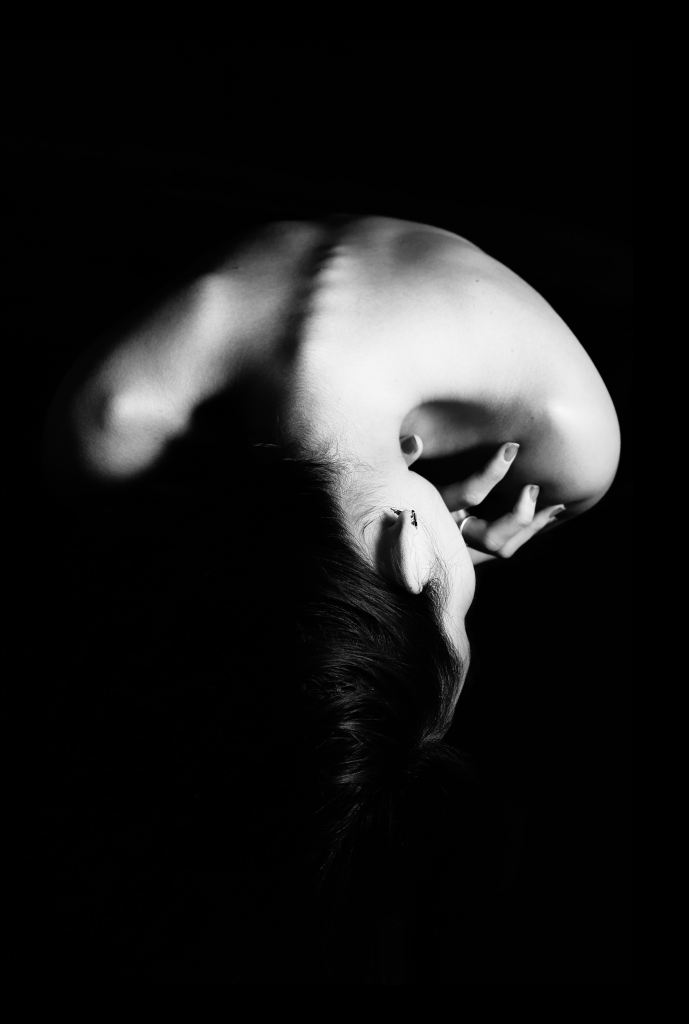
Black and white photo of a woman’s bare back. She is hunched over, emphasizing the knobs of her spine. Photo courtesy of Jairo Alzate, Unsplash
She tilted her head sympathetically and said, “Have you been feeling depressed?” A passage from an article I read flickered through my brain: on average, women have to report significantly higher pain levels than men do before they are prescribed pain medication, and that instead, women were more likely to have their pain categorized as a mental illness. I remembered this briefly before saying, “I do have a history with episodes of depression but I have not been feeling like I am in one, no.”
The doctor proceeded to write me a prescription for an anti-depressant that she said also can help with pain. I blinked, confused. Hadn’t I just said that I wasn’t experiencing depression? I protested weakly that this didn’t make sense but she said, “You want to be active and try something? Well, let’s try something. Let’s try this!”
Tears were still falling down my face but I nodded, my brain still filled with white noise as she walked out of the room. Did she believe me that I was in pain? Did she hear the ways it was impairing my daily function? Is it reasonable to expect this level of physical difficulty at age 26? Did she listen to me at all?
I shakily walked out of the exam room, down the hall, and ducked into the bathroom. I put my face in my hands and cried silently, trying desperately to get a grip on myself. But I couldn’t. I was broken into a million tiny shards and there were too many to pick up in 10 minutes. I washed my face as best as I could and headed to the receptionist to make another appointment. Their earliest slot was in five weeks.
They asked me to fill out a feedback form about how well they had helped me today. I declined.
I cried as I walked to the bus stop. I cried as I bussed home. I cried as I walked up the stairs to my apartment and I cried as I walked in the door. This low-level crying was all I could do to keep from collapsing into uncontrollable sobs. Only when I reached my boyfriend’s arms did I let it all out. I told him everything and then I called several of my best friends and I told them the story again. I didn’t really stop crying for several hours, hoping each re-tellings would relieve the sensation that the foundation of my Self had cracked. At some point, I vaguely realized that the appointment had been traumatic and that I now had a new trauma to heal from on top of my already longer than average list.
In the weeks that followed, I learned that my friends with chronic illness, chronic pain and disabilities have all been traumatized by doctors visits; practitioners doubting them, assuming mental illness and sending them to psychotherapists, ignoring their files and giving them medication they were allergic to, delaying crucial treatments due to incorrect diagnoses, invasive procedures without consent, over and over and over again. They had long lists of experiences like mine. This was just my first one.
KELLA HANNA-WAYNE(Yopp!) is a member of The Zine core team and a co-host of this month’s blog series on illness and disability. Kella is a disabled, chronically/mentally ill freelance writer who is the editor, publisher, and main writer for Yopp, a social justice blog dedicated to civil rights education, elevating voices of marginalized people, and reducing oppression; and for GlutenFreeNom.Com, a resource for learning the basics of gluten-free cooking and baking. Her work has been published in Ms. Magazine blog, Multiamory, Architrave Press and is forthcoming in a chapter of the book Twice Exceptional (2e) Beyond Learning Disabilities: Gifted Persons with Physical Disabilities. For fun, Kella organizes and DJ’s an argentine tango dancing event, bakes gluten-free masterpieces, sings loudly along with pop music, and makes cat noises. You can find her on Facebook, Twitter, Patreon, Medium, and Instagram.
A few months ago, Vi La Bianca, a previous guest writer for my blog Yopp, invited me to be on her YouTube show Secular Sexuality, a show that looks at every angle of sexuality that you can think of, with an emphasis on noticing how mainstream US culture has shaped our opinions and practices around sex. I was invited specifically to discuss the intersection between sex and disability, which is a topic many people are deeply uncomfortable with.
I wanted to share and recommend this episode because, in addition to offering a lot of very useful advice to fellow disabled people and their partners about how to engage with sex and dating, a large portion of the show is devoted to discussing important issues that disabled people face in general.
This is not the first time I’ve been invited to an interview of this kind, and while my interviewers tend to be highly knowledgeable about activism and social justice, it always takes them by surprise just how much is happening within the disability activist community that they don’t know about. Disability rights are a severely neglected branch of social activism, even among some of the best and most thoughtful mainstream activists.
So, if you’re looking to get a glimpse into this world of issues as well as a lot of information specifically about sex/dating and disability, I highly recommend watching this really fun and educational episode! The video is one hour and thirty-six minutes long, including two live callers who share their experiences of how disability affects their sex lives. Not Safe for Work themes and language are also covered.
how we can improve the amount of access available to disabled people
ADA violations and the lack of input from the disabled community on accessible design
the intersection of being a woman in addition to being disabled/chronically ill
the hurdles of navigating the medical system (primarily regarding the US)
disability representation is fiction and media
Disability and dating/sexuality
the difficulties of dating while disabled
the issue of disclosure (”coming out”) as disabled
cultural resistance to the idea of disabled people having sex
the fetishization of disabled people
exploring your sexuality as a disabled person
communicating with your partner about how your disability will impact your sex life
putting your needs and physical safety first
You can watch the episode, for free, below. Enjoy!
If you are viewing this post from an email subscription, you may have to link through to the site to view this video.
Kella Hanna-Wayne
KELLA HANNA-WAYNE (Yopp!) is a member of The Zine core team and a co-host of this month’s blog series on illness and disability. Kella is a disabled, chronically/mentally ill freelance writer who is the editor, publisher, and main writer for Yopp, a social justice blog dedicated to civil rights education, elevating voices of marginalized people, and reducing oppression; and for GlutenFreeNom.Com, a resource for learning the basics of gluten-free cooking and baking. Her work has been published in Ms. Magazine blog, Multiamory, Architrave Press and is forthcoming in a chapter of the book Twice Exceptional (2e) Beyond Learning Disabilities: Gifted Persons with Physical Disabilities. For fun, Kella organizes and DJ’s an argentine tango dancing event, bakes gluten-free masterpieces, sings loudly along with pop music, and makes cat noises. You can find her on Facebook, Twitter, Patreon, Medium, and Instagram.
Social Security Commissioner Andrew Saul announced a new final rule today, modernizing an agency disability rule that was introduced in 1978 and has remained unchanged. The new regulation, “Removing the Inability to Communicate in English as an Education Category,” updates a disability rule that was more than forty years old and did not reflect work in the modern economy. This final rule has been in the works for a number of years and updates an antiquated policy that makes the inability to communicate in English a factor in awarding disability benefits.
“It is important that we have an up-to-date disability program,” Commissioner Saul said. “The workforce and work opportunities have changed and outdated regulations need to be revised to reflect today’s world.”
A successful disability system must evolve and support the right decision as early in the process as possible. Social Security’s disability rules must continue to reflect current medicine and the evolution of work.
Social Security is required to consider education to determine if someone’s medical condition prevents work, but research shows the inability to communicate in English is no longer a good measure of educational attainment or the ability to engage in work. This rule is another important step in the agency’s efforts to modernize its disability programs.
In 2015, Social Security’s Inspector General recommended that the agency evaluate the appropriateness of this policy. Social Security owes it to the American public to ensure that its disability programs continue to reflect the realities of the modern workplace. This rule also supports the Administration’s longstanding focus of recognizing that individuals with disabilities can remain in the workforce.
As if the long venomous tongue jutting out
Would bite me lethally
Instantly on seeing
But the number of death
Bitten by long pointed tongues
As thousand time less
Than the number killed by
Blunt tongues
Failure far exceeds the achievements
The fear of losing in achievement
is not there in failure
As the fact
How heartbreaking s the sorrow
Of losing after having
Compared to
Not having at all
Is vivid in memory of the snake
It juts out its long forked tongue
So that none can settle at a desolate corner of its heart
The tongue is the impenetrable sentinel
Of the inner world of the snake
Visitor takes to its heels
On seeing the guard
But snake do not chase to bite anyone
Actually
All the snakes are innocent
We are indeed
Panicky
SLEEP
Sleep is bliss
Death is bliss too
The first one is not permanent like the second
But the transitory is favoured to the permanent
Fatigue after gratification
Sleep after fatigue
Gratification possible following sleep
Gratification impossible after death
That is the reason
The second one is everyone’s favourite
We are basically punters
Punters need more sleep
ILLNESS
Now
She cooks meals
I devour
She washes the clothes
I put on
She is responsible for
Fetching the children
To and fro from school
She is responsible for
Receiving guests and relatives
Marriage and functions
Meetings and discussions
Are her responsibility
She is like a bobbin
Since waking up
Till retiring to bed at night
GUNA MORAN is an Assamese poet and critic. His poems and literary pieces are published in national and international magazines, journals, webzines, newspapers and anthologies such as –
(i) Tuck magazine (ii) Merak (iii) Spillword (iv) Setu (v)Story Mirror (vi) Glomag (vii) Poem Hunter
(viii) The Sentinel (ix) The Hills Times (x) Litinfinte (xi) Best Poetry (xii)Academy of the Heart and Mind (xiii) The Creation times (xiv)Infinite sky (xv) International Anthology of Poems on Autism (xvi) International Anthology on Water (Waco Fest Anthology 2019) (xvii) International anthology on TIME (xviii) THE VASE : 12th Guntur International Poetry Fest Anthology 2019. (xix) POETICA : The Inner Circle Writer’s Group Poetry Anthology 2019 (xx) Nocturne (poetry of the Night, An Anthology). (xxi) Phantasmagoria Magazine.Apart from this, his poems have been translated into Italian and French, Bangla language also.
BIBEKANANDA CHOUDHURY, an electrical engineer by profession working with the State Government of Assam has completed his Masters from BITS-Pilani. He has also earned a diploma in French language from Gauhati University. He has got published works (both original and translated) in Assamese, Bengali & English in popular periodicals and newspapers. His translated poems have been published in ‘Indian Literature’, the bi-monthly journal of sahitya akademy. ‘Suryakatha’, the Bengali adaptation done by him of the is being taught in the undergraduate Courses of Banglore University and Post graduate Courses of Gauhati University. A collection of 101 folk tales from the foothillsof Patkai translated by him has also been taken up by publication by Gauhati University. He is presently the editor-in-chief of Dimorian Review a multidisciplinary web journal.
GERARD SARNAT is a poet, physician, executive, academic and social activist. Gerry is an MD who’s built and staffed homeless and prison clinics as well as a Stanford professor and healthcare CEO. Currently Gerry is devoting energy/ resources to work with internationally known and recognized leaders addressing global warming.
Sarnat won the Poetry in the Arts First Place Award plus the Dorfman Prize and was nominated for Pushcarts plus Best of the Net Awards. Gerry is published in academic-related journals including University of Chicago, Stanford, Oberlin, Brown, Columbia, Virginia Commonwealth, Arkansas, Harvard, Johns Hopkins, Wesleyan, Slippery Rock, Appalachian State, Grinnell, American Jewish University, Sichuan University, University of Edinburgh and University of Canberra. Gerry’s writing has also appeared widely including recently in such U.S. outlets as Gargoyle, Main Street Rag, New Delta Review, MiPOesias, poetica, American Journal Of Poetry, Poetry Quarterly, Poetry Circle, Every Day Poems, Clementine, Tiferet, Foliate Oak, Failed Haiku, New Verse News, Blue Mountain Review, Danse Macabre, Canary Eco, Fiction Southeast, Military Experience and the Arts, Poets And War, Cliterature, Qommunicate, Texas Review,Brooklyn Review, San Francisco Magazine, The Los Angeles Review and The New York Times. Pieces have also been accepted by Chinese, Bangladeshi, Hong Kongese, Singaporian, Canadian, English, Irish, Scotch, Australian, New Zealander, Australasian Writers Association, Zimbabwean, French, German, Indian, Israeli, Romanian, Swedish, Moscovian and Fijian among other international publications. Mount Analogue selected KADDISH FOR THE COUNTRY for pamphlet distribution nationwide on Inauguration Day 2017. Amber Of Memory was chosen for the 50th Harvard reunion Dylan symposium. He’s also authored the collections Homeless Chronicles (2010), Disputes (2012), 17s (2014), and Melting the Ice King (2016). Gerry’s been married since 1969 with three kids, five grandsons with a sixth on the way and looking forward to future granddaughters.
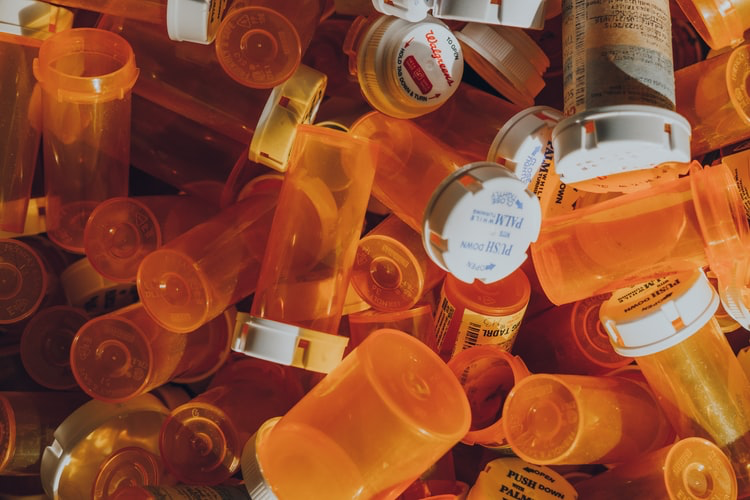
Each year there are about 400,000 poison center calls and 50,000 ER visits as a result of young children ingesting medications when adults weren’t paying attention. A new study finds that more than half of the time when children get into prescription pills, the medication had already been removed from the child-resistant container by an adult.
The findings come from a study of calls to five U.S. poison control centers by researchers from the U.S. Centers for Disease Control and Prevention (CDC), Emory University School of Medicine, and the Georgia Poison Center. The study appears this week in The Journal of Pediatricsexternal icon.
“These data suggest it may be time to place greater emphasis on encouraging adults to keep medicines in containers with child-resistant features,” says the study’s senior author, Daniel Budnitz, M.D., MPH, of CDC’s Division of Healthcare Quality Promotion. “There is an opportunity here for innovative medication container options that promote adult adherence and provide portability and convenience, while maintaining child safety.”
Child-resistant packaging keeps kids safe – but only when pills are inside
The current study found four common scenarios in which young children get into prescription pills after the pills are out of their original containers:
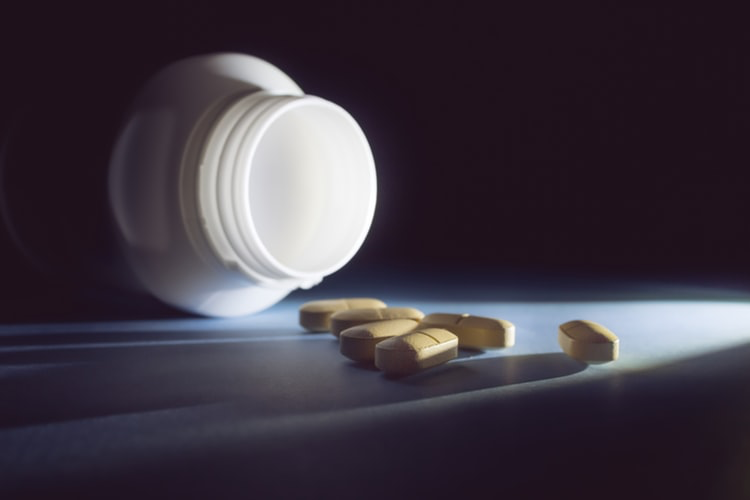
Removed to remember to take as prescribed: Adults put pills into pill organizers that are not child-resistant.
Removed for ease of travel or transport: Adults put pills into baggies or other small containers that are not child-resistant to carry with them.
Removed for convenience: Adults leave pills out on countertops or on a bedside table for someone to take later.
Removed unintentionally: Adults sometimes spill or drop pills and may miss some when picking them up.
The most common scenarios varied by type of medication. Attention-deficit/hyperactivity disorder (ADHD) medications (49%) and opioids (43%) were more often not in any container when found by young children. Diabetes drugs (34%) and cardiac medications (31%) were more often transferred to alternate containers such as pill organizers or baggies. Nonprescription medications were most often accessed from the original containers, but for many of these medications, child-resistant packaging is not required because of low potential for toxicity.
Grandparents’ pill organizers often involved
Investigators also asked whose pills the children were getting into. Most of the time, the children got into their parents’ pills. However, for some prescription medications that can be very harmful to young children in small amounts (e.g., diabetes or cardiac medications), over half belonged to grandparents. Therefore, it will be important to remind grandparents, as well as parents, about the importance of keeping medications up and away and out of the reach and sight of children.
CDC recommends keeping medications in the original child-resistant packaging. If one must remove pills from their original containers, a few precautions can help keep children safe:
Use a container that is child resistant.
Securely re-close the container after every use.
Put the container up and away and out of a child’s reach and sight immediately after every use.
Keep purses, other bags, or pockets with medicines in them up and away from young children.
If pills are spilled when taking or transferring medications, double-check to make sure that all pills are picked up.
Save the Poison Help number in your phone – (800) 222-1222 – and call right away if you think your child might have gotten into a medicine or a vitamin, even if you are not sure.
He came into this world with an innocent spirit but with a physical condition, recognized as ‘Development Disability’. At that time it was commonly called ‘Mental Retardation’, which meant anyone suffering from it would be having difficulties in certain areas of life, especially in “language, mobility, learning, self-help, and independent living”.
A helpless human being born in this world with an innocent soul, oblivious to life’s reality, unaware of its purpose, totally unconscious of self but for the fulfillment of the basic need for food and strangely, of extreme sensitivity to music. The tunes that caught his fancy would excite him to the point of screaming that gradually melted into crying and, after long hours, would end by fatigue and sleep.
Everyone at home loved music. Father had quite a collection of 75 rpm records and a stylish Grundig record player which would be attached to the radio. Almost every evening there would be a half-hour music session before dinner was served.
My earliest memories are of joyful moments when he was born. Good looking, with dark eyes, long eyelashes, adorable face specially when it broke into a smile, but something was very odd about him. I could not understand just what at that time. Two years old but hardly able to sit: “when will he play with us? Why doesn’t he speak ?” The only answers were “with time dear” and “in due time, he will.” We would run off and get busy with our own games and books, accepting the quietly given explanation.
When he was five, he began to sit, but still no speech, nor play, nor self awareness. He would sit on the tricycle but could not pedal or ride. With time he learned to stand and one day took a few steps. Soon with the support of the wall he began to walk. Still no speech. Fits of laughter began to occur and would end up in screams. Lying on the floor nothing would stop the screaming untill time brought an end to them.
He never knew he had a name. He was not conscious of t parents, siblings, or anyone else. He had no idea of day or night. When he started walking he was not aware of the way to go. Once unnoticed he walked out of the gate and onto the road, he was almost run over by a passing vehicle. He was hit and the fall broke two of his ribs. It was a painful time for him. From then on he had to be strictly monitored and often in a bolted room.
With passing years the truth of his never getting well and normal was accepted. He would never be able to converse or take care of himself. He needed constant vigilant care for falls or injuries, for safety against electric wires and shocks, for all sorts of dangers. There was no end to care as he was alive in a world of his own. Parents did all they could. No medicine would work.
Hunger is a strong instinct. He would reach out and hold the arm tightly of anyone close to him at that moment and would push that person towards the door of the room.I t was a clear indication that he was asking for food, but he had to be fed. He could not hold a spoon or a cup, nor a biscuit nor a piece of bread. Sometimes the morsel would get stuck in the throat because it was not properly chewed. Panic would result. Fortunately the first aid of patting on the back would work.
He was not aware of the dangers of injury. Once, in a fit of laughter he clutched the electric extension wire on the floor and let out a loud scream, by the time the connection was cut his hand was burned, the flesh cut and bleeding. The wound healed but the hand could not be normal again. The need for constant vigilance kept the whole family alert. The risk of leaving him alone even for a few seconds was profound and life threatening. One aspect in his personality was that he was a docile human being. Nonviolent.
A newly established state had very little health care or disability support centers for special-needs children or adults. Tariq ,as he was named would live in his own home, which for the family became a guarded place. Fear concern and worry prevailed, only prayer would bring some solace and strength to the heart. One can never fully understand nor find any answers. The truth is with the One Power Almighty.
Disability of all sorts needs constant care comfort patience respect and love. May Allah the Most Gracious and Most Merciful save and protect his people on this beautiful Earth and May all be blessed with the best of health and happiness.
This one is dedicated to those many who continue to create in the face of sometimes dramatic physical health issues and disabilities. Be as well as you can be. You are valued.
There are two videos included here. If you are reading this post from an email subscription, it’s likely that you’ll have to link through to the site to view the videos. They’re both worth the time and effort.
The Spoon Theory (see video above) is a clear and vivid way of explaining what it is like to live with any chronic, catastrophic and potentially life-threatening illness. I suspect that it also explains what life is like for those who have lived long enough to be described as “elderly.” Understanding The Spoon Theory gifts us with compassion for ourselves and patience with how long it takes to get even the smallest tasks done.
The first step in living successfully with catastrophic illness and advanced aging is to recognize (acknowledge/understand) the ramifications in terms of everyday life and its details. The Spoon Theoryhelps with that.
The second step is acceptance. That’s about letting go of your story. It’s about not being defined by the circumstances of your life. It’s about living with not struggling against. This requires something much more profound than positive thinking, which tends toward the superficial.
Letting go of our stories means letting go of judgement and attachment and a sense of victimization, which are the root causes of many of our very human pathologies. The philosopher Arthur Schopenhauer wrote of this my-story mentality as “striving, disappointment, and boredom” or a life that is devoid of Spirit. Songwriters, who often make their living by stoking the “pain body” or the residue of emotional pain that stays with us [Eckhart Tolle], call this the IFD disease – idealization, frustration (the ideal cannot be achieved) and demoralization.
The third step in the journey is to adapt, a business of the heart. Adapting is not about giving up. It’s about finding our core of joy and gratitude and no one reminds of joy and gratitude better than the beloved Benedictine monk, Brother David Stendl-Rast (video below), who combines the wisdom of traditional Christianity with pragmatism of Buddhism.
No guilt. No judgement. Just joy. With understanding, self-compassion, patience and acceptance, we can still produce as so many of us do … and maybe, instead of beating ourselves up over what didn’t get done each day, we’ll be able to pat ourselves on the back for all we do accomplish. We cannot share The Spoon Theory with everyone. Many people will not understand our challenges. All that matters is that we do and that we support one another.
I’m bulbling, bumbling like a dumb blond(e) from the Golden Age of Hollywood
without the figure
or the yellow locks,
a himbo who isn’t very beau.
How can a petite podwery, poerdy, poderwy-
POWDERY damn it
wite, white pill-or is it the pinkish-bluish capsule with the cryptic digits-
besiege a brain and morph it
into mash, or is it mush, to match
the collywobbles in the gut during
eight days of frustrating pharma fog thicker
than a full-frat, full-fat Frappuccino?
Science squashes my IQ as I misplace my cell phone, followed by the TV remote, keys and
bank card and my, um…I forget.
As if hijacked by the shakiness of a heat haze, I stumble to the ice machine but
come back with nothing.
Dates and deadlines become meaningingless in a malfunctioning memory bank, and
I fix and refix phrases like “extra much” that sounded Shakespearean when I typed them.
Mercurial emotions mock me like the menacing Space Invaders of my childhood as
innocuously constructive criticism rips up any remnants of calm.
Someone’s profiting from my prescriptions while I’m vantiqued, vanquished by the salvos of adverse effects.
Originally publish in U-Rights Magazine, December 2019.
Crisscrossing North America as a language professional, Pushcart Prize and Best of the Net nominee Adrian Slonaker is fond of opals, owls and fire noodles. Adrian’s work has been published in WINK: Writers in the Know, Ariel Chart, The Pangolin Review and others.
For you, Ms. Frizzle, I would fold
my fingers around the curves of my stomach, dig
my nails into the flesh, rip
it open so you can go right in.
Take your big-eyed bus full of curious children
and explore my mysterious body.
Watch organs lighting up a little too bright.
Red blood cells drifting lonely
like they’ve lost their best friends.
Scattered inflammations and infections hiding
in muscle and tissue.
Explain to the children that these are things
that make me hurt
but not enough for anyone to see.
And when people don’t see something,
they don’t do anything.
Teach them that lesson.
It will always apply.
This poem first appeared in Philosophical Idiot and in Alana’s chapbook, The Uncertainty of Light
Halt
I’m enthralled as I watch an actor scribble symptoms
in notebooks and cry when the pain is too strong
and see doctors who seem to know a little too much
about what’s happening, but it’s okay.
I’ll keep watching.
I can’t be that picky.
I ignore all the cues that this will end
the same way as all the other TV
reflections of me, the fun house mirrors
that only show sickness as a distorted, shortened
one-way road.
There was no other ending.
He’s only got one place to go.
His actor family
weeps over his departure
at just the right time
in the series.
His death is art.
My life goes unseen.
This poem first appeared in AlienPub and in Alana’s chapbook, The Uncertainty of Light
ALANA SALTZ (alanasaltz.com) is the editor-in-chief of Blanket Sea, an arts and literary magazine showcasing work by chronically ill, mentally ill, and disabled creators. Her poems have appeared in Occulum, Five:2:One, YesPoetry, Moonchild Magazine, LadyLibertyLit, and more. She’s the author of the poetry chapbook, The Uncertainty of Light. You can visit her website at alanasaltz.com and follow her on Twitter, Facebook, and Instagram @alanasaltz.
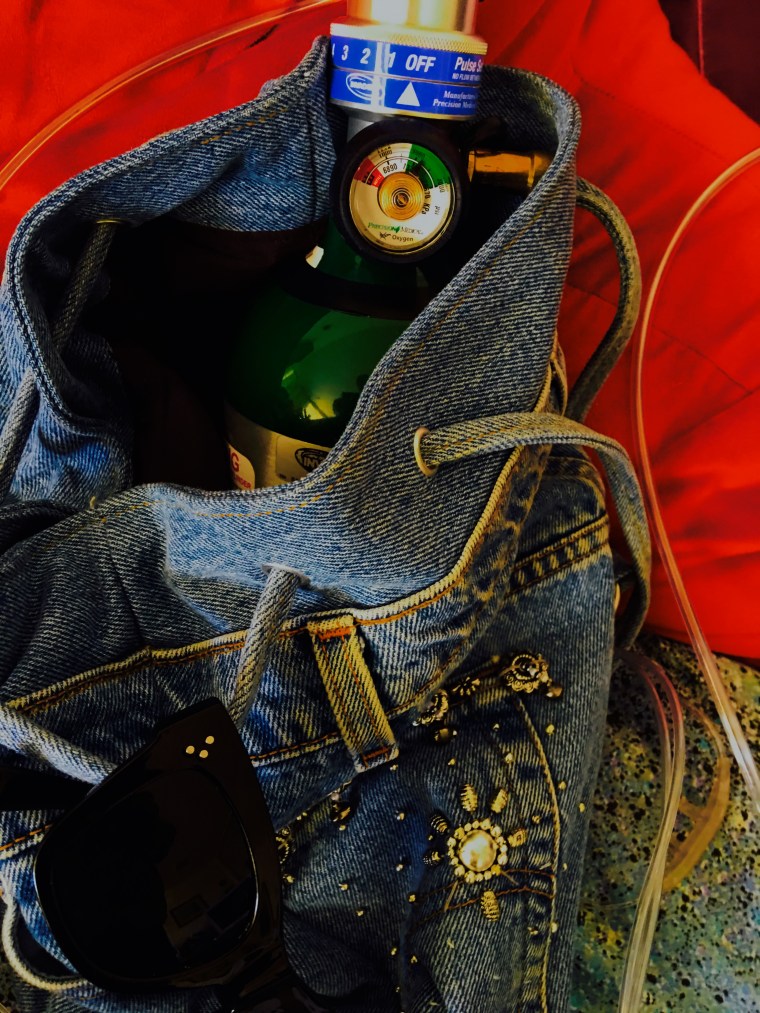
Thanks to the support of my world-class son and a stellar medical team, I’ve lived for about two decades past my original medically predicted expiration date. Every year or so I feel compelled to get on my soap box – though the topic is off-theme for my poetry site, The Poet by Day – about lung disease, its increasing prevalence, and its debilitating effects. This post was originally written in 2016 for The Poet by Day. At that time, I needed oxygen for activity only and carried a small tank or two in a backpack as above. As expected, over time the disease progressed and years of insufficient oxygen resulted in other complications: pulmonary hypertension and right-sided heart-failure. These are further complicated by a rare blood cancer (not curable but managed). These complications result in my being home-bound and often bed-bound for days.
I am now on high-flow oxygen (15 liters) 24/7 and am attached to two linked stationary oxygen concentrators at home and have large portable tanks for doctor visits and to get around the senior housing facility that is my home. These are moved around with specially-designed carts. My son must come with me to doctor appointments because it takes four tanks per trip, which is too much for me to handle on my own.
At the time in our history when we started to see nature as something apart from us, when we gave up our shamanic instincts and in our hubris separated them from our growing science, when we devolved from stewardship and one-with to ownership and power-over, we set ourselves up for a world of multifaceted pain and disruption. One result in modern times is environmentally induced disease caused by xenobiotic substances that result in cancers, autoimmune disorders, and interstitial lung diseases (ILDs).
My concern here – as a powerful and noteworthy example of the impact of industrial pollutants and of wars and other violence to the earth and its inhabitants – is interstitial lung disease. I have hypersensitivity pneumonitis, an ILD that can be caused by smoking. I am a lifelong non-smoker. Everyone – EVERYONE – is at risk of ILD, smokers or not, and so are other animals. We know that in the United States and England alone, the numbers suffering from ILD are growing. No matter where in the world we live and what we do for work, we all need to recognize and acknowledge this as part of the complex package of environmental injustices.
Our lungs are the only organs that are exposed and immediately vulnerable to industrial pollutants and inhaled chemicals, dust and other particulate matter in the air. One study tells us, “Lung cancer is the number one cause of cancer-related deaths in humans worldwide. Environmental factors play an important role in the epidemiology of these cancers.”
Consider the two hundred ILDs: These are diseases that affect the tissue and space around the air sacs (alveoli) of the lungs resulting in scaring (fibrosis). We – and other animals – can’t breath through scar tissue, which is not permeable. Hence the exchange of carbon dioxide and oxygen is inhibited. The result is a slow, horrifying and painful death by suffocation. This is mitigated for people like me who have access to healthcare, supplemental oxygen and medications like prednisone and mycophenolate mofetil and, when the time comes, palliative care and ultimately hospice. People living in poverty, in war-torn areas or working at risky occupations in third-world countries, get no such relief and no palliative care is available to them in the final stages. This is unimaginably cruel.
While the most common interstitial lung diseases are considered idiopathic, they can result from exposure to certain chemicals– including medications – and from secondhand smoke and occupational exposure to agents such as asbestos, silica, and coal dust. They may also evolve from an autoimmune reaction (hypersensitivity pneumonitis) to agents in the environment, some of which might be naturally occurring and benign for many people.
Forbes Magazine cites lung disease as one of the continuing legacies of 9/11, the result of “toxic collections of airplane fuel, asbestos, fiberglass, metal, plastic, garbage, waste materials, fecal material, human remains and who knows what else.” In reading this description, one can’t help but think also of the people of Syria and other regions of war and conflict. It is not uncommon for soldiers returning from war to report newly developed respiratory disorders.
Industry, war and conflict, greed and denial, all combine to put the very ground we live on at risk, the air we breath, and the precious functioning of our lungs … We rightly worry about and advocate for issues of deforestation, pollution, hunger, dislocation, destruction of property and other issues of environmental injustice. Not the least of our motivations, concerns and advocacy must be for the sake of our lungs. It’s a fight for the very breath that enlivens us.
It wouldn’t be so bad
if I lost it in one place
at least I’d know where to find it!
But Noooo…
I have to lose it here!
I have to lose it there!
And just when I find it there
I‘ve lost it again here!!
People wonder why
I never answer my own door
I wonder if they can hear me
breathing from under my covers?
Sometimes I hear myself
calling from another room
Or it could be that other guy
who blames everything on me
Of course it’s never his fault
Nothing ever is!
You see
Nothing is enough for him!
First he impersonates me and steals my best lines
Now he covers his ears with mine
and complains that I don’t sing
with the right inflection!!
As if
he’s the only one
who has to listen to me at night !
Song of the Deaf
What can I say
that you haven’t already heard
before me?
I feel left out
Everyone else has two sides
but when I turn around to face the other way
I still point in the same direction!
Sometimes people talk behind my back
right in front of me!
Of course I must expect that
I try to anticipate everything
otherwise I fall behind
and I have nothing to fall back on!
That is why
my world is suspended in animation–
I use my hands to balance silence
the way stars hold up the sky
A cloud can fall back on the sky
but I must climb deeper
into God’s Ear!
Only…where does the sky begin?
I’d give anything you know
just to hear the color blue
Song of the Blind
It bothers me that my eyes are broken
and God will not fix them
Each morning I watch and listen for Him
and wonder through which doorway of my senses
He will choose to enter next
Each day He and I together
make and remake the bed–
make and remake the world
Mostly it is the same
And that is both my comfort and my fear
I have heard that once someone is truly loved
she is never the same
You cannot imagine how I long for change!
You cannot imagine how I long for certainty!
I can only imagine
I never quite know which
I will stumble into next:
Death that l o n g night
or
Life that l o n g day!
Dear Lord
I am without sight
I am not without vision
Please find me
Song of the Homeless
How long must I go on
pushing my life before me?
My feet are bare and swollen—
they do not know me anymore
And I haven’t yet enough hands
to keep me warm
nor make a pillow for my head
Maybe I’ll grow new fingers tomorrow
so they too can stick out
like a sore thumb
I suppose you think
I can find a better place to hide
than in the poverty of my skin
Do you think I like
carrying my heart around with me
in a basket?
You do not care
that I have forgotten the words
to the songs I am singing
And I am running out of songs
How could you know first-hand
that it is not my death I fear…
only that I should learn of it
second-hand
A former San Francisco Poetry Slam Champion, Antonia Alexandra Klimenko is widely published. Her work has appeared in (among others) XXI Century World Literature (in which she represents France) and Maintenant : Journal of Contemporary Dada Writing and Art archived at the Smithsonian Institution in Washington, D.C. and New York’s Museum of Modern Art. She is the recipient of two grants: one from Poets in Need, of which Michael (100 Thousand Poets for Change) Rothenberg is a co-founder; the second—the 2018 Generosity Award bestowed on her by Kathleen Spivack and Josheph Murray for her outstanding service to international writers through SpokenWord Paris where she is Writer/ Poet in Residence
CLARISSA SIMMENS (Poeturja) is an independent poet; Romani drabarni (herbalist/advisor); ukulele and guitar player; wannabe song writer; and music addict. Favorite music genres include Classic Rock, Folk, Romani (Gypsy), and Cajun with an emphasis on guitar and violin music mainly in a Minor key. Find her onAmazon’s Author Page, on her blog, and on FacebookHERE.
MBIZO CHIRASHA ((Miombo Publishing Blog Journal) is one of the newest members of The BeZine core team. He is the Poet in Residence at the Fictional Café (International publishing and literary digital space). 2019 Sotambe Festival Live Literature Hub and Poetry Café Curator. 2019 African Fellow for the International Human Rights Art Festival , Essays Contributor to Monk Art and Soul Magazine in United Kingdom .Arts Features Writer at the International Cultural Weekly .Featured Writer Poet Activist at The Poet A Day. Core Team Member and African Contributor to Bezine of Arts and Humanities(https://thebezine.com/) in USA. Flash/Short Fiction Writer for Squawk Back Publication.Contributing Writer( Africa) to IHRAF Publishes–publishes.The Originator of the Zimbabwe We Want Poetry Campaign. Curator of Miombo Publishing Blog Journal. Founder and Chief Editor of WOMAWORDS LITERARY PRESS. Founder and Curator of the Brave Voices Poetry Journal. Co-Editor of Street Voices Poetry triluangal collection( English , African Languages and Germany) initiated by Andreas Weiland in Germany. Poetry Contributor to AtunisPoetry.com in Belgium. African Contributor to DemerPress International Poetry Book Series in Netherlands. African Contributor to the World Poetry Almanac Poetry Series in Mongolia. His latest 2019 collection of experimental poetry A LETTER TO THE PRESIDENT was released by Mwanaka Media and Publishing and is both in print, on Amazon.com and at is featured at African Books Collective. 2003 Young Literary Arts Delegate to the Goteborg International Book Fair Sweden (SIDA AFRICAN PAVILION) .2009 Poet in Residence of the International Conference of African Culture and Development (ICACD) in Ghana. 2009 Fellow to the inaugural UNESCO- Africa Photo- Novel Publishers and Writers Training in Tanzania. 2015 Artist in Residence of the Shunguna Mutitima International Film and Arts Festival in Livingstone, Zambia. A globally certified literary arts influencer, Writer in Residence and Recipient of the EU-Horn of Africa Defend Defenders Protection Fund Grant, Recipient of the Pen Deutschland Exiled Writer Grant. He is an Arts for Peace and Human Rights Catalyst, the Literary Arts Projects Curator, Poet, Writer, publicist is published in more 200 spaces in print and online. Mbizo’s Amazon Page is HERE.
When being sick was all you knew
Sweet Jesus, the doc last week asked
“When was the last time you felt good,”
Me and Bobby McGee and I saw black
Roses. Could not thread my way to good.
Life a Harlem-globetrotter procession of sham
Dunks and wheezes. Born RH negative all my
Blood exchanged. Lord have mercy then
Coughing times in bed over and over again.
I hadda find good feeling cuz i was an other early
Outcast over and over. Put the music on
And I would play the piano
Rocking to peace my outcast soul.
Sickness made me hold on to my
Strange and play it on an Aeolian harp
To woo the good places and make me me.
Thank you Kris Kristofferson,
Good enough for a life to live,
To share with you the secrets
Of my soul on the edges
Of strong all along. Be a pearl
On my own making the
Good happen. Jiving Janis.
Feeling good was good enough for me.
LINDA E. CHOWN grew up in Berkeley, Ca. in the days of action. Civil Rights arrests at Sheraton Palace and Auto Row. BA UC Berkeley Intellectual History; MA Creative Writing SFSU; PHd Comparative Literature University of Washington. Four books of poetry. Many poems published on line at Numero Cinq, Empty Mirror, The Bezine, Dura, Poet Head and others. Many articles on Oliver Sachs, Doris Lessing, Virginia Woolf, and many others. Twenty years in Spain with friends who lived through the worst of Franco. I was in Spain (Granada, Conil and Cádiz) during Franco’s rule, there the day of his death when people took to the streets in celebration. Interviewed nine major Spanish Women Novelists, including Ana María Matute and Carmen Laforet and Carmen Martín Gaite. Linda’s Amazon Page is HERE.
“Authors, like coins, grow dear as they grow old; It is the rust we value, not the gold.” – Alexander Pope
I come to this place of Elder Power through a cascade of chronic catastrophic illnesses and disabilities, which – like life – are ultimately fatal. Some have encouraged me to write from a clinical perspective. It would seem, however, that the clinical lessons have less significance than the life lessons. It is the life lessons that give us the strength to keep going, that are the true value to be shared, and that make us elders. To me “elder” implies more than “senior” or “senior citizen,” which I see as demographic terms for people who have reached retirement age. A senior is someone who has merely put in time, while elder is about attitude and state of mind. Elder implies one who is accomplished, who has learned a few things along the way.
As a poet, writer, and content editor, it is the life lessons, not the clinical ones, which inspire and inform my work. I have learned, for example, that all humans are in process and therefore imperfect; and that, no matter what our differences are, the most important thing is to remain open to communication and to accept and release our own follies and those of others. I have learned that neither illness nor threat of death preclude joy. I have learned that people who are joyful rarely do harm to themselves or others. I have learned that fear of death has to be directly addressed and then firmly put aside in favor of the business of living. As the saying goes: “It’s not over until it’s over.” Until then, we have responsibilities to others and ourselves. The only real difference between someone who has a life- threatening illness and someone who doesn’t is that the former is no longer in denial.
“If people bring so much courage to this world, “ wrote Hemingway in A Farewell to Arms, “the world has to kill them to break them. The world beaks everyone, and afterward, many are strong at the broken places. But those that will not break, it kills. It kills the very good and the very brave and the very gentle impartially. If you are none of these it will kill you too but there will be no special hurry.”
I am not good, or brave, or particularly gentle. I do not – and never have – suffered fools kindly. Sometimes I let it all get me down. I descend into fear. I am impatient with process, with taking meds and going for seemingly endless tests and doctors’ appointments. Maybe that’s why I’ve outlived my original medically-predicted expiration date by over eighteen years. My mother used to say, “Only the good die young.” My best quality may be that under my protective shell of intractability, I actually am willing to be broken and reformed. I suppose only time will tell if I have grown “strong at the broken places.”
So, here I stand, twenty-odd years into it, hugging my 70s at the dawn of a bright new day in a body that is now dramatically disabled and quite a bit older. It’s still a good morning and a good body. I recognize I once dealt with a worse handicap than my current disabilities. That handicap is commonly referred to as “youth.” I survived. Maturity on the other hand is a true boon, a gift to savor and enjoy with layers of luxurious nuance I had not anticipated. I do not long for my youth. I love my graying hair. I love my wrinkles and the loose skin on my neck. I love the mild deformity of my feet. These things remind me that I am still here after all. It’s unlikely that I’ll dye my hair, though I have. I will not get chemical injections or cosmetic surgery. I will not use rejuvenating grooming products that have been tested on defenseless animals. I am inspired by civil-rights-era African-Americans who sported Afros, said essentially “this is who we are and what we look like,” and chanted “black is beautiful.” I am graying. I am wrinkled. It’s all lovely and lyrical and makes me smile. It’s about ripeness, not rottenness. It’s honesty: what you see is what you get. Aging is beautiful. With maturity, one finds character refined and perspective broadened, energy expands and compassion flowers. The experience of joy comes more easily.
As survivors, we owe it to those who have gone on to live in gratitude for this gift of a long life. How ungrateful and what an insult it is to them for us to bemoan our maturity and yearn for our youth as we so often do. What an incredible waste of time and energy such yearning is. Many don’t survive childhood in their impoverished and war-torn areas. Some others don’t survive childhood due to congenital or other diseases. My sister died by her own hand when she was twenty-seven. I have a wonderful, talented, smart friend in her mid-thirties who will pass within three months from this writing. Like you, I have relatives and friends who didn’t make it to fifty, much less sixty or seventy. All things considered, aging is a gift not a curse.
“People worldwide are living longer. Today, for the first time in history, most people can expect to live into their sixties and beyond. By 2050, the world’s population aged 60 years and older is expected to total 2 billion, up from 900 million in 2015. Today, 125 million people are aged 80 years or older. By 2050, there will be almost this many (120 million) living in China alone, and 434 million people in this age group worldwide. By 2050, 80% of all older people will live in low- and middle-income countries.” World Health Organization MORE
Some of our power comes from our sheer numbers. According to the World Health Organization, 900 million of us were aged sixty or more in 2015 and as of 2018 125 million of us were aged over eighty. We represent a huge political constituency, a lucrative market, and an enormous fount of energy, experience, and expertise. If that isn’t power in this modern world, what is? What a force for peace we could be.
Some of our power comes from consciousness. We are awake now. We have learned how to live in the moment and how to live joyfully, hugely. That alone is a lesson to share. Some of our power comes from more time and focus. Many of us are retired or semi- retired or on disability, or soon will be. Implicit in that is the time to keep abreast of issues in our communities, countries, and our world. We can take the time and make the effort to get accurate information, to analyze carefully, and to share appropriately; that is, in a well considered, non-inflammatory, non-sensational manner. We can act with grit and grace.
Let the elders among us be the Global Movement of Strength in Broken Places. Let those of us who have this gift of long life seize on it and ply our elder power individually and in concert. Let’s live with joy, do good, and have fun. Most of all let us be generous with our love. Soon enough, when the time is ripe, our bodies will become earth once more. Our spirits will travel on but the river of mortal life will continue to flow. Our children will see us reflected in the eyes of their children. Our grandchildren will strain to hear our voices in rustling leaves and breezes that whisper to them in the night. They will seek us out in moonlight and the warmth of the sun, in the roar of the oceans and the gentle meandering of a lazy brook. They will find us in the hearts of the lives we’ve touched with concern and compassion.
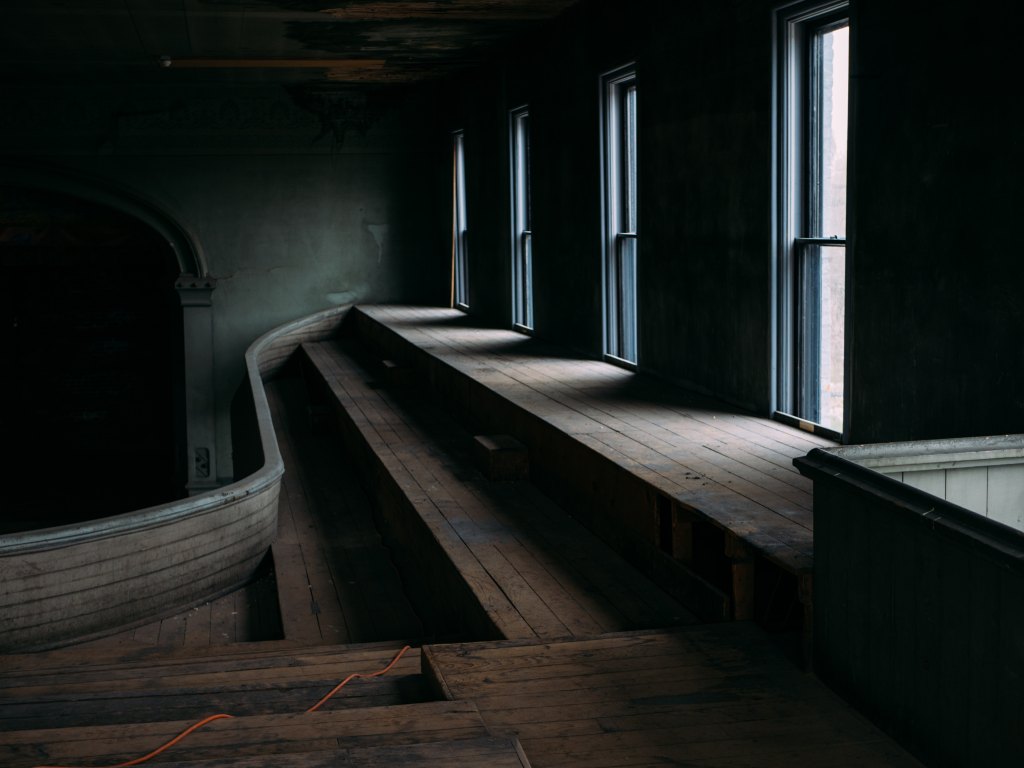
A dusty, dimly lit room filled with empty space and rough wooden floor boards. Along one wall there is a series of narrow windows, that let in very little light. Photo courtesy of Chris Bair, Unsplash.
Nothing but “I can’t I can’t I can’t” is sounding in my head.
My best friend has her hand on my knee. She’s carefully offering me solutions to try to get me out of this trap. I say no to every single one. I know it looks like I don’t want to find a way out. I do. I can’t find it. I want permission to lose it, permission to stop searching for a way to function like a normal person. I don’t want to be held together. I want to split apart and lose myself in the fragmentation.
It’s like the most vulnerable part of me is exposed to the outside world and I have to protect it from even the smallest hardship because it has no armor, and if I damage it, it will never recover. It’s like every tool I’ve learned my entire life to cope with the workings of my mind, to cope with the unpredictability of other people, to cope with my tendency to give all of myself, is inaccessible. I cannot protect myself from anything.
I hang up the phone. My event has been canceled with just a few hours of notice. I don’t know the words in my language to name the feelings in my head. Anger? Disappointment? Stress? What emotions do those words embody? Are they the ones that I have?
For some reason, I can’t tell anyone that my world is crashing down until I know what words describe my feelings. Somewhere inside me I know there was an explosion of twenty emotions contained by a vacuum but all I felt was the muffled noise that the explosion made when the bomb went off. I want to open the door to this capsule and look at the damage but I can’t find the door either. I want to peel off this band-aid. I can’t find the edge of it, even though I’m scraping my skin, hunting for it.
There are flashes of pain in my heart, and then my vision goes fuzzy as I stare at nothing. I stay like this for a minute and then resurface, the pain returning but a little diluted, and I catch my breath. I don’t remember if I was breathing while I dissociated.
I come up for air and with no warning, I’m lucid again. I feel like myself and yet I thought I was myself before. I want to connect with my boyfriend, I can feel his touch. It penetrates all the way to my core. It’s as if I haven’t seen him all day. Just an hour ago, I was pushing the words, “How was your day?” out of my mouth, as tears built up under my face, filling my cheeks and the contours of my eyes, clouding my vision, making my thoughts slow, waiting to burst out again.
A window into my writer’s brain opens for a brief moment, I manage to type out three paragraphs and then I feel the window slowly closing, my heart succumbing to numbness like a cloud that covers my connection to myself. It’s an impulse to protect myself from something I can’t quite name. I hear a distant cry of grief as my creativity, my productivity, my reason for being valuable, slips away from me once more.
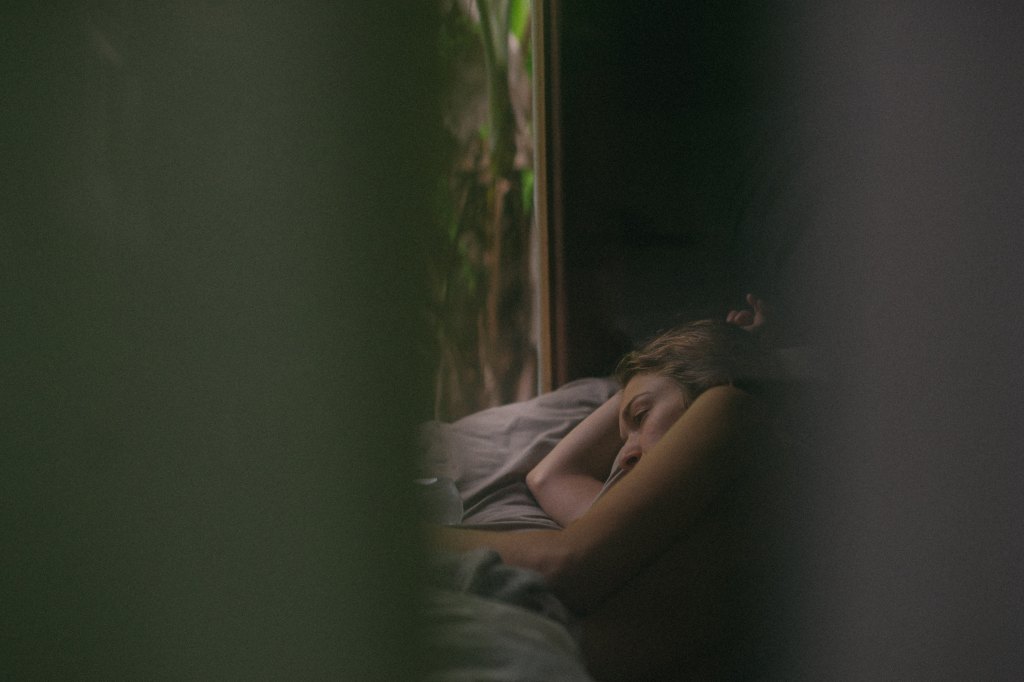
A woman lies on her side on a bed, her arm under her head, staring blankly ahead of her. The view of her is partially obscured by an blurry obstacle in the foreground on either side of her. Photo courtesy of Jordan Bauer, Unsplash.
I’m fine just a little sad and I’m lying on the floor wondering why I’m a little sad but I’m fine and then it hits me like a sack of bricks dropping onto my chest that I’m not scared of abandonment I’m scared of losing access to intimacy, this precious substance, the lack of which causes me to wither and numb myself, and why am I so afraid of losing it? Don’t I know I can find it with someone else? But no, this time, I cannot dance to fill the hole in my heart, this time I cannot easily meet new people to try to date again, this time my disability hangs on my shoulders like a neon sign that says “I’M NOT WORTH YOUR TIME” and I have no way of knowing who can see the sign and who can’t. The bricks stay on my chest even as sobs explode out of me and I gasp at the pain, this new strange backward crying I’ve started doing, as if the act of pushing the pain out of my chest only makes the pain from this wound more vivid, and every breath, I cry to rid myself of the pain and then gasp again as the pain penetrates deeper. The crying stops because I have no answer to the question, “what will I do if I lose intimacy again?”
One month of increased anti-depressants or maybe it’s getting to the other side of the trauma or maybe it’s the most recent conversations with my boyfriend but whatever it is, I can feel the streaks of dopamine cutting through the dull molasses that so recently covered my heart every moment of the day. Rather than every task being a dead end, pointless, sad endeavor, some of them have light at the end. And then because your brain responds not just to the dopamine trigger itself but the lead up to the dopamine, I get that little bit of light earlier and earlier, like catching my breath for just a moment at the end of a devastating work out that has no benefit. I keep expecting to fall into the tank of quicksand again– where I will respond to every thought, every need with “I don’t care,” or “what’s the point”– but instead I step and there’s solid ground. My feelings swirl and collect neatly, still sharp and intense but they present themselves clearly so I can pick them up one at a time and hold them close.
Like the first day back after a wipeout flu, I’m exhilarated by how functional I am, trying to cram as many to-do’s into this stretch of motivation and energy as I can. I start to slow down and find myself scrolling through Facebook an hour after I finished my last task. Determined to teach my depression that my doing-things neurons can fire even when that cloud is consuming me, I barter with myself until I find a reward motivating enough to get me up. I wash dishes and chop some vegetables for the dinner that I will never make. I sit back down, feeling as if the flu has hit me again and it takes a moment before I realize I’m not depressed, I’m spent. 7pm and I am done for the day.
This weight in the center of my chest keeps pulling me inward. I try to interact, to connect, to think of things to talk about. What do healthy people talk about for fun? I try to predict what is expected of a person like me in a situation like this and mimic what would be done, but it’s as if I’ve never done it before. What did I use to do?
The longer I resist the pull to withdraw, the more exhausted I feel. As I give into the pull, tears come to my eyes without words to accompany them. The pain surges up and out but I am no closer to understanding it. I crumple inward, angry at my inability to understand my own mess.
I read my writing from three months ago and stare and stare at the clearly illustrated points and organized structure. How was my mind ever free enough to write this?
I have a doctor’s appointment to follow up on my medication change. I rate my symptoms on a scale of 0-3, trying to accurately represent what I feel and also accurately represent the difference between the last time I filled out this sheet and now. Last time, I counted out my total, decided it was too high, crossed out several of the numbers, and replaced them with lower ones. I struggle to describe to my doctor the paradox of grief and emotional pain so deep that I can barely function, and yet somehow I am not in danger of hurting myself or neglecting basic needs. Each day I am simultaneously devastated and okay. It’s as if I’m sitting at the edge of a pool and I’m choosing to throw myself in, let myself sink to the bottom, struggle and writhe, and then float back up, out of breath and exhausted. My doctor tells me that it’s okay to call my weird childhood a source of trauma. I think she thinks I’m a person who undermines my own trauma. I am. But not like that.
I’m cleaning my room for the first time in I don’t know how long. My desk became a storage unit, items without homes stacking higher and higher. I start at the top and place one thing at a time in the recycling, the trash, or the place it belongs. The stacks get a little smaller and then my hand falls on… A bar of chocolate? From who knows how many weeks ago, my favorite type of chocolate was sitting untouched at the bottom of a pile of junk. I have no memory of buying it or putting it here.
It’s another reminder of how far away I am from healthy me. I know she’ll come back but I have no sense of how long she’ll be gone. It feels strange having concrete evidence that, just a few months ago, I was clear-headed enough to buy myself a treat for later in the week. I was not constantly inundated with feelings that halt my body until they’ve moved through me, wrecking me in the process, that I was not always resisting the pull of numbness, of something brainless to take the edge off this hurt. I don’t know what the path back to health looks like. I just know I’ve done it before.
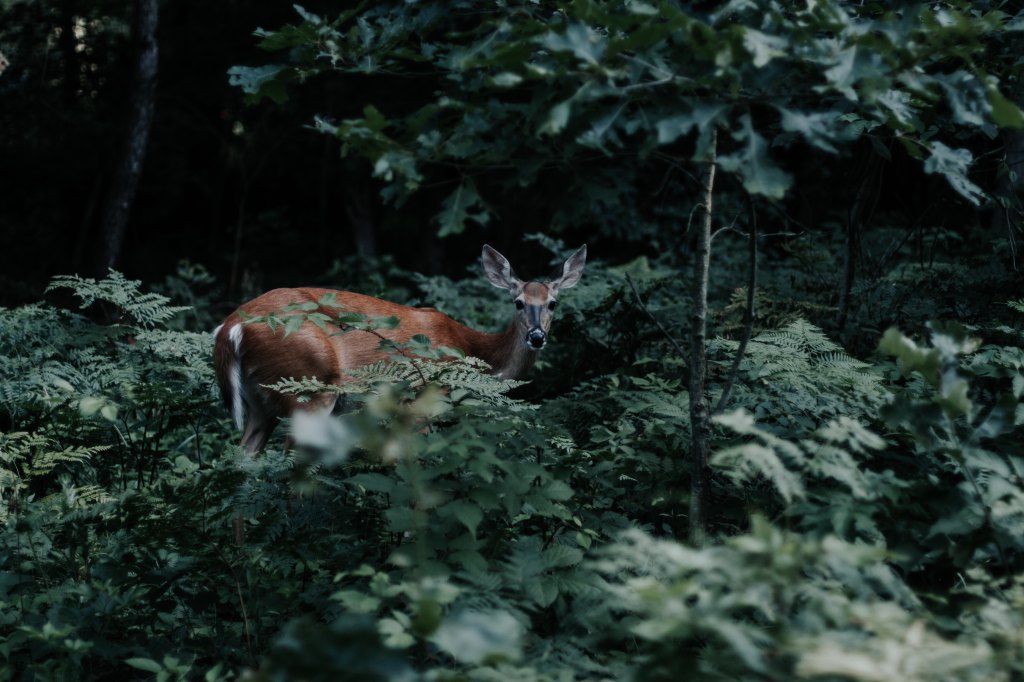
A deer crouches, staring into the camera, tail tucked, frightened and cautious, surrounded by dark green foliage. Photo courtesy of Carly Rae Hobbins, Unsplash.
I slowly open a tiny door and peek inside. A warm vulnerable feeling fills me, like watching a fawn and holding your breath hoping it will not startle and run away. The feeling is so delicate and precious that I tell no one I have it. I cannot step inside the door for more than a minute at a time, the fear of self-expression is too powerful.
When I interact with other people, I close myself off and pull away so that they won’t startle the fawn either. Even when I want to connect, my door inside closes and so does the rest of me, my body language turning away as if I want to avoid all contact even when part of me wants to show my new discovery so badly.
But I watch as unwittingly, words flow through my fingertips, I have something to say, I think something important and moving and I express it, without the usual wall of doubt surrounding me. If I ask myself to write in a formal document, the terror returns, rising up in my throat as if asking myself to write a paragraph is as bad as asking myself to tell my therapist I no longer want to see her. But I did that, so maybe I can do this too.


 The BeZine