The BeZine Blog

Posted in find yourself, Liliana Negoi, Meditation, meditative, Story Telling, Photo Story, teacher, Teachers

On learning and remembering

I was installing something on my computer this morning and I smiled when I remembered that, prior to meeting my husband, computers were for me something that I barely touched, using the one in my house back then only to write some paper work for university from time to time (yeah, that was a different age, we used handwriting more often 😛 – I still use it probably more than half of you, dear readers, although I discovered also that Microsoft Office is quite a friendly application :).

Anyway, what I’m trying to say is that after meeting my husband I “evolved” up to the point where I’m not only capable to use the current system, but I’m able to assemble one from pieces, install the software (starting with the OS) and whatever other programs I need, and do many other things with it. In other words, “I learned”. Which is something that we ALL do, all our lives, voluntarily or involuntarily – we learn in order to adapt to the circumstances presented to us by life. Some say that we are able to learn even prior to being born from our mothers’ wombs – I don’t know about that, but for sure we are able to learn starting with the moment when we are born, and we continue to learn until the day we die.

The reasons why we learn are obvious. The reasons why we don’t learn can also be obvious, but neither ones nor the others make my topic for today. Instead I am going to mention a discussion that I had with a friend only a couple of days ago, in which he (my friend), who, coincidentally, is going to be a professor, was telling me that if I’m not able to teach someone a certain thing, maybe it’s because of the method that I’m applying.

I was tempted to reject the idea, for many reasons (pride among them), but fortunately for me I was smart enough in that moment to simply shut up, to listen to what he was saying and to chew on his words later that night. And then I realized that he was pretty much telling me what I always stated – that prior to teach someone WHAT to learn, you have to teach them HOW to learn. Ignacio Estrada said that “If a child can’t learn the way WE teach, maybe we should teach the way THEY learn”. The final goal is not for our own teaching to impose itself unto the mind of a being, but for that being to learn something from our teaching.

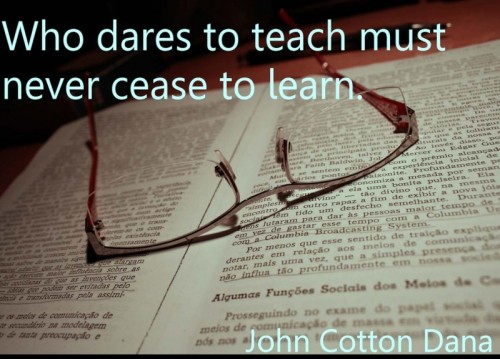
What my friend may not have realized at that point was the lesson that I myself had to learn that evening – and that is that the hardest to learn is when you think you already know what you’re learning. But as John Cotton Dana said, “He who dares to teach must never cease to learn”. And I myself feel lucky to have remembered such a beautiful lesson of life – and above all, lucky to have friends to teach it to me again :). Namaste!

who-dares-to-teach-must-never-cease-to-learn-education-quote© 2014 Liliana Negoi

The image used was taken from http://quotespictures.com/who-dares-to-teach-must-never-cease-to-learn-education-quote/

IMG_7667LILIANA NEGOI  (Endless Journey and in Romanian curcubee în alb şi negru) ~ is a member of our core team on Into the Bardo. She is the author of three published volumes of poetry in English, which is not her mother tongue but one that she came to love especially because of writing: Sands and Shadows, Footsteps on the San – tanka collection and The Hidden Well.  The last one can also be heard in audio version, read by the author herself on her SoundCloud site HERE.  Many of her creations, both poetry and prose, have been published in various literary magazines.

Posted in Essay, Spiritual Practice, Terri Stewart

Sacred Space in the Mirror

My theology and my anthropology descend from two ideas:

  • We are all created as beloved children and as an image of the divine
  • We are called to enter lovingly into sacred mystery, to enter lovingly into our deepest selves, and to enter lovingly into caring for the whole world

That makes the Divine and people ultimately loving and good in my view. The place that I believe that it is most difficult to lovingly accept is when we look into the mirror and see ourselves. What do you see in your mirror? Are you noticing every flaw? Or are you seeing perfection? Those are probably two places that are hard to be. What if we looked in the mirror and found love? acceptance? our ancestors? the future? It is all there!

I am wondering if you could offer a reflection in whatever form speaks to you on what you see in the mirror.

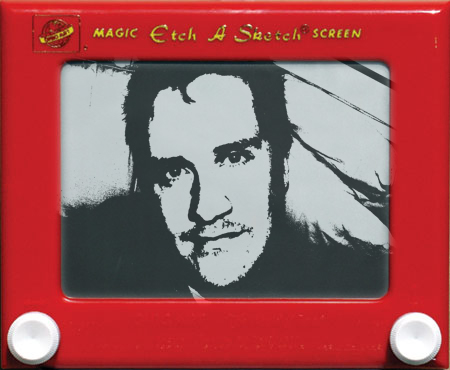
my face is not an
etch-a-sketch
the lines do
not disappear
when you shake me
they are there forever
traced over by time
lovingly etched
by laughter and
tears

my fingers
trace the lines
no knobs to turn
to change directions
the path already
traveled
knowing that each
line
knowing that each
curve
reflects love

no.

I would not trade
these engravings for
an etch-a-sketch
shake-shake-shaking
away each
memory, erasing
each person
that has walked
the line creating a
new face, a
new face, a
new face
and again, a
new face

cc licensed ( BY NC ND ) flickr photo by Welshdan: http://flickr.com/photos/welshdan/415087493/

(c) 2014, post, Terri Stewart

REV. TERRI STEWART is The Bardo Group’s Sunday chaplain, senior content editor, and site co-administrator. She comes from an eclectic background and considers herself to be grounded in contemplation and justice. She is the Director and Founder of the Youth Chaplaincy Coalition that serves youth affected by the justice system. As a graduate of Seattle University’s School of Theology and Ministry, she earned her Master’s of Divinity and a Post-Master’s Certificate in Spiritual Direction. She is a contributing author to the Abingdon Worship Annual. (The 2014 issue just released!)

Her online presence is “Cloaked Monk.” This speaks to her grounding in contemplative arts and the need to live it out in the world. The cloak is the disguise of normalcy as she advocates for justice and peace. You can find her at www.beguineagain.com ,www.twitter.com/cloakedmonk, and www.facebook.com/cloakedmonk.  To reach her for conversation, send a note to cloakedmonk@outlook.com

Posted in Joseph Hesch, poem, Poems/Poetry, poetry

Cold Comfort

In one hand, the ruddy-faced,
ragged wanderer wraps a coffee cup
and his smoke. The other he keeps
in the pocket of his third-hand Mets jacket.
Whether he’s grasping something within
or just trying to keep it warm
is a mystery. Chances are 4-to-1
no cash shares those five fingers’ berth.

Joyous, the drifter throws smiles
like sunbeams right into the faces
of the straight-life, shivering souls with whom
he coasts these stark morning streets.
Their eyes are up too, but they focus
past the runny-nosed no one shuffling nearby,
seeing instead only the faces in the
steamed-up coffee-shop window.

The same familiar, frowning reflections
as yesterday’s.

– Joseph Hesch

© 2014, poem and photograph, Joseph Hesch, All rights reserved

Hesch Profileproduct_thumbnail-3.phpJOSEPH HESCH (A Thing for Words) is a writer and poet from Albany, New York , an old friend of Bardo and a new core team member. Joe’s work is published in journals and anthologies coast-to-coast and worldwide. He posts poems and stories-in-progress on his blog, A Thing for Words.  An original staff member at dVerse Poets Pub website, Joe was named one of Writers Digest Editor Robert Lee Brewer’s “2011 Best Tweeps for Writers to Follow.” He is also a member of the Grass Roots Poetry Group and featured in their 2013 poetry anthology Petrichor Rising.

Posted in General Interest

The Packrat Gene and the Clutter Queen

((With the new year upon us, many will be thinking about “de-cluttering” their lives for a fresh, new start. Buddhism and Taoism teach us that all that “stuff” we acquire and become attached to is actually detrimental to our lives and our spiritual well-being. With that in mind, this is a piece I wrote a while ago regarding clutter and “stuff”. I find myself looking around my house and having the itch to ‘purge’ some more material belongings. I imagine others do, too…))
Packrat by Ursula Vernon

I’ve often wondered in life if there really is such a thing as a “Pack-Rat Gene”? Is a tendency toward hoarding or clutter an inherited trait? I have to wonder, because there are so many members of my family who seem to exhibit this tendency. Some are worse than others, and I am determined NOT to fall victim to it in my lifetime. I think part of it stemmed from the generation who survived the Great Depression, where consumer goods like aluminum foil were re-used and re-cycled because it saved money. I can still remember my grandmother washing out plastic sandwich bags (yes, and reusing foil, too, we’ve all heard about that) and hanging them on the faucet upside down to dry. In that sense, it could be considered “frugal” or “thrifty” and so if I do it, too, it’s partially because of that, but also a small attempt at being environmentally conscious regarding plastic, etc.

I know that another part of it has to do with “creativity”. I think it was Einstein who said “Clutter is a sign of genius.” (*pauses to look that up*) Yup. It was him. I’ve also heard that it’s a sign of creativity, and I have close family members who take this to heart. But there’s a difference between the “clutter” of someone who is actively working on something, and “clutter” of someone who is storing anything and everything which might be useful “at some nebulous, unknown point in the future, for some just as unclear and unknown project in the future”. There’s a difference, and therein lies the secret, I think.

There is a point, and I think it’s different for everyone, where it becomes “hoarding” behavior. Like going to the store and stocking up on something you like because it’s on sale…but then going back again for the limit when it’s on sale again, even though you may already have enough to last you and your future generations through WWIII. I think there is a fear of “running out” or not having enough. I don’t do this, but I’m related to people who have and do. And I don’t WANT all that “stuff”. Perishable or not, I don’t want to clutter my living environment with “stuff”.

And it’s really ALL just “stuff”, you know. We can’t take ANY of it with us when we check out. Empty space has a tendency to fill. It’s like a Natural Law or something, and if it’s not, then it should be, because you know it’s true! The question is, is it “stuff” you’ll be using now or soon? We may not even BE here to use it tomorrow, so why keep it if you’re not using it? My dad always taught me it’s “better to have it and not need it, then need it and not have it,” and to some extent, that’s a wise philosophy. It speaks of being prepared and anticipating future problems and solutions ahead of time.

BUT…there IS something very true about Feng Shui and the “less is more”, minimalist viewpoint. Clutter and hoarding speak volumes about what’s going on inside of a person – a person’s living environment can be very telling about their inner emotional and mental states. The two are tied together, and I think that cleaning up one can affect and help clean up the other (inside vs. outside or vice versa). Balance and order in one area can guide a person to both in the other area.

In an attempt to keep from becoming a “Clutter Queen”, I try to keep in mind a few things:

1) Can I or will I (realistically and actually) use something today or tomorrow? If so, how and for what? Unfortunately, my ‘skinny clothes’ probably fall into this category – I MAY end up at that smaller size again, but I sure can’t fit into them now, and they are taking up a lot of space in the closet and chest. Hmmm….

2) How does having something enhance who I am or benefit my life NOW, TODAY? Do I need it? <—Important note: there are sometimes when just having the peace of mind knowing I have something in case of an emergency (like extra oil for the car, for example) is worth having to store it.

3) Do I have the space for it? Keeping in mind that empty space will fill, do I really want to fill that empty space with this particular thing?

4) How does it affect my environment? Does it clutter or add to my ‘living space’ in a positive way?

5) If I bring in something ‘new’, I have to get rid of something ‘old’ to make room for it – it’s about keeping the balance/flow of what I want around me. If I REALLY WANT or NEED that ‘new’ thing, then there should be something ‘old’ that I can move out to make room for it.

So what about you? How do you handle the clutter in your life? Is it true that “One man’s trash is another man’s treasure”? Do you think there’s a Pack Rat gene? Or is it more nurture instead of nature (i.e. environmental upbringing instead of inherited traits)?

Thanks for reading. 🙂 Comments are welcome and appreciated!

– Corina Ravenscraft

© 2014, essay, Corina Ravenscraft, illustration, Ursula Vernon All rights reserved

effecd1bf289d498b5944e37d8f4ee6fAbout dragonkatet Regarding the blog name, Dragon’s Dreams ~ The name comes from my love-affairs with both Dragons and Dreams (capital Ds). It’s another extension of who I am, a facet for expression; a place and way to reach other like-minded, creative individuals. I post a lot of poetry and images that fascinate or move me, because that’s my favorite way to view the world. I post about things important to me and the world in which we live, try to champion extra important political, societal and environmental issues, etc. Sometimes I wax philosophical, because it’s also a place where I always seem to learn about myself, too, by interacting with some of the brightest minds, souls and hearts out there. It’s all about ‘connection(s)’ and I don’t mean “net-working” with people for personal gain, but rather, the expansion of the 4 L’s: Light, Love, Laughter, Learning.

Posted in Essay, General Interest, John Anstie, Peace & Justice

The Value of Life

Word art image by John Anstie via 'Cloudart'
Word art image by John Anstie via ‘Cloudart’

This year marks the centenary of the beginning of a war that should have ended all wars. My thoughts for this piece were inspired, nay possibly provoked, by commentary from two recent sources.

The first was an item on the BBC’s Newsnight. This was a contention by some commentator that the perspective of the horrors of the Great War had swung “too far to the left”!

The second came from somewhere inside those compartments of my brain that store data from my professional life in commerce and trade. It relates to how successful companies aim to keep the balance sheet healthy (and the shareholders or directors happy).

It doesn’t matter which political regime is in government – left, centre or right – we keep going to war, somewhere in the world, for some reason, the truth of which is often illusory. So, whichever social, political or historic perspective we decide to adopt to absolve ourselves of the guilt, brought on by the inhuman horror of war, it alters neither the fatal results on the lives of so many, nor its lasting and damaging effects on the survivors and future generations.

Any company, developing a new product for market, will want it to succeed in the market. If the product fails to sell in sufficient quantities or survive against the competition, then would they carry on producing it and pushing it into the market, expending their valuable resources on a failing campaign? The answer is a resounding NO! They would either review and redevelop the product, remodel its placement in the market or withdraw it altogether!

An army, like a commercial company, has as its main resource what any organisation should value most, it’s people. Their operations in the field have to be managed in a way that ensures the highest probable success at the lowest possible cost. So the generals (and their political masters), who presided over operations at the front in the First World War, failed! It still hurts now, even after nearly one hundred years, that, by any measure, the obscene loss of young lives in that war was a failure on a catastrophic scale. However great was the threat that existed from Central Europe’s ‘Triple Alliance’ (Germany, Austria-Hungary and Italy), they could have managed that threat with far better strategy, better tactics.

Surely few could have foreseen the horrors that would follow but, years later, with countless tomes of historical reportage, documentary … and some of the most poignant poetry ever written … there comes a time for reconciliation; a time for present leaderships to face the truth, admit their predecessors were wrong and apologise to the descendants of all those lost and hurt by such bad management. I think it is important for any civilisation, if it is not to descend into a dark Orwellian future, if it’s peoples are not to be subjugated by fear of war, foreign invasion and death, that its leadership, regardless of political colour, must be able to stand up and face the truth, admit their failures and apologise for taking us to war, any war! We all need to seek truth and reconciliation.

It has been said that we should not ‘celebrate’ but rather ‘commemorate’ the First World War at its anniversary. I disagree. I believe we should celebrate it, which means that, once we acknowledge it was a complete failure because of its decimation of life, it should serve as an unforgettable beacon that we will always celebrate for reminding us of the value of life.

© 2014, John Anstie, All rights reserved

John_in_Pose_Half_Face3JOHN ANSTIE (My Poetry Library and 42) ~ is a British poet and writer, a contributing editor here at Bardo, and multi-talented gentleman self-described as a “Family man, Grandfather, Occasional Musician, Amateur photographer and Film-maker, Apple-MAC user, Implementation Manager, and Engineer. John participates in d’Verse Poet’s Pub and is a player in New World Creative Union. He’s been blogging since the beginning of 2011. John is also an active member of The Poetry Society (UK).

* * * * *

product_thumbnail-3.php51w-rH34dTL._BO2,204,203,200_PIsitb-sticker-arrow-click,TopRight,35,-76_AA300_SH20_OU01_John has been involved in the recent publication of two anthologies that are the result of online collaborations among two international groups of amateur and professional poets. One of these is The Grass Roots Poetry Group, for which he produced and edited their anthology, “Petrichor* Rising. The other group is d’Verse Poet Pub, in which John’s poetry also appears The d’Verse Anthology: Voices of Contemporary World Poetry, produced and edited by Frank Watson.

Petrichor – from the Greek pɛtrɨkər, the scent of rain on the dry earth.

Posted in Nature, poem, Poems/Poetry, poetry, Victoria C Slotto, Victoria C. Slotto

outside my window, life goes on

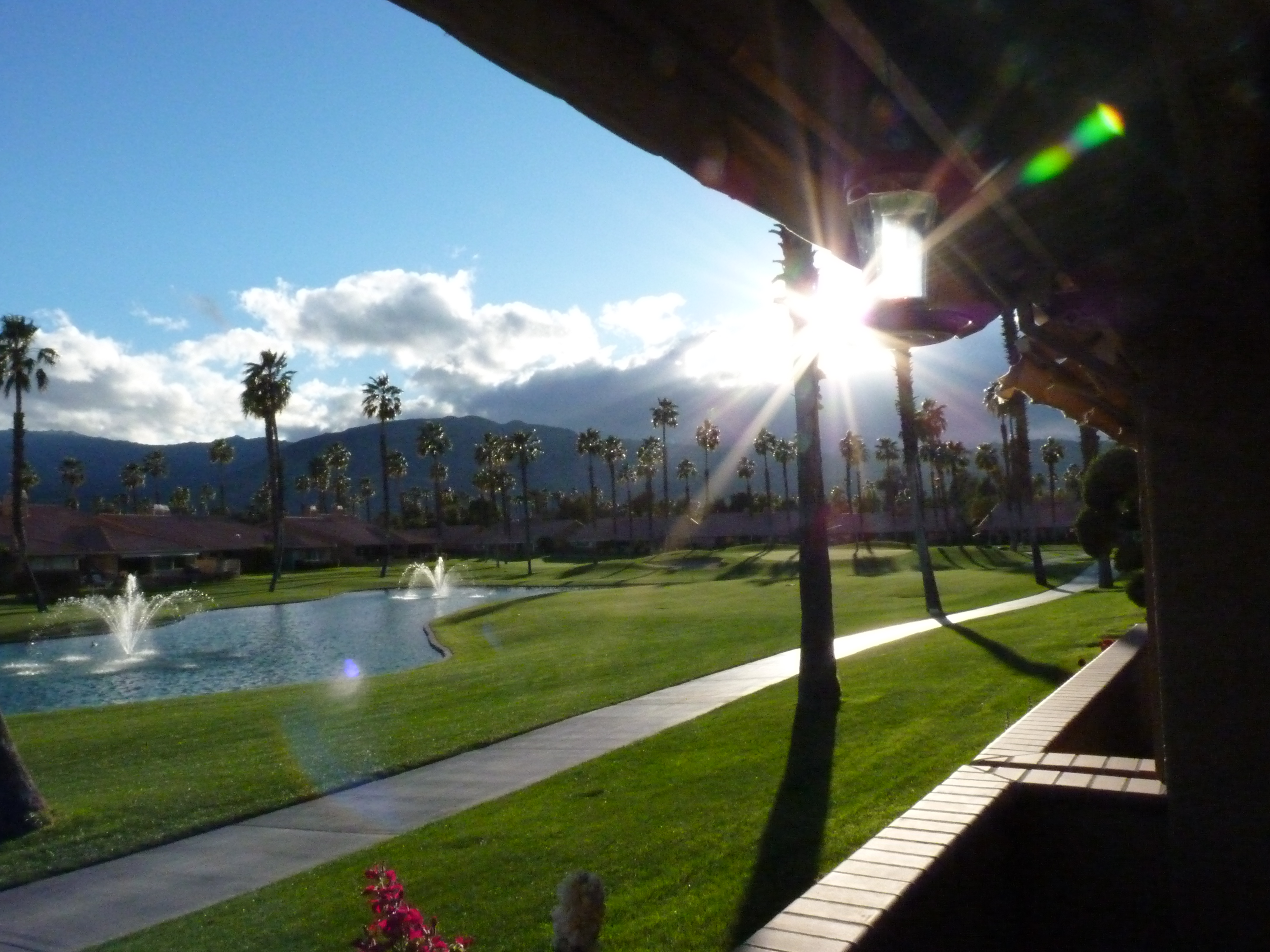
Photo: Victoria Slotto

outside my window, our neighbor putters in her garden.
her roses languish while weeds have their way.

chemo, a fourth round, has taken its toll.
a few wispy hairs blow in the soft breeze.

i close my door gently behind me and we exchange a quick hug.
fear of crushing fragile bones holds me back a little

though her spirit soars, strong, unwavering
like the circling hawk above us, sun on golden wings.

at a distance a blackbird caws,
while hummingbird savors nectar,

drinks in the sweetness of the moment,
unafraid of that which is to come.

– Victoria Slotto

Photo: David Slotto
Photo: David Slotto

© 2014, poem and all photographs, Victoria Slotto, All rights reserved

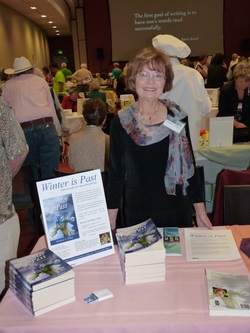
Victoria at the Palm Springs Writer's Expo March 2012
Victoria at the Palm Springs Writer’s Expo March 2012

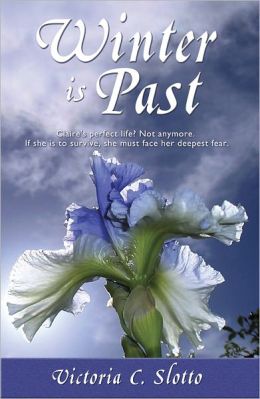
2940013445222_p0_v1_s260x420VICTORIA C. SLOTTO (Victoria C. Slotto, Author: Fiction, Poetry and Writing Prompts) ~ is an accomplished writer and poet. Winter is Past, published by Lucky Bat Books in 2012, is Victoria’s first novel. A second novel is in process. On Amazon and hot-off-the-press nonfiction is Beating the Odds: Support for Persons with Early Stage Dementia. Victoria’s ebooks (poetry and nonfiction) are free to Amazon Prime Members. Link HERE for Victoria’s Amazon page.

Editorial note: Congratulations, Victoria, on that the long awaited publication of print copies of Jacaranda Rain, Collected Poems, 2012, Beautifully done.

Writers’ Fourth Wednesday is hosted by Victoria from January through October and always posts at 7 p.m. PST.

Posted in Essay, General Interest, Michael Watson

Edge of America

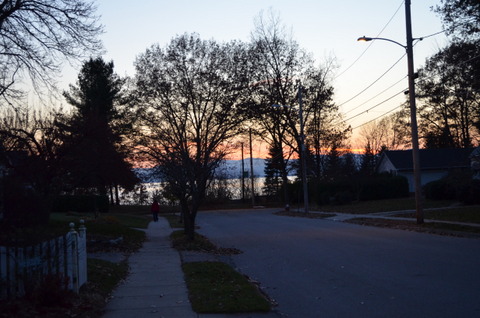
Winter-TwilightThe days are lengthening; the intense cold of the winter thus far has receded for the time being. Overnight a light snow fell, fluffy and bright, the form of snow that arrives with temperatures in the upper 20’s.

Yesterday a Six Nations friend dropped by with a film, Edge of America. I’ve been stuck at home for the past week, following some surgery, and I was beginning to feel a touch of cabin fever. I had managed to go the the university library for 45 minutes and out for a quick cup of coffee earlier in the week, but mostly I have been sleeping and reading.

I had missed the film when it played in the theaters here briefly several years ago. Then, as has been my habit for a number of years, I never got around to borrowing a copy. The plot is pretty basic. A Black man arrives to teach English on the Res, revives the high school women’s’ basketball team (they have not won a game in years), finds a home, and creates the conditions for a good deal of much needed healing. On the road to redemption he tramples all over his team, his friends, the local medicine woman, and his spirit. I sure could relate!

Watching the film I was carried back to my middle school days in rural Illinois where the world turns around basketball and agriculture. I was the manager of the basketball team; when I was in eight grade we won the state tourney in double overtime. The women of our film lose in the state finals (in double overtime) to a team that is racist and represented the very worst of the dominant culture. None-the-less, our heroines are greeted on their return home by the entire Res community. The view of people and vehicles lining the highway brought a flood of memories. (Somewhere I have a memorial book that includes photos of the victory parade. The other team had one, too.)

Just before the team arrives home they have a conversation about winning and losing. They are bitterly disappointed, working hard to resist recriminations. They have lost sight of just how much they have accomplished. The community, however, remembers and reminds them. They are winners.

They are also women. Most of our Indian cultures are women centered; healing arises from the strength and wisdom of women, just as life arose from the sacrifices of Falling Woman. We men are definitely the weaker gender. (Then there are the two-spirits but that is another story.)

Edge of America addresses the hard parts of life on and off the Res: alcohol, violence, poverty, and crushing racism, drawing connections between Indian and Black experience. It also explores the inevitable tension between the healer’s need to remain traditional while nurturing the future. And yes, there is a strong undercurrent of good old Indian spirituality. (There is a priceless scene in which the medicine woman (whose daughter plays for the team) and her friends, are listening to the women’s game on their transistor radio, in a beautiful, spacious, hogan far from anywhere. One of the players has been “witched”, has required a healing ceremony, and now must make crucial free throws. The healer switches from rambunctious fan to medicine person, does what is needed, and returns to fandom, all in maybe 20 seconds.)

So there we sat, two light skinned male Indians who have never lived anywhere close to the Res. We are well in to our sixties, reasonably affluent, over-educated urban professionals. We’re laughing, crying, and hooting for the good guys. (I remember as a kid wanting to be a cowboy so I could win occasionally.) We are also noting the racism and just plain viciousness coming from all the guys: Indian, White, and Black. No holds barred there. At the film’s conclusion I am choked with emotion.

I believe that at the very heart of human experience lies story. Sitting in my living room, wrapped in my electric blanket, gazing at the TV screen, I was blessed to be told a remarkably good story. In the process I was reminded that together a good friend, a community, and a great tale can be remarkably healing. Last night my dreams carried that notion forward. In my dreams the spirits and Ancestors came to remind me that these things are good to live and good to think about. They are indeed profoundly healing.

– Michael Watson, Ph.D.

© 2013, essay and photographs (includes the one below), Michael Watson, All rights reserved

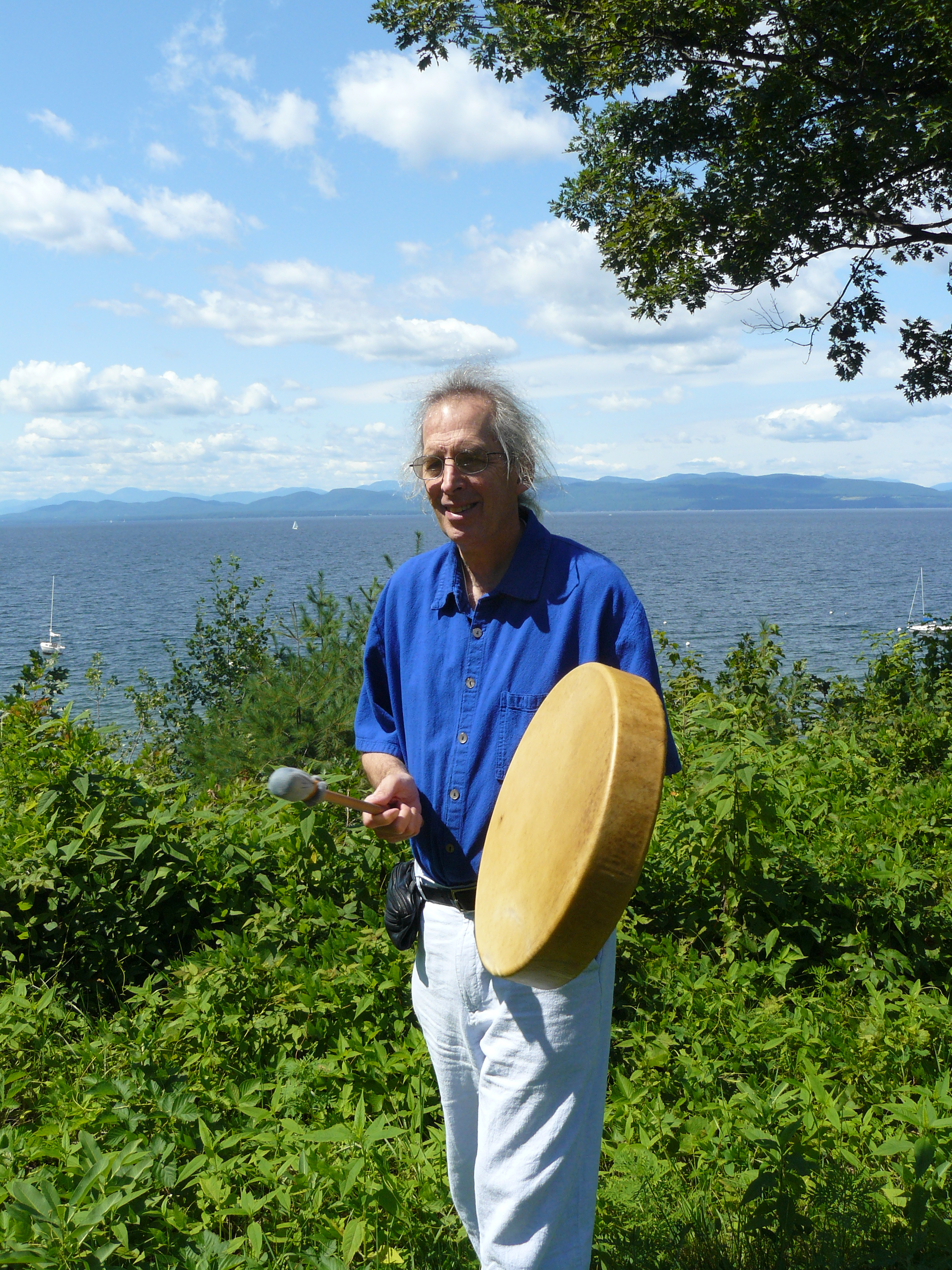
michael drumMICHAEL WATSON, M.A., Ph.D., LCMHC (Dreaming the World) ~ is a contributing editor to Into the Bardo, an essayist and a practitioner of the Shamanic arts, psychotherapist, educator and artist of Native American and European descent. He lives and works in Burlington, Vermont, where he teaches in undergraduate and graduate programs at Burlington College,. He was once Dean of Students there. Recently Michael has been teaching in India and Hong Kong. His experiences are documented on his blog. In childhood he had polio, an event that taught him much about challenge, struggle, isolation, and healing.

Posted in General Interest, Music, Niamh Clune

When The Dreamer Meets The Dreamed.

I thought I might tell it in music. I hope you enjoy listening.

From the CD Touching Angels:

430564_3240554249063_1337353112_n-1orange-petals-cover_page_001DR. NIAMH CLUNE (Plum Tree Books Blog) ~ is the author of the Skyla McFee series: Orange Petals in a Storm, and Exaltation of a Rose. She is also the author of The Coming of the Feminine Christ: a ground-breaking spiritual psychology. Niamh received her Ph.D. from Surrey University on Acquiring Wisdom Through The Imagination and specialises in The Imaginal Mind and how the inborn, innate wisdom hidden in the soul informs our daily lives and stories. Niamh’s books are available in paperback (children’s books) and Kindle version (The Coming of the Feminine Christ). Dr. Clune is the CEO of Plum Tree Books and Art. Its online store is HERE.  Niamh’s Amazon page is HERE.

Posted in Disability, Essay, General Interest, Jamie Dedes

drawing the world back into ourselves … celebrating Lung Leavin’ Day

Heather Von St. James is an eight-year survivor of mesothelioma – a rare cancer caused by asbestos exposure. She initiated Lung Leavin’ Day to encourge people to face their fears, whatever those fears might be. Together she and Jamie Dedes share some of their experiences with and victories over Interstitial Lung Disease (ILD) and encourage you care for yourself.

Jamie Dedes's avatarJamie Dedes' THE POET BY DAY Webzine

“Breathing involves a continual oscillation between exhaling and inhaling, offering ourselves to the world at one moment and drawing the world into ourselves at the next…” David Abram, Becoming Animal: An Earthly Cosmology

469px-Lungs_diagram_detailed.svgBreath: So necessary to the maintenance of life and so often a metaphor for life and spirit. Every year around this time, I take advantage of my blog to change the subject and write about diseases that harm the mechanism of breath, our lungs. I don’t do this to draw attention to myself. I do it to draw attention to the lung disease. I want people to be aware because Interstitial Lung Disease (ILD) can go undiagnosed or misdiagnosed and unattended for too long adding even more devastation to what is frankly horrific.

This year I was contacted by Heather Von St. James who wrote to me saying, ” I am an 8-year survivor of mesothelioma – a rare…

View original post 638 more words

Posted in Essay, Spiritual Practice, Terri Stewart

Inviting Sacred Space Into our Intentions

flickr photo by B Duss  cc licensed ( BY NC )
flickr photo by B Duss
cc licensed ( BY NC )

There is a lot said now about doing things “with intention.” Deepak Chopra says that “intention is the starting point of every spiritual journey.” But sometimes I think we take the concept of intention and confuse it with goals. Setting an intention, “live more compassionately,” becomes conflated with the actions that it takes to reach the goal of compassion. What is a more compassionate life? A life that feeds the hungry? Houses the homeless? Goes into places of deep discomfort? Maybe. It is here that our intention becomes about action or about doing.

But what if it is not about what we do to become a compassionate person, but about inviting compassion to fully invade our being. Dr. Dyer says that this is the process of intention is to allow freedom to enter your consciousness and letting go, becoming free. It separates from what you want and becomes what you are.

“You have to just be. You have to let go. You have to allow. You have to be free and make this your consciousness.” He continues, “Basically, what you would see is a frequency (of energy) that manifests itself through the process of giving, of allowing, of offering and of serving. It asks nothing back.”

Dr. Dyer illustrates the concept of giving without expectations by quoting the great poet Hafiz: “Even after all this time, the sun never says to the earth ‘you owe me.’ Just think of what a love like that can do. It lights up the whole world.”

It seems it is a process of claiming an intention, inviting it in, and then releasing it. Not that we should not be doing, but our aim is not in the doing, it is in the being.

My friend, Deborah Globus at LaPadre recently wrote a short ritual for intention setting. I’d like to share it here so you can, if you like, invite sacred space into your intentions … or … release your intentions to the sacred.

What You’ll Need:

  • Candles (tapers) and candle holders
  • Matches/lighter
  • Carving knife (pocket knives, steak knives and paring knives all work equally well.)
  • Sharpies markers for decoration (optional)

What You’ll Do:

Meditate on what you’d like to bring in

Choose 1-3 words or symbols to represent what you’d like to bring in

Carefully carve into the candle (or write it on with Sharpies or paint pens.)

Light your candle. As the wax melts your intention is released to the Universe.

Resources:

Monthly Newsletter from LaPadre http://archive.constantcontact.com/fs139/1101784704875/archive/1116388396325.html

“The Power of Intention” http://www.drwaynedyer.com/articles/the-power-of-intention

“The Power of Intention” http://archive.chopra.com/namaste/intention

Youtube Time Lapse of a Candle Melting http://www.youtube.com/watch?v=edtoA4vKMyE

(c) 2014, post, Terri Stewart
terri

REV. TERRI STEWART is The Bardo Group’s Sunday chaplain, senior content editor, and site co-administrator. She comes from an eclectic background and considers herself to be grounded in contemplation and justice. She is the Director and Founder of the Youth Chaplaincy Coalition that serves youth affected by the justice system. As a graduate of Seattle University’s School of Theology and Ministry, she earned her Master’s of Divinity and a Post-Master’s Certificate in Spiritual Direction. She is a contributing author to the Abingdon Worship Annual. (The 2014 issue just released!)

Her online presence is “Cloaked Monk.” This speaks to her grounding in contemplative arts and the need to live it out in the world. The cloak is the disguise of normalcy as she advocates for justice and peace. You can find her at www.beguineagain.com ,www.twitter.com/cloakedmonk, and www.facebook.com/cloakedmonk.  To reach her for conversation, send a note to cloakedmonk@outlook.com

Posted in Essay, General Interest, Guest Writer

RAY BRADBURY: PART II, Flying Up Among the Stars

While there were many salutes to Ray Bradbury upon his death on June 5, 2012, we encountered none with as much warmth, insight and appreciation as this piece by Colin Blundell (colinblundell)Though it is far longer than our current 1,000 word limit ( one lesson experience has taught us is that the Blogosphere is largely a sound-bite world), we thought it was time to bring it out, dust if off and share it again. On reading this essay, you will understand why . . . 

Forty years ago, I began teaching ‘English’ to 11-16 year-olds in a comprehensive school in a suburb of Luton, Bedfordshire UK—Stopsley High School. A class of 4th year boys was well on the way to defeating me till I discovered that reading Ray Bradbury short stories to them was a really good way of keeping them quiet for a whole lesson and even inspiring them to think and write. Ray Bradbury was the key that opened doors for these boys who had mostly been rejected by the system they found themselves enslaved by. Admittedly, by report, some of them later did a stretch in prison but not a few of them went on to get degrees, to become teachers and hold responsible jobs in local industry. I have sadly lost touch with all of them.

The short story that seemed to have the most immediate effect, and the one I always associate with that period of my life, was The Murderer from The Golden Apples of the Sun (1953). It was the story that perhaps meant most to me, one I could put my heart and soul into the reading thereof.

Music moved with him in the white halls. He passed an office door: ‘The Merry Widow Waltz’. Another door: ‘Afternoon of a Faun’. A third: ‘Kiss Me Again’. He turned into a cross corridor: ‘The Sword Dance’ buried him in cymbals, drums, pots, pans, knives, forks, thunder, and tin lightning. All washed away as he hurried through an anteroom where a secretary sat nicely stunned by Beethovens Fifth. He moved himself before her eyes like a hand; she didnt see him. His wrist radio buzzed.
“Yes?”
“This is Lee, Dad. Don’t forget about my allowance.”
“Yes, son, yes. Im busy.”
“Just didnt want you to forget, Dad,” said the wrist radio. Tchaikovsky’s ‘Romeo and Juliet’ swarmed about the voice and flushed into the long halls.

Where are we? What’s going on? Forty years back there was no such thing as a mobile phone; the wrist radio is part of Ray Bradbury’s accurately terrifying vision of the future, which is now: the mobile phone is a symbol for the way life for many people seems to be threaded on messages from an imagined other place, messages, usually of no real consequence, that materialise to interrupt life while it is being lived, to divert attention from the concentrated flow of existence.

Once upon a time, you were able to move from experience to experience without the feeling that at any moment your flow was going to be interrupted by messages from an outer space which is not yours; life has changed and with it consciousness—it’s no longer a direct relationship between you and mountain, river, birdsong, zebra, touch of skin, and sensation of wind but something mediated by a mechanical drive to make contact with somebody to express the connection in some dull-witted way, or have it interrupted by somebody else’s account of their own experience of zebras and so on…

I do not remember that piped music was everywhere when I was growing up (I don’t think it was) but it’s more or less impossible to avoid the intrusiveness of the assault on the ears nowadays. The person with the switch assumes that it’s OK to bombard us with Muzak; most people don’t notice that it is washing over them—it’s the mechanical norm.

One might just consider oneself lucky to have Beethoven’s Fifth or L’après-midi d’un faune swarming about the long halls of the supermarket rather than the latest pop-crap but on the whole, instead of having others impose their banal choices on me, I prefer to organise my own listening schedule just when I want it to happen and not otherwise.

Ray Bradbury is simplistically referred to as a Science Fiction writer but it’s more the case that he is of that fraternity that seems to be plugged into the way things are going in fact rather than as fiction—those who are sufficiently tuned into human trends and weaknesses to understand where things are heading. H.G. Wells was another member of the clan.

“Prisoner delivered to Interview Chamber Nine.”
He unlocked the chamber door, stepped in, heard the door lock behind him.
“Go away,” said the prisoner, smiling. The psychiatrist was shocked by that smile. A very sunny, pleasant warm thing, a thing that shed bright light upon the room. Dawn among the dark hills. High noon at midnight, that smile. The blue eyes sparkled serenely above that display of self-assured dentistry.
“I’m here to help you,” said the psychiatrist, frowning. Something was wrong with the room. He had hesitated the moment he entered. He glanced around. The prisoner laughed. “If you’re wondering why it’s so quiet in here, I just kicked the radio to death.”

At length we find that our hero is Mr Albert Brock, who calls himself ‘The Murderer’. The psychiatrist, who intends to put him right, deems him violent, but Brock says that his violence is only towards ‘machines that yak-yak-yak…’

He quickly demonstrates his murderous intentions.

“Before we start…” He moved quietly and quickly to detach the wrist radio from the doctor’s arm. He tucked it in his teeth like a walnut, gritted, heard it crack, handed it back to the appalled psychiatrist as if he had done them both a favour. “That’s better.”

I often feel like doing this to mobile phones and other beeping implements on trains when my quiet reading is interrupted by them.

Deviant Behaviour

The psychiatrist asks Brock to talk about his deviant behaviour.

“Fine. The first victim, or one of the first, was my telephone. Murder most foul. I shoved it in the kitchen Insinkerator! Stopped the disposal unit in mid-swallow. Poor thing strangled to death. After that I shot the television set! … Fired six shots right through the cathode. Made a beautiful tinkling crash, like a dropped chandelier…”
“Suppose you tell me when you first began to hate the telephone.”

Because the telephone used to upset me as a child and because I would still rather not talk over the telephone I used to read the following explanation to my classes with extreme relish and rhetorical gusto, loudly and at increasing speed.

“It frightened me as a child. Uncle of mine called it the Ghost Machine. Voices without bodies. Scared the living hell out of me. Later in life I was never comfortable. Seemed to me a phone was an impersonal instrument. If it felt like it, it let your personality go through its wires. If it didn’t want to, it just drained your personality away until what slipped through at the other end was some cold fish of a voice, all steel, copper, plastic, no warmth, no reality.
It’s easy to say the wrong things on telephones; the telephone changes your meaning on you. First thing you know, you’ve made an enemy. Then, of course, the telephone’s such a convenient thing; it just sits there and demands you call someone who doesn’t want to be called. Friends were always calling, calling, calling me. Hell, I hadn’t any time of my own. When it wasn’t the telephone it was the television, the radio, the phonograph. When it wasn’t the television or radio or the phonograph it was motion pictures at the corner theatre, motion pictures projected, with commercials on low-lying cumulus clouds. It doesn’t rain rain any more, it rains soapsuds. When it wasn’t High-Fly Cloud advertisements, it was music by Mozzek in every restaurant; music and commercials on the buses I rode to work. When it wasn’t music, it was inter-office communications, and my horror chamber of a radio wrist watch on which my friends and my wife phoned every five minutes. What is there about such ‘conveniences’ that makes them so temptingly convenient? The average man thinks, Here I am, time on my hands, and there on my wrist is a wrist telephone, so why not just buzz old Joe up, eh? …I love my friends, my wife, humanity, very much, but when one minute my wife calls to say, “Where are you now, dear?” and a friend calls and says, “Got the best off-colour joke to tell you. Seems there was a guy…”

The climax came when Brock ‘…poured a paper cup of water into the intercommunications system’ at his office which shorted the electrics and had everybody running around not knowing what to do with themselves. Then Brock ‘got the idea at noon of stomping my wrist radio on the sidewalk. A shrill voice was just yelling out of it at me, This is People’s Poll Number Nine. What did you eat for lunch? I kicked the Jesus out of the wrist radio!’

A Solitary Revolution

Brock decided to ‘start a solitary revolution, deliver man from certain ‘conveniences’… Convenient for anybody who, out of boredom or aimlessness wanted a diversion.. “Having a shot of whisky now. Thought you’d want to know…” Convenient for my office, so when I’m in the field with my radio car there’s no moment when I’m not in touch…’

Why on earth should we ever wish to be ‘in touch’ with people, with contacts, with a million or so connections on the Internet, with ‘friends’ on Facebook? Why do we feel a need to communicate our insignificant ideas to anybody who will, we imagine, click in on a regular basis? Why am I writing this?

We are living the Twentieth Century illusion of total connectedness; we imagine an audience; we think we are making something happen. We are not. All that’s happened is that our concept of the world has changed; we like to think that we are all in it together—it could well be that this has affected the shape of ‘consciousness’ itself.

Why is it that the bosses imagine now that they can extend the working day 24 hours a day, 7 days a week by  constantly having workers ‘in touch’? We let them get away with it.

In touch! There’s a slimy phrase. Touch, hell. Gripped! Pawed, rather. Mauled and massaged and pounded by FM voices. You can’t leave your car without checking in: “Have stopped to visit gas-station men’s room.” “Okay, Brock, step on it!” “Brock, what took you so long?” “Sorry, sir.” “Watch it next time, Brock.” “Yes, sir!”

Brock progressed his one-man revolution by spooning a quart of French chocolate ice cream—chosen because it was his favourite flavour— into the car radio transmitter.

The psychiatrist asked what happened next.

Silence

“Silence happened next. God, it was beautiful. That car radio cackling all day, Brock go here, Brock go there, Brock check in, Brock check out, okay Brock, hour lunch, lunch over, Brock, Brock, Brock… I just rode around feeling of the silence. It’s a big bolt of the nicest, softest flannel ever made. Silence. A whole hour of it. I just sat in my car, smiling, feeling of that flannel with my ears. I felt drunk with Freedom!”

Then Brock rented himself a ‘portable diathermy machine’. Now, if ever there was a sensible invention this is one. Often, especially on trains, I’ve thought to myself, “If only I had a  ‘portable diathermy machine’, I could turn it on and silence all the inane chat, all the music blasting out of half-wit headphones, all the tapping and beeping that so disturbs me…”

I’ve even thought of trying to invent something that would do the trick. I once met a man who said he could help though there might be issues of legality. Brock, c’est Moi, I thought.

In the story, the effect of Brock’s murderous impulses was striking.

“There sat all the tired commuters with their wrist radios, talking to their wives, saying, ‘Now I’m at Forty-third, now I’m at Forty-fourth, here I am at Forty-ninth, now turning at Sixty-first.”

“I’m on the train…”

“One husband cursing, ‘Well, get out of that bar, damn it, and get home and get dinner started, I’m at Seventieth!’ And the transit-system radio playing Tales from the Vienna Woods, a canary singing words about a first-rate wheat cereal. Then—I switched on my diathermy! Static! Interference! All wives cut off from husbands grousing about a hard day at the office. All husbands cut off from wives who had just seen their children break a window! The Vienna Woods chopped down, the canary mangled! Silence! A terrible, unexpected silence. The bus inhabitants faced with having to converse with each other. Panic! Sheer, animal panic!”
“The police seized you?”
“The bus had to stop. After all, the music was being scrambled, husbands and wives were out of touch with reality. Pandemonium, riot, and chaos. Squirrels chattering in cages! A trouble unit arrived, triangulated on me instantly, had me reprimanded, fined, and home, minus my diathermy machine, in jig time.”

The psychiatrist, namby-pamby liberal democrat, suggests that Brock could have joined a club for gadget-haters, got up a petition, asked for a change in the law… Brock says he did all these things and more but he still found himself in an undemonstrative minority. The psychiatrist says that the majority rules.

“But they went too far. If a little music and ‘keeping in touch’ was charming, they figured a lot would be ten times as charming. I went wild! I got home to find my wife hysterical. Why ? Because she had been completely out of touch with me for half a day. Remember, I did a dance on my wrist radio? Well, that night I laid plans to murder my house… It’s one of those talking, singing, humming, weather-reporting, poetry-reading, novel-reciting, jingle-jangling, rockaby-crooning-when-you-go-to bed houses. A house that screams opera to you in the shower and teaches you Spanish in your sleep. One of those blathering caves where all kinds of electronic Oracles make you feel a trifle larger than a thimble, with stoves that say, ‘I’m apricot pie, and I’m done,’ or ‘I’m prime roast beef, so baste me!’ and other nursery gibberish like that. With beds that rock you to sleep and shake you awake. A house that barely tolerates humans, I tell you. A front door that barks: ‘You’ve mud on your feet, sir!’ And an electronic vacuum hound that snuffles around after you from room to room, inhaling every fingernail or ash you drop. Jesus God… ”

The psychiatrist suggests he minds his language.

“Next morning early I bought a pistol. I purposely muddied my feet. I stood at our front door. The front door shrilled, ‘Dirty feet, muddy feet! Wipe your feet! Please be neat!’ I shot the damn thing in its keyhole! I ran to the kitchen, where the stove was just whining, ‘Turn me over!’ In the middle of a mechanical omelet I did the stove to death. Oh, how it sizzled and screamed, ‘I’m shorted!’…  Then I went in and shot the television, that insidious beast, that Medusa, which freezes a billion people to stone every night, staring fixedly, that Siren which called and sang and promised so much and gave, after all, so little…”

Having been arrested for destroying other people’s property, Brock was sent to the Office of Mental Health to be straightened out by a psychiatrist. Brock is unrepentant and says he’d do it all over again. The psychiatrist checks that he’s ready to take the consequences

“This is only the beginning,” said Mr. Brock. “I’m the vanguard of the small public which is tired of noise and being taken advantage of and pushed around and yelled at, every moment music, every moment in touch with some voice somewhere, do this, do that, quick, quick, now here, now there. You’ll see. The revolt begins. My name will go down in history!”

He’s prepared to admit that all gadgets were initially dedicated to making life less of a drudgery.

They were almost toys, to be played with, but people got too involved, went too far, and got wrapped up in a pattern of social behaviour and couldn’t get out, couldn’t admit they were in, even.

The gadgets have now become an unquestioned part of life. The next generation grows up with all the e-things and cannot understand old fogies like me wanting to, as they might see it, put the clock back.

Brock points out the irony that he ‘…got world-wide coverage on TV, radio, films… That was five days ago. A billion people know about me now. Check your financial columns. Any day now. Maybe to-day. Watch for a sudden spurt, a rise in sales for French chocolate ice cream!

Brock looks forward to spending six months in jail, free from noise of any kind.

The psychiatrist’s diagnosis announced over the tannoy system is that Brock seemed convivial but ‘…completely disorientated’ refusing ‘… to accept the simplest realities of his environment and work with them…’

A Story to Shape the Soul

Re-reading Ray Bradbury’s brilliant short story on the day I heard of his death at 91, I realise, not for the first time, how much it has shaped my being; my disgust with the way the world is now, my refusal to compromise, my sense of horror at the way people are sucked into A Influences and diverted by gadgetry from the things that really matter: the life of the soul, responses to Nature and all that comes under the heading of Understanding properly nurtured by Knowledge and Being… Indiscriminate working with the realities of one’s environment means giving in to crass stupidity, mass resignation to the way things are fostered by Big Business brain-washing and the endless traps of Capitalism.

Accept nothing unless it nurtures the soul. Verify everything for yourself, says Gurdjieff…

Brock walks cheerfully to prison looking forward to a nice ‘bolt’ of silence. Meanwhile for the psychiatrist normal life resumes…

Three phones rang. A duplicate wrist radio in his desk drawer buzzed like a wounded grasshopper. The intercom flashed a pink light and click-clicked. Three phones rang. The drawer buzzed. Music blew in through the open door. The psychiatrist, humming quietly, fitted the new wrist radio to his wrist, flipped the intercom, talked a moment, picked up one telephone, talked, picked up another telephone, talked, picked up the third telephone, talked, touched the wrist-radio button, talked calmly and quietly, his face cool and serene, in the middle of the music and the lights flashing, the two phones ringing again, and his hands moving, and his wrist radio buzzing, and the intercoms talking, and voices speaking from the ceiling. And he went on quietly this way through the remainder of a cool, air-conditioned, and long afternoon; telephone, wrist radio, intercom, telephone, wrist radio, intercom, telephone, wrist radio, intercom, telephone, wrist radio, intercom, telephone, wrist radio, intercom, telephone, wrist radio…

End of a Story…

What I would dearly love to know is whether The Murderer penetrated the soul’s of the lads I taught all those years ago as much as it has penetrated mine. Amongst others, Paul, Martin Chris, Richard, Stephen, John and also Chris & Pete who went off to swim unwillingly amongst the stars in the 1970’s.

If any of you should chance to read this, please get in touch, as they say…

– Colin Blundell

© 2012, essay and portrait (below), Colin Blundell, All rights reserved
COLIN BLUNDELL (colinblundell) ~ is a generous and informed writer whoand covers the range: poetry, fiction, and philosophical tomes. When he isn’t writing, he is busy making music and hand-made paperback books, painting watercolours, and going on long-distance motorbike treks. He’s left off being a wage-slave in 1991. He is now an independently teaching Neuro-Linguistic Programming (NLP), Accelerated Learning, Steven Covey’s Seven Habits, Change Management, Problem-solving and Time Management, and the art and practice of the Enneagram.

Posted in General Interest

Selling the Shadow to Support the Substance: Ain’t I a Woman

Jamie Dedes's avatarJamie Dedes' THE POET BY DAY Webzine

373px-Carte_de_visiteOne of the many guises in which poetry presents itself:  Here American actress Alfrie Woodard delivers New Yorker Sojourner Truth‘s spontaneous speech, “Ain’t I a Woman.” Sojourner gave this speech at the Women’s Convention in Akron, Ohio in May of 1851.

SOJOURNER TRUTH (1797-1883)

African-American Abolitionist and Women’s Right Activist

Thanks to Laurel D. for sharing the video.

View original post

Posted in Culture/History, Poems/Poetry, poetry, Poets/Writers, Video

RAY BRADBURRY: Part I, At his charming best ~ “If Only We Had Been Taller” …

Video uploaded to YouTube by JPLnews.

41us4g0+esL._SL500_SY300_IF ONLY WE HAD BEEN TALLER

The fence we walked between the years
Did balance us serene;
It was a place half in the sky where
In the green of leaf and promising of peach
We’d reach our hands to touch and almost touch the sky,
If we could reach and touch, we said,
‘Twould teach us not to, never to, be dead.

We ached and almost touched that stuff;
Our reach was never quite enough.
If only we had taller been,
And touched God’s cuff, His hem,
We would not have to sleep away and go with them
Who’ve gone before,
Who, short as we, stood tall as they could stand
And hoped by stretching thus to keep their land,
Their home, their hearth, their flesh and soul.
But they, like us, were standing in a hole.

O, Thomas, will a Race one day stand really tall
Across the Void, across the Universe and all?
And measured out with rocket fire,
At last put Adam’s finger forth
As on the Sistine Ceiling,
And God’s hand come down the other way
To measure Man and find him Good,
And Gift him with Forever’s Day?
I work for that.

Short man. Large dream. I send my rockets forth between my ears,
Hoping an inch of Good is worth a pound of years.
Aching to hear a voice cry back along the universal Mall:
We’ve reached Alpha Centauri!
We’re tall, O God, we’re tall!

– Ray Bradbury

© Estate of Ray Bradbury

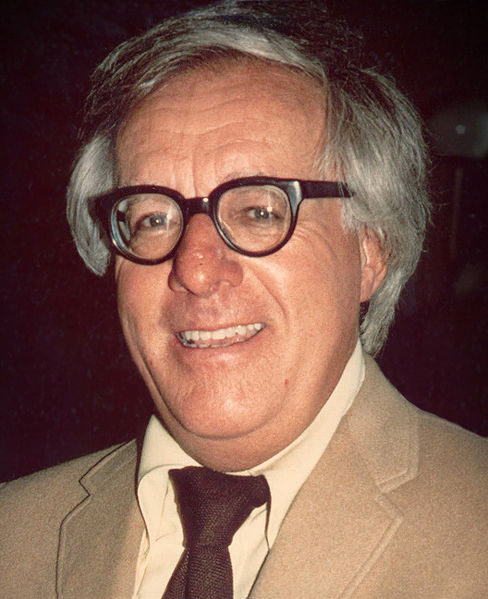
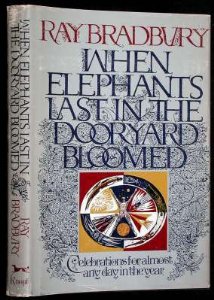
Ray Bradbury’s When Elephants Last in the Doorway Bloomed is a collection of poems in which he writes wistfully about childhood and about inventors, scientist, and explorers, often using religious imagery.

Posted in Liz Rice-Sosne, Photo Essay, Poems/Poetry, Shamanism, Teachers

Traveling to Macchu Pichu

There is something truly wonderful about travel.  I have been blessed in the past to be able to visit a number of other countries.  I have been to Egypt, France, England, China, Mexico, Switzerland, Bolivia, Peru, Spain and I lived in Okinawa for a year.  The Okinawa year was when I was quite young and with a former husband, not a really, really great experience.   David and I never really traveled as Americans.  We have always been aware of the “ugly American syndrome” and truly did not wish to participate in it.   We did not make any reservations other than airline.  Although to be honest, I brought that sort of travel to an end in 1996 when we arrived in Seville without Hotel reservations after having driven from Madrid.  I was 50, it was hot, we were dirty and very tired.  Exhausted, looking for a hotel while driving down streets no wider than the car was not my idea of fun.  But we survived and we were introduced to Tapas.

Travel, if you allow it to do so will open your mind to the rest of the world.  You will see people other than those to whom you are accustomed.  You will see things through their lens.  When visiting ancient cities or ruins should you take the time you can see things through the lens of those who once were.  I believe that travel builds compassion, empathy, sensitivity, mercy and tolerance towards others within the individual traveler.  Traveling is about real connection with another culture.  Visiting Machu Picchu was something that I wished to do since I was 8 years old.  I did not grow up with a television but instead had a subscription to National Geographic Magazine.  How I loved it.  It opened up for me new vistas and made me aware of the world that was “out there.”  I had my first yearnings to connect with others, different from myself.

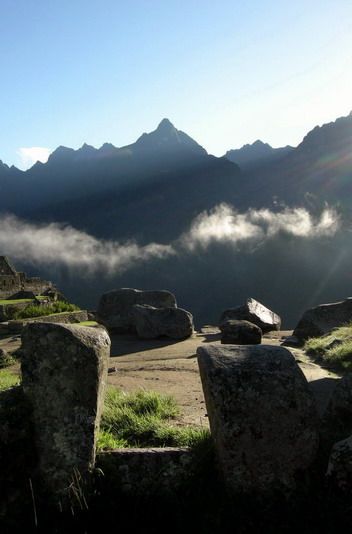
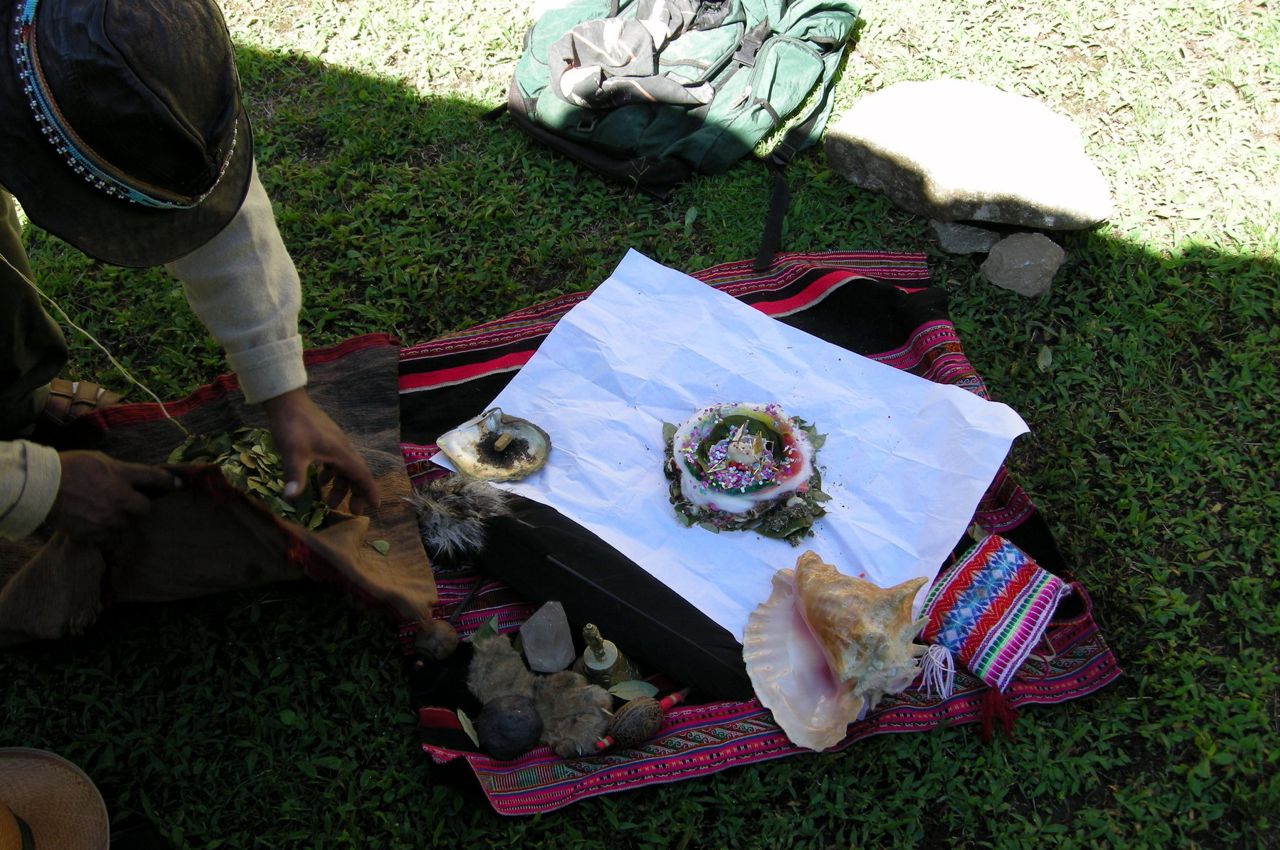
It is difficult to select a favorite trip.  I remember incredible aspects of each country that we have visited.  Below is a poem and  a few photos from one of my favorite trips:  Machu Picchu, Peru.  I was privileged to be able to engage a native shaman while on my trip to Peru.  At Machu Picchu my husband went one way and I another to do ceremony with the shaman.  Later we met up and navigated the mountain.  One of the important things that happened to me while there was that I lost my rapidly growing fear of heights.  The only way up the mountain was by bus.  The road was one bus-wide.  Looking out my window straight down the  mountain face was frightening.   Really frightening!  It was at that point that I said to myself, enough!  I will no longer be afraid of heights!  By the time that I was on top of the mountain my fear was gone.  I knew that this was true when I walked up to the edge of of the plateau and dangled my foot over the edge.  I was so grateful for that loss, it was life changing.

Still, stillness now

Quiet, center … centered now
Go deeply within
yourself.
Slowwwwww … ly
Deeply quiet.
Deep within
Space consummation.
Not hurtling … no, not hurtling towards the void.  But slowly advancing.
Slowwwwly … condense all thought.
Become nothing.
Find
your place
your opening
mo v  v v v e  slowly towards
your opening.  Be still.
Enter.
Slide
down
through
the tunnel.
LAND.  Quietly.
Summon … your Power.
Summon your … Animal.
Let.
Let him/her
Now take you into the void.  Void.  VOID.
CIRCLE … find what you need.
bring it back.  BLOW.
Rattle … feather.
Return now … open, open, open … your … eyes.
6uv MP
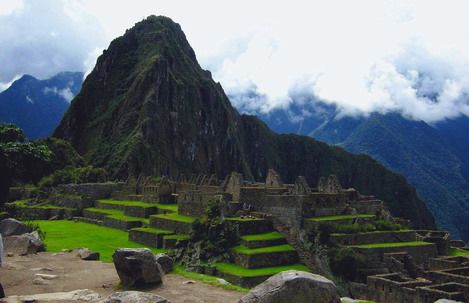
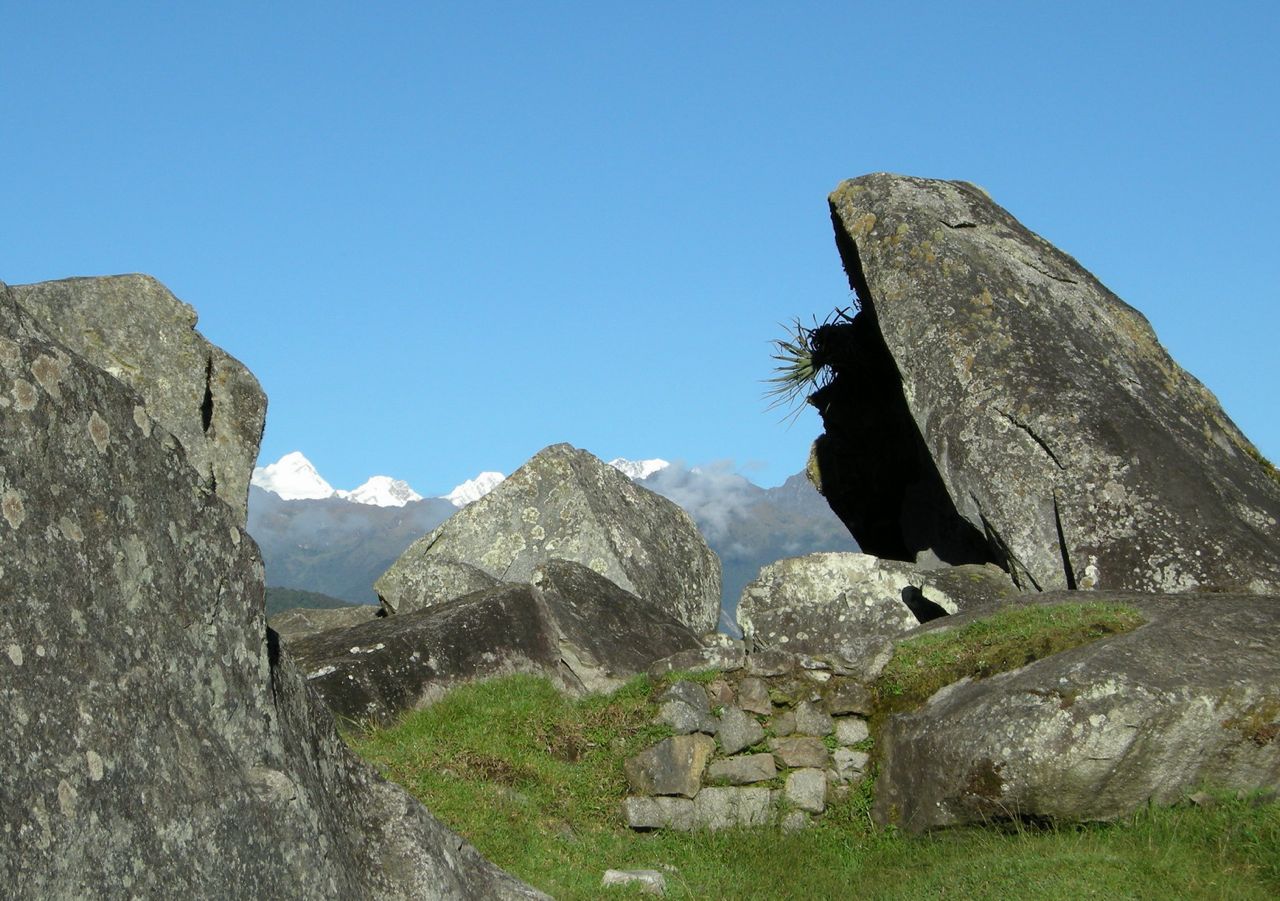
The rocks carved to mimic the mountains in the foreground.
6u MP
Surrounded by the Andes.
14
One could quite literally reach out and grab the clouds.
15
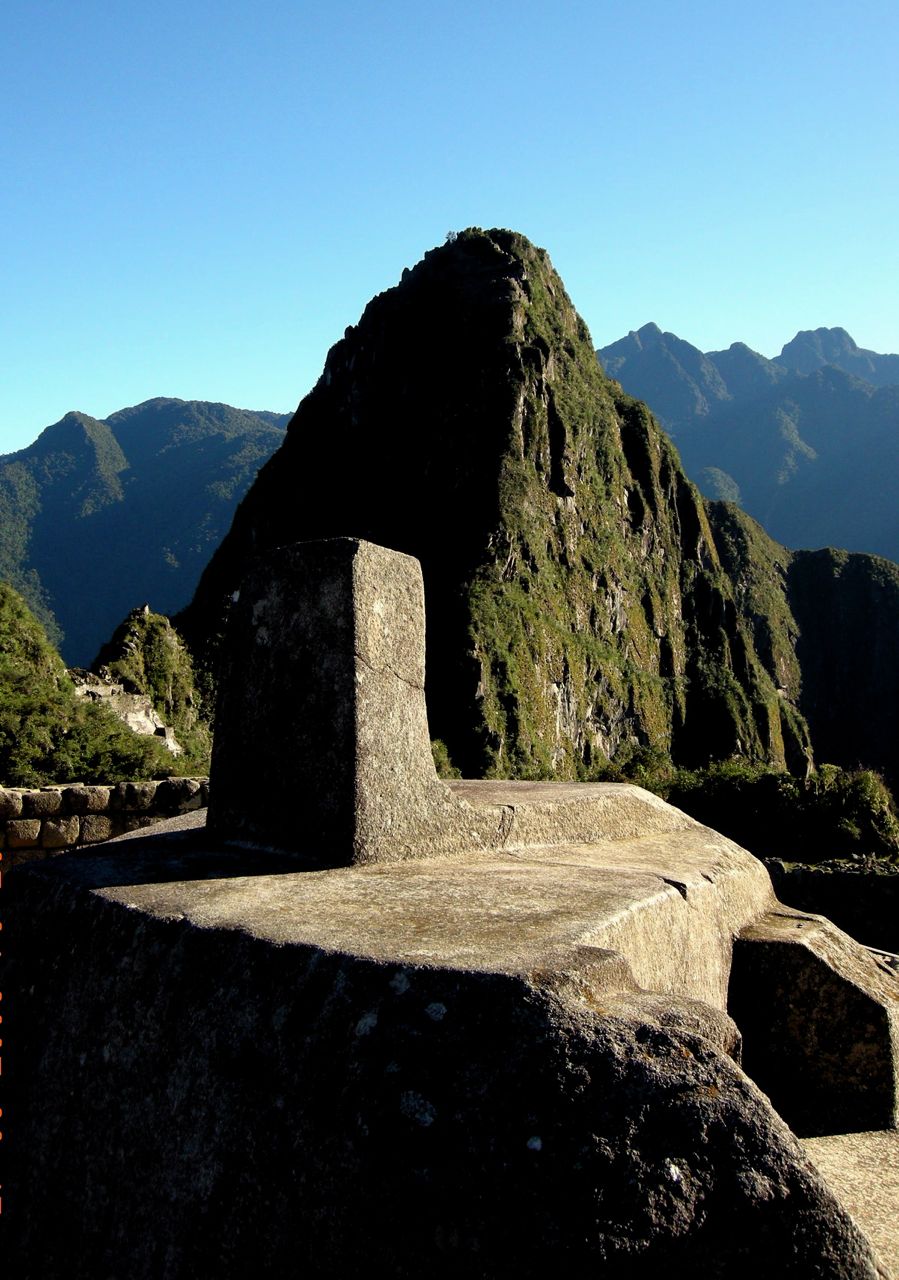
One of the two mountains on top of Machu Picchu.
18
Another view as the day moved forward and the mists lifted.
DSCN0647
Unique perspectives!
DSCN0662
An ancient alter.
MP4
A view of the terracing.
MP 1
Looking down, no longer afraid!
26
Doing ceremony with the Peruvian shaman.
DSCN0523
This is one of my favorite photos.  Rain was upon us.  We took cover in one of the nooks and crannies looking up at the sky covering us all.

– Liz Rice-Sosne

© 2013, essay and photographs, Liz Rice-Stone, All rights reserved

unnamed-2LIZ RICE-SOSNE a.k.a. Raven Spirit (noh where), perhaps the oldest friend to Bardo, is the newest member of The Bardo Group Core Team. She is also our new Voices for Peace project outreach coordinator and our go-to person for all things related to haiku.  She says she “writes for no reason at all. It is simply a pleasure.” Blogging, mostly poetry, has produced numerous friends for whom she has a great appreciation. Liz is an experienced blogger, photographer and a trained shaman. We think her middle name should be “adventure.”

Posted in General Interest, Naomi Baltuck, Photo Essay, Photography/Photographer

A Celebration of Fenestration

The Latin word for window is “fenestra.”  The old English word for window, “eagbyrl,” means “eye-door.”   Just like a door, it can be used for peeking out…

…or peeking in.

Whether you are looking in or out, there are so many things to see, just behind the glass.

The earliest windows were holes in a wall.

Only big enough to let in a bit of light with the cold air, or to shoot an arrow through.

The ancient Romans were the first to use glass.

Then came windows of animal horn or hides, cloth, and in the Far East, even paper.

The Inuit people say, “Don’t let the window of your home be so small that the light of the sun cannot enter.”

Elizabeth Kubler-Ross said people are like stained glass windows.   They sparkle and shine when the sun is out…

…but when the darkness sets in, their true beauty is revealed.

In the Ukraine they say you don’t really see the world, if you look only through your own window.

And what a world there is out there to see!


There is another old saying, “The eyes are the window to the soul.”

…and one that says a smile is a window on your face to show your heart is at home.

The world on either side of your window can be sad…

…distant…

…daunting…

…and scary.

All the more reason to let the light in.

Let your window’s light shine like a beacon…

…and reflect upon the beauty of our world.

All the windows of the world!

All words and images copyright Naomi Baltuck

NaomiPHOTO1-300ppi51kAqFGEesL._SY300_NAOMI BALTUCK ~ is a Contributing Editor and Resident Storyteller here410xuqmD74L._SY300_ at Bardo. She is a world-traveler and an award-winning writer, photographer, and story-teller whose works of fiction and nonfiction are available through Amazon HERE. Naomi presents her wonderful photo-stories – always interesting and rich with meaning and humor – at Writing Between the Lines, Life from the Writer’s POV. She also conducts workshops such as Peace Porridge (multicultural stories to promote cooperation, goodwill, and peaceful coexistence), Whispers in the Graveyard (a spellbinding array of haunting and mysterious stories), Tandem Tales, Traveling Light Around the World, and others. For more on her programs visit Naomi Baltuck.com

Posted in Essay, General Interest, John Anstie

When I’m Sixty-Four

Will you still need me, will you still feed me …

At the time of writing this, when the Beatles and the Stones were playing out yet another rock and roll battle at the Grammy‘s, I was reminded of this song, which, if not their greatest hit, is one of their most memorable because it passes the ‘Old Grey Whistle Test‘.

In the fifty years since their major ‘battles’ for supremacy in the charts, in which these two famous bands were engaged, our life expectancy has increased by almost ten years*. So, the perspective of a young man in the mid-1960’s of someone in the seventh decade of their life, would have been of an old grouch off the end of the scale of life. At sixty-four, however, I find myself with better prospects of success for carrying out my ambitions in retirement, than I would have had fifty years ago.

Life expectancy, the quantity of life, is, whichever way you look at it, merely a statistic and is of little value on its own; we need quality of life as well. I watch as my 95 year old step-mother soldiers on, despite the continual but manageable ailments, with which she has to cope. Her complaints are nothing if not a physical body that is slowly wearing out, but they remind me that old age is not for the faint-hearted. I am conscious of the aches and pains that I have to deal with already, but, in my more insightful moments, I am constantly grateful that they are occasional or, if regular, not chronic (and by ‘chronic’, I mean permanent, lifelong conditions).

Perhaps the most important point about this is the effect that living with illness or pain, be it arthritis or any one of several age related chronic conditions, can severely reduce the quality of our life. I know that I truly have little to complain about, but I am acutely aware that I still, sometimes, have a grumpy disposition, which leads me to appear rude and dissatisfied, even when I know I am not dissatisfied – setting aside a kind of world-weariness that comes from my daily observations of what the human race is up to – but sometimes I need some help not to allow myself to become a grouch, especially with my wife of nearly forty years, who doesn’t deserve it.

If there were a universal prayer that I’d like to say here, it would be: please grant me a greater equanimity and remind me that I should be grateful for the ability, I know I already have, to see and enjoy the beauty, both visible and invisible, which is in so many parts of our lives. Above all, let me not forget to afford the elderly my understanding for them.

Give me your answer, fill in a form
Mine for evermore
Will you still need me, will you still feed me,
When I’m sixty-four?”

Source: England and Wales, Total Population, Life Tables

John_in_Pose_Half_Face3JOHN ANSTIE (My Poetry Library and 42) ~ is a British poet and writer, a contributing editor here at Bardo, and multi-talented gentleman self-described as a “Family man, Grandfather, Occasional Musician, Amateur photographer and Film-maker, Apple-MAC user, Implementation Manager, and Engineer. John participates in d’Verse Poet’s Pub and is a player in New World Creative Union. He’s been blogging since the beginning of 2011. John is also an active member of The Poetry Society (UK).

*****

product_thumbnail-3.php51w-rH34dTL._BO2,204,203,200_PIsitb-sticker-arrow-click,TopRight,35,-76_AA300_SH20_OU01_John has been involved in the recent publication of two anthologies that are the result of online collaborations among two international groups of amateur and professional poets. One of these is The Grass Roots Poetry Group, for which he produced and edited their anthology, “Petrichor* Rising. The other group is d’Verse Poet Pub, in which John’s poetry also appears The d’Verse Anthology: Voices of Contemporary World Poetry, produced and edited by Frank Watson.

Petrichor – from the Greek pɛtrɨkər, the scent of rain on the dry earth.

Posted in Liliana Negoi, Meditation, meditative, Mortality, Story Telling, Photo Story

What seas and bicycles and whiskey have in common

“You can’t cross the sea merely by standing and staring at the water.”

These words belong to Rabindranath Tagore, and they came to my mind while I was actually looking at an over-water bridge that is currently being consolidated in the area where I live. I looked at the bridge this early morning, seeing it for what it is – a connection between the two shores of the river, meant to ease people’s access from one side to the other. And then I realized that the important aspect of Tagore’s quote was not what was said in it, but what it implied: the idea of moving, of doing something. The idea of not waiting for things to come to you, but of trying to reach those things somehow, whether by building bridges towards them, or by getting around the obstructions.

Man learned to cross seas and mountains because of his need for exploring, for moving, for trying to obtain the “better”. Up until now, evolution was not done only by staying still and admiring the circumstances – although, if sitting still means learning and evaluating the pros and cons of an action, it is also called “moving”, in my opinion.

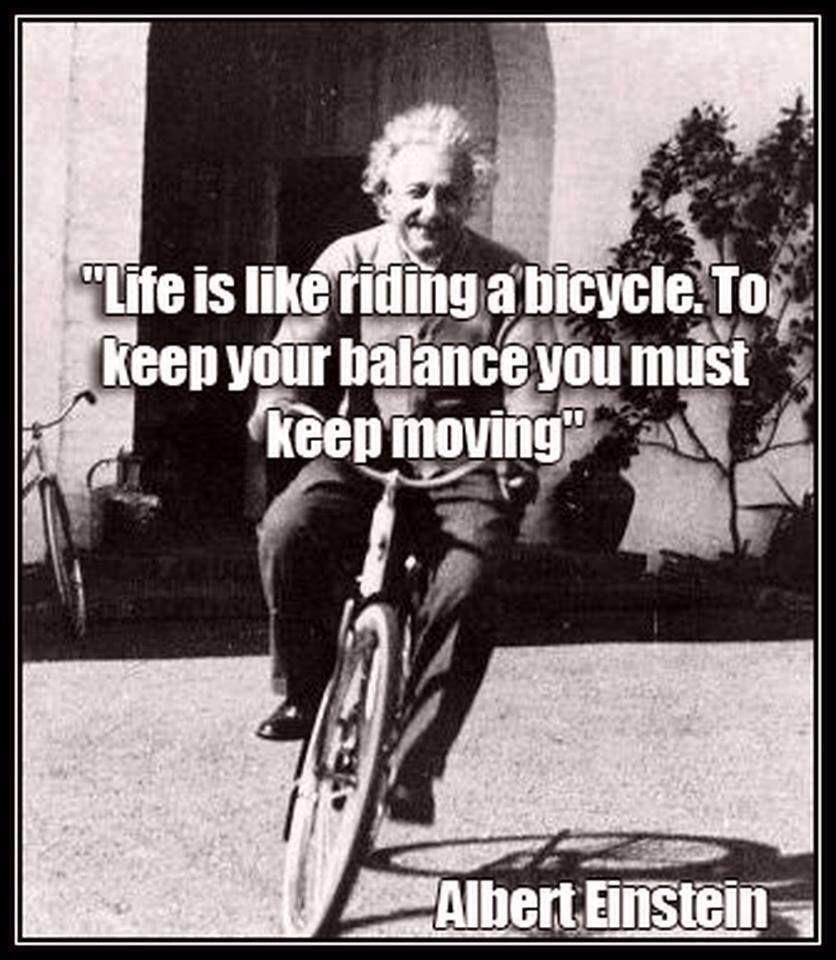
Einstein - movingSeas, waters, obstacles, are always in our paths. Sometimes we see them from a distance, thus having time to prepare for them, other times we wake up right in front of them, and we have to make a decision. And most of the time the decision implies moving – either towards our goal, or away from it. Sitting there and not doing anything about it, although a valid choice, is the worst, because you willingly confine yourself into a dead end. And life is not – or at least it should not be – about dead ends.

“Life is like riding a bicycle. To keep your balance you must keep moving.”

The one who said that was Einstein – and the main word in that quote is the last one, because no matter what happens at a certain point in time, in a specific place, no matter how big the pain, the horror, the joy or whatever the experienced feeling, time, as we, humans, perceive it, continues to flow. Things change. Life goes on – with or without us.

And related to that, I’ll end my pondering with one of the shortest quotes that apply here – Johnny Walker’s “Keep walking”.

© 2014 Liliana Negoi

IMG_7667LILIANA NEGOI  (Endless Journey and in Romanian curcubee în alb şi negru) ~ is a member of our core team on Into the Bardo. She is the author of three published volumes of poetry in English, which is not her mother tongue but one that she came to love especially because of writing: Sands and Shadows, Footsteps on the San – tanka collection and The Hidden Well.  The last one can also be heard in audio version, read by the author herself on her SoundCloud site HERE.  Many of her creations, both poetry and prose, have been published in various literary magazines.
Posted in Bardo News, General Interest

BARDO NEWS: Argentine poet Juan Gelman, Creative Collectives, Year-End Report, Terri Stewart’s work on behalf of homeless and youth

Juan Gelman (1930-2014) Argentine poet, jounalist and activist
Juan Gelman (1930-2014) Argentine poet, journalist and activist

WE SALUTE THE ARGENTINE POET and SOCIAL ACTIVIST, JUAN GELMAN, who died on the 14th in Mexico City where he moved after his exile and lived for the last twenty years.

A bird lived in me.
A flower traveled in my blood.
My heart was a violin.

Gelman was revered in Latin America and in Spain for his work against the junta of Argentina, his subject matter largely addressing injustice and oppression, but he was renowned the world over for his excellence and his ethic. He became a symbol of the “disappeared,” when he began a search for his granddaughter after his son and daughter-in-law were disappeared and killed. If you don’t know his story, you can read it HERE.

Shelley wrote that poets are the protectors of moral and civil laws, “the unacknowledged legislators of the world.” Gelman certainly wrote in just such a spirit.

Professor Ilan Stavens (Amherst College) reads Juan Gelman’s poem End.


Photo credit ~ Presidencia de la Nación Argentina under CC A 2.0 Generic license.

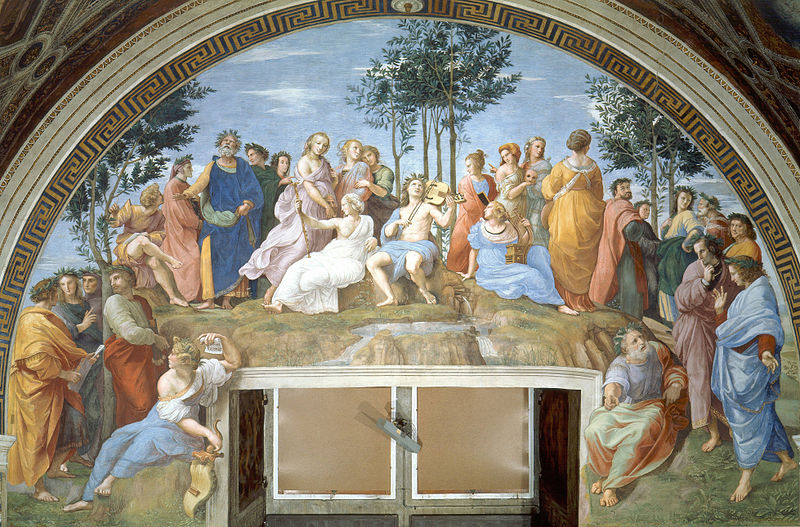
800px-Rafael_-_El_Parnaso_(Estancia_del_Sello,_Roma,_1511)

OUR YEAR-END REPORT FROM WORDPRESS: The concert hall at the Sydney Opera House holds 2,700 people. This blog was viewed over 38,000 times in 2013. If it were a concert at Sydney Opera House, it would take about 14 sold-out performances for that many people to see it. In 2013 there were 354 new posts. There were 412 pictures uploaded, which is about a picture per day. The busiest day of the year was January 18th with 524 views. [LAUNCH AT LAST! … Rhineo & Juliet, Love & Tragedy in Africa – unfortunately the two videos that were included in that post are no longer available for review.]

MORE ON CREATIVE COLLECTIVES: In another Bardo News post we wrote:

We are nurturing a growth that goes beyond the simple idea of “connectivity” to a more productive virtual “proximity” … think in terms of artistic gatherings  – not always formally organized – that you’ve read about and perhaps loved –  Bloomsbury in England or the cafe gatherings of the so-called Lost Generation in Paris of the 1920s or even the Algonquin Round Table in New York, also the 1920s, though we will forego the pranks and practical jokes of the latter.

We received a response to that from a Bardo friend who wishes to remain anonymous: “I had developed some additional thoughts or elaborations I’m passing on to you.

“Prior creative and intellectual movements benefited greatly from geographic proximity. It wasn’t enough to be part of community, but that the community shared and debated some essential values and were in constant contact. The idea is that fervency, serendipity and discovery arise out of actual physical proximity.

“This is why artists still flock to cities. Despite the Internet, we still go to Mecca.

“Connecting technologies have always strengthened the bonds between people with like-minded interests (letter-writing, magazine letter columns, BBS, chatrooms, message boards, social networking, etc), fostering community. But, in the last 40 years, I haven’t seen technology yet truly replicate the creative synergy that occurs with physical proximity.

“Which led to my conclusion: any creative person who is working via connected technologies (Internet, etc), needs to focus on how they can go beyond mere community and replicate the qualities caused by physical, geographical proximity.

“I think those qualities, include:

1. regularly scheduled contact
2. opportunities for random contact
3. an agreement on the values under discussion (not necessarily in agreement on the rightness or wrongness of the values themselves).
4. diversity of interest and perspective on those values.

“Several recent groups are decent examples (these are not necessarily endorsements), including:

• The Beats (rather amorphous really, but SF, NY, and Tangiers at various times)
• The Objectivists (in NY, prior to the broader expansion)
• Maybe, the “Fog City Mavericks” in film; Lucas, Spielberg, Eastwood, Coppola, Kaufman, Zaentz.
• The Inklings
• The Futurians

“Of course, as I read this, I also recognize that the ultimate failure of these groups and collectives was often caused by a descent into orthodoxy that stifled creativity and diversity.”

Hesch ProfileINTRODUCING JOSEPH HESCH (A Thing for Words): Joe joined us as a member of the core team late last year. He is a writer and poet from Albany, New York. Many of his poems and stories are inspired by his almost 400-year-old hometown, but most spring from his many travels between his right ear and his left ear. A former journalist, he’s written for a living more than thirty years, but only recently convinced himself to rediscover the writer he once thought he was. Five years ago, he began to write short fiction. Two years later, in a serendipitous response to a blinding case of writer’s block, he wrote his first poem…ever. He hasn’t looked back.  

Since then his work has been published in journals and anthologies coast to coast and worldwide. He posts poems and stories-in-progress on his blog, A Thing for Words (http://athingforwordsjahesch.wordpress.com/).  An original staff member at dVerse Poets Pub website, he was named one of Writers Digest Editor Robert Lee Brewer’s “2011 Best Tweeps for Writers to Follow.”

Gather AB -1INTRODUCING LIZ RICE-SOSONE a.k.a. RAVEN SPIRIT (Noh Where): Liz is probably the most long-standing friend of Bardo. She guested here on several occasions and late last year joined us as a core team member and as the point person for our Voices of Peace Project. Liz began writing when older and housebound due to illness. HIV/AIDS work was the most rewarding work of her lifetime.  Her animals are the loves of her life.  Her husband is her best friend and also the love of her life.  She received a master’s degree in 2008 in gerontology and creative writing at the age of 62.  She started her second blog Noh Where in 2012.  She has a deep connection to all things Corvid.

terriIF YOU ARE IN THE SEATTLE AREA, TERRI STEWART (Begin Again) is co-hosting “Exploring Spiritual Identity with heART.” It is a mandala exercise facilitated with Julia Weaver at mandalaweaver.com. You can find more about the event athttp://beguineagain.com/events/ .
.
Additionally, let’s celebrate with Terri as she was invited to provide testimony at her state legislature on January 29th. She will provide witness regarding the effect of having confidential juvenile records. Her state does not consider juvenile records confidential and any court proceedings are subject to the open records act. Additionally, the state she lives in sells juvenile records before the youth is even an adult and able to follow the steps to sealing their record. Making the records confidential is a huge step forward in providing peace and justice in the youth’s lives.
.
CHARLIE MARTIN’S BOOK: Bea In Your Bonnet: First Sting is now available through Lulu and Amazon. We all love Aunt Bea and this is a long-awaited volume. Charlie (Read Between the Minds) says:
.
product_thumbnail-4.phpBea In Your Bonnet: First Sting is a collection of germinal poems featuring Aunt Bea. Aunt Bea’s voice is one I’ve heard almost every day of my life. Family observations, lessons, and advice given to me and every other family member who had the good sense to listen. Her homespun philosophy most likely will not be found in any collegiate textbooks or for that matter in any local town crier newspaper catering to city dwellers. Indeed, she has a different way of viewing the world; a bit old fashion, sassy, and steely at times but a viewpoint which has engaged my imagination and heart. I sincerely hope you too will find some morsel of wisdom in her personal observations and interpretations of life’s events, but do watch out for her stingers.”
.
FEBRUARY BLOG EVENTS: Please join us on February 14 for Bloggers in Planet Love. Mr. Linky will be open for 72 hours begining on the 14th. We hope you’ll share your post on nature, environment and environmental protection, food and farming, climate change and any other earthy subject. We welcome all forms of artistic expression: poems and photography, visual and video art, music, fiction, creative nonfiction and essay. We hope that you will also visit the other participants so that we can support one another while we all encourage appreciation and care of this beautiful planet of ours. The next Writers’ Fourth Wednesday prompt with Victoria Slotto (Victoria C. Slotto, Author/Fictionn, Poetry and Writing Prompts) is on February 26th. Thanks to those who joined with us last week. We look forward to seeing your participation again.
.
JAMIE DEDES (The Poet by Day) posted three short stories as Pages on her blog:
  1. The City of Ultimate Bliss, one girl’s faith in the magic of her city to bring her a singular precious bliss.
  2. The Time of Orphaning, “It’s tough when your’e orphaned at seventy,” says the narrator.
  3. Señora Ortega’s Frijoles, a woman shares the dichos (sayings) of her foremothers with her daughter.
JOHN NOONEY’S (Johnbalaya) post, Some Thoughts on Adoption, drew considerable – if quiet -traffic and garnered fifty Facebook “Likes.” We’re thinking maybe there’s potential for a book in the expanded version of the story, John. Just sayiing!
.
GOT NEWS? Please feel free to leave any news you may have in the comments section today. The next Bardo News is scheduled for Sunday, February 23 at 7 p.m. and the deadline for submitting your news is Friday, February 21. If you have news you’d like shared in that post, please leave a message in the comments section of any post between now and then and someone will get back to you. Thank you!
.
Thank you for your readings, writings, sharing, “Likes,” and comments. All valued, as are you.
.
With loving kindness,
– The Bardo Group