Posted in General Interest, Guest Writer, Imen Benyoub, Music, Peace & Justice, Poems/Poetry

Music, Language of the Soul: the second in a series from Imen Benyoub on music in the context of war and occupation

The first post in this series is HERE.
10423604_519811371480762_878196538_n
Music, the language of the soul
The cultural Intifada*…From stones to musical instruments.
The story of Ramzi Abu Radwan.

They impressed the world
And all they had in their hands were stones
They lit like lanterns, and came like messengers
From “children of the stones” Nizar Quabbani (1923-1998), Syrian poet and publisher

The first Intifada is the Palestinian uprising against the Israeli occupation that started on December 1987 in Jabalia** refugee camp and spread throughout the rest of Gaza, the West Bank and East Jerusalem. It lasted six years until the signing of Oslo Accords in 1993.

It was an unarmed, spontaneous yet exploding uprising, men with their faces covered with keffiyehs***, women and children with nothing but stones, slingshots and Molotov cocktails faced tanks and live ammunition of well-trained, heavily equipped Israeli soldiers.

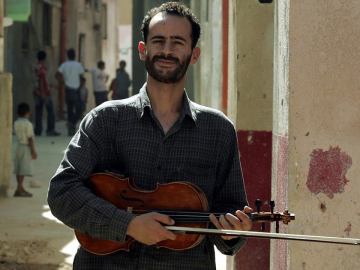
10423556_519811321480767_1963506964_aOne of those children, a kid wearing blue jeans and a red jacket whose picture reached the world newspapers became a legendary symbol of the Intifada, a skinny kid throwing stones at an army jeep, his eyes welled with tears, on his face a mixture of anger, fear and defiance. This kid, whose picture was reproduced in posters all over the world as an icon of the uprising, never knew that his destiny will change forever and he will become a visionary artist.

This was Ramzi Aburadwan, born in Bethlehem in 1979, he spent his childhood and first teenage days in a refugee camp in Ramallah where his family was forced to live after the Nakbah****, his best friend died on their way home from school during a military operation, he was eight when a journalist took a picture of him hurling stones and was later called “the iconic child of the Intifada”.

Ramzi was introduced to music at the age of 17, when a woman invited him to attend a course, he immediately loved it and this was the beginning of his journey with music.

After a year of study in the Edward Said National Conservatory of Music at Birzeit University, he received a scholarship to study in a Conservatoire in France; on 2005 he went back to Palestine after graduation with dreams and promises of a brighter life for children.
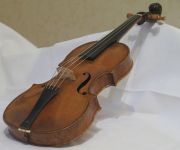
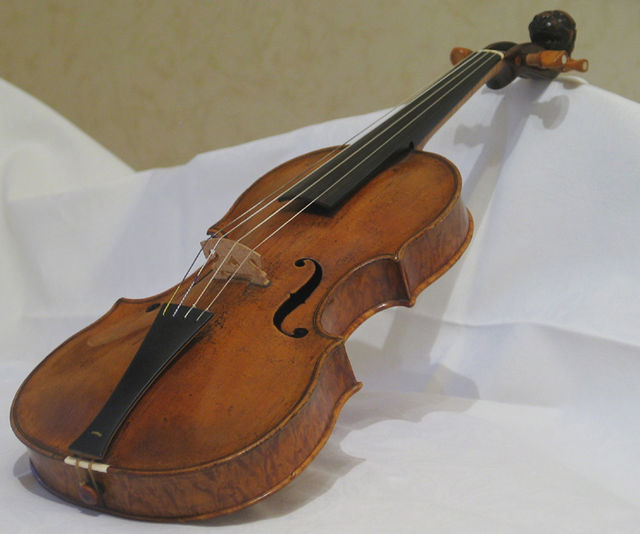
640px-StainerThe multi-talented Aburadwan founded Al Kammanjati*****, a nonprofit organization that offers children especially from refugee camps music lessons, its aim is to keep them in touch with their cultural heritage, develop and nurture their skills and create an intimately entertaining atmosphere away from the violence and frustrations of their daily life under occupation. It gave them a precious chance to travel, play with different orchestras and meet young musicians from all over the world. Classical music is also introduced as a valuable weapon in the so called “the cultural Intifada” a peaceful way of resistance to save Palestinian culture and identity through letters, art and musical notes, something Palestinians began to understand with time because of Israeli policy of extensive judaisation of the land and fierce attempts to bury and distort Palestinian history and heritage.
He takes part in the West Eastern Divan Orchestra directed by Israeli-Argentine born conductor and pianist Daniel Barenboim who said about him:

“Aburadwan has transformed not only his life, his destiny but that of many, many, many other people, this is an extraordinary collection of children all over Palestine that have all been inspired and opened to the beauty of life”

Al Kammanjati was honoured by “prince Klaus award” from the Netherlands in 2006.

* Intifada: Arabic word for “uprising”-Bethlehem, Ramallah: Palestinian cities in the West Bank.
**Jabalia: a refugee camp in the North of Gaza.
***Keffiyeh: a traditional black and white Middle Eastern cotton scarf, later considered a symbol of Palestinian nationalism and solidarity
***Bethlehem, Ramallah: Palestinian cities in the West Bank.
****Nakbah: Arabic word for “catastrophe” refers to the mass expulsion of more than 750.000 Palestinians from their lands in 1948 and creating a state of Israel on the occupied land.
****
*Al Kammanjati: Arabic word for “the violinist”

Trill_example_ornaments

A concerto for stone and violin:

The story of this generous musician and fighter inspired me to write this poem

A Poem for Ramzi Abu Radwan

The meditation of stone
In my hand
Is my song of freedom
That even your bullets
Can never pierce

Look at me
I am the child of the Intifada
These Palestinian hands
That were uprooted from my village
Like olive trees
And grew up in a camp
Small and scratched
will braid another song
From strings of a violin

Years pass
And the weeping violin
In my exiled soul
Will always remain
My song of freedom
That even your oppression
Can never silence

– Imen Benyoub


A portrait of the man:

The man’s music:

© 2014, essay and poem, Imen Benyoub, All rights reserved; Photograph (1) Ramzi Abu Radwan, adult and child, courtesy of Mr. Abu Radwan and ramallah cafe; photo of violin courtesy of Frink54 via Wikipedia under CC BY-SA 3.0; musical notations courtesy of Sprouls via Wikipedia under CC BY-SA 3.0.

pictureIMEN BENYOUB ~ is a multilingual, multi-talented writer, poet, and artist from Guelma, Algeria. Imen currently lives in East Jerusalem. She is a frequent guest here on The Bardo Group blog and with On the Plum Tree and Plum Tree Books Facebook page as well.

Posted in Buddhism, General Interest, Jamie Dedes, Peace & Justice

The Garden of My Heart

With all the strife in the world now, it seems a good thing to post something healing and peaceful.

Thich Nhat Hanh (b. 1926) Zen Monk, Dharma Teacher, Social Activist, Writer, Poet, Peacemaker

Thich Nhat Hanh is now recognized as a Dharmacharya and as the spiritual head of the Từ Hiếu Temple and associated monasteries. On May 1, 1966 at Từ Hiếu Temple, Thich Nhat Hanh received the “lamp transmission”, making him a Dharmacharya or Dharma Teacher, from Master Chân Thật. MORE [Wikipedia]

Though a Zen Buddhist monk, Thich Nhat Hanh combines traditional Zen with techniques from Theravada Buddhism, the wisdom of the Mahayana tradition, and ideas of modern Western psychology to teach meditation and spiritual values and practices in a way that resonates for people from diverse religious, political, and cultural backgrounds. He is a writer, poet, and peacemaker with over one-hundred books published, many in English. He was suggested for the Nobel Prize for Peace by Dr. Martin Luther King, Jr. in 1967. He was nominated again 2013.

Since 1966, Thich Nhat Hanh has lived in exile. Based at Plum Village, a meditation community in the south of France, he is a leading Buddhist teacher, encouraging engaged Buddhism, a movement for social activism that he founded. He organizes and supports many worthwhile humanitarian efforts.

Thich Nhat Hahn coined the term “interbeing,” a pointer to the Buddhist principles of impermanence and non-self, which bring light to the idea and ideal of the inter-connectedness of all things. He founded The Order of Interbeing, the members of which include lay people. Link HERE to brief summaries of each of the fourteen mindfulness trainings of the Order of Interbeing.

“If in our daily lives we can smile, if we can be peaceful and happy, not only we, but everyone will profit from it. If we really know how to live, what better way to start the day than with a smile? Our smile affirms our awareness and determination to live in peace and joy. The source of a true smile is an awakened mind.” ~ from Peace is Every Step by Thich Nhat Hanh

Here is  a meditative interlude. The title of this post is a quote from the meditation, which is an excerpt from an album called Graceful Passages: A Companion for Living and Dying. It features spiritual teachers from many traditions offering advice to the dying … in other words, advice to all of us.

Photo on 2014-03-31 at 17.16 #3unnamed-18JAMIE DEDES (The Poet by Day)~I am a medically retired (disabled) elder and the mother of married son who is very dear. I started blogging shortly after I retired as a way to maintain my sanity, to stay connected to the arts and the artful despite being mostly homebound. My Facebook pages are: Jamie Dedes (Arts and Humanities) and Simply Living, Living Simply.

With the help and support of talented bloggers and readers, I founded and host The Bardo Group because I feel that blogging offers a means to see one another – no matter our tribe – in our simple humanity, as brothers and sisters and not as “other.”

“Good work, like good talk or any other form of worthwhile human relationship, depends upon being able to assume an extended shared world.” Stefan Collini (b. 1947), English Literary Critic and Professor of English Literature at Cambridge

Posted in General Interest, Humor, Peace & Justice, Perspectives on Cancer

stalking the wild tombstone

This slideshow requires JavaScript.

The six-acre Historic Union Cemetery in Redwood City, California runs unobtrusively along Woodside Road where it sits adjacent to a plant nursery and is bordered on other sides by boring boxy 1960s housing. The cemetery was established in the mid-nineteenth century and is inhabited by – among others – soldiers of the American Civil War who died after they were mustered out and members of the sadly depleted but happily still extant Metamora Native American Tribe. No surprise this: the cemetery is said to be haunted. If so, our delightful afternoon of stalking the wild tombstone, while fun for us, was apparently of little interest to the inhabitants. The day was uneventful. I was test-driving a modest digital camera, which was new to me that week and died not long after this expedition.

© 2011, words and photographs, Jamie Dedes, All rights reserved


kif_0858-1Photo on 2014-03-31 at 17.16 #3JAMIE DEDES (The Poet by Day)~ I am a medically retired (disabled) elder and the mother of a married son. The graces of poetry, art, music, writing and reading continue to evolve as a sources of wonder and solace, as creative outlets, and as a part of my spiritual practice. My Facebook pages are: Jamie Dedes (Arts and Humanities) and Simply Living, Living Simply.

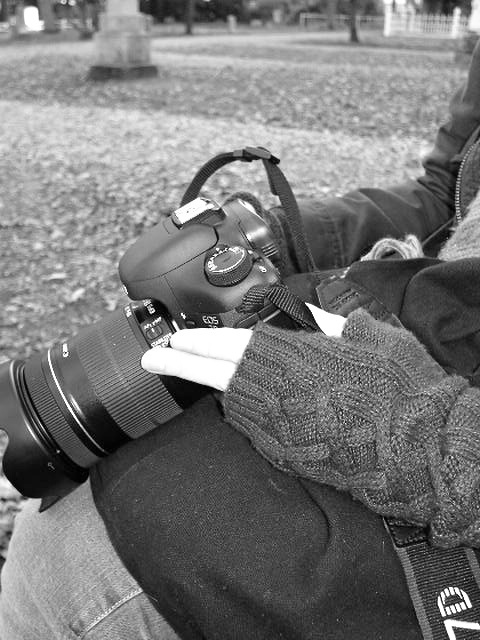
The photograph to your right, Portrait of a Photographer is a portrait of my friend and fine art photographer, Wendy Alger. I guess it might be more correct to say it’s a portrait of the camera not the photographer, though it was meant to capture the spirit in which Wendy works. I took the photograph some years ago during out trek through Historic Union Cemetery in Redwood City, California. Wendy pursued her art and I was chauffeur and tag-along doing the best I could. My own portrait here is a selfie captured using the photo feature on my MacBook. Happy interNational Photography Month.

Posted in Culture/History, General Interest, Guest Writer, Imen Benyoub, Music, Peace & Justice

Music, Language of the Soul

1912340_522627457840294_1074926792_n

“Music is…a higher revelation than all wisdom and philosophy”
Ludwig Van Beethoven.

Sarajevo under siege…a city in ruins that wakes up on the sound of shelling and bombing and sleeps on that of mourners. This beautiful city, so rich in history, architecture and art suffered the horrors of a four years siege considered the longest in modern history, and became Europe’s capital of hell since the war broke in 1992, to coincide with another atrocious civil war that broke in my own country and lasted almost ten years, what we Algerians know as “the dark decade”.

At 4 pm on May 27, people were queuing in front of a bakery in Sarajevo for bread; a mortar shell dropped in the middle and killed 22 people instantly. A man witnessed the massacre and was so appalled by the sight of blood and torn bodies so he decided to do something.

This man was Vedran Smailović, a widely recognized and talented cellist who went everyday for 22 days to the bombed site the exact time of the massacre and played cello, in honour of those who died in front of him and all of the victims, all those hiding from snipers’ bullets, the refugees, the hungry, the wounded, the destroyed homes and for his smouldering, exhausted city that struggled to survive.

This man sent a prayer of peace through his music, that the city of his heart might witness a brighter future, and he became the symbol of peace all over Bosnia, playing in graveyards and bombed sites, despite the shelling and fired bullets, Smailović was engulfed by light, the light of hope he was spreading all over the battered city. No crowd applauding to his performance, just Angels protecting him.

It’s been years since the dreadful siege and the civil war in my country ended, but did Sarajevo recover from its dark past? Did my people ever forget? the victims, the mass graves, and the fear they lived in all those years…

We are never entirely healed of our memory.

Al Yarmouk refugee camp in Damascus Syria, another Sarajevo, another siege, people dying from a severe lack of food, water and medical supplies, massive destruction of homes and buildings, for weeks the Government forces besieged the camp and starved its people on purpose, the majority of them Palestinians who were exiled from their country in 1948, they found themselves caught against their will in a merciless war that made Damascus, a beautiful and rich city…Middle East’s capital of hell.

History repeats itself, it always strikes me how it does, and not always in the gentlest way, I believed it with all my being when I saw young men with a battered piano in the middle of rubble playing music and singing for peace and freedom, I said: if Vedran Smailović could see those proud and defiant guys whose souls are connected to his, one of them a pianist who started playing since he was six, he used to repair musical instruments with his father and studied music in the university of Homs*, the others, just ordinary people praying for the end of the war, and dreaming of a safe united country again in their own way.

They sang: “Oh displaced people, return; the journey has gone for too long. Yarmouk we are a part of you and that will never change.”

Smailović would have loved what those Palestinians did, because he, of all people will understand the meaning of creating beauty amid destruction, and defying death with the language of the soul…Music

(I would secretly thank that man who set up his piano in front of armed police, a day after protesters in Kiev brought down the statue of Lenin, and played Chopin…he inspired me to write this post)

*Homs: a Syrian city

Editorial note:  A partial translation of the song and apologies for any inaccuracy.
“from among the ruins and under the ashes, the [Palestinian] phoenix sings for life and will rise again for the cause of freedom …”

– Imen Benyoub

© 2014, essay, Imen Benyoub, All rights reserved; photo credit ~ Rashid Essa (Almadon News), youth in Al Yarmouk Refugee Camp, ” © electronic cities” under CC A-SA, no modification to photograph is allowed

.

pictureIMEN BENYOUB ~ is a multilingual, multi-talented writer, poet, and artist living in Guelma, Algeria. She is a regular contributor to Into the Bardo and to On the Plum Tree and Plum Tree Books Facebook page.

Posted in Imen Benyoub, Peace & Justice, Poems/Poetry, poetry

Elegy to Damascus


Arabian Jasmine (another name for Damascus is City of Jasmine)

He writes with a wounded language
He is a stranger
The alphabet bleeds when it’s heavy with memory
And poems will always taste
Of dry blood

Everything wounds him
In his naked solitude
Light wounds his face
A wing of a dove and a passing cloud
Wound his orphan shoulder

He writes and his wound becomes a full moon
That bleeds white in the darkness of his exile
It becomes a silk road where he travels alone
He rubs its sides with salt
And adorns it with statues
White as his pain

His wound is an unanswered prayer
His wound is a city
*****
Streets of Damascus, streets of the heart
Minarets and church bells mourn
O bride of the East with your veil soaked in blood

Your face is a dusty cracked mirror
Your womb is full of thorns

Somewhere
A poet dreams of his childhood house
His mother’s bread
His father’s prayer carpet
And the smell of henna and rose water
On the hands of a woman

He doesn’t know that his house is a graveyard
And Damascus is no longer pregnant with jasmine

– Imen Benyoub

 ©2014, poem, Imen Benyoub, All rights reserved

Photo credit ~ via Wikipedia by Scott Zone under CC A 2.0 Generic license

.

pictureIMEN BENYOUB ~ is a miltilingual, multi-talented writer, poet, and artist living in Guelma, Algeria. She is a regular contributor to Into the Bardo and to On the Plum Tree and Plum Tree Books Facebook page.

Posted in Essay, General Interest, John Anstie, Peace & Justice

The Value of Life

Word art image by John Anstie via 'Cloudart'
Word art image by John Anstie via ‘Cloudart’

This year marks the centenary of the beginning of a war that should have ended all wars. My thoughts for this piece were inspired, nay possibly provoked, by commentary from two recent sources.

The first was an item on the BBC’s Newsnight. This was a contention by some commentator that the perspective of the horrors of the Great War had swung “too far to the left”!

The second came from somewhere inside those compartments of my brain that store data from my professional life in commerce and trade. It relates to how successful companies aim to keep the balance sheet healthy (and the shareholders or directors happy).

It doesn’t matter which political regime is in government – left, centre or right – we keep going to war, somewhere in the world, for some reason, the truth of which is often illusory. So, whichever social, political or historic perspective we decide to adopt to absolve ourselves of the guilt, brought on by the inhuman horror of war, it alters neither the fatal results on the lives of so many, nor its lasting and damaging effects on the survivors and future generations.

Any company, developing a new product for market, will want it to succeed in the market. If the product fails to sell in sufficient quantities or survive against the competition, then would they carry on producing it and pushing it into the market, expending their valuable resources on a failing campaign? The answer is a resounding NO! They would either review and redevelop the product, remodel its placement in the market or withdraw it altogether!

An army, like a commercial company, has as its main resource what any organisation should value most, it’s people. Their operations in the field have to be managed in a way that ensures the highest probable success at the lowest possible cost. So the generals (and their political masters), who presided over operations at the front in the First World War, failed! It still hurts now, even after nearly one hundred years, that, by any measure, the obscene loss of young lives in that war was a failure on a catastrophic scale. However great was the threat that existed from Central Europe’s ‘Triple Alliance’ (Germany, Austria-Hungary and Italy), they could have managed that threat with far better strategy, better tactics.

Surely few could have foreseen the horrors that would follow but, years later, with countless tomes of historical reportage, documentary … and some of the most poignant poetry ever written … there comes a time for reconciliation; a time for present leaderships to face the truth, admit their predecessors were wrong and apologise to the descendants of all those lost and hurt by such bad management. I think it is important for any civilisation, if it is not to descend into a dark Orwellian future, if it’s peoples are not to be subjugated by fear of war, foreign invasion and death, that its leadership, regardless of political colour, must be able to stand up and face the truth, admit their failures and apologise for taking us to war, any war! We all need to seek truth and reconciliation.

It has been said that we should not ‘celebrate’ but rather ‘commemorate’ the First World War at its anniversary. I disagree. I believe we should celebrate it, which means that, once we acknowledge it was a complete failure because of its decimation of life, it should serve as an unforgettable beacon that we will always celebrate for reminding us of the value of life.

© 2014, John Anstie, All rights reserved

John_in_Pose_Half_Face3JOHN ANSTIE (My Poetry Library and 42) ~ is a British poet and writer, a contributing editor here at Bardo, and multi-talented gentleman self-described as a “Family man, Grandfather, Occasional Musician, Amateur photographer and Film-maker, Apple-MAC user, Implementation Manager, and Engineer. John participates in d’Verse Poet’s Pub and is a player in New World Creative Union. He’s been blogging since the beginning of 2011. John is also an active member of The Poetry Society (UK).

* * * * *

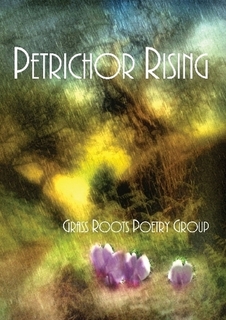
product_thumbnail-3.php51w-rH34dTL._BO2,204,203,200_PIsitb-sticker-arrow-click,TopRight,35,-76_AA300_SH20_OU01_John has been involved in the recent publication of two anthologies that are the result of online collaborations among two international groups of amateur and professional poets. One of these is The Grass Roots Poetry Group, for which he produced and edited their anthology, “Petrichor* Rising. The other group is d’Verse Poet Pub, in which John’s poetry also appears The d’Verse Anthology: Voices of Contemporary World Poetry, produced and edited by Frank Watson.

Petrichor – from the Greek pɛtrɨkər, the scent of rain on the dry earth.

Posted in Jamie Dedes, Peace & Justice, Poems/Poetry

I Want To Make It Sane Again

file0001824554659what must it be like for you in your part of the world?

there is only silence, I don’t know your name, i know only
that the fire of life makes us one in this, the human journey,
search and return, reaching for the sun, running through mud

walking the gauntlet without a prayer or a blessing

our eyes meet in secret, our hearts open on the fringe,
one breath and the wind blows, one tear and seas rise,
on the street where you live, your friends are all gone

the houses are crushed and the doves have flown

there is only silence, no children playing, no laughter
here and there a light remains to speak to you of loneliness,
my breath caught in my throat, i want to make it sane again

“Sometime they’ll give a war and nobody will come.”
Carl Sandburg (1878-1967), American poet, writer, and editor

– Jamie Dedes

©2013, poem, Jamie Dedes, All rights reserved, Photo courtesy of morgueFile

photo-on-2012-09-19-at-19-541JAMIE DEDES (The Poet by Day)~ I am a mom and a medically retired (disabled) elder. The graces of poetry, art, music, writing and reading continue to evolve as a sources of wonder and solace, as a creative outlet, and as a part of my spiritual practice.

Posted in Charles W Martin, Nelson Mandela, Peace & Justice, Photography/Photographer, poem, poetry

mandela…

mandela

once
or twice
in a lifetime
an ancient returns
showing
the way
not
as a prophet
or
god-like figure
but as
a man
or
a woman
willing to expend
all their life forces
to open
the minds
of all those
willing
to listen
and
do
as they
have done
the world
always
sees
them
and
offers up
great praise
so
when they die
mourners
shed tears
in the rain
but
the world
quickly
loses its way
in the fog
of greed
until
the next
ancient
is
reborn

.
678ad505453d5a3ff2fcb744f13dedc7-1product_thumbnail.php41V9d9sj5nL._SY344_PJlook-inside-v2,TopRight,1,0_SH20_BO1,204,203,200_CHARLES W. MARTIN (Reading Between the Minds) — earned his Ph.D. in Speech and Language Pathology with an emphasis in statistics. Throughout Charlie’s career, he maintained a devotion to the arts (literature/poetry, the theater, music and photography). Since his retirement in 2010, he has turned his full attention to poetry and photography. He publishes a poem and a photographic art piece each day at Read Between the Minds, Poetry, Photograph and Random Thoughts of Life. He is noted as a poet of social conscience. Charlie has been blogging since January 31, 2010. He has self-published a book of poetry entitled The Hawk Chronicles and will soon publish another book called A Bea in Your Bonnet: First Sting, featuring the renown Aunt Bea. In The Hawk Chronicles, Charlie provides a personification of his resident hawk with poems and photos taken over a two-year period. Charlie’s lastest book, When Spirits Touch, Dual Poetry, a collaboration with River Urke, is available through Amazon now.

Posted in Christianity, Essay, Jamie Dedes, Peace & Justice

THE TIPPING POINT: Good will from and toward women and men everywhere!

Nativité_de_CostaThis is simultaneously blogged on Rev. Terri Stewart’s blog and my own personal blog.

Today begins the first day of our Terri Stewart’s Advent event. There are many bloggers participating in this event. Each day of the Christian celebration of Advent will be sponsored by a different blogger who will post appropriately on his or her site. Their posts will also go up on Terri’s site and the kick-off is on Into the Bardo today.

If you follow Into the Bardo  regularly, you know that we share work here that is not necessarily religious but is reflective of diverse cultures and spiritual paths and representative of universal human values, however differently they might be expressed. This is a space where we hope you’ll delight in learning how much you have in common with “other” peoples.

We acknowledge that there are enormous theological differences and historical resentments that carve wedges among and within the traditions, but we believe that ultimately self-preservation, common sense, and human solidarity will empower connections and collaboration and overcome division and disorder. We work for the tipping point when compromise – an admittedly imperfect peace – will overcome war and respect for life will topple resentment. That may not happen in our time, but it has to start somewhere and sometime and this is our modest contribution toward an end for which diverse people the world over are working.

For those who are not Christian, Advent is the period of time leading up to the Nativity of Christ (Christmas). It is celebrated somewhat differently by different Christian sects and by Roman and Eastern Catholics and Eastern Orthodox churches. I think the details of the celebrations are less important than the scriptural quote for the day …

James 4:1-3
1 Those conflicts and disputes among you, where do they come from? Do they not come from your cravings that are at war within you? 2 You want something and do not have it; so you commit murder. And you covet something and cannot obtain it; so you engage in disputes and conflicts. You do not have, because you do not ask. 3 You ask and do not receive, because you ask wrongly, in order to spend what you get on your pleasures.

Indeed, where do the conflicts and disputes originate: in the cravings that make us restless within ourselves, in coveting things or situations we don’t have (and may not really need), and in not using right means for just ends? These are appropriate considerations as we approach the annual celebration of the “Prince of Peace,” a celebration which is in the end a call for compassion and understanding.

May our compassion have legs.

PEACE ON EARTH
The tipping point:
GOOD WILL FROM AND TOWARD WOMEN
AND MEN EVERYWHERE!

… and Happy Thanksgiving and Happy Hanukkah to those who are celebrating  …

Follow the entire Advent season
with Terri Stewart HERE.

… If you are so inclined, we would be grateful to have this post reblogged. Thank you! …

– Jamie Dedes

© 2013, essay, Jamie Dedes, All rights reserved
Photo credit ~ Pramzan via Wikipedia under CC A-SA 3.0 Unported 2.5 Generic, 2.0 Generic, 1.0 Generic license

Photo on 2012-09-19 at 20.00JAMIE DEDES ~ Poetry remains a gift in disability and medical retirement. It’s a compact thing that I can still manage. I am the founder and host of Into the Bardo, a spirited international collaborative of word-play, music, art and photography where our core team members function independently and yet with a remarkable synergy. They do everything. They are the stars. I have simply created a space in which to share.

For the past five years I’ve blogged at The Poet by Day, the journey in poem, formerly titled Musing by Moonlight (hence the url). Poetry is my spiritual practice.

Posted in Peace & Justice

From Weaponry to Livingry

164265_234820096661258_1944501766_n

Hunger kills more people every year than AIDS, malaria and tuberculosis combined.

The following statistics are courtesy of the United Nations World Food Programme.

* 842 million people in the world do not have enough to eat. This number has fallen by 156 million since 1990.

* The vast majority of hungry people (827 million) live in developing countries, where 14.3 percent of the population is undernourished.

* Asia has the largest share of the world’s hungry people (some 552 million) but the trend is downward.

* If women farmers had the same access to resources as men, the number of hungry in the world could be reduced by up to 150 million.

* Poor nutrition causes nearly half (45%) of deaths in children under five – 3.1 million children each year.

* One out of six children — roughly 100 million — in developing countries is underweight.

* One in four of the world’s children are stunted. In developing countries the proportion can rise to one in three.

* 80 percent of the world’s stunted children live in just 20 countries.

* 66 million primary school-age children attend classes hungry across the developing world, with 23 million in Africa alone.

* WFP calculates that US$3.2 billion is needed per year to reach all 66 million hungry school-age children.

“God is a verb not a noun.” Buckminster Fuller

May our compassion have legs.

Related articles:

* 2013 World Hunger and Poverty Facts and Statistics by World Hunger Education Service

* An End to World Hunger, Hope for the Future

* How to Help Typhoon Haiyan Survivors

* Help Syrian Refugees

Illustration ~ most likely thelivingmoon.com or, if it’s yours, let us know and we will credit you or take it down. 

– compiled by Jamie Dedes

Posted in John Anstie, Peace & Justice, Poems/Poetry

Hearts of Oak

poppy-fieldThis is primarily for Remembrance Day, at the 11th hour of the 11th day of the 11th month, the Armistice. It speaks not just, as used to be so often the case, those who gave up their lives in war, but for all those countless others, from civilian and service life, who suffered as a result of war, their lives damaged in so many different ways.  It begs the question: “what is the point of war?”

In all that’s written of this day
I will say only this:
for every single life that’s lost
hereafter may be bliss,
but not the kind of bliss that you
can feel of heavenly truth,
those dreamy summer days that lost
the innocence of youth.

It isn’t here that rapture’s found
nor magic hearts of oak.
Instead, to free the body’s hurt
and love of life that broke,
in time, the route from suffering,
when they could fight no more,
was caring for their brotherhood,
and yielding life to war.

How soon forgot the agony,
the torture of their ends
and freeing them from all the tears
that tragedy portends.
By all the loved ones left behind
a lasting price is paid.
For they must live with pain of loss,
their own release delayed.

By all the soldiers left behind
another price is paid.
For they must live with damaged soul
a mind forever frayed.
So on remembrance day be sure,
when you recall the lost,
remember too the broken soul,
their bliss a greater cost.

– John Anstie

© 2013, poem, John Anstie, All rights reserved
Photo credit ~ Martin Birkin, Public Domain Pictures.net

John_in_Pose_Half_Face351w-rH34dTL._BO2,204,203,200_PIsitb-sticker-arrow-click,TopRight,35,-76_AA300_SH20_OU01_JOHN ANSTIE (My Poetry Library and 42) ~ is a British poet and writer, a contributing editor here at Bardo, and multi-talented gentleman self-described as a “Family man, Grandfather, Occasional Musician, Amateur photographer and Film-maker, Apple-MAC user, Implementation Manager, and Engineer.  John participates in d’Verse Poet’s Pub and is a player in New World Creative Union. He’s been blogging since the beginning of 2011. John is also an active member of The Poetry Society (cover1UK).

John has been involved in the recent publication of two anthologies that are the result of online collaborations among two international groups of amateur and professional poets. One of these is The Grass Roots Poetry Group, for which he produced and edited their anthology, “Petrichor* Rising. The other group is d’Verse Poet Pub, in which John’s poetry also appears The d’Verse Anthology: Voices of Contemporary World Poetry, produced and edited by Frank Watson.

Petrichor – from the Greek pɛtrɨkər, the scent of rain on the dry earth.

Posted in A.V. Koshy, Peace & Justice, Poems/Poetry

My Wish for Peace

Mars, God of War
Mars, God of War

I write late
and for nothing
for no reason other than my love for writing
and my wish for peace
and no war
I write thinking of the pride of the young
when they become soldiers
Everybody loves a soldier
Then comes the call
Mankind let us fight only in games
and on virtual screens
Let us kill each other only in 3D, if need be
if violence must be and mayhem and carnage
Dissolve the armies
but I know no one will heed
my call for peace
As long as man exists
there will be soldiers, wars and armies
weapons and battles
and poets mourning these
We cannot live without our warrior half, our dark brother
The only way out is to be at war with oneself

– Ampat Koshy

© 2013, poem and portrait (below), A.V. Koshy, All rights reserved
Photo credit ~ Jean-Pol GRANDMONT under CC Attribution License 3.0 unported

pp2-141e+859f+hL._SY344_PJlook-inside-v2,TopRight,1,0_SH20_BO1,204,203,200_A.V. KOSHY ~  a teacher of some merit, is presently Assistant Professor, in the Dept of English, Faculty of Arts (Girls), Academic College, Jazan University, Kingdom of Saudi Arabia. Before this he has also worked as Head of the Liberal Arts Department in Srishti School of Art, Design and Technology, Bangalore, Associate Professor in Teacher Training College, Dept of English, in Al Khooms University, Libya, Assistant Professor in King Abdul Aziz University, Jeddah, Saudi Arabia, Head of the Dept, of English, Mallya Aditi International School, Bangalore and Senior Lecturer, Dept of English, Fatima College, University of Kerala.

He has published several books, both poetry collections and treatises on poetry. He has also written ciriticism, short story, research and research papers. He was nominated for the Pushcart Prise. He is also a regular columnist for newsloop.in and contributor to Destiny Poets, UK. His greatest desire is to build a village for people having autism where all their needs are met. He runs an NGO called “Autism for Help Village Project” with his wife for this dream to come true.

Posted in Peace & Justice, Spiritual Practice, Terri Stewart

LISTEN and LOVE: Working with At-Risk Youth

Listen, Listen, Love, Love: Working with At-Risk Youth, an open letter from our own Rev. Terri Stewart. I appreciate what she’s doing – I’ve worked with at-risk youth too – so I wanted to share this with everyone.  J.D.

1381796454ha80uHi! I’m Terri Stewart, the founder of the YOUTH CHAPLAINCY COALITION, Seattle, Washington. I work with youth who are affected by incarceration. That can be youth who are in prison, youth who have left prison, or youth whose parents have been or are in prison. There is a consistent theme – prison.

“Then the righteous will answer him, ‘Lord, when was it that we saw you hungry and gave you food, or thirsty and gave you something to drink? 38 And when was it that we saw you a stranger and welcomed you, or naked and gave you clothing? 39 And when was it that we saw you sick or in prison and visited you?’ 40 And the king will answer them, ‘Truly I tell you, just as you did it to one of the least of these who are members of my family, you did it to me.’”(Matthew 25:37-40)

I love working with these youth and their families. My typical week is filled with driving from Woodinville to Seattle to Snoqualmie to Kirkland to Yakima and back home again. At least it isn’t all in one day!

Why do I do this crazy amount of driving? Because we practice what I call Extreme Accompaniment ministry. An Accompaniment ministry is when you walk with someone listening and loving. You don’t walk in front, leading them. You don’t walk behind, pushing them. You walk with them, wherever their path leads. Sometimes that path starts at King County Youth Detention Center and leads to Echo Glen Children’s Home in Snoqualmie and then to the Ridgeview Girl’s Group Home in Yakima! It can be a circuitous route! But Extreme Accompaniment has the possibility to cause restoration, transformation, and healing unlike any other method.

The difficulty of this method lies in its intensity and commitment. There are few called to travel with a marginalized youth for 12 months or more. But that is what makes it Extreme! And it is extremely fun! Extremely fulfilling! Extremely challenging! And Extremely transformative!

Right now, the ministry has 3 needs: volunteers, donations, and committed, daily prayer warriors.

Prayer Warriors: I always lecture the volunteers that work for me that their spiritual grounding comes first—without great spiritual practices of Bible reading, prayer, and accountability groups, they will not be able to maintain a healthy ministry. Given that, I list prayer warriors as the #1 priority! The spiritual grounding of the chaplaincy comes first.

Volunteers: We need people to join in the task of Extreme Accompaniment. If you feel called to a 12 month commitment of one-on-one relationship with a youth affected by incarceration, we need to talk!

There are three exciting ways this can be experienced:

Neighborhood Youth Mission Team: This is the Extreme Accompaniment of following a youth from incarceration at King County Youth Detention Center to wherever that youth’s path may go.

Mentors in Mission: This program works with youth before they are incarcerated who are in the at-risk category—from low-income homes and with incarcerated parents. This is a weekly mentor opportunity/meeting combined with the mission work of creating a community garden for the youth’s family. A ministry two-fer! You help a child and you feed their family!

Kairos Prison Ministry Torch Mentoring: Here, you commit to participating to a spiritual renewal retreat within a detention setting where you will meet a youth and walk beside them for the time after the retreat until they move on to their next steps.

Additionally, we need administrative support to maintain our Facebook, Twitter, and web presence. A data entry specialist to do a few hours of work a week. And traditional chaplain volunteers to enter the detention centers.

Donations: Currently, all the financing comes from what little time I have left over to devote to raising funds. That means not very much! We need donations to buy supplies, pay for gas, buy Bibles, etc.

If you would like more information about any of these items or opportunities, please contact me at YCC-Chaplain@TheChurchCouncil.org or call me at 425-531-1756.

Shalom,

Rev. Terri Stewart

Youth Chaplaincy website
Youth Chaplaincy Facebook Page
Chaplaincy Program Ministers to Some of Seattle’s Most Troubled Youngsters, The Seattle Times

WP_20131026_034REV. TERRI STEWART is Into the Bardo’s  Sunday chaplain, senior content editor, and site co-administrator. She comes from an eclectic background and considers herself to be grounded in contemplation and justice. She is the Director and Founder of the Youth Chaplaincy Coalition that serves youth affected by the justice system. As a graduate of Seattle University’s School of Theology and Ministry, she earned her Master’s of Divinity and a Post-Master’s Certificate in Spiritual Direction. She is a contributing author to the Abingdon Worship Annual. (The 2014 issue just released!)

Her online presence is Cloaked Monk. This speaks to her grounding in contemplative arts and the need to live it out in the world. The cloak is the disguise of normalcy as she advocates for justice and peace. You can find her at www.cloakedmonk.com, www.twitter.com/cloakedmonk, and www.facebook.com/cloakedmonk.  To reach her for conversation, send a note to cloakedmonk@outlook.com

Posted in Peace & Justice, Poems/Poetry, Renee Espriu

I Consider Myself

soldier-silhouette-at-sunsetI consider myself to be
a peaceful person
living in a place
not fraught with war
void of detonating bombs
fragments of life gone

I consider myself but
to no avail
for the rumbling of war
has never been far
as off in the distance
on foreign soils
it creeps very close
to my own back door

I considered myself to be
living my life apart
even during Viet Nam years
seen on broadcast news
of death and others tears
of something I was
unable to touch

I considered myself & then
my son joined in the ranks
of men and women called
to fight in a war fueled
by the inner turmoil
of a people distant
and out of sight

I considered myself to be
untouched by the carnage
the destruction of
people unknown to me
whose lives were
never mentioned

I considered myself & then
you came home & you
seemed different
for you brought the
memories with you
that now touch my life
to forever affect it
with war

I have known many who became soldiers. My own father and his brothers fought in World War II, my brother was in service during Viet Nam but did not see battle. But when my own son went to the Middle East, even though he was fortunate enough not to have had to be in a battle, he saw enough of the aftermath, that it has affected his life in ways I will never be able to understand.  For most soldiers do not speak of what they have seen and heard but these things, I know, cannot be erased from memory.

– Renee Espiru

© 2013, poem, Renee Espiru, All rights reserved
Photo credit ~ Karen Arnold, Public Domain Pictures.net

c796b9e96120fdf0ce6f8637fa73483cRENEE ESPRIU ~ is a creative prose writer and poet. She began delighting us with her work at Turtle Flight, My Muse & Angels in March 2011. The work she shares with us there includes short stories. Renee is a daughter, mother, grandmother, and seeker of spiritual peace and soul-filled freedom. She’s studied at the graduate level and has attended seminary. She describes her belief system as eclectic, encompassing many faiths. She believes “Nature is the basis of everything that is and everything that is also a part of Nature.”

Posted in Charles W Martin, Peace & Justice, Poems/Poetry

an act of plagiarism…

an-act-of-plagiarism

the brown bag prophet
said
i submitted a script
for a new
television
reality show
called
the voiceless
where
a panel
of international judges
based upon
their own
personal gain
decide
on which acts
of genocide
and
human crisis
are
addressed
by
foreign intervention
saving
as
a collateral event
the lives
of innocent
women
and children
but
the studios said
that show
was
already airing
it’s called
the un

.
678ad505453d5a3ff2fcb744f13dedc7-1product_thumbnail.php41V9d9sj5nL._SY344_PJlook-inside-v2,TopRight,1,0_SH20_BO1,204,203,200_CHARLES W. MARTIN (Reading Between the Minds) — earned his Ph.D. in Speech and Language Pathology with an emphasis in statistics.  Throughout Charlie’s career, he maintained a devotion to the arts (literature/poetry, the theater, music and photography).  Since his retirement in 2010, he has turned his full attention to poetry and photography. He publishes a poem and a photographic art piece each day at Read Between the Minds, Poetry, Photograph and Random Thoughts of Life. He is noted as a poet of social conscience. Charlie has been blogging since January 31, 2010. He has self-published a book of poetry entitled The Hawk Chronicles  and will soon publish another book called A Bea in Your Bonnet: First Sting, featuring the renown Aunt Bea. In The Hawk Chronicles, Charlie provides a personification of his resident hawk with poems and photos taken over a two-year period. Charlie’s lastest book, When Spirits Touch, Dual Poetry, a collaboration with River Urke, is available through Amazon now.

Posted in Naomi Baltuck, Peace & Justice, Photo Essay, Photography/Photographer

Black and White (or not)

A black and white photo is light and dark, its sharp contrasts easy on the eye.

Perhaps black and white is easier on the mind as well.  No difficult decisions, no wavering, no questioning right from wrong.  But real life is in color, with many subtle hues and shades.  Condemned prisoners who crossed over The Bridge of Sighs in Venice got one last peek at their beloved city.  Did they see their world in terms of black and white, or in color?  Perhaps one’s perception depended upon whether one was looking in or out, whether one was coming or going.

It is easy to cast judgements, until you have walked a mile in another person’s shoes, looked into her eyes, heard his story.  The world is not black and white.  It is the color of flesh and blood, with many gray areas.  What is the color of a human tear?

All images and words by Naomi Baltuck, copyright 2012

Note: For another facet of this topic,  check out this link by Carbon Leaf, The War Was in Color, and my post Remembering Uncle Lewis.

NaomiPHOTO1-300ppi51kAqFGEesL._SY300_NAOMI BALTUCK ~ is a Contributing Editor and Resident Storyteller here410xuqmD74L._SY300_ at Bardo. She is a world-traveler and an award-winning writer, photographer, and story-teller whose works of fiction and nonfiction are available through Amazon HERE. Naomi presents her wonderful photo-stories – always interesting and rich with meaning and humor – at Writing Between the Lines, Life from the Writer’s POV. She also conducts workshops such as Peace Porridge (multicultural stories to promote cooperation, goodwill, and peaceful coexistence), Whispers in the Graveyard (a spellbinding array of haunting and mysterious stories), Tandem Tales, Traveling Light Around the World, and others. For more on her programs visit Naomi Baltuck.com

Posted in John Anstie, Peace & Justice, Poems/Poetry

Battle Horse

Lonely_by_Sylwiaa
[I’ve heard Ekphrasis* described as one of the ugliest words in the English language. In writing this poem, I would like to try and make it ironic]

In this, another war poem, at the same time I both celebrate and mourn the destiny of millions of horses in the front lines on World War 1. Here, I may talk about a strong stallion with great heritage from the same lines as pure bread battle horses that served knights of old before war became so mechanised.  The first world war was the turning point between the old and new ages of war, in which the military cavalry masters of the old order clashed with the new; and the result was an unmitigated armageddon, an unprecedented tragedy of slaughter in blood and mud … there is no undue irony in this great stallion’s story, insofar as it’s consequences, though its life is spared, its mental health is not, like so many human members of the armed forces who serve on or near to the front lines, who physically survive but who are consumed, through trauma, by some degree of mental illness.

Her gentle hand enwrapped his nose
and pulled it to her face.
Behind his nostril, where there is
the very softest place,
she kissed him tenderly and smelt
the scent of peerless blood
that coursed his veins and caused his mane
to tremble with a power
that came from generations of
highbred aristocracy.
This kind of power was visible,
it rippled like a lake
that caught a sudden gust of wind,
and shimmered, glistening.

He’d knightly strength for greater things
and so it proved to be.
A friend of friends, an officer,
had visited to see
and beamed at his magnificence
there was no doubt for him
that this beast was set to ride
for glorious history…

…until his inglorious return,
a sight that broke her heart.

His eyes had depth of understanding
she knew too well. Their look,
injected as they were with fear,
but not the normal kind
– the kind that came from healthy gallops
over his favourite fell.

No. This fear, its source was made …
(what she saw then choked her eyes)
… made from inner visions of
an unspeakable kind of hell;
mud-filled craters’ stench of death,
through endless shock of shell, but
unshakeable loyalty to his charge
despite his spirit’s knell.

In time the empty frame that stood
motionless in the field,
with timeless care she tended him,
though never fully healed
the scars that stiffened weary spirit
that caused him so much pain,
but filled with love and trust once more
the noble steed regained
a hint of what he used to feel:
excitement for the day,
security in his domain,
where once he held full sway;
desire that burned in his dark eyes
to lead her in his way
back to the stable where he’d sink
his nose in soft sweet hay.

– John Anstie

© 2012,2013 introduction and poem, John Anstie, All rights reserved
Illustration ~ Lonely by SylwiaS Digital Art / Photomanipulation / Surreal©2009-2013 SylwiaS

Ekphrasis or ecphrasis, from the Greek description of a work of art, possibly imaginary, produced as a rhetorical exercise, and is a graphic, often dramatic, description of a visual work of art.

John_in_Pose_Half_Face351bhS0cThKL._SY344_PJlook-inside-v2,TopRight,1,0_SH20_BO1,204,203,200_JOHN ANSTIE (My Poetry Library and 42) ~ is a British poet and writer, a contributing editor here at Bardo, and multi-talented gentleman self-described as a “Family man, Grandfather, Occasional Musician, Amateur photographer and Film-maker, Apple-MAC user, Implementation Manager, and Engineer.  John participates in d’Verse Poet’s Pub and is a player in New World Creative Union. He’s been blogging since the beginning of 2011. John is also an active member of The Poetry Society (UK).

product_thumbnail-2.phpJohn has been involved in the recent publication of two anthologies that are the result of online collaborations among two international groups of amateur and professional poets. One of these is The Grass Roots Poetry Group, for which he produced and edited their anthology, “Petrichor* Rising. The other group is d’Verse Poet Pub, in which John’s poetry also appears The d’Verse Anthology: Voices of Contemporary World Poetry, produced and edited by Frank Watson.

Petrichor – from the Greek pɛtrɨkər, the scent of rain on the dry earth.

Posted in Peace & Justice, Robert Thurman, teacher

Expanding Our Circle of Compassion

tamayoCharter for Compassion is signed by people from all over the world and endorsed by organizations representing the diversity of religions and cultures:
.
“The charter has been translated into more than 30 languages: The principle of compassion lies at the heart of all religious, ethical and spiritual traditions, calling us always to treat all others as we wish to be treated ourselves. Compassion impels us to work tirelessly to alleviate the suffering of our fellow creatures, to dethrone ourselves from the centre of our world and put another there, and to honour the inviolable sanctity of every single human being, treating everybody, without exception, with absolute justice, equity and respect.
.
“It is also necessary in both public and private life to refrain consistently and empathically from inflicting pain. To act or speak violently out of spite, chauvinism, or self-interest, to impoverish, exploit or deny basic rights to anybody, and to incite hatred by denigrating others—even our enemies—is a denial of our common humanity. We acknowledge that we have failed to live compassionately and that some have even increased the sum of human misery in the name of religion.
.
“We therefore call upon all men and women to restore compassion to the centre of morality and religion ~ to return to the ancient principle that any interpretation of scripture that breeds violence, hatred or disdain is illegitimate ~ to ensure that youth are given accurate and respectful information about other traditions, religions and cultures ~ to encourage a positive appreciation of cultural and religious diversity ~ to cultivate an informed empathy with the suffering of all human beings—even those regarded as enemies.” Charter for Compassion, Karen Armstrong
.
From the Charter for Compassion signature page: “We urgently need to make compassion a clear, luminous and dynamic force in our polarized world. Rooted in a principled determination to transcend selfishness, compassion can break down political, dogmatic, ideological and religious boundaries. Born of our deep interdependence, compassion is essential to human relationships and to a fulfilled humanity. It is the path to enlightenment, and indispensable to the creation of a just economy and a peaceful global community.”
.

THE CHARTER FOR COMPASSION AND COMPASSIONATE CITIES ARE ONGOING PROJECTS:  To date some 99,596 people from around the world have signed the Charter, which was started when Karen Armstrong won the TED Prize and made a wish: for help creating, launching and propagating a Charter for Compassion. On November 12, 2009, the Charter was unveiled.

Among those who have given the charter their backing are Richard Branson, Musician Peter Gabriel, Sir Ken Robinson and the Dalai Lama. As of this month, some 99,500 other people from around the world have affirmed it. On April 26, 2010, Seattle became the first city in the world to affirm the charter.

Dalai-Lama_endorsement
.

Photo/illustration credits ~ Robert Thurman, Ph.D. (below) by Tktru via Wikipedia under Creative Commons Attribution – Share Alike 3.0 unported license.Illustration ~ Charter for Compassion copyrighted logo and The Dalai Lama on Compassionate Cities meme are used under Creative Commons Attribution non-Commercial license.

Bob Thurman
Bob Thurman

“Tenzin Robert Thurman became a Tibetan monk at age 24. He’s a professor of Indo-Tibetan Buddhist studies at Columbia University, and co-founder of Tibet House US, a nonprofit dedicated to the preservation and promotion of Tibetan civilization.

“Thurman’s focus is on the balance between inner insight and cultural harmony. In interpreting the teachings of Buddha, he argues that happiness can be reliable and satisfying in an enduring way without depriving others.

“He has translated many Buddhist Sutras, or teachings, and written many books, recently taking on the topic of Anger for the recent Oxford series on the seven deadly sins. He maintains a podcast on Buddhist topics. And yes, he is Uma’s dad..” TED.com

 
.