The BeZine Blog

Posted in Bardo News, General Interest, Islam, Paula Kuitenbrouwer, poem, Poems/Poetry, poetry, Poets/Writers, Spiritual Practice, Terri Stewart

BARDO NEWS: Blessings on Ramadan; “Begin Again” blog expands its writer base and gets funding; artfully eco-friendly . . ….

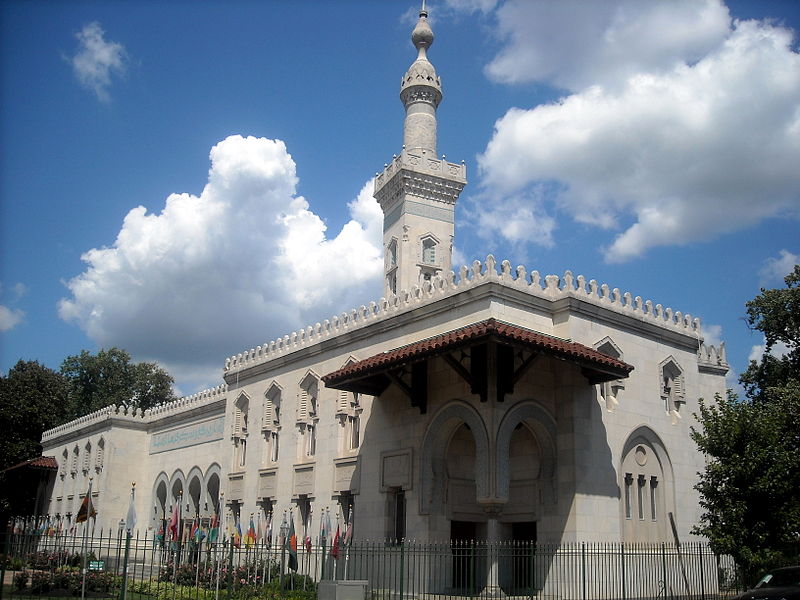
Islamic Center of the U.S. in Washington by agnosicpreachers kid under CC BY-SA 3.o license

BEST WISHES to our Moslem contributors, readers and friends all over the globe on this: the first day of Ramadan. ~ During this month, 1.6 million Muslims – or 23% of the world population according to Pew Research Religion and Public Life Project – observe a strict fast if they are of an age and healthy enough to do so. The fast extends each day from sunrise to sunset. The month-long fasting ends with a feasting celebration, Eid al-Fitr (the breaking of the fast), which falls on 28 July this year.

Britain’s David Cameron has this to say:

Kul ‘am wa enta bi-khair!

May everyday find you in good health!
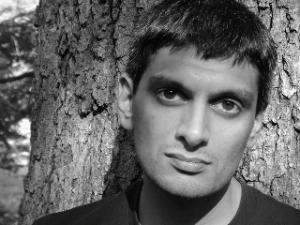
Kazim Ali (b. 1971) American poet
Kazim Ali (b. 1971) American poet (c) Kazim Ali

CELEBRATING POET, NOVELIST, ESSAYIST and EDUCATOR, KAZIM ALI ~  who was born in the UK, is from an Indian Islamic household, and was educated at State University of New York (SUNY) and at New York University. Currently he lives in Oregon.

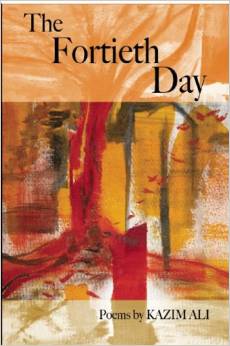
Of his most recent poetry collection, The Fortieth Day, the Library Journal review says that Ali …

“continues his task of creating a rejuvenated language that longs to be liberated from the weight of daily routine and the power of dogmatic usage . . . writing in the tradition of Wallace Stevens, Ali is clearly a poet of ideas and symbols, yet his words remain living entities within the texture of the poem.”


Of his essay collection, Fasting for Ramadan, Notes on Spiritual Practice, Tupelo Press states …

“Kazim Ali’s searching descriptions of the Ramadan sensibility and its arduous but liberating annual rite of communal fasting is sure to be a revelation to many readers — intellectually illuminating and aesthetically exhilarating.

“Fasting for Ramadan is structured as a chronicle of daily meditations, during two cycles of the 30-day rite of daytime abstinence required by Ramadan for purgation and prayer. Estranged in certain ways from his family’s cultural traditions when he was younger, Ali has in recent years re-embraced the Ramadan ritual, and brings to this rediscovery an extraordinary delicacy of reflection, a powerfully inquiring mind, and the linguistic precision and ardor of a superb poet.”
Unknown-8Ali’s poem Ramadan is from his collection, The Fortieth Day.
You wanted to be so hungry, you would break into branches,
and have to choose between the starving month’s

nineteenth, twenty-first, and twenty-third evenings.
The liturgy begins to echo itself and why does it matter?

If the ground-water is too scarce one can stretch nets
into the air and harvest the fog.

Hunger opens you to illiteracy,
thirst makes clear the starving pattern,

the thick night is so quiet, the spinning spider pauses,
the angel stops whispering for a moment—

The secret night could already be over,
you will have to listen very carefully—

You are never going to know which night’s mouth is sacredly reciting
and which night’s recitation is secretly mere wind—

– Kazim Ali
“Ramadan” except from The Fortieth Day. © 2008 by Kazim Ali, posted here under fair use

“Poetry is the smallest way – it is a small, small way, but it is a way indeed – that the individual body can express its own personhood and value in the face of faceless systems.” Kazim Ali

Terri Stewart
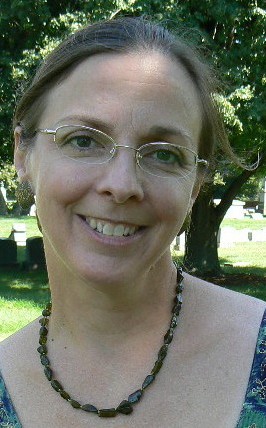
Terri Stewart (c) Terri

TERRI STEWART REPORTS on the expansion of Begin Again, the blog she started and hosts ~ “First news, welcome Bruce Chittick to the team of writers! Woot!! He will bring an awesome perspective to Sundays and inspiration. I can’t wait to get to know his writing. I experience him to be a thoughtful, gracious, inclusive kind of guy. His first post went live on the 22nd!

“And, in other exciting news, we got some funding. The United Methodist Church, in an expansive move towards trying new things (although we aren’t exactly NEW) has decided to fund my position at BeguineAgain.com AND all the technology for the next year and a half. This gives me & us time to build a class & subscription base to move towards an independent funding mechanism. This is awesome on so many counts. They know what we have been publishing and are willing to sit in that tension. Amazeballs! And it also lets the pressure off of me regarding all the work I am doing to create alternate funding mechanisms for my own family’s subsistence. Whew. Chaplaincy pays like zero. It is being billed as an online spiritual community. Very vague.

” … I can’t wait to try some of the new technology that will be available now that I can upgrade us to WordPress pro!”
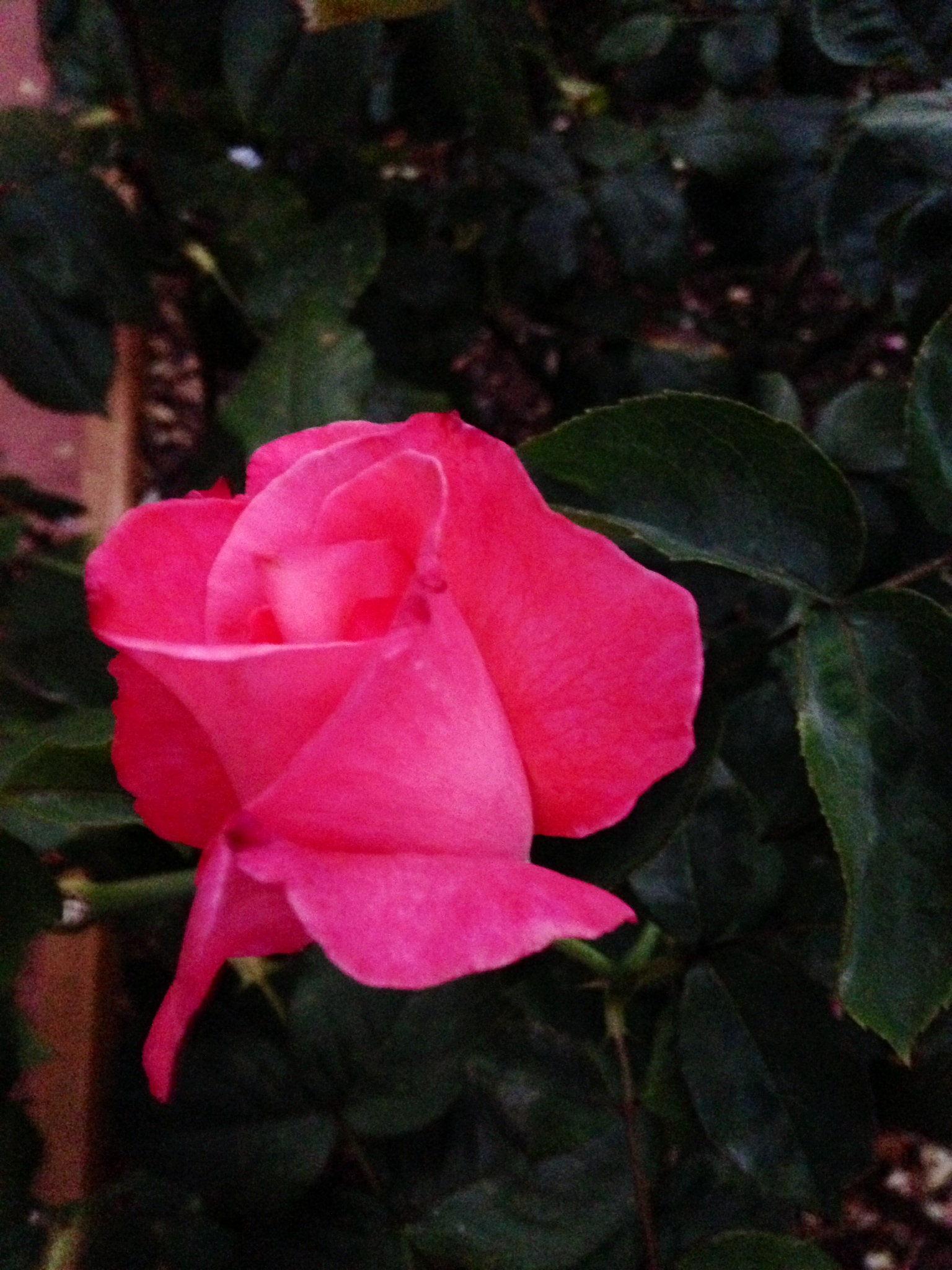
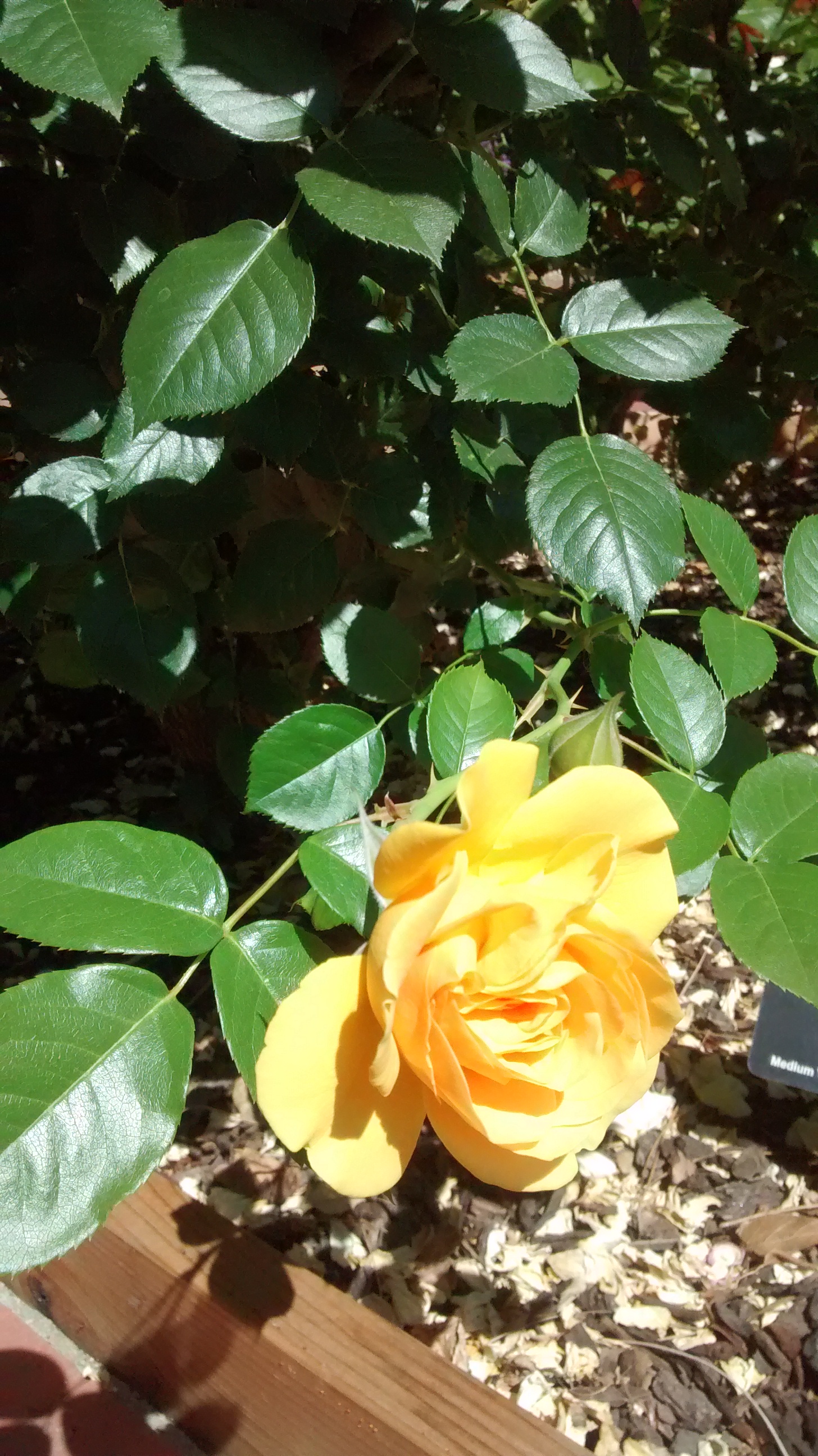
Rose at Dusk (c) Jamie Dedes
Rose at Dusk (c)  Jamie Dedes

ARTFULLY ECO-FRIENDLY

Dutch Nature Artist, PAULA KUITENBROUWER (Mindful Drawing) ~ a long-standing member of The Bardo Group and a contributor to the blog has sent out a call to all of us  – team members, bloggers and friends – to initiate discussions of how and why we are living and working in an eco-conscious ways and how we can use our art and our blogs to encourage environmentally sound practices. Paula shares on her Guilt-Free Art Page …

“My original drawings are drawn on acid free paper. In the process of making acid free paper fewer corrosive chemicals are used, which makes acid free paper significantly environmentally friendlier than normal paper.

“For packing my fine art cards and reproductions, I use biodegradable plastic. I like my art work to be as environmentally friendly as possible and I select my products carefully. My paint-brushes are synthetic without animal hair.”

Other eco-friendly living practices that might be shared would include the ways in which we order our lives to enable no-or-minimal use of cars, mindful shopping (buying only what we need and buying from bulk containers rather than packaged items, buying locally produced food and other products), using biodegradable cleaning products and reusable shopping bags. Yes! All this and how about telling us about your advocacy efforts?

We invite you share your thoughts on this in the comments section here, on your own blogs (then leave us a link under any current post so that we can publicize it in the next Bardo News) or as submissions to The Bardo Group blog this month. (If you are not a core-team member, please email us at  bardogroup@gmail.com.)

Coming up:

… and many more goodies from our Core Team, readers and guests. This month’s guests will include:

Poet K.A. Brace (The Mirror Obscura) and Jewelry-Maker, Writer, Photographer Isadora (Inside the Mind of Isadora)

bardogroup@gmail.com

The Bardo Group Facebook Page

In the spirit of peace, love and community,

THE BARDO GROUP

Posted in Essay, Photography/Photographer, Terri Stewart

Sacred Space in Rest

I am interrupting my series on Sacred Space in the Body. I wish I could say that it was for a lofty reason, but the truth of the matter is that I wrote a sermon that took all the words out of my body and left me with nothing! And this is a beautiful post about resting and sabbath that I co-created with my FB friend and photographer, Tom Ganner. Originally published at BeguineAgain.com. I’ll be back on track with Sacred Space in the Elder Body next week.

Today’s theme of sacred space in rest is offered by photographer Tom Ganner. Tom is a photographer from Haines, Alaska. I met him last year when I went on a cruise. He toured us around Haines to all the “photography” spots. He was so gracious! I encourage you to look at his photography (http://www.timenspace.net/) and if you are in the area, take his tour!

“Rest is not idleness, and to lie sometimes on the grass under trees on a summer’s day, listening to the murmur of the water, or watching the clouds float across the sky, is by no means a waste of time.” 
― John Lubbock, The Use Of Life
The high point of my summer has been two weeks with my grandson. I regret I have to take him down to Juneau today to return him home to Colorado. He says he wants to come back next year.  Photo created up Haines Pass near Three Guardsmen. — with Oliver in Haines, AK.
The high point of my summer has been two weeks with my grandson. I regret I have to take him down to Juneau today to return him home to Colorado. He says he wants to come back next year. Photo created up Haines Pass near Three Guardsmen. — with Oliver in Haines, AK.
“When we live without listening to the timing of things, when we live and work in twenty-four-hour shifts without rest – we are on war time, mobilized for battle. Yes, we are strong and capable people, we can work without stopping, faster and faster, electric lights making artificial day so the whole machine can labor without ceasing. But remember: No living thing lives like this. There are greater rhythms, seasons and hormonal cycles and sunsets and moonrises and great movements of seas and stars. We are part of the creation story, subject to all its laws and rhythms.” 
― Wayne Muller, Sabbath: Finding Rest, Renewal, and Delight in Our Busy Lives
Another ho-hum day in paradise with grandson Oliver at David's Cove. — in Haines, AK.
Another ho-hum day in paradise with grandson Oliver at David’s Cove. — in Haines, AK.
“The meaning of the Sabbath is to celebrate time rather than space. Six days a week we live under the tyranny of things of space; on the Sabbath we try to become attuned to holiness in time. It is a day on which we are called upon to share in what is eternal in time, to turn from the results of creation to the mystery of creation; from the world of creation to the creation of the world.” 
― Abraham Joshua Heschel, The Sabbath
(c) Photos, Tom Ganner, All Rights Reserved
(c) Essay, Terri Stewart, Creative Commons (BY-NC)
terrisignoffblog


Posted in General Interest, Guest Writer, Imen Benyoub, Music, Peace & Justice, Poems/Poetry

Music, Language of the Soul: the second in a series from Imen Benyoub on music in the context of war and occupation

The first post in this series is HERE.
10423604_519811371480762_878196538_n
Music, the language of the soul
The cultural Intifada*…From stones to musical instruments.
The story of Ramzi Abu Radwan.

They impressed the world
And all they had in their hands were stones
They lit like lanterns, and came like messengers
From “children of the stones” Nizar Quabbani (1923-1998), Syrian poet and publisher

The first Intifada is the Palestinian uprising against the Israeli occupation that started on December 1987 in Jabalia** refugee camp and spread throughout the rest of Gaza, the West Bank and East Jerusalem. It lasted six years until the signing of Oslo Accords in 1993.

It was an unarmed, spontaneous yet exploding uprising, men with their faces covered with keffiyehs***, women and children with nothing but stones, slingshots and Molotov cocktails faced tanks and live ammunition of well-trained, heavily equipped Israeli soldiers.

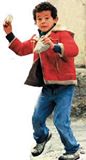
10423556_519811321480767_1963506964_aOne of those children, a kid wearing blue jeans and a red jacket whose picture reached the world newspapers became a legendary symbol of the Intifada, a skinny kid throwing stones at an army jeep, his eyes welled with tears, on his face a mixture of anger, fear and defiance. This kid, whose picture was reproduced in posters all over the world as an icon of the uprising, never knew that his destiny will change forever and he will become a visionary artist.

This was Ramzi Aburadwan, born in Bethlehem in 1979, he spent his childhood and first teenage days in a refugee camp in Ramallah where his family was forced to live after the Nakbah****, his best friend died on their way home from school during a military operation, he was eight when a journalist took a picture of him hurling stones and was later called “the iconic child of the Intifada”.

Ramzi was introduced to music at the age of 17, when a woman invited him to attend a course, he immediately loved it and this was the beginning of his journey with music.

After a year of study in the Edward Said National Conservatory of Music at Birzeit University, he received a scholarship to study in a Conservatoire in France; on 2005 he went back to Palestine after graduation with dreams and promises of a brighter life for children.

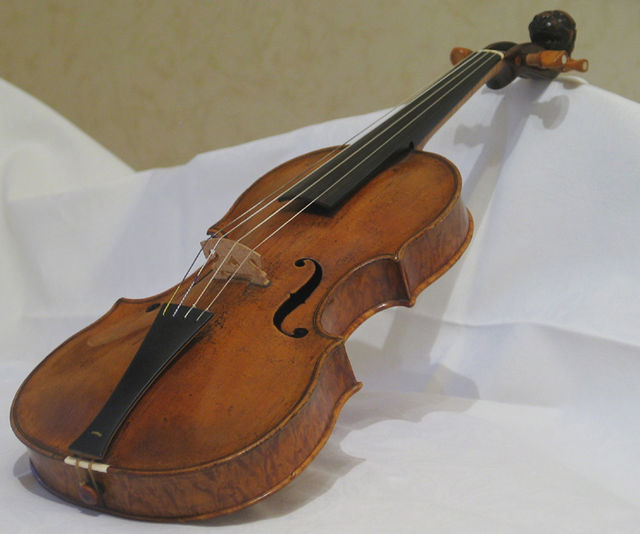
640px-StainerThe multi-talented Aburadwan founded Al Kammanjati*****, a nonprofit organization that offers children especially from refugee camps music lessons, its aim is to keep them in touch with their cultural heritage, develop and nurture their skills and create an intimately entertaining atmosphere away from the violence and frustrations of their daily life under occupation. It gave them a precious chance to travel, play with different orchestras and meet young musicians from all over the world. Classical music is also introduced as a valuable weapon in the so called “the cultural Intifada” a peaceful way of resistance to save Palestinian culture and identity through letters, art and musical notes, something Palestinians began to understand with time because of Israeli policy of extensive judaisation of the land and fierce attempts to bury and distort Palestinian history and heritage.

He takes part in the West Eastern Divan Orchestra directed by Israeli-Argentine born conductor and pianist Daniel Barenboim who said about him:

“Aburadwan has transformed not only his life, his destiny but that of many, many, many other people, this is an extraordinary collection of children all over Palestine that have all been inspired and opened to the beauty of life”

Al Kammanjati was honoured by “prince Klaus award” from the Netherlands in 2006.

* Intifada: Arabic word for “uprising”-Bethlehem, Ramallah: Palestinian cities in the West Bank.
**Jabalia: a refugee camp in the North of Gaza.
***Keffiyeh: a traditional black and white Middle Eastern cotton scarf, later considered a symbol of Palestinian nationalism and solidarity
***Bethlehem, Ramallah: Palestinian cities in the West Bank.
****Nakbah: Arabic word for “catastrophe” refers to the mass expulsion of more than 750.000 Palestinians from their lands in 1948 and creating a state of Israel on the occupied land.
****
*Al Kammanjati: Arabic word for “the violinist”

Trill_example_ornaments

A concerto for stone and violin:

The story of this generous musician and fighter inspired me to write this poem

A Poem for Ramzi Abu Radwan

The meditation of stone
In my hand
Is my song of freedom
That even your bullets
Can never pierce

Look at me
I am the child of the Intifada
These Palestinian hands
That were uprooted from my village
Like olive trees
And grew up in a camp
Small and scratched
will braid another song
From strings of a violin

Years pass
And the weeping violin
In my exiled soul
Will always remain
My song of freedom
That even your oppression
Can never silence

– Imen Benyoub


A portrait of the man:

The man’s music:

© 2014, essay and poem, Imen Benyoub, All rights reserved; Photograph (1) Ramzi Abu Radwan, adult and child, courtesy of Mr. Abu Radwan and ramallah cafe; photo of violin courtesy of Frink54 via Wikipedia under CC BY-SA 3.0; musical notations courtesy of Sprouls via Wikipedia under CC BY-SA 3.0.

pictureIMEN BENYOUB ~ is a multilingual, multi-talented writer, poet, and artist from Guelma, Algeria. Imen currently lives in East Jerusalem. She is a frequent guest here on The Bardo Group blog and with On the Plum Tree and Plum Tree Books Facebook page as well.

Posted in find yourself, General Interest, Liz Rice-Sosne, memoir, Mental Health, Writing

Personal Change

I once was the target of a nasty online attack.  I dove right into the fight and fought the good fight, then extricated myself.  This was long ago but it remains an unnerving and unpleasant memory.  For the most part I believe that kindness is the way to go.  I made a comment not too long ago in another place where I thought I had no contact with these individuals.  The comment was inane really. OMG – the same attacker – same persons all over again in a new place.  I respond to an attacks.  I do not hold back.  And I do not let people walk on me.  This time however, I chose not to respond. I could have done so and I truly “felt” like responding.  Cattiness, meanness, exclusivity don’t play into my vocabulary particularly well.  Had I chosen to respond, those traits would have been encountered immediately.  Instead I wrote a poem, diffusing my own anger.  I stepped back and ignored the persons comments.

the-schoolyardLike most, I have encountered provocation numerous times.  Planned behavioral changes within have given me the tools to navigate life, to navigate provocation.  The second time that I found myself in this situation (mentioned above) I knew to ignore the nastiness.  I would have found myself in the midst of the same sort of fight.  This situation makes me think about kids today who are bullied online.  I cannot imagine the hell into which kids are placed.  For that is exactly what I experienced, a barrage of attackers.  I also know that at 8 or 14 years of age one does not possess the cognitive abilities to make the choice to ignore their bully.  When one is being bullied one fears being seen as weak.  These feelings may elicit a response from the bullied.  Then the fight begins and the bully keeps pushing and bullying.  Then there may be no clear way out.  This second occasion of bullying made me think clearly about consequences (something a child cannot do).  I knew that no response was the most powerful response.  Instead of responding I chose to deal with my emotions by writing in a creative manner.  Writing about what you are experiencing emotionally can release the negativity within.  Now, the poem below is not meant to be a fine poem … just a release valve.  And that valve indeed opened and let escape some of the steam and pressure of that second experience.  The results were all positive.  There was no negative fallout.

dear poet within
i am having
a hard time
finding you

you seem
to be lost
why have you been
drawn into

a swirl of negative
energy a small swirl
when there is so much
that is positive

try to find yourself
do not get lost
find the massive
positive that exists

extricate yourself
from this one small
negative spin
from one very

small negative person
it wasn’t worth
it then
it isn’t now

– Liz Rice-Sosne 

© 2014, essay, poem, and portrait below, Liz Rice-Sosne, All rights reserved; illustration “The Schoolyard” courtesy of Katrina Joyner, Public Domain Pictures.net

.
unnamed-2LIZ RICE-SOSNE a.k.a. Raven Spirit (noh where), perhaps the oldest friend to Bardo, is the newest member of The Bardo Group Core Team. She is also our new Voices for Peace project outreach coordinator and our go-to person for all things related to haiku.  She says she “writes for no reason at all. It is simply a pleasure.” Blogging, mostly poetry, has produced many friends for whom she has a great appreciation. Liz is an experienced blogger, photographer and a trained shaman. We think her middle name should be “adventure.”

Posted in General Interest, Jamie Dedes, memoir, Poems/Poetry, poetry

and then a new generation

10358082_10152372768442034_1234373728_n…and then a new generation …
a boy, an old soul
but a merry new story
fresh at bone and marrow
adhering to Conrad’s dictum
with little shocks and surprises
in every sentence of his book
his life, his metaphor . . .
wearing Truth as his dermis
seeking tears, not blood
and he, like all good art
changed me for the better

© 2014, poem, Jamie Dedes, Photograph courtesy of my cousin Dan, all rights reserved, from the family album, please be respectful

Photo on 2014-03-31 at 17.16 #3unnamed-18JAMIE DEDES (The Poet by Day)~I am a medically retired (disabled) elder and the mother of married son who is very dear. I started blogging shortly after I retired as a way to maintain my sanity and to stay connected to the arts and the artful despite being mostly homebound. My Facebook pages are: Jamie Dedes (Arts and Humanities) and Simply Living, Living Simply.

With the help and support of talented bloggers and readers, I founded and host The Bardo Group because I feel that blogging offers a means to see one another in our simple humanity, as brothers and sisters and not as “other.”

“Good work, like good talk or any other form of worthwhile human relationship, depends upon being able to assume an extended shared world.” Stefan Collini (b. 1947), English Literary Critic and Professor of English Literature at Cambridge

Posted in Art, Poems/Poetry, Victoria C. Slotto, Writers' Fourth Wednesday

Writer’s Fourth Wednesday–The Art of Touch

When introducing school-age children to the world of visual art back when I was a docent at the Nevada Museum of Art, I used to like to ask them, “What tools do artists use?” Typical answers include, “Paint, canvases, clay, ink…” and, indeed, it’s logical that these are the first things that come to mind for most of us. But then, standing before a painting or sculpture, I invited the children to take their responses a step further and, in so doing, we entered the sphere of the elements and principles of art.

As a would-be artist, I’ve learned that the elements and principles of art are tools can serve poets and writers, as well as visual artists. These tools include color, line, shape, space, texture, perspective, balance, contrast, movement, form, pattern, value, emphasis, rhythm and unity. Can you see how visual artists reach into their tool boxes and grab one or more of these to produce a painting or sculpture that will appeal to the eye and will elicit an emotional response? And how they might enrich your own work?

Photo: David Slotto

Today, I’d like to discuss Texture.

Texture refers to the surface quality, whether actual or implied, of artwork. Actual or tactile texture is present when, if you were to touch the piece, you would feel its roughness or smoothness. Implied texture is achieved through illusory techniques that allow your imagination to tell you how an object in the painting would feel.

To create rough texture in a painting, the artist uses heavy applications of paint with a brush or palette knife and layers it on the surface of the painting. This process is called impasto. Simulated or implied texture occurs when the artist creates the impression of smoothness or roughness. To do this he uses color and value contrasts, a dry brush technique, or broken lines. Collage is an art form that emphasizes texture through use of contrasting materials such as fabric, paper, wood, paint, fiber and natural objects.

For this Writers’ Fourth Wednesday, I invite you, as word artisans, to create textural poetry or prose.

  • You may choose to focus on texture as the subject of your poem, exploring and reproducing the rough texture of tree bark or wood, the smooth feel of a baby’s or lover’s body, the cool gloss of ice or the warm fuzz of a cuddly kitten.

  • Or select words that are textural when spoken, perhaps including a recording of your spoken verse.

  • Another option is to select a piece of art that is textured and write to that. Some artists known for texture include the masters Rembrandt and Titian, Impressionists such as Vincent van Gogh, or abstract expressionists such as Willem de Kooning and Jackson Pollock.

  • Perhaps you have a painting, sculpture or photograph of your own that you would like to showcase.

Image Credit: theguardian.com

I hope you enjoy bringing the sense of touch to your writing and look forward to reading your contributions, should you chose to share them. Above all, have fun adding texture to your creative tool box.

To link simply write your piece and post it on your website or blog, then copy the direct URL of your work into Mr. LInky.

2014, essay, Victoria C. Slotto, All rights reserved; photographs as indicated 

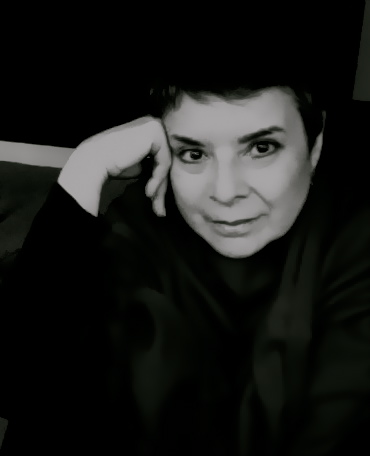
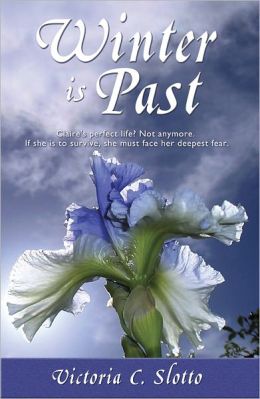
2940013445222_p0_v1_s260x42034ff816cd604d91d26b52d7daf7e8417VICTORIA C. SLOTTO (Victoria C. Slotto, Author: Fiction, Poetry and Writing Prompts) ~ is an accomplished writer and poet. Winter is Past, published by Lucky Bat Books in 2012, is Victoria’s first novel. A second novel is in process. On Amazon and hot-off-the-press nonfiction is Beating the Odds: Support for Persons with Early Stage Dementia. Victoria’s ebooks (poetry and nonfiction) are free to Amazon Prime Members. Link HERE for Victoria’s Amazon page. Victoria’s poetry collection is  Jacaranda Rain, Collected Poems, 2012, Beautifully done.

Writers’ Fourth Wednesday prompt is hosted by Victoria from January through October. Victoria’s next Fourth Wednesday writers’ prompt will post at 12:01 a.m. PST on July 23. Please join us. Mister Linky will remain open for seventy-two hours so that you can link your response to this blog. If you find Mister Linky too cumbersome to use, please feel free to leave your link in the comments section on Wednesday. Victoria and Jamie will read and comment and we hope you will read each other’s work as well, comment and encourage. 

Posted in General Interest, Guest Writer, Photography/Photographer, Spiritual Practice, Wendy Alger

I Still Have Legs

I wish I was more thankful for things before I lost my vision.

Driving, reading, colors, remembering faces, seeing the stars, being independent, my job, looking at photographs, watching my nephews grow up, seeing what I will look like older, nature, television, writing something down on a piece of paper, an art gallery, seeing the wonders of the world.

Perhaps I am more thankful now. Perhaps my lack of vision gave me more to be thankful for.

Yes my feet burn on the hot pavement. I still have legs.

The annoying sounds during the meditation. I still have hearing.

I have a migraine today. I am still alive!

Using my white cane down the busy street, I am present and aware.

A Mini-Gallery of Photographs from Wendy Rose Alger, Fine Art Photographer

IMG_0088

IMG_0147

WRA_2012_02_20_2193-edit

© 2014, words and photographs, Wendy Rose Alger, All Rights Reserved

wra201110071514-1bw-mWENDY ROSE ALGER ~ is a fine art photographer born in 1972 in Chicago, Illinois. Wendy now resides in the San Francisco Bay Area in California. She studied photography at the Academy of Art University in San Francisco where she learned manual SLR and how to use a darkroom. These days Wendy uses a digital camera. With a digital camera she can forego a dark room and check her photographs in the camera. Thanks to her digital camera, adaptive technologies, and a variety of computer applications for photography, she is able to pursue her passion despite the vision limitations that result from retinitis pigmentosa. Her website is Wendy Rose Alger, where you can view a more complete gallery of her photographs.

Posted in General Interest, Naomi Baltuck, Photo Essay, Photography/Photographer

Mad Cow Disease

Last July I visited the Hampshire College campus in Massachusetts. I was there to spend a few days with my daughter Bea…

…who was studying at the amazing Yiddish Book Center at the college.


Hampshire has a lovely campus in the middle of rural farm country.  And it was 97 degrees.

I’m from The Emerald City and I know green when I see it.  Believe me, that countryside was green.

It was midday, and the campus was deserted, except for mad dogs and Englishmen.  Oh, yeah, and Bea and me.  We were walking to the dorm to sit in front of the AC and have lunch (did I mention it was 97 degrees?).  Then out of nowhere came a couple of dairy cows, fresh off the farm, looking like two giant Oreo cookies on the hoof.  Completely out of context, they looked larger than life.

One doesn’t often see cows going faster than a mosey, but these two came galloping toward us–no, frolicking is the only word for it.  They came frolicking across the manicured lawn.

They seemed giddy with the sense of freedom.   No cattle lows here.  In fact, I could almost hear one calling to her girlfriend, “Woo hoo!  C’mon,c’mon,c’mon, come ON!!

Oh, they were fresh, and they were frisky!  Across the campus they bounced, udders swaying, heads bobbing.  Like young girls taking the bus downtown for the first time.  Or mothers in a frenzy of activity when Baby goes down for a nap.  Grownup sisters on their first overnight after the kids are weaned.  Old ladies and their girl herd down at the senior center on Bingo Night.

A student heading out to the parking lot saw them.  Before ducking into the safety of her car, she shouted, “Get inside!  Mad cows on the loose!”  But Bea and I weren’t afraid.  If this was Mad Cow Disease, we wanted to catch it.  I swear, those cows were laughing and shoulder bumping!

They were on their first jump over the moon.  New sights, new smells, new tastes.  Maybe the grass really was greener on the other side of the fence.  How would they ever know if they didn’t give it a try?

You’re going to stick your head into a garbage can?  Then I’m going to stick my head into a garbage can too!”  Thelma and Louise on the hoof!

Out from under Farmer Brown’s thumb!  You go, girls!

I knew then and there, I would never wait for someone to open the gate of the corral.  If it’s locked, I’ll jimmy it.

Whether your middle name is Hamburger Helper or you’re just tethered to a milking machine, life is short.  You can put in your time on the farm, but if you wait patiently for someone to put you out to pasture, chances are it ain’t gonna happen.

It’s up to you to kick up your heels while you still can.

You hear what I’m saying?   Get Moooving!

All words and images copyright 2013 Naomi Baltuck

NaomiPHOTO1-300ppi51kAqFGEesL._SY300_NAOMI BALTUCK ~ is a Contributing Editor and Resident Storyteller here410xuqmD74L._SY300_ at Bardo. She is a world-traveler and an award-winning writer, photographer, and story-teller whose works of fiction and nonfiction are available through Amazon HERE. Naomi presents her wonderful photo-stories – always interesting and rich with meaning and humor – at Writing Between the Lines, Life from the Writer’s POV. She also conducts workshops such as Peace Porridge (multicultural stories to promote cooperation, goodwill, and peaceful coexistence), Whispers in the Graveyard (a spellbinding array of haunting and mysterious stories), Tandem Tales, Traveling Light Around the World, and others. For more on her programs visit Naomi Baltuck.com

Posted in Essay, Spiritual Practice, Terri Stewart

Sacred Space in Our Bodies: Women

Last week, I started exploring finding sacred space in our bodies. I took a brief look at the need for sacred space because of the large influence of Western Christianity on our society and the world. Additionally, the groundwork was laid for a holistic view of our bodies as sexual beings and the unity of being.

Today, I will be speaking to the point of women and body image. I will be using images, factoids, and spoken word to make the point for healing our body image and considering our bodies sacred space

The problem: Pretty

iraneusquoteAccording to society and the media, pretty is not:

  • Dark skin
  • Dark hair
  • Freckles
  • Fat
  • Crooked noses
  • Old
  • Or short

Pretty is:

  • Pale
  • I’d like to point out that even women I consider quite beautiful such as Beyonce, often have their skin “lightened” in Photoshop for magazine covers.  I am sure this is the editor’s choice.
  • Tall
  • Skinny
  • Young
  • Sexualized
  • Vanity Fair magazine did a survey of who the most beautiful woman is in 2009 and Angelina Jolie won by a wide margin.  I believe that she fits all of these categories, especially the sexualized presentation of women.

Often, in the media, sexualized women are used for no apparent reason.  In this advertisement that popped up one day while I was working on research for this presentation, there is this woman presenting her legs and high heels…for an advertisement about school grants.

advertisement

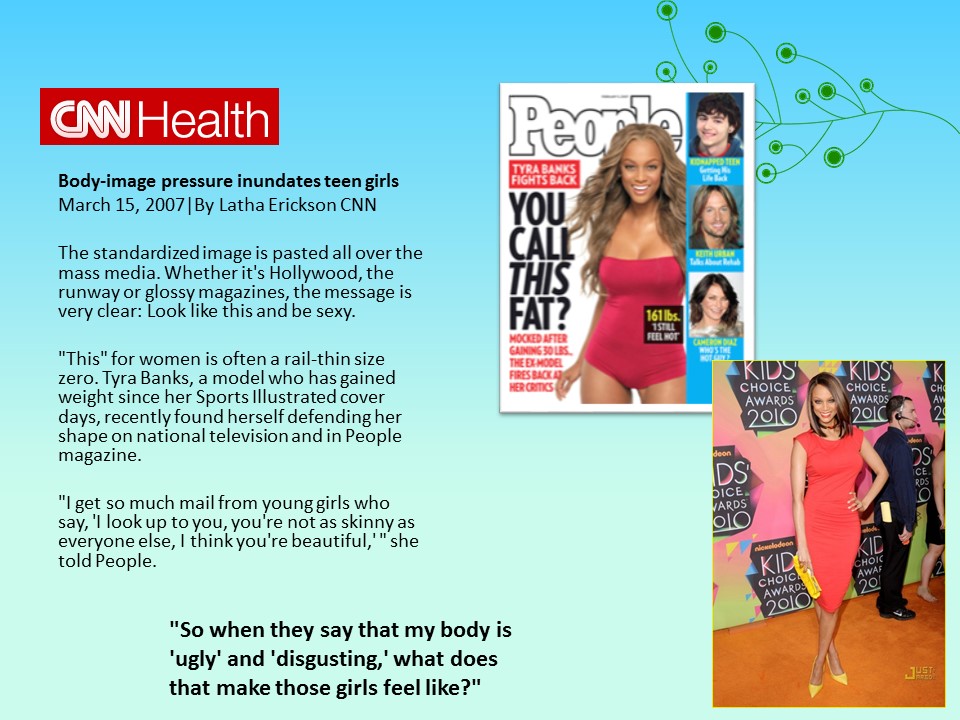
Popular media has a freedom to make fun of what pretty isn’t…whether it is fat, short, old, or freckled.  Here Tyra Banks is being called fat.  She is a role model for young women across America whether we like it or not.  If people are associating fat with her and calling her ugly and disgusting, what does that do to our young women that admire her?

tyra

And now a personal story…

colincaseyThis is my my child Colin and his cousin Casey, my niece.  These two kids both consider themselves fat at this time.  Colin was afraid to wear “skinny jeans” because he thinks they make him look fat so he hides his body behind baggy basketball shorts and sweatshirts. Casey is in the same boat. They already don’t like their bodies.
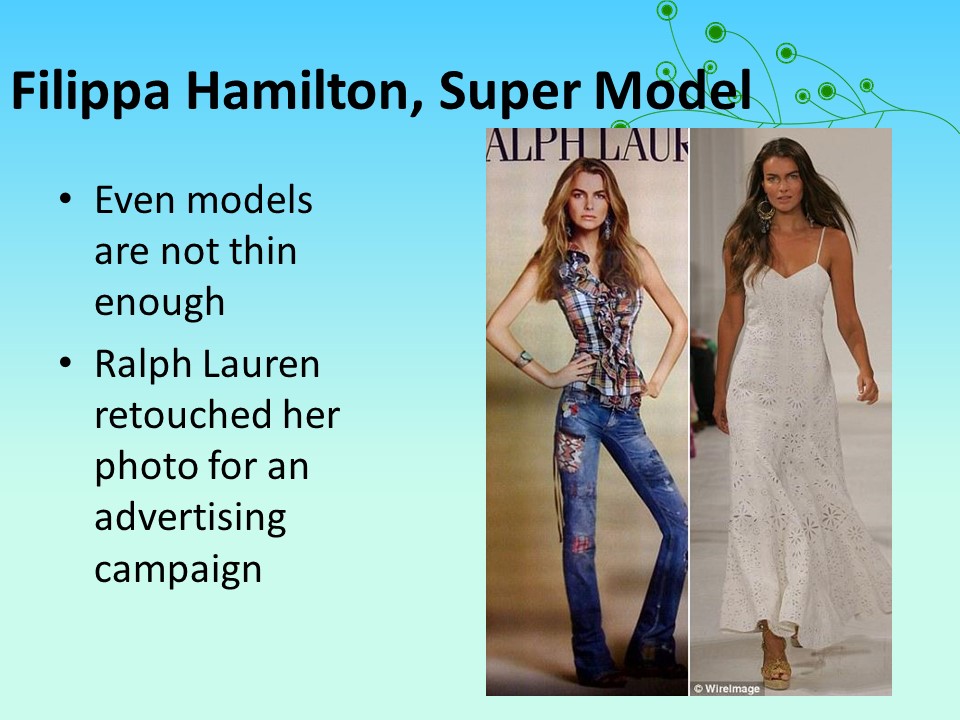

Even models are not thin enough.  Ralph Lauren ran this ad with this image in Japan.  They then fired Filippa Hamilton for “breach of contract” which she says is because she was too big.

filippa

Here, Dove bravely shows us the evolution of beauty:

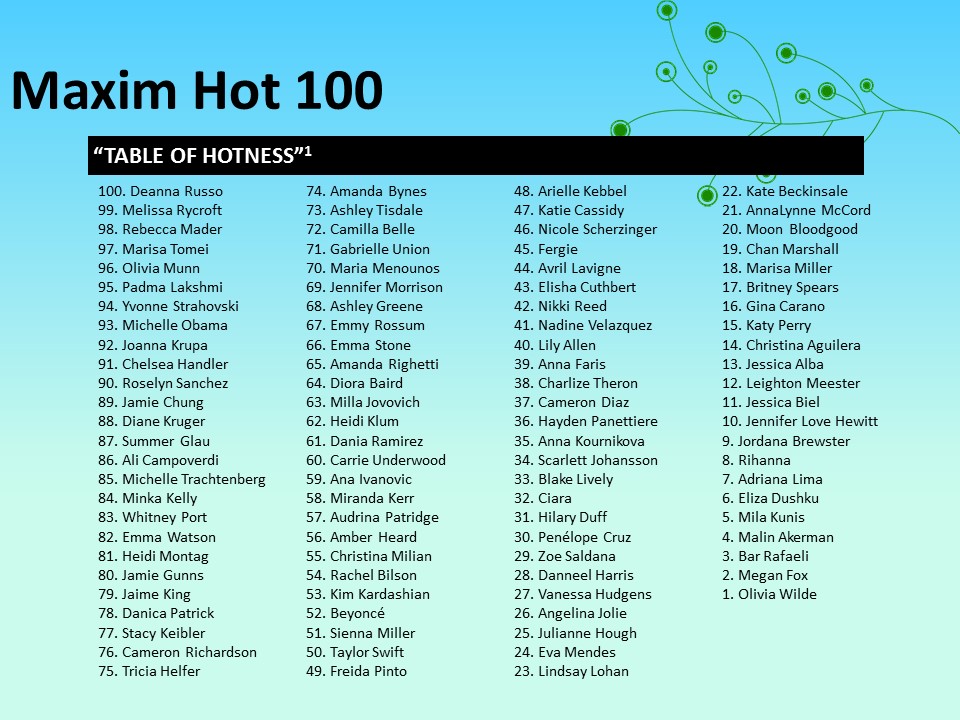
Here is the list of the Maxim Hot 100.  Women and girls measure themselves against this list and this standard of beauty thinking it will bring

  • Happiness
  • Fulfillment
  • Joy
  • Wealth
  • Desire
  • And Self Worth

maxim


This is death dealing to our young women.

  • Teenagers who THINK they are overweight are at a higher risk of suicide.
  • Over 35 million people in the U.S. have an eating disorder of some kind…anorexia, bulimia, or binge eating.  A huge percentage of these people are women.  Up 95% of the people with anorexia or bulimia are women and 65% of people with a binge eating disorder are women.  Or girls.
  • Eating disorders cause early onset of disease and illness.
  • This is being driven down to an earlier age…over 80% of 10 year olds fear being fat.
  • Again, this is death dealing.  Young women are dying from eating disorders.

Just to contrast,  Measuring against this standard of beauty actually brings

  • Depression
  • Sexual Disorder
  • Self Hatred
  • Self Mutilation
  • Eating Disorders
  • And Suicide

Popular music is no better. Here is an offensive song by the Macc Lads called “Ugly Women.” The lyrics include:

Thank God for ugly women, all the boilers bags and trolls, Just so they could get a shag they invented alcohol.

Speaking of self-mutilation and to that which Kathy Makkai spoke of so poignantly in her poem, nearly 1.2 cosmetic surgeries done for non-medical reasons were done in 2008.

plasticsurg

Ridiculously, this is now being marketed in children’s books. There is a book called, “My Beautiful Mommy” available on amazon.

But there is good news! Our young women are changing and the world is moving into a place where we can consider our bodies and body image, sacred space.

Again, what’s theology got to do with it?

  • Body/Spirit dualism allows objectification (Kelly Brown Douglas)
  • Objectification leads to disembodiment in the sense of our body as unholy other
  • When we are disembodied, we can no longer connect to creation (Sally McFague)
  • When we are disembodied, we can no longer connect to the other (Mayra Rivera)
  • When we are disembodied, we can no longer connect to the other within our self (extrapolated from Mayra Rivera)
  • We can neither connect to immanence nor transcendence

Without immanence (experiencing our bodies) or
transcendence (experiencing the other),
we lose our sense of sacred
.

And we become a befuddled mess. My hope and prayer is that you will hear the prophetic words of Kathy Makkai and the Girl’s Making Media and declare your body and your body image sacred space.

Can I get an Amen?

References are here.

terrisignoffblog


Posted in Beauty, Essay, First Peoples, General Interest, Michael Watson, Spiritual Practice

A Brief Meditation on Grace and Comfort

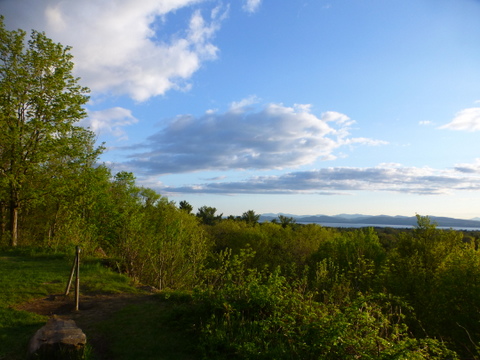
GardensAfter a cool, damp week the sun is out! June is in full bloom, our perennial gardens bursting with color. In the the kitchen garden rows of tender plants have appeared in the raised beds, and we are eating mesclun. Lovely!

Here in Vermont the trees are a dense, lush green. Plants need to take full advantage of our four to five months of warm weather, and go about the tasks of reproducing and storing energy with vigor. In just a few weeks, by late July, the foliage will begin to thin, already preparing for the autumn to come.

We have stopped filling the feeders as the birds have other food sources available to them. Now that the feeders are empty we will likely take them down and store them until October. Come the first chilly days of autumn the birds will remind us to bring out the food; we have a good working relationship!

I recently read a post on Australis Incognita, an interview with an Australian Aboriginal elder, Uncle Paul Chapman. The essence of the conversation is that we learn who we are in the world by paying attention to the landscape and Nature. There is an ancient Indigenous knowing that we can’t figure it out by turning totally inward, as that is out of balance. We learn from bridging the worlds of inner an outer, self and landscape.

Reading Uncle Paul’s words reminded me we are of the landscapes we inhabit; we even have our own internal seasons. I often suggest to students that after we watch for a while we may begin to notice that sometimes the inside and outside worlds are in sync, other times not. Lately I have found myself diving deeply into the interior, even as I engage the Natural world as it bursts into furious activity.

Lately, I seem able to stand with a foot in each world, shifting between them as need be, and am rewarded by moments of grace. Grace reminds me to be grateful for my life, family and friends, and the Beauty surrounding me, even as I feel disappointed and angry with much that is unfurling in the world. Grace encourages me to be concerned for my grandchildren, and curious as to how we humans will manage the road ahead.

In dark, difficult, times it is easy to forget that summer invariably follows winter, and life sprouts anew when given any opportunity. This will be so as long as there is life on our precious blue-green planet. May we take refuge and comfort in that.

Evening-Sky The sun has broken through and the sky is a brilliant blue. Over the lake a layer of clouds, white and bubbly, hangs. Trees and gardens are  abloom, and the scent of lily-of-the-valley and lilac saturates the air. The day is beautiful. May we walk through this day in Beauty, together.

– Michael Watson

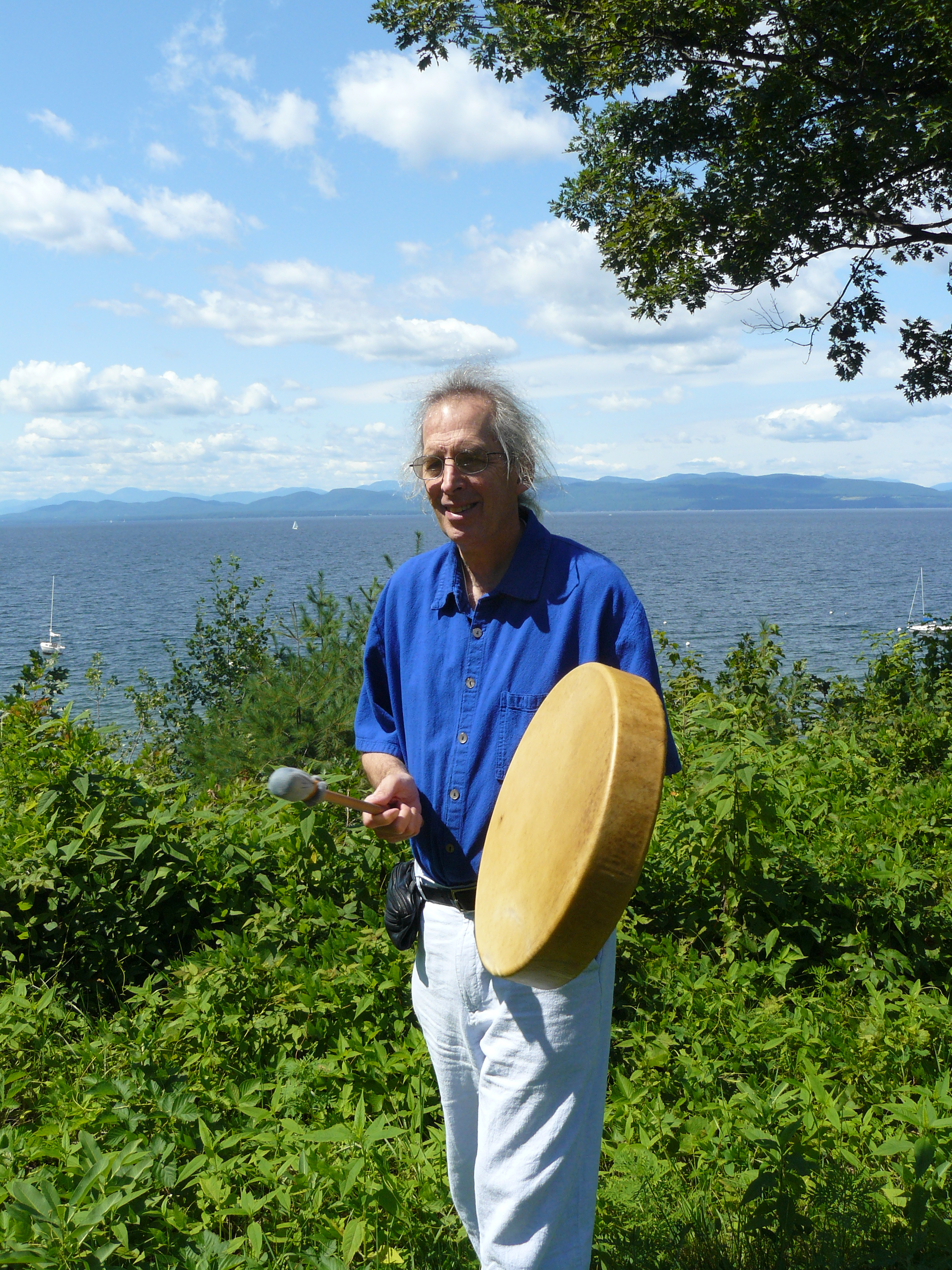
michael drumMICHAEL WATSON, M.A., Ph.D., LCMHC (Dreaming the World) ~ is a contributing editor to Into the Bardo, an essayist and a practitioner of the Shamanic arts, psychotherapist, educator and artist of Native American and European descent. He lives and works in Burlington, Vermont, where he teaches in undergraduate and graduate programs at Burlington College,. He was once Dean of Students there. Recently Michael has been teaching in India and Hong Kong. His experiences are documented on his blog. In childhood he had polio, an event that taught him much about challenge, struggle, isolation, and healing.

Posted in General Interest, story, Video

A StoryCorps Story: a mother, a son, two secrets and much love

“But behind all your stories is always your mother’s story, because hers is where yours begins.”
― Mitch Albom (b. 1958) American author and journalist, quote from For One More Day

Our thanks to Laurel D. for suggesting this one.

Posted in Corina L. Ravenscraft, Culture/History, Essay, Film/Documentaries/Reviews, General Interest, Nature, trees, Video

The Man Who Planted Trees

If you haven’t read or heard the tale, “The Man Who Planted Trees” by French author Jean Giono, it is a wonderful story about how one person can have a tremendous impact on the world! It’s also a story of how everything in nature, including man, is connected.

"The Man Who Planted Trees" by Jean Giono.  Image borrowed from Wikipedia Commons, fair use agreement.
“The Man Who Planted Trees” by Jean Giono. Image borrowed from Wikipedia Commons, fair use agreement.

It tells about how a single, reclusive shepherd manages to successfully re-forest a barren and desolate area in the foothills of the Alps. Elzéard Bouffier, the shepherd, dedicates the latter half of his life to re-planting acorns, beech nuts and other tree seeds, one by one, patiently walking the land where nothing would grow and no water flowed, and the people who lived there were a hard, bitter folk.

When I first heard the tale, I thought that it was based on a true story. I later discovered that it is not. However, there have been real life counterparts! There is a man in Assam, India, named Jadav Payeng, who single-handedly managed to plant a forest covering 1,360 acres. Abdul Karim is yet another man in India who used the same method of planting trees as the shepherd in the story, and over a period of 19 years, created an entire forest from nothing. Another man, Ma Yongshun, was a forestry worker in China who planted more than 50,000 trees in his lifetime!

Tree gif from dragonkatet/photobucket.com

If you haven’t read or heard the story, may I suggest that you pick up a copy from your local library, or even better, watch the short, animated film below. It is an uplifting story full of hope and reassurance that no matter who or where you are, you CAN make a difference as only a single entity! Best of all, your actions may inspire others and create a ripple effect of good. 🙂

~ © Corina L. Ravenscraft 2014 ~

effecd1bf289d498b5944e37d8f4ee6fAbout dragonkatet Regarding the blog name, Dragon’s Dreams ~ The name comes from my love-affairs with both Dragons and Dreams (capital Ds). It’s another extension of who I am, a facet for expression; a place and way to reach other like-minded, creative individuals. I post a lot of poetry and images that fascinate or move me, because that’s my favorite way to view the world. I post about things important to me and the world in which we live, try to champion extra important political, societal and environmental issues, etc. Sometimes I wax philosophical, because it’s also a place where I always seem to learn about myself, too, by interacting with some of the brightest minds, souls and hearts out there. It’s all about ‘connection(s)’ and I don’t mean “net-working” with people for personal gain, but rather, the expansion of the 4 L’s: Light, Love, Laughter, Learning.

Posted in Niamh Clune

My Declaration Of Independence.

I am not governed by a foreign power; I am self-governed.
I am as free as I can be from the control of others.
I am influenced by love and beauty, kindness and compassion, yearning and striving.
I am self-reliant – an independent mind that cannot be reigned in, repressed or shape-shifted to please the status quo.
I do not depend on someone else to decide whether or not, I can express my voice in the world.
I am not determined by fashion – not the next J.K. Rowling – not trying to write the next Fifty One Shades Of Lighter Grey.
I am not determined by the outcome of statistics or the result of a study, or the promise of a guaranteed 5,000 advance sales.
I will not be watered down, nor have my chocolate sweetened.
I am cocoa, Marmite, chilli and garlic ~ an Independent Artist, Writer or Publisher who creates – simply because I can. I must. I will die if I don’t.

I am poor for my art but rich in my soul.  I cannot DO anything other than express the inner urgings of my vision. I am driven, living in wait for that one person able to recognise that what I create has merit. I crave recognition that will, for a moment, exalt the beauty that’s in me. Then I shall no longer hide for fear of derision or being left exposed, naked and alone.

But if I never receive your acknowledgement, I will not falter.  I will remain the bastard child and grow thin waiting for that which nourishes my soul – that golden patronage that stands against the sky and says, “I see you. I see what you are doing. You are the new adventure, the subversive, pure of voice untainted by the fickleness of the board (bored) room. You interfere with the syntax. You interrupt the narrative. You punctuate like a Jazz Drummer. You make me think, feel, wonder anew. You break the rules ~ because you can ~ because you must. It is your destiny. ”

I am an independent artist ~ harder on myself than others ever could  be, working hard day and night sending my voice out into the wilderness.

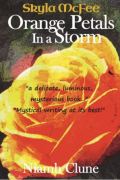
– Niamh Clune © 2014, essay, Niamh Clune, All rights reserved 430564_3240554249063_1337353112_n-1orange-petals-cover_page_001DR. NIAMH CLUNE (Plum Tree Books Blog) ~ is the author of the Skyla McFee series: Orange Petals in a Storm, and Exaltation of a Rose. She is also the author of The Coming of the Feminine Christ: a ground-breaking spiritual psychology. Niamh received her Ph.D. from Surrey University on Acquiring Wisdom Through The Imagination and specialises in The Imaginal Mind and how the inborn, innate wisdom hidden in the soul informs our daily lives and stories. Niamh’s books are available in paperback (children’s books) and Kindle version (The Coming of the Feminine Christ). Dr. Clune is the CEO of Plum Tree Books and Art. Its online store is HERE.  Niamh’s Amazon page is HERE.

Posted in General Interest, John Anstie, poem, Poems/Poetry, poetry

Blind Alley

Copyright 2013 Marsha Berry

Its weight upon her back constrained her breath
and data from a million miles of type
had taken toll of her own inspiration,
drowned beneath the heft of corporate hype.

The pavement and its passengers, detached.
She felt like ailing bug on dying tree.
This morning, as she trudged this weary path,
those slabs were like lead shoes, deprived of glee.

The wall that once reflected all her joy
had cast, as tall as anyone could say,
its shadow, smothering independent thought.
A blinding light then blew it all away.

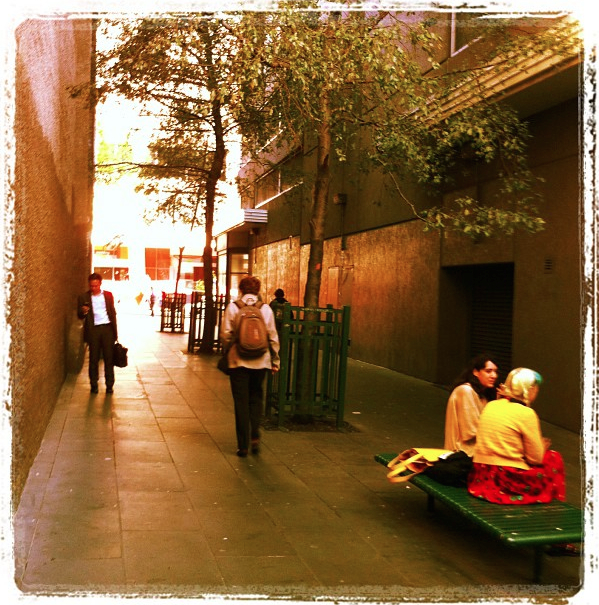
[This was another poem prompted by a photograph. Ekphrasis wins the day again! It was Marsha Berry, another member of the GRPG*, who posted this and it was followed by a variety of poetic responses. This was mine and it carries with it that common thread of philosophical thought, which occupies me often. This is that we must work hard to ensure we retain our insight, a closeness to our conscious and our convictions, lest we lose it all in favour of allowing others to implant another form of consciousness in our minds, by however insidious a process, that is either corporate (the companies for whom we work), commercial (the companies from whom we buy things to stock our material lives) or political (the PR that the political establishment puts out to woo us for our votes).  This poem, I think, rather relates to the first of those three. Or, perish the thought, does that rucksack carry something more destructive? Whichever way this poem is interpreted, I hope it causes the reader to stop and think ]

Poem: © 2013 John Anstie.     Image: © 2013 Marsha Berry (the Poet) and Marsha Berry (the academic)

* GRPG – The Grass Roots Poetry Group


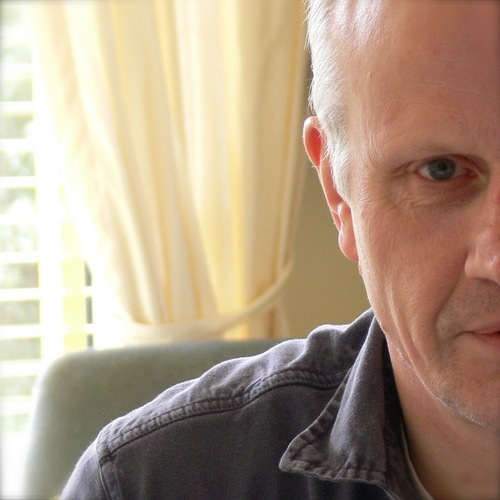
John_in_Pose_Half_Face3JOHN ANSTIE (My Poetry Library and 42) ~ is a British writer and poet, a contributing editor here at Bardo, and multi-talented gentleman self-described as a “Family man, Grandfather, Occasional Musician, Singer, Amateur photographer and Film-maker, Apple-MAC user, Implementation Manager, and Engineer”. He has participated in d’Verse Poet’s Pub and is a player in New World Creative Union as well as a being a ‘spoken-voice’ participant in Roger Allen Baut’s excellent ‘Blue Sky Highway‘ radio broadcasts. John has been blogging since the beginning of 2011. He is also a member of The Poetry Society (UK).

*****

product_thumbnail-3.php

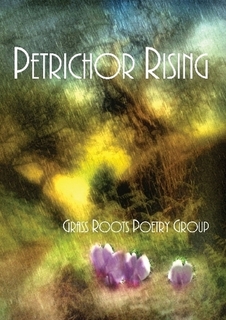
51w-rH34dTL._BO2,204,203,200_PIsitb-sticker-arrow-click,TopRight,35,-76_AA300_SH20_OU01_John has also been involved in the recent publication of two anthologies that are the result of online collaborations among two international groups of amateur and professional poets. One of these is The Grass Roots Poetry Group, for which he produced and edited their anthology, “Petrichor* Rising. The other group is d’Verse Poet Pub, in which John’s poetry also appears The d’Verse Anthology: Voices of Contemporary World Poetry, produced and edited by Frank Watson.

Petrichor – from the Greek pɛtrɨkər, the scent of rain on the dry earth.

Posted in Buddhism, General Interest, Jamie Dedes, Peace & Justice

The Garden of My Heart

With all the strife in the world now, it seems a good thing to post something healing and peaceful.

Thich Nhat Hanh (b. 1926) Zen Monk, Dharma Teacher, Social Activist, Writer, Poet, Peacemaker

Thich Nhat Hanh is now recognized as a Dharmacharya and as the spiritual head of the Từ Hiếu Temple and associated monasteries. On May 1, 1966 at Từ Hiếu Temple, Thich Nhat Hanh received the “lamp transmission”, making him a Dharmacharya or Dharma Teacher, from Master Chân Thật. MORE [Wikipedia]

Though a Zen Buddhist monk, Thich Nhat Hanh combines traditional Zen with techniques from Theravada Buddhism, the wisdom of the Mahayana tradition, and ideas of modern Western psychology to teach meditation and spiritual values and practices in a way that resonates for people from diverse religious, political, and cultural backgrounds. He is a writer, poet, and peacemaker with over one-hundred books published, many in English. He was suggested for the Nobel Prize for Peace by Dr. Martin Luther King, Jr. in 1967. He was nominated again 2013.

Since 1966, Thich Nhat Hanh has lived in exile. Based at Plum Village, a meditation community in the south of France, he is a leading Buddhist teacher, encouraging engaged Buddhism, a movement for social activism that he founded. He organizes and supports many worthwhile humanitarian efforts.

Thich Nhat Hahn coined the term “interbeing,” a pointer to the Buddhist principles of impermanence and non-self, which bring light to the idea and ideal of the inter-connectedness of all things. He founded The Order of Interbeing, the members of which include lay people. Link HERE to brief summaries of each of the fourteen mindfulness trainings of the Order of Interbeing.

“If in our daily lives we can smile, if we can be peaceful and happy, not only we, but everyone will profit from it. If we really know how to live, what better way to start the day than with a smile? Our smile affirms our awareness and determination to live in peace and joy. The source of a true smile is an awakened mind.” ~ from Peace is Every Step by Thich Nhat Hanh

Here is  a meditative interlude. The title of this post is a quote from the meditation, which is an excerpt from an album called Graceful Passages: A Companion for Living and Dying. It features spiritual teachers from many traditions offering advice to the dying … in other words, advice to all of us.

Photo on 2014-03-31 at 17.16 #3unnamed-18JAMIE DEDES (The Poet by Day)~I am a medically retired (disabled) elder and the mother of married son who is very dear. I started blogging shortly after I retired as a way to maintain my sanity, to stay connected to the arts and the artful despite being mostly homebound. My Facebook pages are: Jamie Dedes (Arts and Humanities) and Simply Living, Living Simply.

With the help and support of talented bloggers and readers, I founded and host The Bardo Group because I feel that blogging offers a means to see one another – no matter our tribe – in our simple humanity, as brothers and sisters and not as “other.”

“Good work, like good talk or any other form of worthwhile human relationship, depends upon being able to assume an extended shared world.” Stefan Collini (b. 1947), English Literary Critic and Professor of English Literature at Cambridge

Posted in Essay, Spiritual Practice, Terri Stewart

Sacred Space in our Bodies

I am going to resurrect and modify a presentation I did a few years ago with Terra Morgan, Bjorn Peterson, and Denise Ritthaler. In this presentation, we develop the case for a theology of Liberation of the Body. Although we use references, occasionally, from Christianity, the topics transcend that particularity. And unfortunately, this dialogue has framed much of western culture’s understanding of our bodies.

This will be a four part series looking at:

  1. The case for a Liberation of the Body & Liberation of our sexual being
  2. Liberation of women and particularly body image
  3. Liberation of elder bodies
  4. Liberation of men

(Note: This already is too gendered and separated! But it is the beginning of our thoughts on the topic).

And we just barely touch the iceberg!

Why do I consider this sacred space? I consider that we are in relationship with three things:

  1. us and bodies
  2. us and the world
  3. us and the divine

If we are not at peace with our bodies, our own selves, our angst and anger will spill into our treatment of the world and into our understanding of the divine. If we believe the Divine is within, and within us we hurt ourselves, then the Divine is also hurt. If we believe the Divine is outside of us, and has caused this, the Divine becomes capable of vengeance and capricious pain. Either way, it seems a difficult place to hold. Throw in the world and how we use it, and we are done for. So in an effort to move into peacefulness within ourselves and then in relationship with the world, let us consider our bodies as sacred space worth liberating.

Additionally, since nobody has really written “Let’s liberate our bodies!” what you will experience may be music, images, factual stuff, poetry…it’s all fair game!

Do you want the geeky stuff? Here it is!

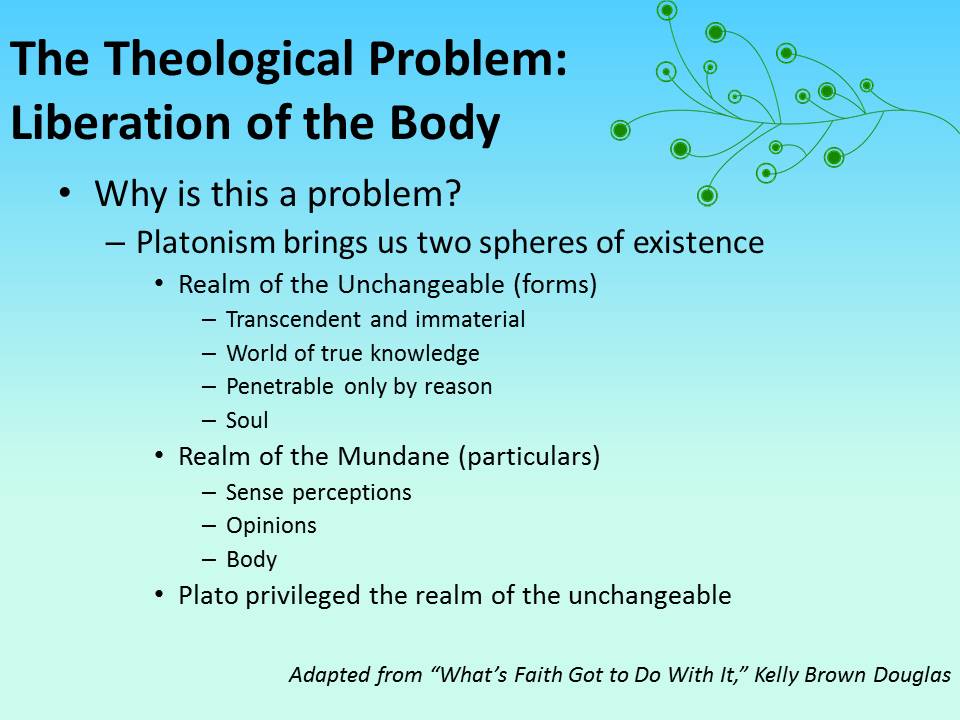
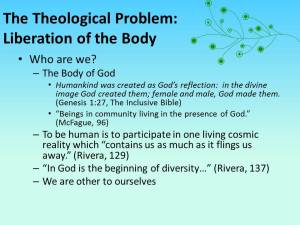
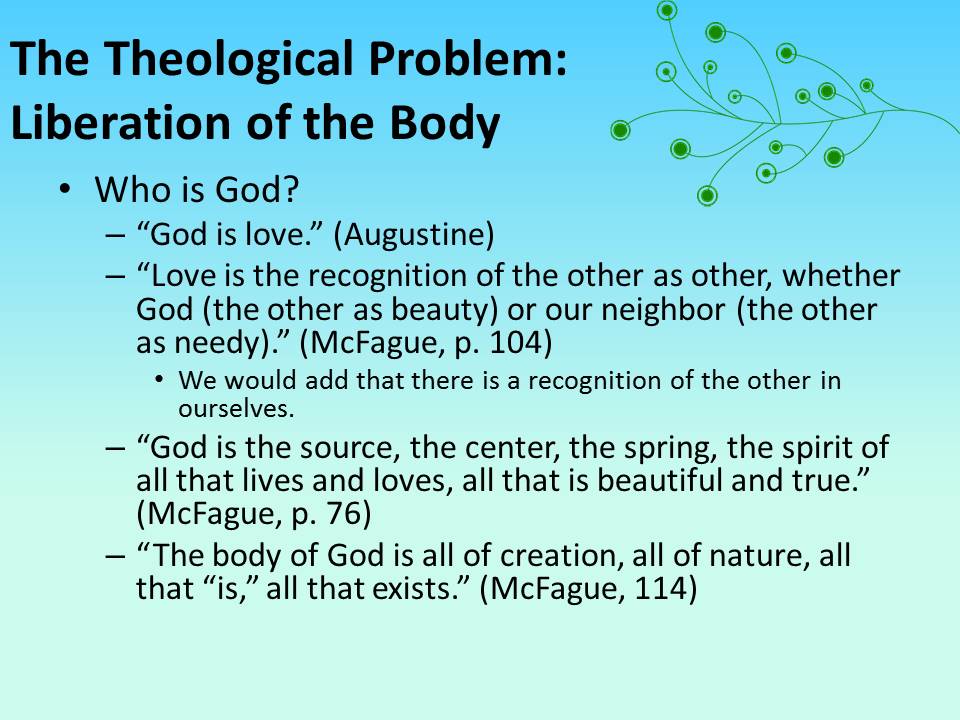
The Theological Problem: Liberation of the Body

by Terri Stewart, Denise Ritthaler, Terra Morgan, and Bjorn Peterson

We are talking about liberating the body in a variety of forms. It is a theological problem that has developed from Platonism which brings us the realm of forms and particulars. In forms we have transcendence, the soul, and reason. This is the optimal way of being in the world. In the particulars, we have our senses, opinions, and our body. This is not the preferred way of being in the world. Separating ourselves into dualistic (tri-istic?) bits ignores that we are one integrated body and only one way to experience our senses.

Platonism impacts Christianity through an interpretation of Jesus’ ascetic personal practices. Then Paul, who was Greek and had a greater influence from Platonic sources, brought a more extreme sexual ethic into his writings.

Then, through the source of tradition, we then have Augustine who tells us that the body is sinful and that the soul and reason are to be preferred. This places God as “out there.” Away from the body because clearly, God is not sinful, therefore, even though the Divine is incarnational, the Divine has nothing to do with the body.

Maya Rivera, theologian, says, “This privileges “sameness over difference, of the One over the multiplicity, of the universal over the particular…in such systems there is no place for real otherness. Totalities reduce persons to categories.” (Rivera, 57)

However, Neale Donald Walsh reminds us of the inseparability.

“Your mind holds the past,
your body holds the present,
your soul holds the future.
Put another way,
the mind analyzes and remembers, Slide5
the body experiences and feels,
the soul observes and knows.”

So who are we really?

We are the body of the Divine participating in one diverse reality that would cast us all as other.

And who is the Divine?

Slide6God is love in the recognition that we and all of creation exist together and yet the Divine is so much more. The source, the center, the spring of existence. The Divine is other, existence is other, and we are other to ourselves. And yet, we are all each an incarnational part of Love’s cosmic creation.

This approach to liberation of the body is through a demonstration of what it means for humans as sexual beings, humans as women and their body image, humans as the elder body, and humans as men. (Note: I would also consider that this is entirely too gendered, but it is a starting point.)

Liberation of the Sexual Body

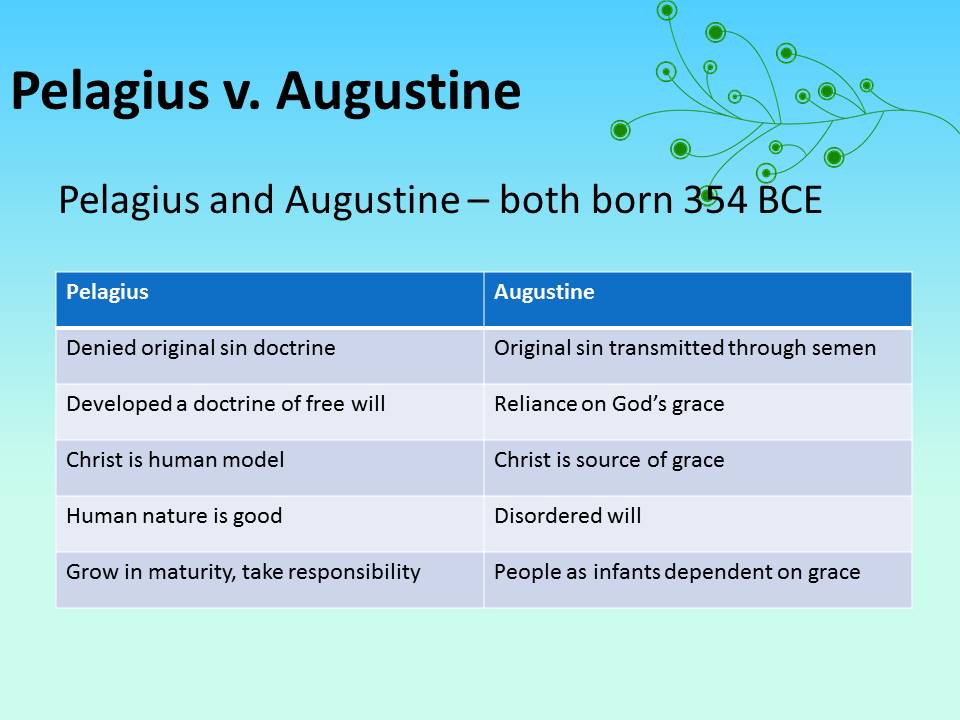
We are all sexual beings. Whether or not we have sex, we are sexual beings. In Western culture (and many others around the world), our sexuality is frowned upon. The appreciation for eros is limited. In ancient Greek, we have three words for love – agapos, philos, and eros. Each one describing a different aspect of love. Eros is believed to be that type of love that is the seat of creativity. In sexuality, we see this as the drive to have children – create! Some scholars believe that eros is the seat of all our creative desires. But our religious authorities rarely express this. This is because of a theological battle endured 1600+ years ago between Augustine and Pelagius.

Slide9If we had only chosen Pelagius! But the foundation is there to have a theology based in free-will and the idea that we are indeed born in a state of being good rather than in a state of being a worm. And it was good! Very, very good!

created by Terri Stewart
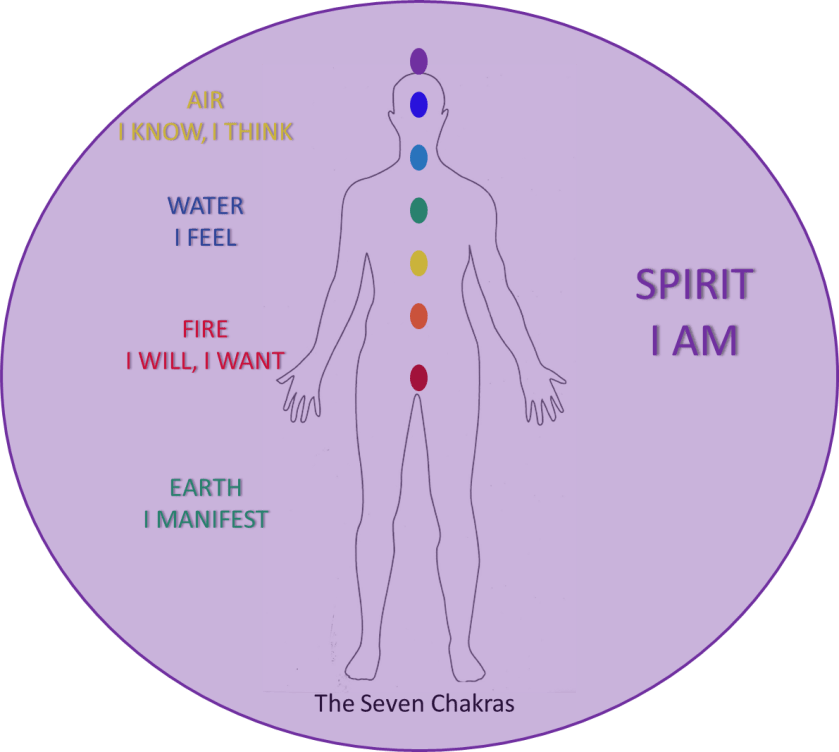
graphic created by Terri Stewart

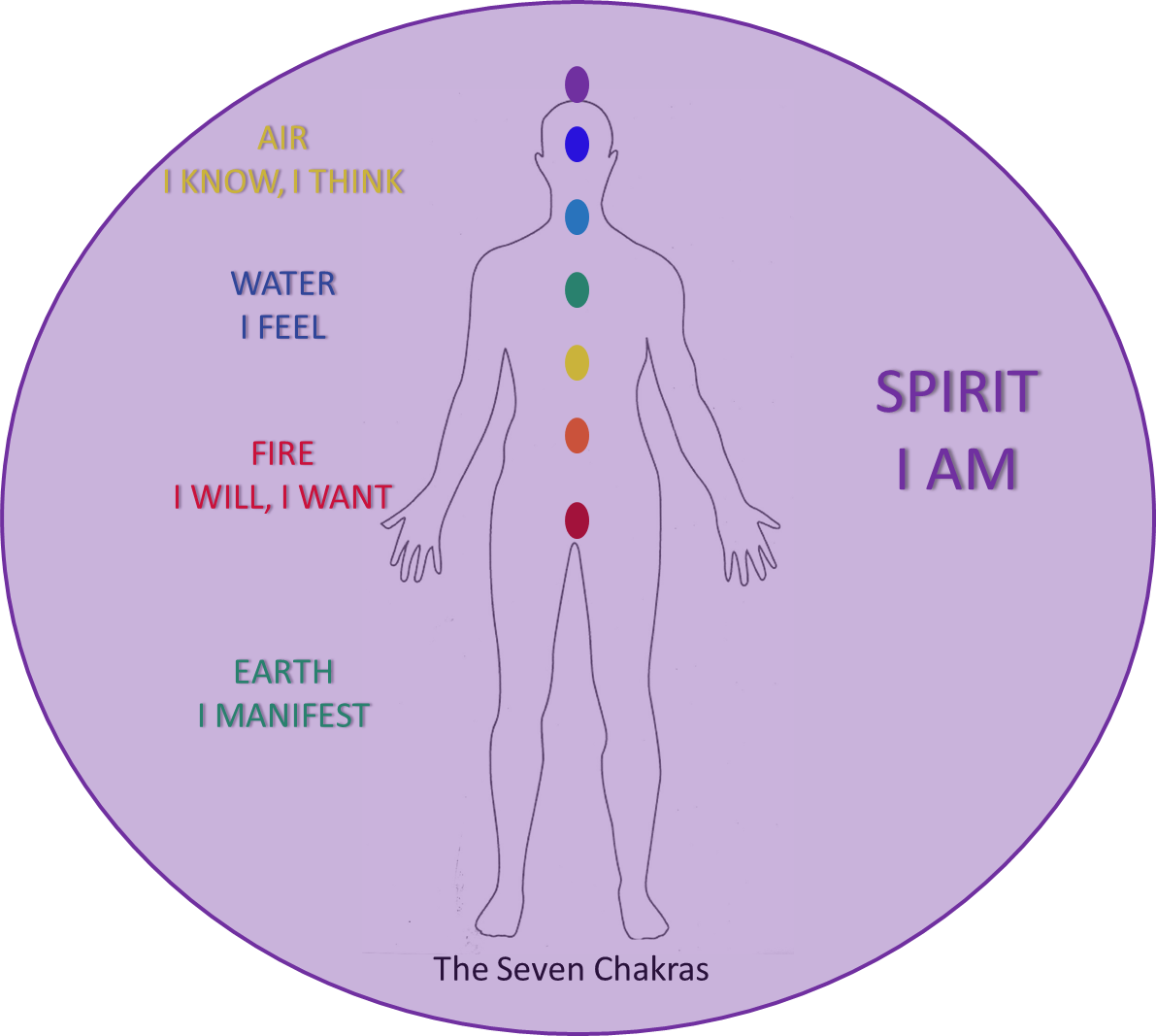
The Unity Church developed a philosophy of “The 12 Powers.” Spiritual abilities that we are perfectly able to express and that are present in every person. These powers hold that the body is good, very very good! This connects very nicely to the Chakras as described in so many ways and visualized to the right.

But through it all, from the beginning to now, the body, mind, and spirit has been connected to our bodies. Pelagius knew that and we can see it. And our creative, generative bodies can also experience being liberated through the concept of liberating our own bodies to give and receive love. We are created, we create. That is the Divine circle of our eros bodies.

One way to experience a liberated body grounded in eros-creativity is through music and movement. I encourage you to listen to the below, simple music and to move your body however you will–without shame or reservation. Reach an arm to the sky! Roll your head from side-to-side! Sway! Thou shalt do what thou shalt do! And this is the end of part 1, laying the groundwork for a Liberation of the Body and using cultural items to show that we are already liberated! Let’s claim our sexual, eros selves as liberated beings.

How would you write your eros liberation?

Pour Yourself In Me ~Rickie Byers Beckwith

A Unity Church Artist

Shalom and Amen!

terrisignoffblogBibliography

“2009 Table of Hotness” Maxim, 6 May 2009. http://www.maxim.com/amg/girls/articles/79154/2009-hot-100.html

Ara, Flora, and Taylor. Girls Making Media: Episode 4, “Body Image.” Written and presented by Ara, Flora, and Taylor. Produced by WomanKraft. Youtube.com. http://www.youtube.com/watch?v=u4GoHhnNhm4

ClassesUSA Advertisement. http://c5.zedo.com//ads2/f/851253/3840/0/0/305001042/305001042/0/305/514/zz-V1-1X1.2.html?a=s%3D514%3Bg%3D172%3Bm%3D7%3Bw%3D52%3Bu%3DsSzaTBYYEZ3Ri6hT6d7nFOXK~111010%3Bi%3D0%3B;l=;p=

Dove Beauty Evolution. Presented by Dove. 1 min., 16 sec.Youtube.com. http://www.youtube.com/watch?v=emQUHRlpeaE0.

Erickson, Latha. “Body-image pressure inundates teen girls” CNN.com, 15 March 2007. http://articles.cnn.com/2007-03-15/health/BK.girls.body.image_1_body-image-middle-school-girls-dads-daughters?_s=PM:HEALTH

Gaudiani, Caroline. “Fact Sheet: Women and Eating Disorders” National Organization for Women, http://loveyourbody.nowfoundation.org/factsheet_2.html.

Makkai, Katie. Pretty. Written and presented by Katie Makkai. 3 min., 29 sec. National Poetry Slam, 2002. Youtube.com. http://www.youtube.com/watch?v=M6wJl37N9C0.

“Model Controversies: Filippa Hamilton” MSN.com, 17 August 2010. http://lifestyle.in.msn.com/gallery.aspx?cp-documentid=4272433&page=3

Phillips, Susan S. Candlelight: Illuminating the Art of Spiritual Direction. Morehouse Publishing: Harrisburg, NY, 2008.

The Macc Lads. “Ugly Women.” From Beer to Eternity. Castle Music UK, 2007.

“Top 5 Surgical Cosmetic Procedures 2008.” American Society for Aesthetic Plastic Surgery. http://www.cosmeticplasticsurgerystatistics.com/statistics.html#2008-GRAPHS

“Who is the Most Beautiful Woman in the World?” Vanity Fair, 30 March 2009. http://www.vanityfair.com/online/daily/2009/03/who-is-the-most-beautiful-woman-alive.html

Takayanagi, Paul, Journal of Religious Gerontology, Volume 10, The Institute of Spirituality and Aging: Identifying and Promoting Spiritual Values of Elders, The Hawthorne Press, Inc. 1996

Cole, Thomas, R., The Journey of Life: A Cultural History of Aging in America, The Body As an Instrument of Control, “Women, Aging and Ethics”, New York: Cambridge University Press, Inc. 1992.

The Robert Wood Johnson Foundation, Last Acts – Rallying Points To Improve Care and Caring Near End of Life, National Resource Center on Diversity, “Diversity Notes”, September 2002.

Chrissy Fitness, July 25, 2008, “Nadine Vlazquez”, http://christyfitnessblogspot.com/2008/07/nadine- vlazquez-body.html

Prescott, Rebecca. “2010 Body Building Steroids and Great Alternatives”, http://www.fitnessfuntastic.com/BodyBuildingSterioids.html

Listal Most Beautiful Female Faces, “Freida Pinto”, January 8, 2010, http://www.listal.com/list/most- beautiful-female-faces

Scott Hoover Photography, Saturday, March 26, 2009, “Male Model and Actor Corey Grant” , http://scotthooverphotogrpahy.blogspot.com/2009/03/corey-grant.html

Shutter Stock Images, “Energetic Girl Dancing”, http://www.shutterstock.com/pic-10071150/stock- photo-of-energetic-girl-dancing-in-the-night-club-with-her-boyfriend-looking-at-her.html

Bloggy Business Today, February 4, 2008, Super Bowl Advertisement, http://bloggybiz.com/business- tools/super-bowl-save-by-tv-commercials.html

Inspirational Quotes, 2010 ”Budweiser, King of Beers”, http://www.inspirational-quotes-short-funny- stuff.com/funny-ads.html

Pierce Mattie Public Relations New York and Los Angeles, November 29, 2006, “Package Wrapping” http://www.piercemattie.com/blogs/trends

Blogger retrieved from Google Search, Titled “How Far Will Beauty Take Us?”, Victoria Secret Cover http://www.d.umn.edu/~loche006/beauty.html

False Eye Lashes Info, Davidoff Echo Woman, “Ladies Perfume for Summer”, http://falseeyelashesinfo.com/ladies/perfume/

The Scented Salamander, 2008 New Fragrances, Jennifer Lopez “Deseo for Men”, http://www.mimifroufrou.com/scentedalamander/2008/05/jennifer_lopez_for_men_2.html

Smith, Zach, Indy Week.com, August 11, 2010 “In it’s 15th Year, the N.C. Gay and Lesbian Film Festival has mainstream clout”, Photo courtesy of MAD STU MEDIA, documentary “Gen Silent”, http://www.indyweek.com/indyweek/in-its-15th-year-the-nc-gay-and-lesbian-film-festival-has- mainstream-clout/Content?09d=1594193

Wagner, John, The Hallmark Shoebox Collection, “I Keep Hitting Escape”, http://www.tcnj.edu/~hofmann/Maxine/maxine.htm e-Forwards.com, posted by John, “The Not So Golden Years”, http://www.e- forwards.com/2009/12/not-so-golden-years

Book FHR.com, “Better Access For Disabled Passengers at Prestwick Airport”, posted by Graham Greenaway October 9, 2008, http://www.fhr_net.co.uk/travel- news/1467/better_access_for- disabled_passengers_at_prestwick_airport

Department of Management & Budget, Office of Retirement Services, State Employees Defined Benefit Plan, http://www.michigan.gov/orstatedb/0,1607,7-208-30608_33437-,00.html

Lazzaretto, John, Independent Health Insurance Broker, “Medicare Supplemental Insurance Needs”, http://medicarejohn.com/medicare%20basics.html

Bayview Hunters Point Multipurpose Senior Services, Inc, 2009, “Money Management Services”,http://www.phpmss.org/aarp_money_management_services.html.

Burkhard, Brian, R., Your Funeral Guy, March 29k, 2010 “Funeral News with the Consumer in Mind”, http://yourfuneralguy.wordpress.com/2010/03/29/neptune-socieity-ad-another- cremation-marketing-blunderyourfuneralguy.html

MySA, San Antonio Home Page advertisement, http://www.legacy.com/obituaries/sanantonio/obituary-funeralhome.aspx?fh=neptune- society-&fhid=10111.

Evergreen Hospice Care, Copyright © 2008-2009 Evergreen Hospice Care, Inc. All rights, http://www.evergreenhospicecare.com/

Enya, A Day Without Rain, “Only Time” Produced by Enya and Nicky Ryan, 2000 EMI Songs Ltd./EMI Blackwood Music Inc., Warner Music UK Ltd

Hub Pages, by Peaceful Warrior, “Slow Down the Aging Process 69” http://www.hubpages.com/hub/Slow-Down-the-Aging-Process.html

Terrafolia Flowers, Advertisement, “Rutgers Study Links Flowers to Senior Citizens Well Being” http://www.terrafolia.ca/flowers-seniors.html#ixzz15INxnrfi

http://www.terrafolia.ca/flowers-seniors.html (orange shirt)

Brown Douglas, Kelly. What’s Faith Got to Do with It? Black Bodies/Christian Souls. Orbis Books: Maryknoll, NY, 2005.

Dennen, Bret. There is so Much More. So Much More. Dualtone Music Group, 2006.

McFague, Sallie. A New Climate for Theology: God, the World, and Global Warming. Fortress Press: Minneapolis, 2008.

Rivera, Mayra. The Touch of Transcendence: A Postcolonial Theology of God. Westminster John Knox Press: Louisville, 2007.

Williams, Saul. Sha-Clack-Clack. Slam: The Soundtrack. Sony, 1998.

Morgan, Fiona, Daughters of the Moon Tarot, Daughters of the Moon, Willits, CA, 1984.

Comstock, Gary David, A Whosoever Church, Westminster John Knox Press, Louisville, Ky., 2001.

Comstock, Gary David, Gay Theology Without Apology, Wipf and Stock Publishers, Eugene, Oregon, 2009.

Fillmore, Charles and Cora, The Twelve Powers, Unity House, Unity Village, MO, 1999.


Posted in Dharma Talk, Essay, Meditation, memoir, Poets/Writers, Priscilla Galasso

Honoring My Father

George William Heigho II — born July 10, 1933, died March 19, 2010.

Today I want to honor my dad and tell you about how I eventually gave him something in return for all he’d given me.

My dad was the most influential person in my life until I was married.  He was the obvious authority in the family, very strict and powerful.  His power was sometimes expressed in angry outbursts like a deep bellow, more often in calculated punishments encased in logical rationalizations.  I knew he was to be obeyed.  I also knew he could be playful.  He loved to build with wooden blocks or sand.  Elaborate structures would spread across the living room floor or the cottage beach front, and my dad would be lying on his side adding finishing touches long after I’d lost interest.  He taught me verse after verse of silly songs with the most scholarly look on his face.  He took photographs with his Leica and set up slide shows with a projector and tripod screen after dinner when I really begged him.  He often grew frustrated with the mechanics of those contraptions, but I would wait hopefully that the show would go on forever.  It was magic to see myself and my family from my dad’s perspective.  He was such a mystery to me.  I thought he was God for a long time.  He certainly seemed smart enough to be.  He was a very devout Episcopalian, Harvard-educated, a professor and a technical writer for IBM.  He was an introvert, and loved the outdoors.  When he retired, he would go off for long hikes in the California hills by himself.  He also loved fine dining, opera, ballet, and museums.  He took us to fabulously educational places — Jamaica, Cozumel, Hawaii, and the National Parks.  He kept the dining room bookcase stacked with reference works and told us that it was unnecessary to argue in conversation over facts.

Camping in Alaska the summer after his senior year in High School: 1951.

My father was not skilled in communicating about emotions.  He was a very private person.  Raising four daughters through their teenaged years must have driven him somewhat mad.  Tears, insecurities, enthusiasms and the fodder of our adolescent dreams seemed to mystify him.  He would help me with my Trigonometry homework instead.

Playing with my dad, 1971.

I married a man of whom my father absolutely approved.  He walked me down the aisle quite proudly.  He feted my family and our guests at 4 baptisms when his grandchildren were born.  I finally felt that I had succeeded in gaining his blessing and trust.  Gradually, I began to work through the  more difficult aspects of our relationship.  He scared my young children with his style of discipline.  I asked him to refrain and allow me to do it my way.   He disowned my older sister for her choice of religion.  For 20 years, that was a subject delicately opened and re-opened during my visits.  I realized that there was still so much about this central figure in my life that I did not understand at all.

Grandpa George

In 2001, after the World Trade Center towers fell, I felt a great urgency to know my father better.  I walked into a Christian bookstore and picked up a book called Always Daddy’s Girl: Understanding Your Father’s Impact on Who You Are by H. Norman Wright.  One of the chapters contained a Father Interview that listed dozens of questions aimed at bringing out the father’s life history and the meaning he assigned to those events.  I decided to ask my father if he would answer some of these questions for me, by e-mail (since he lived more than 2,000 miles away).   Being a writer, this was not a difficult proposition for him to accept.  He decided how to break up the questions into his own groupings and sometimes re-phrase them completely to be more specific and understandable and dove in, essentially writing his own memoirs.   I was amazed, fascinated, deeply touched and profoundly grateful at the correspondence I received.  I printed each one and kept them.  So did my mother.  When I called on the telephone, each time he mentioned how grateful he was for my suggestion.  He and my mother shared many hours reminiscing and putting together the connections of events and feelings of years and years of his life.   On the phone, his repeated thanks began to be a bit eerie.  Gradually, he developed more symptoms of dementia.  His final years were spent in that wordless country we later identified as Alzheimer’s disease.

I could never have known at the time that the e-mails we exchanged would be the last record of my dad’s memory.  To have it preserved is a gift that is priceless to the entire family.  I finally learned something about the many deep wounds of his childhood, the interior life of his character development, his perception of my sister’s death at the age of 20 and his responsibility in the lives of his children.   My father is no longer “perfect”, “smart”, “strict” or any other concept or adjective that I could assign him.  He is simply the man, my father.  I accept him completely and love and respect him more holistically than I did when I knew him as a child.  That is the gift I want to give everyone.

I will close with this photo, taken in the summer of 2008 when my youngest daughter and I visited my father at the nursing home.  I had been widowed 6 months, had not yet met Steve, and was anticipating my father’s imminent passing.  My frozen smile and averted eyes are fascinating to me.  That I feel I must face a camera and record an image is somehow rational and irrational at the same time.  To honor life honestly is a difficult assignment.  I press on.

© 2014, essay and photographs, Priscilla Galasso, All rights reserved

.

004PRISCILLA GALASSO ~ started her blog at scillagrace.com to mark the beginning of her fiftieth year. Born to summer and given a name that means ‘ancient’, her travel through seasons of time and landscape has inspired her to create visual and verbal souvenirs of her journey. Currently living in Wisconsin, she considers herself a lifelong learner and educator. She gives private voice lessons, is employed by two different museums and runs a business (Scholar & Poet Books, via eBay and ABE Books) with her partner, Steve.

Posted in General Interest, Illness/life-threatening illness, Jamie Dedes, poem, Poems/Poetry, Poets Against War Week

Our Sighs Ride the Ebb-tides of Eternity …


On May 28, our group for people with life-threatening illnesses celebrated the lives of those who have already passed on. I was unable to attend the memorial service due to bronchitis, but I celebrate them, two of my family, and this wonderful group here today.

Our group is composed of people from several different religious traditions and is hosted by our local Insight Meditation Center. The group was founded and is run by a Buddhist chaplain who has been very kind and is a stalwart friend to each of us.

I no longer attend meetings. By some surely unearned grace, I am now considered “chronic and stable” and I’ve grown to the point that the news of death no longer disturbs me. The major take-away for me from this experience is that the only difference between having a medically predicted expiration date and not knowing when our time will come is that with a diagnosis, we no longer fall into those moments of denial. That’s a huge gift. Huge! The result is that we become present in each moment. 

Today, is my loving celebration of: Ann, Deborah, Dick, Ernie, Hilda, Mary, Parvathy, Robert, Mary Kate, Steve, Victor and to family lost in recent years: my former husband, Kirby (the most decent man I’ve ever known), and my cousin, Christopher, with whom I grew-up and who was like a brother … 

Each moment and every person is precious and beautiful and the only thing that really matters is how much we have loved and been loved and that – as survivors – we continue to live in the service of our families and those in need. In the end it would seem that’s the best way to honor the family and friends whose memory we treasure .

IMG_20140525_103644407Eternity flowed deftly through the last eight years
enfolding in her stream eleven with whom we
contemplated Knowledge and Mortality
Looking back, we ponder amazed at love among friends,
……….it blossoms fragrant, as gentle
……….as a dewy rose among thorns and thistles
We thrash and crawl and climb
……….puzzling
……….over the sea and fire that stalks us
Our hearts, cupped in one another’s hands
……….like castanets, beat in unison
Our measured moments grave lines in phantom fears,
……….they float like storm clouds above us
In words of jade, we speak elegies and encomiums
Our smiles mask our sorrows and yearning
Our laughter is love grown wild
We see each other in a thousand shapes and dreams
……….and in nameless names
Our sighs ride the ebb tides of Eternity
…..Another moment:
…..and even the sun will die
…..but our lotus song will echo on ….
……….We have lived! We have loved!

© 2014, poem and photograph (yellow roses traditionally symbolize friendship), Jamie Dedes, All rights reserved

Photo on 2014-03-31 at 17.16 #3unnamed-18JAMIE DEDES (The Poet by Day)~I am a medically retired (disabled) elder and the mother of married son who is very dear. I started blogging shortly after I retired as a way to maintain my sanity, to stay connected to the arts and the artful despite being mostly homebound. My Facebook pages are: Jamie Dedes (Arts and Humanities) and Simply Living, Living Simply.

With the help and support of talented bloggers and readers, I founded and host The Bardo Group because I feel that blogging offers a means to see one another – no matter our tribe – in our simple humanity, as brothers and sisters and not as “other.”

“Good work, like good talk or any other form of worthwhile human relationship, depends upon being able to assume an extended shared world.” Stefan Collini (b. 1947), English Literary Critic and Professor of English Literature at Cambridge