The BeZine Blog

Posted in  Mya Schneider, General Interest, poetry, Poets/Writers, Writing

Myra Schneider asks, “Who is poetry for?”

1815_coversNote: This full-length feature article is presented as an appropriate wrap after celebrating interNational Poetry Month (April). The feature was originally published by ARTEMISpoetry (13 November 2013) and is delivered here with the permission of the publisher (Second Light Live) and the author, Myra Schneider. Although Myra discusses poetry in Britain, we feel her observations apply to other countries as well. Jamaica only just appointed a poet laureate for the first time in fifty years. This month in the U.S. King Features Syndicate partnered with the American Academy of Poets to present poetry to the general public along with the news, which hasn’t been done in the U.S. for more than a generation.

Some months ago at one of the twice-yearly poetry readings, which I help organize for Poetry in Palmers Green, a woman I didn’t know, turned to me as she was leaving and said apologetically: ‘I’m afraid I don’t write poetry.’ It was as if she had been attending under false pretences. I told her we welcomed everyone and felt it important our audience didn’t only consist of writers. The conversation reminded me sharply that in Britain poetry is in the main seen as a separate world. Who would go to a concert feeling uncomfortable that she/he didn’t play a musical instrument?

Why is it that contemporary poetry is often viewed as a minority art form when there is often no more potent way of expressing and communicating vital aspects of life and thought?

One problem is the poor coverage of poetry by the media. BBC Radio 4 broadcasts the poetry request programme Poetry Please. The medium of radio is, in fact, ideal for poetry and Radio 4, which includes readings twice a day from prose books, could offer much more. However, there are some green shoots. Radio has given serious attention to some contemporary translations of classical poetry, such as Amy Kate Riach’s translation of The Seafarer broadcast with sound effects and music on Radio 4, summer 2012. This programme also included a discussion of the poem led by Simon Armitage. This year a Radio 4 play was based on the life of the poet Clare Holtham, drawing on her writing. Radio 4 is also due to broadcast in January next year, as an Afternoon Play, Pam Zinnemann-Hope’s adaptation of her book-length poem On Cigarette Papers about the lives of her parents. More programmes with a poetry focus would be valuable.

Television rarely gives attention to poets and poetry. Serious drama, art and classical music, are all featured on both radio and television. Over recent years national newspapers have cut down the space they give to poetry. At one time there was a daily poem in The Independent and a weekly poem in The Observer. These have been dropped. The Guardian usually features a very short poem in its Saturday Review and a long review of one collection by a well-known poet. It used also to include two or three short reviews. Few bookshops hold good collections of poetry.

The mainstream media’s focus on a very small number of ‘hyped’ poets disguises the great range of lesser-known but strong writers whose poetry deserves to be heard. A large number of poetry collections are published each year but potential readers have no pointers about what is on offer amongst this confusing variety. If they go into a bookshop which does have an extensive poetry section (rare!) they may alight on books in which the poetry is obscure, erudite or both and others which are streetwise or jokey. They may remember some poems from the past which they liked as children but have no idea how to make their way into contemporary poetry. Unless they chance upon a book they can relate to they will probably give up.

There are, however, certain organizations and individuals who are concerned to take poetry to a wider audience. The Bloodaxe anthology, Staying Alive, and its sequels include in themed sections a wide range of accessible contemporary, twentieth century together with a few earlier poems, that is poems whose language and rhythm communicate their general sense. In comparison with the normal sales of poetry books, these anthologies have had huge and deserved success.

In London the Southbank Centre offers a fair number of readings by acclaimed poets from the UK and overseas. These draw in some non-poets as does Poet in the City’s themed readings. The Poetry Libraries in London and Edinburgh are invaluable resources with their comprehensive collections of books for children as well as adults. Both stock magazines and leaflets, provide information and put on intimate readings by a wide range of poets. Poems on the Underground and the charity, Poems in the Waiting Room, both long-running, bring poetry to the many who are unused to hearing or reading poems. The Poetry Society, which sees part of its role as bringing poetry to the public and is the main organizer of National Poetry Day, helps promote Poems on the Underground.

Of prime importance is the work done, on whatever scale, by individuals who have found ways to introduce poetry directly to non-poets. I want to mention some of the very different examples I am aware of.

Deborah Alma, who wrote about her Emergency Poet Service in ARTEMISpoetry 10, is in great demand at city centre events and venues such as pubs as well as at poetry and arts festivals. She travels as a poetry ‘doctor’ in her adapted ambulance and comments, ‘What I do by “prescribing” a poem for their “empty-nest-syndrome”, their stress or heart-break, is show them that poetry has something to say, that it can speak intimately…I try to tailor the poem to their reading habits and taste. I really do believe that poetry is for and about everyone. I might recommend a Bloodaxe anthology…It works! And it matters.’

Poet Kaye Lee, who attends a WEA Writing for Pleasure class, was asked by the tutor, whose interest was prose, to run a poetry session. She told me it was difficult because although one member of the group had requested poetry most of the others were antagonistic, considering it outlandish and too difficult. She started by reading and discussing several accessible list poems by Ruth Fainlight and other poets as a lead-in to writing and gradually won the group over. Keeping to the format of beginning with themed poems, she now runs one very popular session every term. Some members of the group are reading poetry for pleasure at home.

This year the Second Light Network invited a few book-groups to accept copies of Mary MacRae’s posthumous poetry collection, Inside the Brightness of Red, to study her work and to send in reviews. Some book-groups had previously avoided poetry books and a typical comment was: ‘Only twice in the last fifteen years…have we ventured into poetry. The few reviews coaxed from our group suggest that we might do well to dedicate more evenings to poetry in the future.’ Though Mary MacRae was widely admired by fellow-poets, she did not have a high public profile. Nevertheless, the many new readers targeted by this project were able to appreciate both the power of her work: ‘This is a luscious book of poetry. It oozes beauty and wistfulness and is a joy to have by the bed – a poem at bedtime.’ Such enthusiasm makes you wonder what it would take to bring more people and more poetry back together (‘a poem at bedtime’?).

While she was manager of Palmers Green Bookshop Joanna Cameron, a non-poet who loves poetry, ran a series of successful poetry readings. Much of the audience was made up of customers who didn’t write poetry. Later, Joanna was a founder member of Poetry in Palmers Green and she has brought many non-poets to the readings. She now lives near Cambridge where she is putting on readings for Oxfam. She believes it is important to be inclusive while offering a high standard of poetry. She told me she’s seen tightly buttoned men cry at events and heard people saying, ‘I didn’t know poetry could be like that’.

Coming from a background of working in casinos and playwriting, William Ayot became interested in poetry, both reading and writing it, in the 1990s. He included poetry in rehab work he did in prisons and for many years he has used poetry as part of teaching leadership in boardrooms and business schools all over the world. Unable to find a poetry group when he moved to Chester some years ago, he started Poetry on the Border. The series offers accessible poets to large audiences, many of whom are not poets. Recently he set up NaCOT (National Centre for Oral Tradition) and poetry, of course, has a role in this.

Poet John Killick has done major work using poetry with people who have dementia. He writes down a person’s words and then shapes them on the page. The resulting text is then approved by the person and released for circulation among care staff, relatives and a wider public. Anthologies of these poems have been brought out by the publisher, Hawker. John is now mentoring other poets to work in the same way. He also gives readings from these poems and his own at events which link poetry and health issues. Earlier in his career he used poetry in full time educational work with prisoners and he has done poetry residences in hospices.

Other poets are making valuable contributions in healthcare areas. Rose Flint has used poetry in hospital wards, special units and community groups. Another example is Wendy French who has worked in various health areas and been chair of Lapidus, an organization concerned with writing for personal development which very much involves poetry. Survivors Poetry offers poetry and poetry writing to those have suffered mental illness.

It goes without saying that bringing poetry to children is of paramount importance and the Poetry Society see it an essential part of their role to send poets into schools. The work of Sue Dymoke and Anthony Wilson, poets and university lecturers who support teachers by showing them exciting ways of introducing poetry to their pupils, is immensely valuable.

The Internet also offers routes into poetry. In the Guardian Poem of the Week Carole Rumens presents a poem with detailed description and comment. Helen Ivory posts a daily poem on Ink Sweat and Tears, a site which sometimes includes reviews of poetry. Oxford Brookes Poetry Centre posts a weekly poem. Some enthusiastic poets have blogzines in which they regularly introduce poets, together with one of their poems, in an informal but informative way. These sites are helpful to those beginning to read poetry and experienced writers are likely to gain insights from them too.
Blogzines I particularly I admire are posted by Kim Moore, Anthony Wilson and Jamie Dedes.

Kim Moore begins her posts with a lively account of her poetry week, then moves on to her chosen poet and poem. She told me she hoped to normalize poetry as having a part of a working week. In his daily Lifesaving Poems Anthony Wilson (mentioned above) presents a poem which is key to him and includes the personal circumstances in which he came across it as part of his commentary. Jamie Dedes, a retired journalist who lives in California, loves and now writes poetry. She often features articles, poems and interviews with poets in her daily blogzine, The Poet by Day.

It is very clear that themes of wide general interest as well as an informal approach provide inviting routes into poetry. This was underlined for me by Kim Moore. She was asked, as a local writer, to take part in a reading by a visiting poet on the subject of pregnancy and breastfeeding. The evening, she told me, was very popular and though none of her poems had any connection with the subject and no one in the audience whom she spoke to her had ever been to a poetry reading before, she sold nine copies of her debut pamphlet.

Although the media view poetry as a minority art I take heart from the fact that there are organizations and generous individuals committed to fostering an interest in it. I would like to think their number is growing and also that some of those who read this article might consider developing their own ‘open house’ approach.

How might we contribute? Possibly by boldly offering our own creative and/or critical work to various media. Would a long poem or sequence of yours, adapted, suit a Radio 4 ‘Afternoon Play’. Have you considered such a submission? Are we willing to post reviews of excellent collections we have read? Do we dare to invite a book group that we attend – one that never trifles with poetry – to look at a suitably accessible, intriguing individual collection of poetry or an anthology?

I know that the editors of ARTEMISpoetry would welcome and consider printing any information about schemes for widening the audience for poetry. After all, we are worth it.

Myra Schneider

© 2013, essay and portrait below, Myra Schneider, All rights reserved; © 2014, illustration, Second Light Live, All rights reserved

References:

Amy Kate Riach, The Seafarer, Sylph Editions, 2010
Bloodaxe Books, http://www.bloodaxebooks.com
The Poetry Library, Southbank, London, http://www.poetrylibrary.org.uk
The Scottish Poetry Library, Edinburgh, http://www.scottishpoetrylibrary.org.uk/‎
Poems on the Underground, http://www.tfl.gov.uk/corporate/projectsandschemes/2437.aspx
The Poetry Society, http://www.poetrysociety.org.uk
Poems in the Waiting Room, http://www.poemsinthewaitingroom.org‎
Kaye Lee, http://www.secondlightlive.co.uk
Second light Network of Women Poets, http://www.secondlightlive.co.uk
Mary Macrae, Inside the Brightness of Red, Second Light Publications, 2010
Joanna Cameron, joannacameron@live.com
Deborah Alma, Emergency Poet, emergencypoet.com
William Ayot, http://www.williamayot.com
John Killick, http://www.dementiapositive.co.uk
Wendy French, wendyfrench.co.uk
Rose Flint, http://www.poetrypf.co.uk
Lapidus, http://www.lapidus.org.uk
Survivors Poetry, http://www.survivorspoetry.org
Anthony Wilson, http://anthonywilsonpoetry.com
Sue Dymoke, http://suedymokepoetry.com/books
Guardian Poem of the Week, http://www.theguardian.com/books/series/poemoftheweek‎
Oxford Brooks Poetry Centre, ah.brookes.ac.uk
Ink Sweat and Tears, http://www.ink-sweat-and-tears.com
The Poet by Day, http://musingbymoonlight.com
Kim Moore, http://kimmoorepoet.wordpress.com

How might you contribute? Possibly by boldly offering you own creative and/or critical work to various media. Would a long poem or sequence of yours, adapted, suit a Radio 4 ‘Afternoon Play’. Have you considered such a submission? Are you willing to post reviews of excellent collections we have read? Do you dare to invite a book group that you attend – one that never trifles with poetry – to look at a suitably accessible, intriguing individual collection of poetry or an anthology?

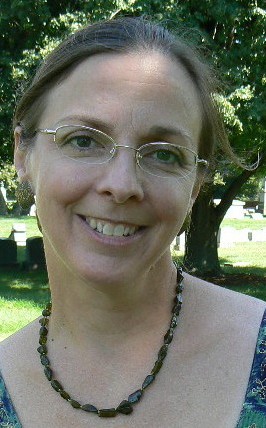
IMG_0032-1Myra’s long poems have been featured in Long Poem Magazine and Domestic Cherry. She co-edited with Dilys Wood, Parents, an anthology of poems by 114 women about their own parents. She started out writing fiction for children and teens. We first discovered Myra through her much-loved poem about an experience with cancer, The Red Dresswhich she generously shared with readers here in our Perspectives on Cancer series in 2011.

Currently Myra lives in North London, but she grew up in Scotland and in other parts of England. She lives with her husband and they have one son. Myra tutors through Poetry School, London. Her schedule of poetry readings is HERE.

Posted in Culture/History, Disability, First Peoples, General Interest, Mental Health, Michael Watson, Shakti Ghosal

Trauma, Story, and Healing

Evening-Sky

He sat on the sofa, pulled deeply into himself, almost disappearing before my eyes, as he told me about his dad’s violence. I wondered whether he knew I was in the room with him. “I feel terribly fragmented; I don’t know who I am,” he explained. “I can’t remember ever being like everyone else; they seem so at home in themselves.”

One of my teachers, a Psychoanalytically oriented clinician, always said the real problem is the second trauma. Her view was the first trauma one encounters sets the stage for PTSD and related problems; the second trauma triggers the cascade. Repeated traumas in childhood physically alter the function of the developing brain, leaving one more vulnerable to new trauma. Even if only one trauma occurs in early childhood the person may remain susceptible to PTSD via a second trauma as an adult.

Continue reading “Trauma, Story, and Healing”

Posted in General Interest, Guest Writer, poem, Poems/Poetry, poetry

Burnt Mustard

In micro pots I scattered chilly seeds a week ago
sunflower a couple of days back
yesterday mustard

trying to push away a gift of space
suffusing the air with its acrid smell of loss

A vacuum sucks thoughts till I have none left
to appraise
I am
water draining through loam
spring cleaning myself
though that feels like being robbed

Arrivals are better at sustaining life
I hug and hold myself from draining out
through the tiny holes in the pots

There is a creamy curry in a blackened dish
spoilt by attention wandering through
spicy sunflower fields

There too a smell of burnt seeds preceded me
Strange
The mustard hasn’t sprouted
yet it has claimed the breeze

– Reena Prasad

(c) Reena Prasad, poem and portrait below

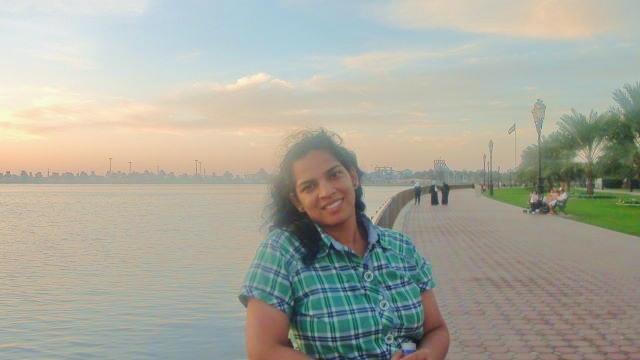
reeREENA PRASAD (Butterflies of Time, a canvas of poetry) ~ is a poet from India, now based in Sharjah. She has several poems published in English anthology collections (Change, Indus Valley, Love in Verses, Musings–a Mosaic, eight anthologies by Barry Mowles and Friends and ten of Brian Wrixon’s anthologies, also in online jounals: Carty’s Poetry Journal, Indian Ruminations, Indian Review and in online magazines such as Youth Ki Awaaz and Thanal Online. Her poems have found place among the winning entries in contests by Writer’s Cafe, Ekphrasis India and Poets Corner. She is a contributor to many international journals like

The Copperfield Review, First Literary Review-East, Angle Journal, Poetry Quarterly etc.

Posted in Bardo News, General Interest

BARDO NEWS: Enitharmon Press Launches 3 Poetry Collections; Connotation Press Call for Submissions; Plum Tree Books’ Children’s Imprint; interNational Poetry Month celebrations… and more…read on…

KUDOS FIRST Terri Stewart has been selected to present a first person monologue at the Network of Biblical Storytellers Conference in Los Angeles in August. She was also selected to teach a workshop titled “Developing First Person Monologues with Integrity.” She will be the keynote speaker at the United Methodist Women’s (Pacific Northwest) conference in October. She is speaking there on Creating Safe Space.

interNATIONAL POETRY MONTH is coming to an end. We recreated this annual April event, which is national in Canada and the United States, into an international celebration inclusive of everyone in our collective and consistent with our philosophy. Poetry – as all art – knows no borders.

What a good time we shared with readers and writers as we enriched one another’s lives. We published ten poems on the blog, were introduced to the lives and work of two poets, the Bulgarian Blaga Dimitrova (courtesy of Blaga Todorova) and the American Chirlane McCray (courtesy of Jamie Dedes), and sponsored two reader-participation events: Writers’ Fourth Wednesday hosted by Victoria C. Slotto and A Poem in Your Pocket hosted by Corina Ravenscraft.

We are pleased to share the news that Elegy to Damascus from the exquisite pen of Algerian Imen Benyoub garnered much attention, including two re-blogs and nearly fifty Facebook “Likes.” The poem is very much in the spirit of Bardo.

WHO IS POETRY FOR? This coming Wednesday as we put closure on poetry month – but not poetry – we share an essay from Bardo friend, Myra Schneider, who is much appreciated for her work as a poet and teacher, a consultant to Second Light Network and for her encouragement of others to read and write poetry for well-being. Myra asks, “Who is Poetry For?” and invites suggestions on how we might widen the audience for poetry. Feel free to offer suggestions in the comments section whether you are invested in this art as vocation or avocation or as an enthusiastic reader.

SECOND LIGHT NETWORK‘s next issue of ARTEMISpoetry is due out in May. The network’s anthology Her Wings of Glass is forthcoming this October. On Wednesday a review of the November issue by Jamie Dedes will post on The Poet by Day. Note: Second Light Network was founded and is based in England but its membership is open to women world-wide. See the site for more info on membership qualifications, membership costs and benefits.

PLUM TREE BOOKS (PTB) Niamh Clune announced this week that PTB had a face-lift. “We are focussing on DR. NANA PLUM’S AMAZING BOOKS FOR CHILDREN and have updated our web-site accordingly.”

The launch of the new web-site is on Saturday 3rd of May. “We hope you will join us then for story-telling and more.” Niamh has invited us to visit, so do save the date and lend your support. For a taste of what’s to come, visit Dr. Nana Plum’s Story Corner.

PTB Anthology in the works: Niamh reports thatwe have received some wonderful poetry submissions and art for our Mother anthology. There is still time to send in yours.”

BRAVO! A pat on the metaphorical back of Jamaica, which just this month named its first National Poet Laureate in fifty years. Read all about it HERE.

YOUTH POET LAUREATES: Los Angeles County Youth have until May 19th to submit work to Urban Word, which will name one talented person (aged 14-19)LA Youth Poet Laureate. Details HERE.

In January at Mayor Bill de Blasio’s inauguration, New York’s Youth Poet Laureate, Ramya Ramana, read her poem entitled New York City, a poem dedicated to Mr. de Blasio.

YOUTH CORNER: The Bardo Group is still looking for a youth – aged 19-24- to run a Youth Poetry Corner. Email us at bardogroup@gmail.com if you are interested.

ENITHARMON PRESS: The media team at Enitharmon Press alerts us to the publication of three new books of poetry in May with announcements of book launches in London for those in our collective who live or are visiting the area.

BOOK LAUNCH INVITES, 1, 13, 22 May 2014

This slideshow requires JavaScript.

SOME LETTERS NEVER SENT by Neil Curry ~ “Deceptively relaxed in tone, these verse letters – sometimes serious, sometimes whimsical – are addressed to such figures as Angelea Carter, the Venerable Bede and from Odysseus to Gilbert White’s tortoise, on topics as diverse as smallpox and the paintings of Vermeer, landscape-gardening, the King James Bible and Eddie Eddi Stobart’s lorries on the M6. There has not been a collection of verse letters of this nature since the Epistles of the Roman poet Horace and, fittingly, it is to Horace that the final letter is addressed, partly by way of apology.”

SOONER OR LATER FRANK by Jeremy Reed “Sooner or Later Frank finds Jeremy Reed optimising his London quarter of Soho and the West End, its outlaws, opportune strangers and rogue mavericks condensed into poems coloured by an imagery that pushes pioneering edges towards final frontiers. Right on the big city moment, and with an eye for arresting acute visual detail, Reed makes the capital into personal affairs. His characteristic love of glamour, rock music, seasonal step-changes, and a Ballardian preoccupation with the visionary render this new PBS Recommendation, in John Ashbery’s words on Reed’s recent work, ‘a dazzling tour de force.'” You’ll find the poem that lends its name to the book HERE.

THE ORCHID BOAT by Lee Harwood ~ “A weave of stories: some personal, some historical, some real, some imaginary. Often these stories may co-exist in a poem just as they do in one’s everyday mind, as a collage mirroring our own perception of the world. It is a mix that can include Alexandria or China or Brighton or North Wales. These interwoven stories insist on the acceptance of contradictions and complexity in people and in life; a recognition characteristic of Harwood’s poetry and shaped by his acknowledged influences: Gide, de Montherlant and Cavafy, John Ashbery and Frank O’Hara. In Harwood’s poems the richest material and tone is found in ‘the ordinary’, and in The Orchid Boat this focus is thrown into even greater relief as he explores the power and weight of memories.”

CALL FOR SUBMISSIONS: Robert (Bob) Clark Young tells us that, “As the creative nonfiction editor for Connotation Press, I’m always looking for new essays. I invite you to submit nonfiction on a topic of your choice. I’m looking for creative nonfiction, narrative nonfiction, memoirs, and personal essays–with the understanding that these categories often overlap. Up to 10,000 words. Please submit work directly to me at robertclarkyoung@connotationpress.com. I look forward to reading your work.”

Bob was a guest writer on Bardo. In his piece, Escape from the Nursing Home, he shared his story – and the rewards – of caring for elderly and infirm parents.

SAVE THE DATES

From Oxford Brookes Poetry Centre and the Arts Council of England

10157346_646561198748661_273577449520339020_n-1

From The Bardo Group: While we don’t have a striking poster such as the one above, we do have some fun and interesting virtual events coming up:

  • WRITER’S FOURTH WEDNESDAY prompt hosted by Victoria C. Slotto is scheduled next for May 28th.

  • VOICES FOR PEACE PROJECT in concert with 100,000 Poets for Change (Michael Rothbenberg and Terri Carrion organizers) is hosted by Liz Rice-Sosne and scheduled for September 27, 2014. We are officially partnered with 100,000 Poets of Change as of April 10, 2014.

Join us on our Facebook Page

BARDO NEWS: Thanks to everyone who contributed today’s news. The next news day is May 25, 2014 and the deadline to get your news into the next post is Friday, May 23, 2014.

Email: bardogroup@wordpress.com.

If you missed the deadline for this post, please feel free to share your news in the comments section.

– The Bardo Group

Posted in General Interest, Meditation, Terri Stewart

The Invisible Spiral of Violence

What Christ Saw from the Cross

Originally published June 20, 2013

I am away working with youth affected by incarceration this weekend. I recently read the below meditation and found it to be moving. I hope you will also find inspiration. Terri

From Richard Rohr’s Daily Meditation
Center for Action and Contemplation

The Invisible Spiral of Violence

“If you cannot recognize evil on the level of what I call the world, then the flesh and the devil are inevitable consequences. They will soon be out of control, and everything is just trying to put out brush fires on already parched fields. The world or “the system” is the most hidden, the most disguised, and the most denied—but foundational—level of evil. It’s the way cultures, groups, institutions, and nations organize themselves to survive.

It is not “wrong” to survive, but for some reason group egocentricity is never seen as evil when you have only concentrated on individual egocentricity (“the flesh”). That is how our attention has been diverted from the whole spiral of violence. The “devil” then stands for all of the ways we legitimate, enforce, and justify our group egocentricity (most wars; idolization of wealth, power, and show; tyrannical governments; many penal systems; etc.), while not now calling it egocentricity, but necessity!

Once any social system exists, it has to maintain and assert itself at all cost. Things we do inside of that system are no longer seen as evil because “everyone is doing it.” That’s why North Koreans can march lockstep to a communist tyranny, and why American consumers can “shop till they drop” and make no moral connections whatsoever. You see now why most evil is hidden and denied, and why Jesus said, ‘Father forgive them, they don’t know what they are doing.’ (Luke 23:34) We don’t.”

Shalom and Amen
Chaplain Terri

Illustration ~ photograph of opaque watercolor over graphite on gray-green woven paper circa 1886 by James Tissot (1836-1902) and released into the public domain.

RICHARD ROHR, OFM is a globally recognized ecumenical teacher bearing witness to the universal awakening within Christian mystical and the Perennial Tradition. He is a Franciscan priest of the New Mexico Province and founder of the Center for Action and Contemplation. MORE

The foundational elements of The Perennial Tradition are: 1.) There is a Divine Reality underneath and inherent in the world of things. 2.) There is in the human soul a natural capacity, similarity, and longing for this Divine Reality. 3.) The final goal of existence is union with this Divine Reality.

terriTERRI STEWART is Into the Bardo’s  Sunday chaplain, senior content editor, and site co-administrator. She comes from an eclectic background and considers herself to be grounded in contemplation and justice. She is the Director and Founder of the Youth Chaplaincy Coalition that serves youth affected by the justice system. As a graduate of Seattle University’s School of Theology and Ministry, she earned her Master’s of Divinity and a Post-Master’s Certificate in Spiritual Direction with honors and is a rare United Methodist student in the Jesuit Honor Society, Alpha Sigma Nu. She is a contributing author to the Abingdon Worship Annual.

Her online presence is “Cloaked Monk.” This speaks to her grounding in contemplative arts and the need to live it out in the world. The cloak is the disguise of normalcy as she advocates for justice and peace. You can find her at www.cloakedmonk.com, www.twitter.com/cloakedmonk, and www.facebook.com/cloakedmonk.  To reach her for conversation, send a note to cloakedmonk@outlook.com

Posted in Essay, find yourself, General Interest, John Anstie

Quid est veritas? … Veritas vos Liberabit

(What is truth? … The truth shall set you free)

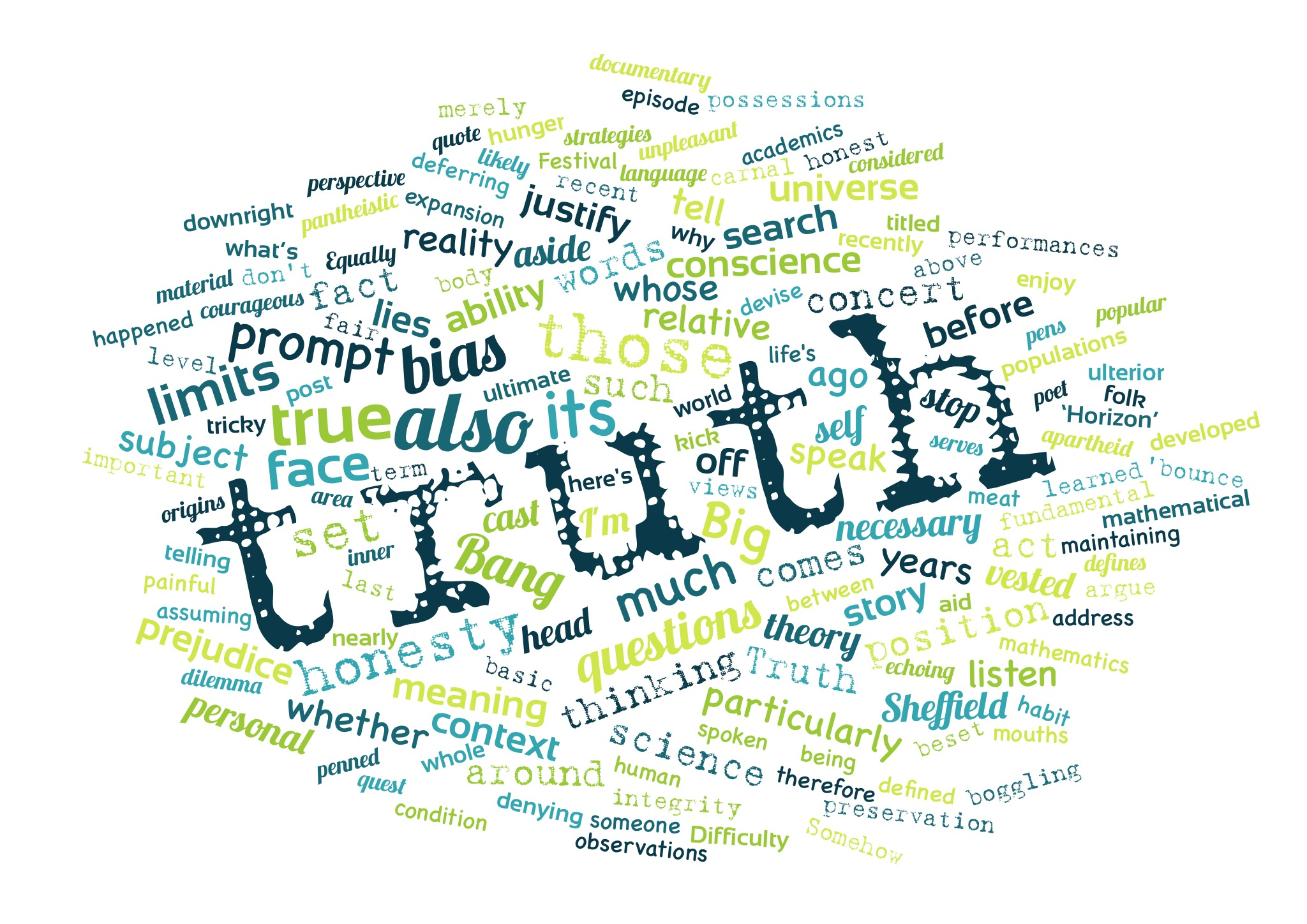
The story of cosmology is the story of our search for the ultimate truth

Produced using Cloudart

This quote comes from a recent episode of one of my favourite BBC documentary programmes, ‘Horizon’, which was titled ‘What happened before the Big Bang?’. It centred on the thinking, with the aid of mathematics and string theory, of a handful of professorial academics from around the world, who have developed some new theories. One such theory suggests that the expansion of our known universe since the Big Bang, nearly fourteen billion years ago, is only one ‘bounce of a ball’, of a cyclic series of events and that its apparently infinite size is merely a minimal starting point for the next Big Bang. I don’t know about you, but I find this, at the same time, utterly mind boggling and totally fascinating. It also serves to bring into perspective the true meaning of our lives and, in particular, the meaning of truth, which, in consequence, is only a relative term, particularly when it comes to this area of science. There may be a myriad of learned tomes, on the subject of truth, written by countless thinkers and philosophers over the millennia of human existence, but, setting aside the search for the true answers to scientific and mathematical questions about the origins of our universe, it is on the most basic social and spiritual level that I choose to focus.

My first prompt for this piece occurred three years ago, when I observed, amongst other exceptional acts of forgiveness and the search for truth, the effects of the Truth and Reconciliation Commission, set up in post-apartheid South Africa under Nelson Mandela’s leadership. The second prompt is that constant irritation: politicians! To be fair, this affects all those in positions of influence, with vested interest in maintaining status quo or personal wealth, who are so often inclined to be ‘economical with the truth’, if the truth is likely to compromise their position or possessions. This probably includes all of us from time to time. However, if you are in a position of power, when your decisions affect whole populations, then being economical with the truth may be considered, at best, morally wrong, if not downright contemptible! So much depends on the ulterior motive. Difficulty arises when you listen to words spoken by someone, whose allegiances are unknown to you, and therefore leave you with the dilemma of whether or not you believe they are speaking the truth. For me, sometimes, the solution to this is to do your own research; it is your call.

The third prompt is meat to those who, in telling lies, would argue that the truth is relative to its context. As true as that may be, there are some fundamental questions, which it may be helpful to ask. These questions and their answers rely heavily on my own life’s observations and experience. I’ve presented this, for clarity, in the form of a mock interview …

What is the truth?

The truth is without bias, in conformity with fact and reality, and is concerned only with honesty and integrity.

What defines truth?

The truth is not only defined by its context, but also by your ability to address your conscience*, head on, assuming that it has not been corrupted by external bias (i.e. vested interests). Equally important is an ability to face reality, however unpleasant or painful that may be.

How do we justify the limits we place on our honesty about the truth?

We justify limits on our honesty in many ways: by joining a tribe and deferring to its rules; by focussing on our own self-preservation or our vested interests; and by denying voice to our conscience.

How do we know what the truth is and how do we recognise it?

In order to know what the truth is, it is necessary firstly to cast off our natural bias and prejudice; to open our minds; perhaps also to become pantheistic in our outlook.

How much of the truth can we individually consciously face head on?

Knowing your limits is a safe harbour, but may also be a block to discovering the truth. So, it may be necessary to be courageous in the quest.

What strategies can we devise to help us get to the truth?

Somehow we may not only have to overcome personal prejudice and swallow our pride, but also face the facts and stop echoing and repeating popular myths that come from the pens and mouths of those around you.

How much do we have to sacrifice both to seek and to tell the truth?

We have to set aside our need for material things and kick the habit of consumerism. We also need to examine, evaluate and better understand our pride and prejudice (with apologies to Jane Austen).

Who will speak the truth?

Any of us can speak the truth, but, before we do, we will have to develop the inner strength to resist and cast off all those temptations that beset us with envy, greed, carnal hunger and cognitive bias.

I recently attended a concert, in which the headline act were a folk and roots duo, whose talent and performances we have come to enjoy. The unusual and refreshing part of this concert was that the supporting act, who came on to ‘warm’ us up, was a poet, whom I had first met last year through the Sheffield WordLife movement, at the opening of the Sheffield Literature Festival. The poet is Joe Kriss. One of the self penned poems he read, concluded with words to the effect: stop talking, start thinking and listen to what lies between your ears; only then will you know what’s true.

There are many parts of our lives for which exposure of the truth, if shared with the majority and if reconciliation was achieved, would make for a better world. I wonder, however, if finding the truth in every part of our lives would challenge our humanity. If that truth were too unpalatable to face – the prospect of our own imminent failure, the discovery of a skeleton in our own cupboard, life threatening illness and death … would we still want to know the truth?

Perhaps you might let me know if you have found your truth … and whether you feel it set you free? 

_________________________

* The defining of conscience could, no doubt, be the subject of a veritable treatise. For now, suffice to say that conscience is defined as “the complex of ethical and moral principles that controls or inhibits the actions or thoughts of an individual”. Put more simply, it is “the inner sense of what is right or wrong in one’s conduct or motives, impelling one toward right action: to follow the dictates of conscience“.

© 2014 John Anstie

John_in_Pose_Half_Face3JOHN ANSTIE (My Poetry Library and 42) ~ is a British poet and writer, a contributing editor here at Bardo, and multi-talented gentleman self-described as a “Family man, Grandfather, Occasional Musician, Amateur photographer and Film-maker, Apple-MAC user, Implementation Manager, and Engineer. John has participated in d’Verse Poet’s Pub and was an early player in New World Creative Union. He’s been blogging since the beginning of 2011. He is also a member of The Poetry Society (UK).

*****

Petrichor Rising Book Cover.phpd'Verse Anthology Book CoverJohn has been involved in the recent publication of two anthologies that are the result of online collaborations among two international groups of amateur and professional poets. One of these is The Grass Roots Poetry Group, for which he produced and edited their anthology, “Petrichor* Rising. The other group is d’Verse Poet Pub, in which John’s poetry also appears The d’Verse Anthology: Voices of Contemporary World Poetry, produced and edited by Frank Watson.
Petrichor – from the Greek pɛtrɨkər, the scent of rain on the dry earth.

Posted in Imen Benyoub, Peace & Justice, Poems/Poetry, poetry

Elegy to Damascus


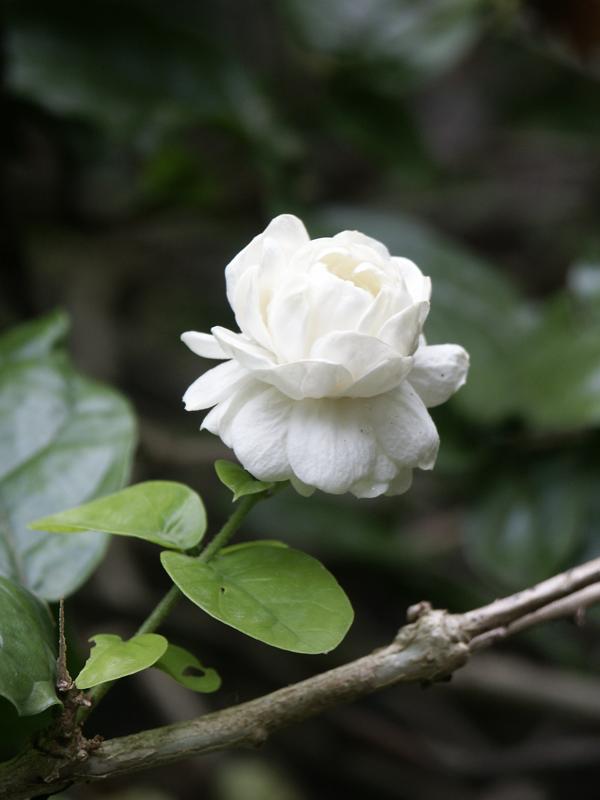
Arabian Jasmine (another name for Damascus is City of Jasmine)

He writes with a wounded language
He is a stranger
The alphabet bleeds when it’s heavy with memory
And poems will always taste
Of dry blood

Everything wounds him
In his naked solitude
Light wounds his face
A wing of a dove and a passing cloud
Wound his orphan shoulder

He writes and his wound becomes a full moon
That bleeds white in the darkness of his exile
It becomes a silk road where he travels alone
He rubs its sides with salt
And adorns it with statues
White as his pain

His wound is an unanswered prayer
His wound is a city
*****
Streets of Damascus, streets of the heart
Minarets and church bells mourn
O bride of the East with your veil soaked in blood

Your face is a dusty cracked mirror
Your womb is full of thorns

Somewhere
A poet dreams of his childhood house
His mother’s bread
His father’s prayer carpet
And the smell of henna and rose water
On the hands of a woman

He doesn’t know that his house is a graveyard
And Damascus is no longer pregnant with jasmine

– Imen Benyoub

 ©2014, poem, Imen Benyoub, All rights reserved

Photo credit ~ via Wikipedia by Scott Zone under CC A 2.0 Generic license

.

pictureIMEN BENYOUB ~ is a miltilingual, multi-talented writer, poet, and artist living in Guelma, Algeria. She is a regular contributor to Into the Bardo and to On the Plum Tree and Plum Tree Books Facebook page.

Posted in Corina L. Ravenscraft, Poems/Poetry, poetry, Poets/Writers, Writing

A Poem In Your Pocket Day

Is that a poem in your pocket, or are you just happy to see me? 😉

Image borrowed from http://www.publicdomainpictures.net

All month, we have been celebrating International Poetry Month. Today, we’re celebrating Poem in Your Pocket Day here at The Bardo. This event truly is a neat way to introduce and share poetry with just about anyone. One of the best things about pocket-sized poems, is of course, that they’re portable! No matter where you are, if you have a pocket, you can share, too. This page even has pre-made, down-loadable ‘pocket-sized’ poems in .PDF formats, so all you have to do is download them and print! Or here is another template from Scholastic.com that you can use on which to put your own poem. How easy is THAT? 😀

Image borrowed from http://jimmie.squidoo.com/hspoetry

Probably the hardest part of participating in this celebration is deciding what poem to share. If it’s too long, it might not fit on a smallish, pocket-sized piece of paper. (Although, you can always print it out and then fold it up). It should be a poem that means something to you, whether it’s one that you’ve written and want to share, or one by a favorite author. The point is to get out there and share what you love about poetry! I combined this day with a couple of the other ideas I suggested back at the beginning of the month, to post poetry in unexpected places and take a poem to lunch. I utilized Post-It notes for the first one (both because of their stick-to-it-ness properties and because they could fit in lots of unusual places). I even recruited some friends to help me place the poems all around campus. I decided to use Haikus, because they are short and easy to write on Post-Its, and I don’t think they (Haikus) are properly appreciated these days. 🙂 Post-It Haikus As you can see, I printed the haikus with the authors’ names on them and taped a small note to the bottom which said, “Celebrate National Poetry Month all April!” I chose orange because it’s a high-contrast, noticeable color. I only actually witnessed the result of one of the poems I had placed…on the inside door of a restroom stall where I work…(captive audience and all that…hahaha). The young woman came out of the restroom holding the post-it in her hand with a big smile on her face. One of my friends posted one on the inside of the elevator door, so that you didn’t see it until the doors closed and you were in the elevator on the way to your floor. “Unexpected places”, indeed. When I “took a poem to lunch” I invited my mother to go to lunch and asked her to bring a poem, too. I chose Emily Brontë’s poem, “No coward soul is mine” (which had to be folded up to fit into my pocket, by the way) and my mother brought “If” by Rudyard Kipling. It was a wonderful addition to our delicious lunch. In fact, we enjoyed it so well that I think we may even do it next month, too. 😉 Have fun today sharing the poems in YOUR pockets. You never know, you may just inspire someone else to do the same! And please join us by sharing your poem with all of us here, in the online world, by using Mister Linky. © 2014, essay, Corina Ravenscraft All rights reserved

PLEASE USE MISTER LINKY BELOW TO CONNECT

THE URL TO A POEM OF YOURS YOU’D LIKE TO SHARE

OR TO ANY POEM THAT YOU FIND ESPECIALLY MEANINGFUL

YOU MAY ALSO POP A FAVORITE POEM INTO THE COMMENT SECTION FOR THIS POST

IF YOU’D PREFER. Thank you! 

effecd1bf289d498b5944e37d8f4ee6fAbout dragonkatet Regarding the blog name, Dragon’s Dreams ~ The name comes from my love-affairs with both Dragons and Dreams (capital Ds). It’s another extension of who I am, a facet for expression; a place and way to reach other like-minded, creative individuals. I post a lot of poetry and images that fascinate or move me, because that’s my favorite way to view the world. I post about things important to me and the world in which we live, try to champion extra important political, societal and environmental issues, etc. Sometimes I wax philosophical, because it’s also a place where I always seem to learn about myself, too, by interacting with some of the brightest minds, souls and hearts out there. It’s all about ‘connection(s)’ and I don’t mean “net-working” with people for personal gain, but rather, the expansion of the 4 L’s: Light, Love, Laughter, Learning.

Posted in General Interest, Victoria C. Slotto, Writers' Fourth Wednesday, Writing

WRITER’S FOURTH WEDNESDAY: Color My Moods–Writing with Color

Image: silkhlens.com

As a would-be artist and a former museum docent, I enjoy playing with the elements of art in my writing–both in fiction and poetry. A favorite is to use color to create mood. In art, abstract expressionists often use color as the primary tool to convey their “story.” There are many interpretations of the meaning or symbolism accorded to each color. I’m offering a few of my own: Yellow is a happy color and can be used to liven up a scene–to make it joyful, while Red signifies anger, passion, love. Think about it: when you’re feeling intense emotions, such as rage and close your eyes, sometimes your visual field appears red. Blue and Green convey calm and  peace Black represents the unknown or fear while Brown is a grounded, earthy color. Violet or Lavender speak of spirituality while White is used to represent truth and innocence.

Photo: allparentstalk.com

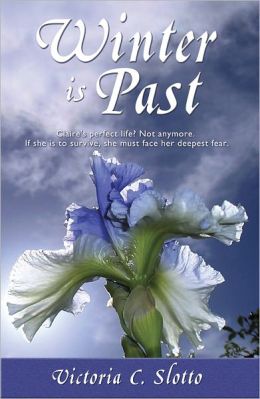
My interpretation is gleaned, in great part, from a book I use for dream interpretation and it seems to work well for me. Perhaps you will see it differently. Consider that, in Asian countries, red is used for funerals and white for funerals. Both culture and personal life experience influence how we see color. (Reference: The Dream Book by Betty Bethards) I’m including a short description from my novel, Winter is Past, that strives to convey a mood using color. In the dim light, the church, clothed in red, marked the joyous season of Pentecost. The altar was covered in an abundance of flowers—gold, yellow, orange and red gladioli—tongues of flame marking the climax of the Pascal season. Helene’s mood, however, was somber, spiraling into blackness. The red surrounding her spoke to her of blood and death—the death of her spirit. She suppressed a sob…


Do you have an example from your own writing you would like to share? How do you see color as it influences mood? We invite you join in, if you like, using Mister Linky at the bottom of this post or simply add your link in the comments secion if you prefer.

Image: tympanus.net
Image: tympanus.net

2940013445222_p0_v1_s260x42034ff816cd604d91d26b52d7daf7e8417VICTORIA C. SLOTTO (Victoria C. Slotto, Author: Fiction, Poetry and Writing Prompts) ~ is an accomplished writer and poet. Winter is Past, published by Lucky Bat Books in 2012, is Victoria’s first novel. A second novel is in process. On Amazon and hot-off-the-press nonfiction is Beating the Odds: Support for Persons with Early Stage Dementia. Victoria’s ebooks (poetry and nonfiction) are free to Amazon Prime Members. Link HERE for Victoria’s Amazon page. Editorial note: Congratulations, Victoria, on that the long awaited publication of print copies of Jacaranda Rain, Collected Poems, 2012, Beautifully done. Writers’ Fourth Wednesday is hosted by Victoria from January through October and posts at 12:01 a.m. PST. The next Writers’ Fourth Wednesday is scheduled for May 28.  In (unofficial) concert with the American Academy of Poets, Corina Ravenscraft (Dragon’s Dreams) will host A Poem in Your Pocket on Thursday, April 24. You are invited share your own work or that of a favorite poet. Instructions for sharing will be included in the post, which will go up at 12:01 a.m. P.S.T.

Posted in Victoria C. Slotto, Writers' Fourth Wednesday

HEADS UP: Writers’ Fourth Wednesday is tomorrow …

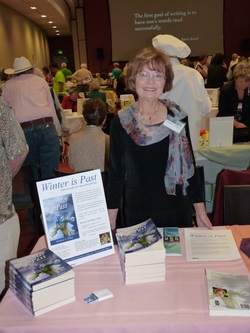
Victoria at the Palm Springs Writer's Expo March 2012
Victoria at the Palm Springs Writer’s Expo March 2012

Poet, novelist and writing coach, Victoria C. Slotto is host. The prompt is about writing with color and it will go up at 12:01 a.m. PST on this blog. We hope you link in your own work – you have seventy-two hours to do so – and share it with us and that you will visit and support other participants.

Photo credit ~ Victoria Slotto, All rights reserved

Posted in Joseph Hesch, poem, Poems/Poetry, poetry

Where Memory Becomes Forever

Shed
Out the big basement window, the wind
slathers the snow like cake icing
up against the trees as if they were
birthday candles, and smooths it over
the roof of old Cliff’s gingerbread shed,
where the rabbits would hide.

But I don’t see the path we’d carve
in those drifts, from this place to our place.
I can imagine high-stepping through
the knee-high purity of it all, though,
smell that clear and evocative smell,
as chaste as the expanse ahead of me.

If I were to fall, splat face-first into
the stinging reality of it all, I think
I’d roll onto my back and watch those
long trails of flakes and let them
redden my face. They’d be like kisses
from that place where memory becomes
forever.

– Joseph Hesch

© 2014, poem, photograph and portrait, Joseph Hesch, All rights reserved

Hesch Profileproduct_thumbnail-3.phpJOSEPH HESCH (A Thing for Words) is a writer and poet from Albany, New York , an old friend of Bardo and a new core team member. Joe’s work is published in journals and anthologies coast-to-coast and worldwide. He posts poems and stories-in-progress on his blog, A Thing for Words.  An original staff member at dVerse Poets Pub website, Joe was named one of Writers Digest Editor Robert Lee Brewer’s “2011 Best Tweeps for Writers to Follow.” He is also a member of the Grass Roots Poetry Group and featured in their 2013 poetry anthology Petrichor Rising.

Posted in Art, Beauty, Essay, Paula Kuitenbrouwer, Spiritual Practice

Empty Space as an Aesthetic Significance

I’ve read an intriguing quote in Japanese Women Don’t Get Old or Fat by Naomi Moriyama;

‘The importance of ‘empty’ space in the presentation of Japanese cuisine can scarcely be exaggerated. Receptacles are never filled to the brim, but are left with a certain margin of emptiness- emptiness of an aesthetic significance comparable to that in a Zen ink painting‘.

(Chef Masaru Yammamoto).

Considering the importance of empty space is what I do when I draw or paint. Often an empty space is needed to guide the viewer to the place that needs his attention. Other times, empty space is filled with suspense. Because empty space can create guidance, tension and calm contemplation, it is full of possibility.

Isn’t possibility what emptiness is? The emptiness or absence of sound means a bird can fill it with its song. Emptiness as possibility works in compositions exactly the same. An empty place can be filled in or left open.

It is important to notice what exists in an empty space. If I paint a bird on the left side of my drawing looking at the right, what is the bird looking at? The empty space isn’t empty at all. It is full of possibilities. Is the bird looking at a mate? Or a prowling cat? Not filling up an empty space often works well; it adds more possibility, tension or imagination to a painting. Other times a large empty space is too dominating or too much a void, in that case, doing something with it is better. It is a place that offers calm contemplation, leave it open.

If you are a home educator, don’t teach you child that the whole page or canvas needs to be filled in. (The only reason why you should offer an art assignment in which nobody is allowed to leave the class room before his paper is completely covered, is when your students need to overcome shyness, self restrained, or inhibition).

If you are a creative therapist or an understanding friend, sit down with your client or friend, and analyse his doodle or drawing by asking what is going on in its empty space. Talk, investigate, and dream together. You will be surprised how many possibilities or interpretations will emerge.

If you are a parent and your young child is proudly showing you a painting, play with your child. Ask what is going on with the objects that are drawn, and what is happening within the empty space. Then built a story on what the child tells you. Your child will charm and entertain you with pure child fantasies. Empty spaces are full possibilities.

You thought empty space is boring or shows a lack of imagination? Or a bad composition? Certainly not always, often quite the opposite.

Returning to the book on Japanese food; I always dread the moment when I have to stop drawing in order to prepare a dinner. From now on, I will plan to continue my mindful meditation by bringing aesthetic principles into my kitchen.

– Paula Kuitenbrouwer

© 2013, essay and photographs and artwork (above and below), Paula Kuitenbrouwer, All rights reserved

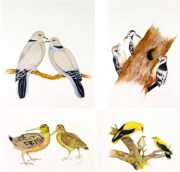
birdcardsPAULA KUITENBROUWER ~ is a regular contributor to Into the Bardo and a Dutch nature artist living in The Netherlands and sharing her work with us on her blog, Mindful Drawing and on her website.   In addition to art, Paula’s main interest is philosophy. She studied at the University of Utrecht and Amsterdam. She has lived in Eastern Europe and in Asia. Paula says that in Korea, “my family lived next to a Buddhist temple. In the early morning we would hear the monks chanting. During my hours of sauntering with my daughter through the beautiful temple gardens, I felt a blissful happiness that I try to capture in my drawings.” Paula sometimes teaches children’s art classes. She lives with her husband and daughter and close to her father. You can view her portfolio of mindful drawings HERE.

Posted in General Interest

Ecco Panis

A poem for Easter … the bread of the angels …

Posted in Essay, Spiritual Practice, Terri Stewart

Sacred Space in the Doorway

Often, in religion-land, we talk (I talk) about being created in the image of God. Imago Dei. I usually think about this in terms of other people. I look and I see a beautiful youth, a reflection of the divine, and know that they are loved and are love.

But what about looking at myself?

Monday, I was at the IRS. Ugh. I have had my identity stolen. I needed to prove to the IRS I was who I said I was so that they would let H&R Block file my taxes. The proving part was easy, and a criminal case has been opened. What was hard was the waiting. And the human hubris.

Sunday, I was at Lake Washington UMC, presiding and preaching. It was a blast and I tackled a difficult subject–radical nonviolence. Especially, the nonviolence that begins with myself–interior nonviolence. I was greatly moved when a woman talked to me afterwards about now hearing the internal put-downs as doing violence to herself. “Awesome!” I thought. And I was really feeling it–this tug towards nonviolent action that starts with yourself.

Monday, waiting in line at the IRS, there were 40 people jammed into a little office and 40 people waiting in the hallway of the office building the IRS rents space in. Then the vacuum lady came. She said, “Everybody get out of the hallway now! Get inside!

Confusion amongst the people.

“Get inside or go downstairs!”

She just wanted to vacuum and the company rules are that no vacuuming can occur unless there are zero people in the hallway. Some liability issue with the cord and people tripping. :-/

I looked at the amount of people jammed into the office and thought, “There is no way. This is unsafe, someone will get hurt.” And I thought of going downstairs and losing my place in line, and I thought, “There is no way I am losing my place in line.” And there may have been curse words interspersed in there.

I said, “It is unsafe, capacity in this office is exceeded.” I then stood on the edge of the doorway between the office and the hallway. I now view that doorway as a liminal space–a sacred space of potentiality.

She said, “I will shut the doors to the office.”

I thought, “Bring it!

How quickly I devolved from nonviolence to violence in my thinking and communication. At least my internal communication. I didn’t say anything to her, but I am sure that my stance and eyes communicated all that needed to be said. Which was, “Call the cops on me–I don’t care.” Yep. I was willing to risk arrest so that I would not lose my place in line at the IRS. That may or may not be bordering on the ridiculous.

The upshot is, where do we see the divine? Is it in perfected behavior? In the “love” and “patience” and “serenity?” Or can we see it in the “anger” and “frustration?” Because if we are honestly made in the image of the Divine, then those must be qualities that come from God!

Anyway, after the vacuum-lady left, the IRS called a bunch of numbers and we were all confused as to who they were because nobody came when the numbers were called (some people actually did go downstairs). Until one number was called and we all knew who it was–a family with little kids. And we knew that they had gone downstairs. People spoke up. They were willing to extend their wait in line to see that the injustice of losing their place in line was righted. The staff went downstairs and got the family, taking more of their time when they had a bunch more people impatiently waiting. This family was cared for.

Maybe that is where we see the best of the imago dei. The willingness to extend our own discomfort to ensure that justice is done.

“The Lonely Vacuum of Space ”This Sucks” by JD Hancock CC BY 2.0 at Flickr.com
The Lonely Vacuum of Space
”This Sucks”
by JD Hancock
CC BY 2.0 at Flickr.com

Post by Terri Stewart (c) 2014, originally posted at www.BeguineAgain.com

terriTerri Stewart ~ a member of our Core Team,  comes from an eclectic background and considers herself to be grounded in contemplation and justice. She is the Director and Founder of the Youth Chaplaincy Coalition that serves youth affected by the justice system. As a graduate of Seattle University’s School of Theology and Ministry, she earned her Master’s of Divinity and a Post-Master’s Certificate in Spiritual Direction with honors and is a rare United Methodist student in the Jesuit Honor Society, Alpha Sigma Nu. She is a contributing author to the Abingdon Worship Annual.

Her online presence is “CloakedMonk.” This speaks to her grounding in contemplative arts (photography, mandala, poetry) and the need to live it out in the world. The cloak is the disguise of normalcy as she advocates for justice and peace. You can find her at www.cloakedmonk.com,www.twitter.com/cloakedmonk, and www.facebook.com/cloakedmonk.  To reach her for conversation, send a note to cloakedmonk@outlook.com.
Posted in General Interest

Living With Mystery

Possessing a human brain is no picnic. The cumbersome chunk of gray matter is quite the dictator. It wants to know: Who? What? When? Where? Why? How? It shines the light in our eyes, makes us squint and squirm until we come up with an answer. And “I don’t know” won’t appease its inquisition. Somewhere in our distant evolutionary history, this dictatorship must have presented some advantage to survival. Possibly it pressed us to a more efficient way to find food or use tools or attract a desirable mate. When the interrogation continues after it has served its immediate purpose, it becomes rather annoying and can create anxiety, frustration, torment and suffering. Think of a 4-year-old asking “Why?” to every explanation offered. It never ends. When you shout back, “I DON’T KNOW!” do you feel you’ve failed and slink off to ponder your existence? (For a good example of this “insane deconstruction” peppered with ‘adult language’, check out comedian Louis C.K. in this clip.)

Humor aside, the suffering is universal. We have all lived the anguish of a mystery at some point. As I write this, I am thinking of all the people whose loved ones disappeared on the Malaysian jet that has been missing for 11 days. Unanswered and unanswerable questions must plague them. The few photos of their grief that I’ve seen are hard to bear. Add to that circle connected to those 239 people all of the families of military personnel MIA throughout history, all of the families of travelers to foreign countries in unstable political climates who never returned, all of the parents of children abducted and gone without a trace. The stories of devastation are heart-breaking and inevitable. The common denominator is The Great Mystery – Death. Ironically, it is the most mundane mystery as well. We will all be touched by it, every one. And we know it. The two deaths that I experienced first hand were not shrouded by any great cloud of darkness. My sister and my husband both died right beside me: my sister in the driver’s seat of a car, my husband in our bed. They were not ‘missing’ by any means. And yet, I will never have the answer to basic questions like, “What were they feeling?” “When exactly did they lose consciousness?” “Was I to blame?”

Mystery is the Truth. We do not know. We delude and comfort our demanding brains in a parade of ideas. When that effort is expended, can we accept and live with Mystery? What does that feel like? How do I do that?

006

You see, again the questions surface, the never-ending tide of the probing lobe of consciousness. Maybe some day that flow will be replaced by the still, mirrored surface of a quiet mind.

Peace out,

Priscilla

© 2014, essay and photographs, Priscilla Galasso, All rights reserved

004PRISCILLA GALASSO ~ started her blog at scillagrace.com to mark the beginning of her fiftieth year. Born to summer and given a name that means ‘ancient’, her travel through seasons of time and landscape has inspired her to create visual and verbal souvenirs of her journey.

Currently living in Wisconsin, she considers herself a lifelong learner and educator. She gives private voice lessons, is employed by two different museums and runs a business (Scholar & Poet Books, via eBay and ABE Books) with her partner, Steve.

Posted in Essay, General Interest, John Anstie

Good Friday, Good Fortune and Forgiveness

“Never let the sun set on an unforgiving thought” © 2012 John Anstie

It started one Good Friday morning, three years ago, sitting, as we sometimes do on a weekend, in bed, with a cup of tea, reading, reviewing, talking, relaxing.

Because the finances are my responsibility, unusually, I used this moment to run through the ‘state of the nation’. We then fell to looking ahead to our imminent retirement and the likely income from our pensions, such as they would be.

Every time we fell to talking about pensions, I was irresistibly drawn to musing about the first of my four different private pensions, which exist by virtue of changing employers. This pension was with the steel company, for whom I worked for the first eleven years of my career, which was ‘frozen’ upon its merger with another company. The process of reviewing whether to leave my original pension frozen or move it into a private fund was aided by a ‘friend’ who worked with a mutual insurance company at the time. Given that this was in the midst of the Thatcher era and the new market economy, ‘advice’ abounded that pensions should become more portable as the work force became more mobile and everyone was getting on Norman Tebbit‘s proverbial bike!

Long story short, the outcome was that I chose to move it to the private pension recommended by my ‘friend’ and the fund ended up being worth one third of what it would be had I left it where it was. So it was too late to make up the loss.

Whether or not I forgive my ‘friend’ for whatever responsibility he could himself reasonably shoulder for this advice, was rendered irrelevant by my next prompt, which occurred whilst I ate my breakfast and watched the second half of an hour-long documentary on BBC1, “What’s The Point of Forgiveness?”, presented by Historian, Bettany Hughes. It took a look at the history of this virtue, which emanates from the apocryphal words of Jesus, “forgive them, they know not what they do…”. In her thesis Hughes presents the alternative to forgiveness as being the vicious cycle of revenge, which inhibits recovery, engenders pain and does not allow us to move on.

Two significant events that I saw, cited in this programme, were the ‘Truth and Reconciliation Commission‘ setup up in South Africa, following the release of Nelson Mandela and his election as president, and an interview with the wife of the co-pilot of Flight Eleven, which was deliberately flown into one of the Twin Towers in New York in 2001, who, in spite of her emotional struggle to come to terms with the loss of her husband and father to her two children, had somehow found it in her to forgive the terrorists. Both these events stand out in a way that gives us hope for humanity and human spirit. Whilst we can all understandably feel vengeful and hateful against those who harm us or our families, our tribes, our communities, it is only by forgiveness and by not antagonising the perpetrators of atrocities against humanity into a vicious cycle of destructive and vengeful argument that they may become capable of contrition and able to feel remorse. People who have achieved genuine forgiveness, like those already mentioned, accordingly become living proof that genuine forgiveness is the only road to reconciliation and peace.

So, how can I complain when I am able, as I did at the time of writing this, to sit in our sun-bathed garden, ringing with bird song, cup of coffee in hand, in good health and with the freedom to write what I want to say on almost any subject in this blog, here, now, any time it pleases me to do so. How can I feel vengeful toward someone about a pension shortfall, when there are people in the world, who can forgive acts of inhumanity that defy belief; that have caused the loss of life, the torture of innocent people, the deprivation of the most basic of human rights affecting whole communities, populations… there is truly no need to answer this question. One question does, however, remain.

That question is simply this: how can I, in spite of all the good fortune I have had in my life, in spite of the fact I am no longer an angry young man – for which there may have been a little justification early in my life – and in spite of the fact that the sun is shining; how can I follow this advice and ensure that, deep down, I can genuinely forgive anyone, who is guilty of anything, whether it be a simple thoughtless slander or the most unspeakable inhumanity. I feel this is the question I should continually ask myself and strive to achieve the only result that common sense points toward with undoubted clarity. It is so obvious to me that to forgive someone is to take the wind out of their angry or irrational sail; make it pointless for them to consider acting in such a way again, rather like a petulant child who, in moments of insecurity, challenges their parents by pushing at the boundaries, trying to get a reaction; when they don’t get it and the parents show forgiving, but calm and disciplined resolve, they gradually adjust their behaviour. It has to be said, nonetheless, that if it were the easy option, we’d all be able to forgive.

It should be easy for me in my relatively privileged social and economic circumstances, but how much more difficult is it for someone who is wired differently from me; who is younger and is just setting out on life’s difficult journey trying to survive; who may even have more justification for their anger or who is simply wired in an ‘angry’ sort of way. I don’t know the answer to this, but, whatever happens, if the message of Easter is to mean anything, whether or not you are, unlike me, an active Christian, then we ought to keep on trying… to be grateful for good fortune, to forgive and move on. What better cause is there to encourage harmony whenever and wherever in the world we can.

[A longer version of this article was first published on John’s prose blog, ‘Forty Two’ in April 2011.]

Photo and Text © 2014 John Anstie

John_in_Pose_Half_Face3JOHN ANSTIE (My Poetry Library and 42) ~ is a British poet and writer, a contributing editor here at Bardo, and multi-talented gentleman self-described as a “Family man, Grandfather, Occasional Musician, Amateur photographer and Film-maker, Apple-MAC user, Implementation Manager, and Engineer. John participates in d’Verse Poet’s Pub and is a player in New World Creative Union. He’s been blogging since the beginning of 2011. John is also an active member of The Poetry Society (UK).

*****

Petrichor Rising Book Cover.phpd'Verse Anthology Book CoverJohn has been involved in the recent publication of two anthologies that are the result of online collaborations among two international groups of amateur and professional poets. One of these is The Grass Roots Poetry Group, for which he produced and edited their anthology, “Petrichor* Rising. The other group is d’Verse Poet Pub, in which John’s poetry also appears The d’Verse Anthology: Voices of Contemporary World Poetry, produced and edited by Frank Watson.

Petrichor – from the Greek pɛtrɨkər, the scent of rain on the dry earth.

Posted in Fiction, General Interest, Jamie Dedes, story

Señora Ortega’s Frijoles

flores de la frijoles
las flores de frijoles

Her fate was set when she fell under the spell of his kind eyes and bigger than life personality. For his part, he loved her gentle ways, the fluid dance of her hands at work, the sensual swing of her hips as she walked to the market with basket in hand. And so it happened that in 1948, with her father’s permission and her mother’s tears, they were wed in the old adobe iglesia where uncounted generations of her family had been married before her. Not many months after the wedding, she kissed her parents and siblings goodbye, took a long loving look at her village, and she followed her new husband north to los Estados Unidos de América. She was already pregnant with Clarita.

****

As the days and years passed, they settled into their routines. Sunday mornings were her husband’s quiet time. He stayed at home while Señora Ortega and Clarita were at Mass. In their absence he would occasionally put down his newspaper and stir his wife’s frijoles simmering fragrant with pork, a few bay leaves, onions and garlic.

Last night: their Saturday ritual, she and Clarita had sorted and then washed the dried beans in cold water and left them to soak until morning. The child – fast becoming a young woman – took the time and care to do a good job of this. El trabajo es vertud. Work is virtue, Señora Ortega encouraged. In the tradition of Señora Ortega’s own madre, la cocina was a place of teaching – about food, about life, about being a woman, about being human.

“!Ten cuidado, hija!”  Be careful, she would say as she demonstrated her almost sacramental sorting of the dry beans. It was an opportunity to teach Clarita the dichos, the proverbs, of her mother and grandmother and all the grandmothers before. “Los frijoles son nuestra fuerza.” We get our strength from los frijoles, she taught Clarita just as her own mother taught her. Certainly the beans give the strength to our bodies, but also the strength to our character.  There are lessons. “¡Aqui!”  Remove these. Remove the wrinkled, the broken, the discolored or malformed. Remove them as you should remove flaws from your character. One bad frijole will ruin the whole pot.  Taparse con la misma cobija.* … You will be judged by the company you keep. Be cautious in your choice of friends.  Even the norteamericanos have such a saying: one bad apple spoils the bunch.

“Mama,” said Clarita, rolling her eyes after her mother’s latest speech. We are North Americans.” Señora Ortega’s brow furrowed when she heard this. She was given to worry about such reactions from her daughter. What of the child’s values?  It is true after all. My daughter is American. What does this mean for her future, for our relations, and for us as la familia?

****

Soon Señora Ortega had to put her concerns aside. It was springtime. Easter was upon them and with it a visit from her husband’s sister with her two small children. Señora Ortega and Clarita were busy with preparations. The air in her house smelled of poblanos roasting and cookies baking. They put fresh linens on the beds in the guest rooms. They picked flowers from her garden and set them in vases around the house. She gave in and bought chocolate Easter bunnies too, the silly convention of this country, but the children loved them and looked forward to them each year.

Finally the honored guests arrived and the house was filled with the cheerful noises of los niños. The boy and girl were now old enough to learn to prepare beans and, on the eve of Easter Sunday, Señora Ortega gave Clarita the task of showing the children how to sort los frijoles for cooking.  She looked on as Clarita explained the process. “!Ten cuidado, mis primos. Aqui! Remove these. Remove the wrinkled, the broken, the discolored or malformed.  Remove them as you should remove flaws from your character. Remember one bad frijole will ruin the whole pot. Be cautious in your choice of friends. Taparse con la misma cobija. You will be judged by the company you keep. “Los frijoles son nuestra fuerza.” Los frijoles are our strength.

****

At some point, Señora Ortega’s husband had come to stand by her side. She realized he was watching her as intently as she watched their daughter. He put his arm around her and held her close. “You see, mi querida, she is a good girl and you are a good mother. It’s gonna be okay …” “Am I that transparent,” thought Señora Ortega, but she sighed gratefully. All will be well. My mother was right. “Los frijoles son nuestra fuerza.” 

Taparse con la misma cobija – literally: to cover yourself with the same blanket, i.e. likely the same meaning as our expression “birds of a feather.”

© 2012, short story, Jamie Dedes, All rights reserved. This story is a fabrication and not meant to depict any specific person or persons living or dead. It is, however, meant to provide a slight view of immigrant concerns and to show how in some traditions values are passed from mother to daughter. Photo credit ~ Schnobby via Wikipedia under Creative Commons Share-Alike 3.0 unported license

Photo on 2014-03-31 at 17.16 #3– JAMIE DEDES (The Poet by Day)~ I am a mother and a medically retired (disabled) elder. The graces of poetry, art, music, writing and study continue to evolve as a sources of wonder and solace, as a creative outlet, and as a part of my spiritual practice.

Posted in Poems/Poetry, Victoria C. Slotto, Writing

Oh Poetry, Where Art Thou?

Illustration from the cover of Christina Rosse...
Image via Wikipedia

As we celebrate National Poetry Month, I’ve been considering the sources we poets turn to for inspiration–so today’s post is for poets although I’m sure that it’s useful to prose writers as well. I’m going to short-list some of the sources I turn to for inspiration in my writing.

  • Nature–look for details, metaphors, lessons that are present all around us. When stuck, it often helps me to take a walk. I’m blessed to live in a place that is replete with nature’s offerings.
  • Reading–read other poets. Their work often tickles my muse. Keep a list of your favorite poets to turn to when you need a creative boost.
  • News sources–look for the seeds of story-poems hidden in the newspaper, on the Internet or on TV news broadcast.
  • Poetic Forms–do an Internet search and check out poetic forms. For me, the discipline of a form can jump-start an idea.
  • Spirituality–look to metaphysical/religious ideas and writings such as the Bible or holy books of other spiritual traditions. Look within at your own spiritual experience.
  • Relationships–these evoke emotional reactions that are often begging for expression.
  • History–check out historical events as well as your own history. There can inspire narrative and reflective poetry.
  • Mythology–this is not an area of expertise for me, so I’m taking a course in Classical Mythology offered by The Teaching Company.
  • Science–a wonderful well-spring of poetic inspiration.
  • Art–Use painting, sculpture, photography and translate your experience into words.
  • Writing Prompts–those of us who participate in writing communities have a wealth of material tossed out at us on a daily or weekly basis.
  • Political issues–need I say more? My personal viewpoint is to stay away from personal attacks and stick to the issues.

There are many more–feel free to share your favorites in comments.

2940013445222_p0_v1_s260x42034ff816cd604d91d26b52d7daf7e8417VICTORIA C. SLOTTO (Victoria C. Slotto, Author: Fiction, Poetry and Writing Prompts) ~ is an accomplished writer and poet. Winter is Past, published by Lucky Bat Books in 2012, is Victoria’s first novel. A second novel is in process. On Amazon and hot-off-the-press nonfiction is Beating the Odds: Support for Persons with Early Stage Dementia. Victoria’s ebooks (poetry and nonfiction) are free to Amazon Prime Members. Link HERE for Victoria’s Amazon page.

Editorial note: Congratulations, Victoria, on that the long awaited publication of print copies of Jacaranda Rain, Collected Poems, 2012, Beautifully done.

Writers’ Fourth Wednesday is hosted by Victoria from January through October and posts at 12:01 a.m. PST. The next Writers’ Fourth Wednesday is scheduled for April 23. 

In (unofficial) concert with the American Academy of Poets, Corina Ravenscraft (Dragon’s Dreams) will host A Poem in Your Pocket on Thursday, April 24. You are invited share your own work or that of a favorite poet. Instructions for sharing will be included in the post, which will go up at 12:01 a.m. P.S.T.