The BeZine Blog

Posted in The BeZine, The BeZine Table of Contents

The BeZine, Vol. 4, Issue One, Music to the Eyes

October 15, 2017

After silence, that which comes nearest to expressing the inexpressible is music
~ Aldous Huxley

IMG_0004
From: ‘Notable Quotes’ hand carved code

Reading Michael Dickel’s introduction to last month’s edition of The BeZine, sowing the seeds of the mindset at the roots of the ethos of this publication – promoting peace, sustainability and social justice – but in particular, overcoming anger and harnessing it for good, he quotes a good deal of Audre Lorde’s laudable speech and essay The Uses of Anger: Women Responding to Racism,  perhaps a reflection on what divides the world, what creates so much anxiety, political division, protective greed and selfishness.

So, we have music.

I don’t know about you, but there are few times in my life when music has done anything other than have a life enhancing and positive effect on me – with the possible exception of a Moody Blues concert I went to in 1969, in my university days, when I was left with a ringing in my ears for several days. This was, along with competitive shooting of Lee-Enfield .303 bore rifles at school, without ear defenders, probably the root of my tinnitus!  Subsequently, I carry ear plugs and try to avoid over amplified performances by groups of musicians, who employ sound engineers, who may be – shall we say – aurally challenged!

Music, particularly live and acoustic music has played and still does play an increasingly major part in most of my life; it provides a therapy against the rigours and stresses of everyday living. But it does more than this.

My personal perspective on the value of poetry has some relevance here. It is a belief that poetry should always be one step removed from the obvious, the logical and rational, in order for it to awaken the right brain, the creative side of our amazing abilities as humans; to stimulate the visceral (as opposed to the purely intellectual, rational, ‘logical’) response. In turn, this has the potential to stimulate a fresh approach to solving our challenges, be they personal or global. This hits on the core mission of The BeZine in a big way.
BeZine Planning
From: ‘Notable Quotes’ hand carved code

But if poetry has this potential power to stimulate a new way of thinking outside the framework imposed by a culture of consumerism, greed and material comfort, as opposed to our social well being, then music does so with a vengeance. It is truly visceral without the constraints of language. Of course, when the poetry of lyrics is introduced to create song, then there is the opportunity to create something that is greater than the sum of its parts; synergy. It can provide something that dwells in the conscious and even subconscious for a lifetime – whoever forgets the words and melody of a song that they heard at a very poignant moment in their lives, which continues to inhabit a special place in memory, resonate and invoke the most emotional response every time it is heard. There are a few who would argue this is ‘just an over-emotional response’, but it may well be the last resort to aid the development of a greater understanding and a clearer insight into the human need for compassion as well as passion in their lives.

If music be the food of love, play on;” said Duke Orsino “give me excess of it”. The opening lines of Shakespeare’s “Twelfth Night” speaks much for music, even though he goes on, cynically “that, surfeiting, the appetite may sicken, and so die”.  Can you get too much of a good thing, I ask?
BeZine Planning (2)
From: ‘Notable Quotes’ hand carved code

Music is so often a catalyst for romance. We could not even begin to count the number of songs that have ever been written over the ages on the subject of romantic or divine and spiritual love … and its consequences. However, I wonder how often we may contemplate how many instrumental or orchestral compositions there are, which, without words, in a different way, on a very different level, are capable of promoting a feeling of love and, equally, a sense of calm, peace, remorse, sadness, melancholy, a whole gamut of emotional responses that can and very often do bring about a state of mind that is elevated above the daily grind of our lives, the trauma, the tragedies, the disasters and injustices we witness every day in the news, and above all, the ability it has to help us cry. In this way, music can act as a protest against injustice and, in a sense, be ‘angry’, but still it can act as a relief for that anger, just as poets can find simply by writing a ‘political’ poem, which can relieve the frustration and anxiety brought about by political injustice. It is this value that I attach to music that I hold highest in my personal esteem for this art of arts.

It is, in fact, an art that can, like no other, combine the poetry of good lyrics, the rhythms of our roots, the vast array of instrumental sounds and voices, and the spine tingling harmonies they can create, into one; that can team itself with other art forms, particularly in photography, film and dance, but also notably in storytelling. What broadcast programme, be it documentary, drama, comedy, film (movie) is made without serious thought for the addition of music, a song, an orchestral piece, which so often includes a main theme along with incidental ‘tracks’ throughout its production, which then, of course, naturally leads to the merchandising of a soundtrack album.

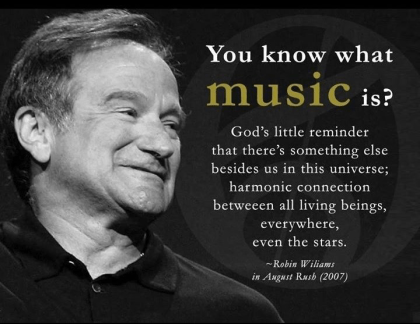
Even the latest generation of advertisers have realised the visceral value of music, sometimes combined with poetry (look at Apple’s poetic narration by the inimitable and dearly missed Robin Williams, who significantly quoted from Walt Whitman’s poem O Me, O Life to evoke the kind of emotional responses that are known to drive most human decisions … in this case, to buy!

As a test of how important a part music plays in teasing our wallets from our pockets, next time such an advert hits your screen, try turning off the sound. What are you left with … not a lot that is meaningful. Now here, I hope the photographers and cinematographers amongst us (Naomi Baltuck) will not take exception to this notion that still and moving pictures cannot move us, which of course they can and a similar thesis to this could be written for the visceral value of great pictures, but I know you will trust that my meaning, in this context, is well intended!

This month, as lead editor for the anniversary edition of The BeZine, the first of its fifth year, we feel quite frankly blessed with the quantity and quality of contributions we have received from our regular core contributors, and I take my hat off to our new guest contributors, including some very talented young writers and musicians. The sizeable response of quality submissions makes this, I believe, our largest issue yet; like a big fat magazine, but without any adverts, in itself, says something about the importance we attach to music.

We have poems galore, almost all of which touch the music theme or contain subtle BeZine Planning (1)references to it. Two fellow Brits are amongst the new contributors to The BeZine. From musician and composer, Joseph Alen Shaw, a piece that addresses the core of the Bardo Group Bequines mission, Music Beyond Belief, on the subject of faith and musical composition in the 20th Century. Joseph has also contributed another account of one of his recent compositions, the Wentworth Cantata. British newcomer, historian and musician, Emily Needle, has written an account of her research on her travels through Eastern USA in 2015, into the achievements of a remarkable and little known Charleston man, who had a surprisingly big influence on Jazz music in the early 20th Century.
Beside Joseph and Emily, other new contributors have all embraced the music theme in such creative ways, mostly poetry but also some lyrical prose, with very interesting results. Stephanie Williams’ Singing Man is a charming prose piece that evokes a child’s certain view of what they like. S.R. Chappell has written a couple of poems in praise of music. Kakali Das Ghosh, in her poem, presents us with some very mystical feelings. Andrew Scott gives us a story of a gritty performer with all the emotional baggage that can accompany that way of life, and JB Mulligan writes three deeply insightful and thought provoking poems.

All of our regular contributors have also given us a wealth of musical delight and I thank them all for their excellence that has made this a very special issue.

Further Acknowledgments

Thanks are due to Glen Armstrong (his deeply nostalgic plea for vinyl records that ‘once had purpose’), Naomi Baltuck (for your photo essay with a family musical conclusion), Sonja Benskin Mesher (her beautiful reflective on ageing, remembering, companionship ends with music), Paul Brookes (fine poems, particularly clever is his onomatopoeic on a Bodhrán), Miki Byrne (whose poems about performance are both clever and revealing), Bill Cushing (and his handful of poems with oh so subtle musical references), Jamie Dedes (whose Orchestra of Impossible Beauty relates the moving story of the British ‘ParaOrchestra’ comprised of people with a variety of disabled conditions), Renee Espriu (and who can resist the image of how a child can hear the recording in a seashell of the sound of the sea or how they can bring home from school a musical instrument that’s bigger than themselves!), Denise Fletcher (on a trip to a Country Music Festival or the intrusive quality of loud music), Priscilla Galasso (for her usual insightful qualities), Mike Gallagher (for his remarkable, lyrical prose piece), Mark Heathcote (and his Whispering Muse), Charles Martin (and his ekphrastic haiku / senryu triplet), Liliana Negoi (for super imaginative variety of expression), Phillip Stephens (with a further challenging ekphrastic poem), John Sullivan (whose poems include a conversation with his radio, deeply embedded with the blues and a call to the Tripitaka of Buddhism), Lynn White (for not allowing us to forget the importance in our lives of birdsong), and the artful collaboration of photograph Amy Bassin and poet Mark Blickley in Screaming Mime.

So much delight from each and every one of our writers, I can’t tell you what a pleasure this has been, to write about one of my favourite pastimes.

Enjoy.

John Anstie


THANK YOU!

It seems somehow right that we dance into our fifth year on a musical note and John’s perceptive and passionate introduction to this month’s The BeZine. It is no exaggeration to say that the longevity of this 100% volunteer effort is the outgrowth of the stalwart support of readers and contributors and the work, creativity, vision and perspicacity of our core team: John Anstie, Naomi Baltuck, James R. Cowles, Michael Dickel, Priscilla Galasso, Chrysty Hendrick, Joseph Hesch, Ruth Jewel, Charlie Martin, Liliana Negoi, Lana Phillips, Corina Ravenscraft ,Terri Stewart (founder of Beguine Again, our sister site), and Michael Watson.

There are so many other ways readers, contributors and team could choose to spend valuable time, but you have all chosen to invest a portion in this small effort to build a community of others.

This site was founded in 2011 with three American Buddhist friends. Two have passed on. Since that time as both blog and zine we have published the works of like-minded representing all races, at least six religions, agnosticism and atheism and, I believe, nearly thirty countries. We have stood in solidarity for kindness and joy and raised our voices for peace, environmental sustainability and social justice.  

HAPPY ANNIVERSARY to all of us. Thank you everyone and may peace and friendship prevail.

On behalf of the Bardo Group Beguines
and in the spirit of peace, love (respect) and community,
Jamie Dedes
Managing Editor

MUSIC TO THE EYES

How to read this issue of THE BeZINE:

Click HERE to read the entire magazine by scrolling, or
You can read each piece individually by clicking the links in the Table of Contents.
To learn more about our guests contributors, please link HERE.
To learn more about our core team members, please link HERE.


TABLE OF CONTENTS

Poetic Musical Musings

Underneath The Stairs, John Anstie

Cannonball Adderley Adrift, Glen Armstrong

Post-Punk, Glen Armstrong

Used Records, Glen Armstrong

Under A Rainbow. Somewhere., Mendes Biondo

First Time, Paul Brookes

Bodhrán, Paul Brookes

When I Used to Play, Miki Byrne

Beginners Night, Mike Byrne

Applause, Miki Byrne

For Gilly Dangerous, Miki Byrne

Music Crashing, S.R. Chappell

Music Within, S.R. Chappell

Ode to Nina Simone, Bill Cushing

On Modest Mussourgsky’s “Bydlo”, Bill Cushing

La Rosa & El Dragon (impressions from the music of “Pan’s Labyrinth”, Bill Cushing

“Zooz’s Brasshouse” Busking, Bill Cushing

Blakeson, Bill Cushing

Harmonic Chanson, Kakali Das Ghosh

The Music of the Conch Shell, Renee Espriu

The Music of Prowess, Renee Espriu

Intrusion, Denise Fletcher

The Whisper of the Muse, Mark Heathcote

Three Notes, Charles Martin

As We Go Together, Sonja Benskin Mesher

String Quartet, JB Mulligan

Consolation #3 in D Flat by Liszt,  JB Mulligan

Canon, JB Mulligan

Song for Agriope, Liliana Negoi

Feathery Song, Liliana Negoi

Mr. Bluesman, Andrew Scott

Understanding the Flautist (Meditation on a Peace Painting), Phillip T. Stephens

Llano Estacado, John Sullivan

True Emergency, John Sullivan

Aubade on Royal Street,  John Sullivan

Chill, Lynn White

To The Passing of The Nightingale,Lynn White

~~~~~~~

Musical Insights

Press Play, Photo Essay from Naomi Baltuck

How Hawkwind Improved My Adolescence, Paul Brookes

Country Music, Cow Pokes and City Girls, Jamie Dedes

The Orchestra of Impossible Beauty, Jamie Dedes

 Stars In My Eyes, Denise Fletcher

Beyond Music Appreciation, Priscilla Galasso

The Clonmel Set, Mike Gallagher

From Rags Through Race to Ragtime, Emily Needle

The Presence of Sound,  Liliana Negoi

Music Beyond Belief, Joseph Alen Shaw

The Singing Man, Stephanie Williams

~~~~~~~

Music, Video & Special Interest

My (Sort of) Desert Island Discs, John Anstie

Wentworth Cantata, Joseph Alen Shaw

Screaming Mime, Amy Bassin and Mark Blickley

Stocksbridge Memorial Project, Ian McMillan

Translating Words Into/From Music, Liliana Negoi


Except where otherwise noted,
ALL works in The BeZine ©2017 by the author / creator


CONNECT WITH US

The BeZine: Be Inspired, Be Creative, Be Peace, Be (the subscription feature is below and to your left.)

Daily Spiritual Practice: Beguine Again, a community of Like-Minded People

Facebook, The Bardo Group Beguines

Twitter, The Bardo Group Beguines

Submissions:

Read Info/Missions StatementSubmission Guidelines, and at least one issue before you submit. Updates on Calls for Submissions and other activities are posted every Sunday in Sunday Announcements on The Poet by Day.


Posted in 100,000 Poets, Musicians, Artists and Activists for Change, Poems/Poetry

Thousands and Millions, a poem by John Anstie

This is our (The BeZine) new poster for 100TPC 2018. It was designed by Corina Ravenscraft (Dragon’s Dreams)

One hundred thousand
Poets for change,
so many voices and
carefully chosen words,
at times decay into a void
of the anechoic chamber.

Earthly Fathers praying
for the Establishment,
that sets our stage,
and casts our values
in concrete, steel,
plastic … and carbon.

Leaders of the World,
whose balance sheets and
logical, numerate intellect
measure only a notion
of success. What is that?
Temper your ambition.

For aren’t we just that,
a wealth of rich and
creative intelligence,
maybe the only hope
for our universe
to understand itself?

Heavenly Mothers ask us
why digitise and monetise
and worship at the alter
of the great god, Thworg,
when we are in the face of
richness beyond measure.

Escape to the stars, if you will,
but answers will be found not
in the vanity of space-time travel,
but here, with this unaided vision
they lie in the green and blue,
right before your disbelieving eyes.

Permit your heart to rule
even if only one day a week, when
the visceral, and the common sense
will sit above logic and intellect, and
that subliminal noise in our head
will slowly rise to the conscious.

Maybe, one day we’ll be
Seven Thousand Million
Poets for Change!
Our time will come. Atonement beckons.
It’s in the wind, this beating heart,
a movement beyond the gaze of mortals …

© 2017 John Anstie, All rights reserved.  You can visit John at My Poetry Library.

This is John’s tribute to the 100,000 Poets for Change – 100TPC 2017 – movement, which had its annual celebration on 30th September.

Posted in General Interest

seer

Gretchen Del Rio’s latest. Enjoy!

Gretchen Del Rio's avatarGretchen Del Rio's Art Blog

watercolor 10/2017

Owls are carriers of souls to the spirit world.

purchase this painting

View original post

Posted in 100,000 Poets, Musicians, Artists and Activists for Change, 100TPC, Artists and Activists for Change, General Interest, The BeZine, The BeZine Table of Contents

100TPC, 2017 / Stand with us now for Peace, Sustainability and Social Justice

This year, the last Saturday of September, the regular day for the Global 100,000 Poets for Change Events around the world, falls on Yom Kippur, considered the Holiest day of the Jewish religion. Observant Jews around the world are fasting, having spent the Days of Awe leading up to Yom Kippur asking the people in their lives for forgiveness and inventorying their transgressions against Creation. Today, we Jews go to synagogue and ask Creation (G-d) for forgiveness. Another name for Yom Kippur is the Day of Atonement.

First, the order matters: We ask the people in our lives for forgiveness. Then we think how we have acted against the World. Then and only then do we turn to G-d for forgiveness.

Second, saying sorry is not enough, in our tradition. It is a start. In the Jewish tradition, people must also act differently, that is, they must enact the apology with a change in how they are in the world.

Third, human purpose can be understood—in how I have been taught—as working toward Tikkun Olam. Tikkun Olam is the repair or healing of Creation. While there is definitely a range of interpretations that could be made on what this healing entails, it certainly incorporates attention to the physical world as well as the spiritual. These two intertwine and interrelate in such a way as to be inseparable. Social Justice, Environmental Sustainability, and Peace—and writing, the arts, music in service of activism for positive change—are very relevant issues to our human purpose, from this view.

And thus, on the Holiest Day of the Jewish Year, it is appropriate to work toward Tikkun Olam, asking G-d’s forgiveness for all we have done that harms our fellow humans, inventorying our own role, and moving forward with action that shows our genuine desire to change and make things right again.

And, further, as the spiritual and the physical are interrelated, so are all of the arts (literature, art, music, dance, stage, film…), so are all three of the themes: Social Justice, Environmental Sustainability, and Peace.

So this year, on Yom Kippur, we ask you to join in with your contributions from any of the arts—share your efforts toward healing and repair of our World. As you do, remember this, paraphrased from the sages:

Do not despair at the iniquity and injustice of the world in which we live. For today, that is, in this period where injustice, racism, and greed seem to have risen to power, do not give up or give in.

It is not up to us to complete the work of Tikkun Olam, but this does not free us from working toward the healing and repair of Creation. That is, although we may not achieve our goals of a just, sustainable and peaceful world in our lifetime, we must continue to make progress, and in working toward them, the healing of Creation will occur, one poem, one essay, one novel, one painting, one sculpture, one song, one symphony, one performance at at a time…

By action, not words alone, will this be done. If ever there was a time when this action is more needed than others, certainly now is one—Resistance! Activism! Peace! Sustainability! Social Justice!

Instructions for how to participate follow below.

—Michael Dickel, Contributing Editor


Thanks to Jamie Dedes for getting our virtual 100TPC underway. Travel issues left me in the lurch. My apologies. May this introduction partially atone for my tardiness in getting the event going! Instruction on how to participate in today’s event are included below:


“It is from numberless diverse acts of courage and belief that human history is shaped. Each time a [woman or] man stands up for an ideal, or acts to improve the lot of others, or strikes out against injustice, he sends forth a tiny ripple of hope, and crossing each other from a million different centers of energy and daring, those ripples build a current that can sweep down the mightiest walls of oppression and resistance.” ~ Robert F. Kennedy South Africa, 1966

Today under the banner of 100,000 Poets (and friends) for Change (100TPC) people the world over are gathered to stand up and stand together for PEACE, SUSTAINABILITY and SOCIAL JUSTICE.

Here is a sampling of the posters announcing these gatherings.They give you a small idea of how far-reaching this annual global event is and for which we have the work and vision of  100TPC cofounders Michael Rothenberg and Terri Carrion to thank.

Think on this when you are tempted to lose all hope for our species. Remember that—not just today, but everyday—there are ripples and waves and tsunamis of faith and courage crossing borders in the form of poetry, stories, art, music, friendships and other acts of heroism. Hang tough. And do join with us—The Bardo Group Beguines—today to share your own creative work and to enjoy the work of others. All are welcome no matter where in the world you live.


This slideshow requires JavaScript.

Meanwhile our 100TPC host, Michael Dickel, was caught somewhere between Israel and the American Midwest, so we got off to a late start. Michael will be around during the day today.  He did especially want you to have the link to the 100TPC Resist Wall, where you can post activist and resistance poetry today or any day.


POST YOUR WORK HERE TODAY

To share your poems, art, photography and music videos for our “live” virtual 100TPC today, please use MisterLinky for url links. Just click on the icon below.  You can also simply paste your complete work or the url into the comments section.  Remember the themes are peace, sustainability and social justice.


To read shared work see the comments section and click on Mister Linky. Enjoy!

On behalf of Michael and the rest of The Bardo Group Beguines
and in the spirit of peace, love (respect) and community,
Jamie Dedes
Managing Editor,
The BeZine

Posted in 100,000 Poets, Musicians, Artists and Activists for Change, 100TPC

Our virtual “live” 100,000 Poets (and friends) for change event …. The Countdown Begins now AND YOU’RE INVITED

Well, the Zine’s virtual “live” 100TPC Master of Ceremonies, Michael Dickel (Meta/ Phor(e) /Play), is doing the event from the Midwestern U.S. this year, not Israel, and I’m here in Northern California as back-up.

We have just a few hours to go before we begin The BeZine 100,000 Poets (and friends) for Change, 2017 (100TPC), our biggest event of The BeZine year.  Do join us and bring your reading glasses and your work suggestive of peace, sustainability and social justice. Michael will get us started and I’ll be on hand to help put a wrap on things. We’ll run at least 24 hours to make it convenient for you to participate no matter where in the world you live.

You may have missed some of these posts that will clarify what we’re doing, how we’re doing it, and how you can participate. Here are two posts that you’ll find helpful:

See you later at The BeZine blog!

Jamie Dedes
Managing Editor, The BeZine
on behalf of Michael and The Bardo Group Beguines


Posted in Essay, General Interest, Michael Dickel, Peace & Justice

Silence i — Warm Blanket of Silence

It was September in 1998 when I last visited this text, but I began writing it in 1988—an unlikely time for warm humid air in Minneapolis where I lived. Still, brought up by storm, bereft of beaches, warm ocean-born air covered me in that north-central city, the nearest seacoast thousands of miles away; I could smell that salt breeze left over from and carried here by hurricane Gilbert and his aftermath.And this is what I wrote in 1988 and revised (somewhat) 1998. Now, in 2016, I pulled it out, dusted it off, made some additional revisions and edits (including cutting about 15 pages out at the end) for the International Day for the Elimination of Violence Against Women. I read the version of the following at Verses Against Violence 3, organized by Rachel Stomel in Jerusalem, on 24 November, 2016. I have made some edits to the version I read and added a bit more, to more clearly state my position at the end. Both the edits and what I added arose from the discussion after the reading in November.

When you read this, the bombs may be falling still, or falling again; or a temporary lull may have been ordered, or a ceasefire may be in effect. This peace-around the corner, while children, invalids, and old people are blown into mass graves, has been the latest, most visible testimony to the power now handled by a few men—which begins to seem like the power of nature, to bring famine, plague, or cyclone and take it away again at will.

“The bombings, for example, if they have anything to teach us, must be understood in the light of something closer to home, both more private and painful, and more general and endemic, than institutions, class, racial oppression, the hubris of the Pentagon, or the ruthlessness of a right-wing administration: the bombings are so wholly sadistic, gratuitous and demonic that they can finally be seen, if we care to see them, for what they are: acts of concrete sexual violence, an expression of the congruence of violence and sex in the masculine psyche.”

—Adrienne Rich, “Vietnam and Sexual Violence,” a column for APR, first published in 1973

“…it’s time for men to start having programs about rape. It won’t stop until men learn that the victims aren’t responsible.”

—Irene Greene, director of the U of Minnesota Sexual Violence Program
in an interview with Doug Grow.]


The Warm Blanket of Silence

It is a comforting warm atmosphere, and that it should bear with it the responsibility for the death of hundreds and the devastation of fragile third world economies, responsibility for the spawning of floods and tornadoes, dumfounds me at this distance. The air around me is a comfortable blanket, secure and cozy, cuddling me into gentle submission, into ignoring the terrible violence that spawned it, that delivered it to my doorstep along with the bananas and the coffee and the economic well-being that are part of my privileged existence. How do I set my comfort aside and grapple with the need for others’ relief, for a fair-weather change? So easy to retreat, to retreat to the warm blanket, to snuggle against the supposed truth: I am not the perpetrator of those violent deeds. For I am not a violent man, myself.

So it is with the storm, the raging blast of destruction and domination that is U.S. foreign policy, especially in the what we once called the “Third World,” now (in 2016) also the Middle East. That storm accounts for the cozy climate of the privileged in the U.S. (and I own that I was, while living there, and still am, as an ex-pat, one of those privileged). Thousands of deaths, devastation of economies, the spawning of the floods of war and the tornadoes of insurrection and destabilization all account for the stolen ocean breezes. And if I feel as helpless against the hurricane of foreign policy as I do against Gilbert, that same comfortable blanket beckons me: I am not the perpetrator of these violent deeds. For I myself am not a violent man.

If not perpetrator, then collaborator, if not in the destruction wrought by the storm, then in the destructive forces let loose when men beat women, when parents beat children, when men beat other men, when men rape women, when men use violence, oppression and sexual power to coerce those around them into submission. And if it seems that I have leapt hugely into an abyss from foreign policy to domestic, personal, and sexual violence (are these different?), then it is because I am looking for the beginnings of our national imperialism in the place it seems to me things begin: at home. If acts of violence in foreign affairs are not acts of sexual violence, as Adrienne Rich suggests they are, and I by no means believe that they are not, then the same indifference and silence towards the raping, beating, and emotional violence that plagues our own sisters, mothers, lovers, colleagues, brothers, and ourselves allows for our silence and indifference about how our nation conducts its foreign affairs. We may not perpetrate the violence, but we collaborate with it when we remain silent: Even if we are not, ourselves, violent men.

Collaborate? With silence. Silence is collaboration, the great hushed whisper that approves by not calling out, by not naming the violence of person against person, by looking the other way. Too long men have ignored the violence, or viewed it as the victim’s problem, or, when forced to acknowledge the truth, tried to suppress the violence in patriarchal fashion with laws, jails, and punishments (more often than not punishment for other suppressed members of society more than for those in power), rather than treating the roots, looking to the core of the matter.

“Such inhumanity will not cease, I believe, until men, in groups of men, say “no more.” Until the Jaycees, Rotary, American Legion, male sports groups, and the like begin to discuss rape in their meetings and begin to give a loud prohibition to sexual abuse of women rape will not stop.”

—Ted Bowman
quoting himself from a letter to the editor
of the Minneapolis Star and Tribune, December 30, 1983.

Part of the problem is that many men do not see wife and child beating as a men’s issue. Here I generalize, for some activist men indeed do (singer, songwriter, activist Geoff Morgan, for instance, or witness quotes above), and no sweeping statements should be made about men, women, or any group of people. Traditionally, however, men do not seem to have dealt with this issue except as an issue of the victim—a woman’s or child’s issue, or if a men’s issue, a men’s issue based on their own victimization, as in child abuse. Rarely have men confronted the issue as an issue of their own suppression of others, or of their own fears or inability to be whole. An issue of their own rage and explosiveness. We often ignore the fact that we can be violent men.

I know I have viewed this as a “women’s issue,” I know my friends have, I know that some of the concerned men I met with in Minneapolis have all ignored men’s responsibility, to greater and lesser extent, while wanting to acknowledge our “sensitivity.” In failing to acknowledge our potential for violence, we continue the oppression. It is when we deny our own anger, often at ourselves or other men, that we become most likely to blow up with rage at others, also.

But, I am not a violent man. And I do not beat or rape women. Why should I consider this my problem?

Because men are the most common perpetrators of this violence, and men ought to consider solutions that will stop other men from violating other human beings. (I speak hear of male abusers because I wish to arouse men to action to stop sanctioning this abuse with our silence—what I say may apply to women abusers as well.)

We should stop being silent and start taking responsibility, stop saying that this only effects the victims and recognize the effects throughout society and culture, stop subscribing to the patriarchal code of silence that allows the male, even requires the male, to dominate and control those around him, and start working with each other to end family and personal violence. If we want accusations like Rich’s to be untrue, (that violence and sexuality are one for men), we have to speak out and say that it is untrue for us and unacceptable in those around us. We have to act according to these words. We must disentangle them in our own psyches and lives and acts. We must, as men, face our own violence, turn our own sexuality from oppression to eroticism (not to be mistaken for pornography) and spirituality (not to be mistaken for patriarchal indoctrination), from desire for self-gratification to tenderness for the Other.

(skipping about 15 pages to coda at end of original essay)

The first step for any change in attitudes we have and perpetuate about gender, sexuality, and violence begins in the mirror. I must face up to my own capacity for abuse, my own tendency to authoritarianism: my own reluctance to feel, to trust, to be vulnerable, to love (and be loved). I must face myself in my worst aspect to create my best. If this has been, up to now, a social commentary and proposal, it is now a call to all men, and to myself, to begin the act of change within each of us. I ask no one to give up manhood. On the contrary, I ask each man reading this to embrace his own manhood, and to recognise that this manhood is not the violent, competitive, truncated beast that is so often reflected in our culture and our self-images.

I am not a storm, unleashed by nature, not a furious distemper whipping and whirling through the world. I am not corrosion, destruction, death and war. I am not powerless in the face of my actions, hopeless or helpless. Although I could be all of those things. I am not Hurricane Gilbert run amuck, nor Gilbert merely placated, worn down by feminism, politics, my mother, my lover, or my therapist. I am a man choosing to change that which I can. I have missed opportunities in the past, and these missed opportunities are scars that run deep into my psyche: I watched one man die violently where I might have made a difference had I not been silent. I experienced the sudden death of my father with an incomplete relationship because the silence between us—despite all of our words—had grown too big, was broached too late. I have attacked myself, despised myself at times, and lashed out at others.

I may be hunter, and warrior, which means I have the capacity for destructive and abusive violence, and also the capacity for sustaining power and strength. I am also lover and parent, which some may take to mean that I could control and possess a (male or female) vessel in an attempt to fill my needs, but for me means that I can form a tender, erotic, spiritual, and emotional alliance which truly satisfies. I am human, which means I have the power to repress and deny the reality of my emotions, and also that I have the power to experience, survive, and grow in the world by knowing my deepest feelings. I am parent, which means that I can continue the cycle of destruction and violence that I have inherited, and also that I can be open to growth and change. I live in the world, which means that I can strive for dominion, and also that I can strive to form a spiritual community not only with my fellow humans (male and female), but with nature itself. Change begins at home, the choices are mine.

If I do not wish to suffocate under a warm blanket of storm blown silence, I will have to own the destruction that the silence protects. If I own the destruction, I take responsibility for the violence, and then I can change. If I change, I empower myself. I can complete myself. I can choose life, spirit, love, nature. I am not, by inheritance from my father or otherwise, beast; but human being by inheritance of my mother and my father, together. And I will try to be.

“While I have yearned for leadership from persons and groups more influential than I, I also know that the burden of responsibility lies on my shoulders. Consciousness-raising doesn’t cut it! It is time to talk with my sons, brothers, and male friends and yours also. Will you join me in speaking to your male acquaintances? Can we make a difference? I think so! Let’s do it!”

Ted Bowman 1988

(This is as far as the reading went.)

I have brought this essay back for what I imagine are, to the readers of The BeZine, obvious reasons—an unrepentant “pussy-grabber” has been elected to the office of President of the United States. As a man, I renew my decades-long commitment to stand against such violence and abuse, to resist the “locker-room” excuses and all violence, but most certainly violence against women and children. One thing I take heart in, though, is that what I have witnessed at the Verses against Violence reading this year and in the past—people speaking out, women (mostly) and men resisting the violence embedded in our society and breaking silence. The outcry about the orange-man’s grabbing statement, while it did not stop him being elected, was loud and clear. In 1988, I suspect his comments would not have been a subject in the media. I suspect, but who can know for sure, that the media of that time would have shrugged their shoulders and themselves said, “locker-room talk.” In 1998… possibly not much better. Things are not where they should be, they are not where I want them to be, but at least there was a shout of “NO!”

So, let’s shake the blanket of silence off of our shoulders. Let’s do what we must, do what we can. Let’s not accept in complacency what this presidency likely will bring.

—Michael Dickel (Meta/Phor(e)/Play)

Posted in General Interest

Thoughts and Guidelines on the Call for Submissions to the October Issue of “The BeZine” themed Music

As we prepare for the October issue of “The BeZine,” here is John Anstie on the theme for the month – “Music”

Jamie Dedes's avatarJamie Dedes' THE POET BY DAY Webzine

John Anstie

” Musick has charms to soothe a savage breast “
~ Playwright and Poet, William Congreve (1670-1729), in his 1697 play, ‘The Mourning Bride’.

A letter from John:

In asking for submissions of writing, poetry, art and even music itself for the Music themed October issue of The BeZine, I am conscious that the very subject of music leaves us with a huge scope. But if I am to offer any guidelines as to what you could think about in submitting work, it might be as follows.

My personal perspective on the value of poetry has some relevance here. It is a belief that poetry should always be one step removed from the obvious, the logical and rational, in order for it to awaken the right brain, the creative side of our amazing abilities as humans; to stimulate the visceral (as opposed to the purely intellectual, rational…

View original post 831 more words

Posted in 100,000 Poets, Musicians, Artists and Activists for Change

100,000 Poets for Change Resistance Poetry Wall … post your poem on peace, sustainability, or social justice


100,000 Poets for Change (100TPC) founders, Michael Rothenberg and Terri Carrion, have “built” a Resistance Poetry Wall in response to calls from all over the world for a place to post poetry and art in reaction to January’s election here in the U.S.

You do not have to limit your poetry to the situation in the States. You can share work that is relative to your country or your specific concerns. As Michael and Terri state:

The poetry and art posted on the WALL are not limited to the USA elections. There are many issues that concern us all and we welcome your contribution to this page.”

These efforts do have their place and power. So far 190 people have shared work on The Poetry Resistance Wall. I hope to see you there too.

– Jamie Dedes

Posted in 100,000 Poets, Musicians, Artists and Activists for Change, 100TPC, General Interest

CALLING ALL POETS, WRITERS, ARTISTS AND MUSICIANS: We Need Your Most Passionate Work

We invite you to share your most passionate works expressing kindness and human connection and the ways that together we might heal the degradation and devastation of wars and genocides; the heartbreak of refugees living in limbo; the desolation of hunger and famine and environmental catastrophes; the insanity of extrajudicial murders; and the disappointing growth in the West of racial and religious tensions and efforts by various administrations to chill dissent.

Please take this opportunity to join hands and hearts in peace and love: TEAM WITH US for The BeZine 100TPC online “live” event this September 30th (our 6th year) to address peace, sustainability, and social justice through poetry, music (videos), art and anything artistic that can be posted online and accessed through a url link or by responding in the comments section of the event post. The BeZine 100TPC is one of hundreds of events that will be held around the world on September 30 under the rubric of Global 100TPC founded by poets Michael Rothenberg and Terri Carrion.


WE ACKNOWLEDGE that there are enormous theological differences and historical resentments that carve wedges among and within the traditions and ethnic or national groups, but we believe that ultimately self-preservation, common sense, and human solidarity will empower connections and collaboration and overcome division and disorder.

100TPC is just one effort that illustrates the higher possibilities of the human heart.

Let us ply our art, meditations, and prayer toward that tipping point when compromise – an admittedly imperfect peace – will overcome war and respect for life will topple resentments and greed. That may not happen in our time, but it has to start somewhere and sometime. Together let this be our modest contribution toward an end for which diverse people the world over are working and praying.


HOW THE BeZINE “VIRTUAL” 100TPC WORKS … It’s easy and will be intuitively obvious, though we will provide instruction. A blog post will go up at The BeZine blog on September 30 with some introductory material and directions. As with any other blog post, you can respond by putting your poem or other work in the comments section. There will also be “Mister Linky” … a way to put in a link to relevant work on your site. It’s easy to use but if you don’t like it, you can just put your link in the comments section. That works!

American-Isreali Poet, Michael Dickel

American-Israeli poet,Michael Dickel (Meta/ Phore(e)/ Play), is an extraordinary – and at this point very experienced – Master of Ceremonies. He’ll maintain a rolling commentary in the comments section. I’ll be online to fill in for Michael when he takes a break and also to extend the length of the event.We’re in different time zones, though this year not half-a-day apart since he will be in the States. The idea is convenience and inclusively.

All types of artists and friends can participate no matter where they live in the world even if there is no event going on in their neighborhood and even if like me they are pretty much or completely home bound (which was the inspiration for the virtual event). You can participate in our virtual event even if you are at an off-line event. You can do both. We hope that you will not only share your artistry but also enjoy the artistry of others, which is what makes it like a live event. See you then … 🙂 We also hope that you’ll visit The BeZine to read our September edition, a prequel to the 100TPC event.

On behalf of The Bardo Group Beguines (publishers of The BeZine) and in the spirit of love (respect) and community,
Jamie Dedes
Founding and Managing Editor
The BeZine

Posted in General Interest, The BeZine Table of Contents

The BeZine, Vol. 3, Issue 12, 100TPC Prequel Edition


1901786_567349210045244_3055969219023926076_nSeptember 15, 2017


Fragments—
Reflecting on anger
a sort of Introduction


i

I am trying to write a social justice-sustainability-peace song. This is as far as I have gotten.

Where have all the flowers gone, since the election?
Where has the dialogue gone, now that we yell and scream?
You may say it’s social media, typing, and not raised voices,
But you know we’re all making some dissonant choices.

This divisiveness, it’s like some sort of infection,
All the medicine won’t do any good, not pill or cream,
You may say it’s someone else, spreading these angry voices,
But you know we’re all making these dissonant choices.

Take care of others now, it’s time to give a helping hand,
Find the empathy in your heart, spread it through the land,
Stand up for justice, peace, sustainability, while you can,
Find the common ground where all of us can stand…

ii

I am searching for interconnections and intersectionality between social justice, sustainability, and peace—how each affects the other. I don’t want to focus on the negative, but I do feel a need to say something that would get at the role of divisiveness and hate in our current anxieties and politics—not just in the November 2016 elections, not just between the camps, not just within the left. It is everywhere, infused with out morning hot drink.

iii

We must reach out our hands to each other. Yes, we can and should express our differences, speak our anger, listen to the anger of others. However, we cannot afford to weaponize that anger, to externalize it into missiles and nuclear warheads. Don’t let anger shoot, stab, run us over in an un-civil war of accusations and blame that wounds our souls. We cannot let this roiling rage keep us from joining together in common cause, which we all have—the need for peace, social justice, and environmentally-sustainable practices. We must use our real angers, somehow, as building tools, to join together to create more humane, just, sustainable, and peaceful structures in our world. We must harness the anger to make love, not war.

Even so, it will be an imperfect world.

But, if we find a way to work together, through our differences, it will be a better world, too.

iv

Audre Lorde had this to say, in her 1981 speech (later printed as an essay), The Uses of Anger: Women Responding to Racism:

Every woman has a well-stocked arsenal of anger potentially useful against those oppressions, personal and institutional, which brought that anger into being. Focused with precision it can become a powerful source of energy serving progress and change. And when I speak of change, I do not mean a simple switch of positions or a temporary lessening of tensions, nor the ability to smile or feel good. I am speaking of a basic and radical alteration in those assumptions underlining our lives.

I have seen situations where white women hear a racist remark, resent what has been said, become filled with fury, and remain silent because they are afraid. That unexpressed anger lies within them like an undetonated device, usually to be hurled at the first woman of Color who talks about racism.

But anger expressed and translated into action in the service of our vision and our future is a liberating and strengthening act of clarification, for it is in the painful process of this translation that we identify who are our allies with whom we have grave differences, and who are our genuine enemies. 

Anger is loaded with information and energy. When I speak of women of Color, I do not only mean Black women. The woman of Color who is not Black and who charges me with rendering her invisible by assuming that her struggles with racism are identical with my own has something to tell me that I had better learn from, lest we both waste ourselves fighting the truths between us. If I participate, knowingly or otherwise, in my sister’s oppression and she calls me on it, to answer her anger with my own only blankets the substance of our exchange with reaction. It wastes energy. And yes, it is very difficult to stand still and to listen to another woman’s voice delineate an agony I do not share, or one to which I myself have contributed. 

Why has this passage come to mind? Besides the fact that it remains relevant about privilege, more than 35 years later, it also speaks to the in-fighting among people who want to change the world positively, who have shared goals in making change—activists, if you will. The need to share our “grave differences,” but at the same time to work together as allies to resist—and overcome—”our genuine enemies.”

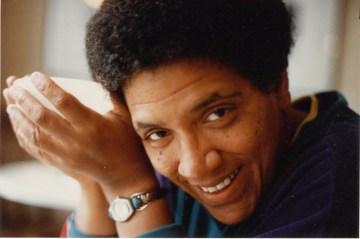
Audre Lorde | Credit/Copyright: Dagmar Schultz
Audre Lorde
Photo: Dagmar Schultz

v

It seems to me that these are some of the tools and forces of our genuine enemies: greed, oppression, racism, ethnocentricity, genders-based bias, unfettered capitalism, and fascism. Also: war, famine, and destruction of resources. Also: hatred, division, rage. Also…

vi

Right now, my Facebook feed streams with angry posts between Clinton and Sanders supporters and third camp—fourth, fifth, sixth… camps—who attack both and each other, all arguing an election nearly a year old and few looking for ways to work together for the mid-term elections a little over a year away. People argue about the best way to resist, all the while they criticize and attack each other for not approaching a particular issue in the “correct” way.

What I don’t feel is a constructive analysis and dialogue emerging from this divisiveness. I don’t feel that the anger focuses on the genuine enemies. Instead, the angry posts shred our (potential) allies against those who would divide us on the way to grinding us up. At times, my paranoia rings its tocsin, suggesting that those who oppose positive, life-and-humanity affirming change—my genuine enemies—foment the pitched battles (especially those in social media). I feel that too many of us (yes, I would include myself) think we “understand” the problems we face, and that others “don’t get it.” We want to be correct. My way or the highway.

That path only leads to traffic jams.

vii

Lorde tells us, “Anger is loaded with information and energy.” Are we listening? I often bristle and respond with anger—I fire off a few well-aimed zingers, a few capable of carrying nuclear warheads. Or else, I turn away and don’t listen. I miss the opportunity to learn from the information in the anger.

I fight against the energy in the anger, draining us both, as I argue my point of righteousness. I don’t take in the energy in the “anger expressed” to help energize our (potential) alliance. I don’t look for ways to translate it “into action in the service of our vision and our future.”

Thus, by not listening and firing my “defensive” missiles, I miss opportunities for “a liberating and strengthening act of clarification.”

This is critical when listening across the social, racial, economic, regional, generational, religious, gendered, and so many other divides of the world. It is as critical when listening to the anger that appears ready to pull apart groups of people who want to make a positive difference. When we are torn apart from each other. Divided, we will fall.

Yet, to stand together, we will have to listen to each other, to engage in learning from each other, and to find ways to translate our anger, our pain, our fear for the future into “… the painful process” of this translation, so that we identify who are “our allies with whom we have grave differences,” and who are “our genuine enemies.”

viii

A storm hammers my brain—this tide of attacks without engaged dialogue hammers my brain—my brain hammers against the ways in which I fail to do all of the many right things that need doing. And in my frustration, I forget to try to do just some of those many right things as well as I can—even if not to the level of an ideal and perfect world.

And here is where I end up, stalled, frustrated, angry. But where I want to end up is caring for humanity with empathy at the intersections of social justice, sustainability, and peace. The writing, music, and photographs in this issue have at their heart, I believe, empathic caring for all of our fellow humans. This caring motivates the work you will find ahead. Yes, you will feel anger. Yes, you will hear anguish. But all of it comes from hearts full of a desire to create “liberating and strengthening act[s] of clarification.”

—Michael Dickel, Contributing Editor


100TPC PREQUEL ISSUE: PEACE, SUSTAINABILITY, SOCIAL JUSTICE

How to read this issue of THE BeZINE:

Click HERE to read the entire magazine by scrolling, or
You can read each piece individually by clicking the links in the Table of Contents.
To learn more about our guests contributors, please link HERE.
To learn more about our core team members, please link HERE.


Table of Contents

Poetry

Honeymoon’s Over, John Anstie
Refugee blues, W. H. Auden
The Hands Off, Paul Brookes
Prisoner, Paul Brookes
The Stricken, Paul Brookes
Three men,  Rob Cullen
Measuring the Weight of Clouds, Rob Cullen
I Didn’t Apologize to the Well, Mahmoud Darwish
gods of our making, Jamie Dedes
let us now praise the peace, Jamie Dedes
do not make war, Jamie Dedes
Pigeon dreams,  Jamie Dedes
Visions Then and Now / Again, Michael Dickel
Come on up folks,  Michael Dickel
High Technology Death, Michael Dickel
the game of war,  Iulia Gherghei
Peace in the Desert,  Joseph Hesch
genome for survival, Charles W Martin
:: submarine ::, Sonja Benskin Mesher
:: reimagine the world ::, Sonja Benskin Mesher
:: the burning ::, Sonja Benskin Mesher
Building Freedom, Carolyn O’Connell
Another Note in an Endless Melody, Phillip T. Stephens
the places between, Reuben Woolley
virginia’s move, Reuben Woolley
knucklebone excess, Reuben Woolley

Musings

Eclipsed, Naomi Baltuck
~ Gen X Musings ~, Corina Ravenscraft

Music

Waiting on the World to Change, John Clayton
Musical Interlude for Change, The Young Bloods and Dionne Warwick and Burt Bacharach


Except where otherwise noted,
ALL works in The BeZine ©2017 by the author / creator


Around the World with 100TPC Posters

Some of them are—like ours—straight-forward with a simple and clear message, some are cluttered with messages, and others are true works of art. No matter which, together they demonstrate the strength of this movement, the passion and commitment.


This slideshow requires JavaScript.


The BeZine 100TPC Virtual Event

The BeZine September issue previews the themes of the 100TPC BeZine online “live” event we will host 30th September, 2017: peace, sustainability, and social justice. We are particularly interested in a positive focus on the need for human connectedness, healthy human interrelations, and caring for our fellow humans as well as ourselves. Sometimes, it takes clarifying anger. More often, this connectedness comes from listening to and learning from the anger and anguish of our fellow humans.

From police killings of unarmed citizens to governments rejecting immigrants and refugees; from racism to anti-Islam and anti-Semitism; from state-sponsored violence to terrorism—the political and social landscape increasingly values some among humanity over others. Any de-valuing of one human devalues all of us.

Given the rise of anti-humanity activism in struggle for “power over”—militarization of police, white supremacism, NAZIism, KKK, and corporate greed, for examples— as part of the “mainstream” U.S. political landscape that culminated with the election of Donald Trump and in the recent violence in Virginia (among other white supremacist terrorist acts), the focus of this year’s 100TPC live event at The BeZine will be why caring for our fellow human beings is the prime desirable human value, and how social justice, sustainability, and peace arise from that caring and contribute to all of humanity.

Come to the event to browse, view, read, and listen; to contribute your own words, art, music, or links; to comment on what others have posted. Instructions will be available here, beginning at 12:01 AM, 30th September (West Coast U.S. Time). Check in throughout the day to see what new has been posted, to post something new yourself.


CONNECT WITH US

The BeZine: Be Inspired, Be Creative, Be Peace, Be (the subscription feature is below and to your left.)

Daily Spiritual Practice: Beguine Again, a community of Like-Minded People

Facebook, The Bardo Group Beguines

Twitter, The Bardo Group Beguines


Posted in General Interest

ripe corn moon

Gretchen’s art and a little story of animal neighbors. Enjoy!

Gretchen Del Rio's avatarGretchen Del Rio's Art Blog

watercolor 7/2017

Raccoon is a lot of different things to a lot of people. Probably one thing that all would agree is that they ‘get into things.’ They are so curious and resourceful. Years ago I lived in a huge old house in the middle of downtown Mountain View California built in 1906. It was on a big piece of property with a full size barn in back of the house. Located on the large back porch was an enclosed single toilet and a laundry room. There were the resident raccoons and opossums who knew no boundaries and in the middle of the city. My family of raccoons used to periodically raid the bag of dog kibble stored in the laundry room. Then, as it is their habit to clean their food, they would wash the kibble off in the toilet. So resourceful. We coexisted….like I always do with the wild things. My…

View original post 40 more words

Posted in 100,000 Poets, Musicians, Artists and Activists for Change


HOW A “VIRTUAL” 100TPC WORKS … It’s easy and will be intuitively obvious, though we will provide instruction. A blog post will go up on September 30 with some introductory material and directions. As with any other blog post, you can respond by putting your poem or other work in the comments section. There will also be “Mister Linky” … a way to put in a link to relevant work on your site. It’s easy to use, but if you don’t like it, you can still just put your link in the comments section. It works! Michael Dickel (Meta/ Phore(e)/ Play) is an extradinary – and at this point very experienced – Master of Ceremonies. He’ll maintain a rolling commentary in the comments section. I’ll be online to fill in for Michael when he takes a break and also to extend the length of the event.We’re in different time zones, though this year not half-a-day apart since he will be in the States. The idea is convenience and inclusivity. People can participate no matter where they live in the world even if there is no event going on in their neighborhood and even if like me they are pretty much or competely home bound (which was the inspiration for the virtual event). You can participate in our virtual event even if you are at an off-line event. You can do both. We hope that you will not only share a poem or two or three but also read the work of others, which is what makes it like a live poetry reading. See you then … 🙂 We also hope that on the 15th you’ll visit thebezine.com to read our September edition, which is a prequel to the 100TPC event.

– Jamie Dedes

Posted in 100,000 Poets, Musicians, Artists and Activists for Change, The BeZine

Submission deadline . . .

If you have something to submit for the 100TPC Prequel edition of The BeZine, the deadline is tonight at midnight P.S.T. Forward work for consideration to bardogroup@gmail.com Themes: Peace, Sustainability, Social Justice. Don’t forget to mark your calendar to join us on September 30 for 100,000 Poets (and other artists and friends) for Change.

Posted in 100,000 Poets, Musicians, Artists and Activists for Change

BEST PRACTICE/STAND UP FOR FREEDOM OF EXPRESSION by expressing yourself and your positions: All writers and poets, artists, musicians, playwrights and film-makers, clergy members and friends are invited to join us on September 30 for our sixth virtual 100,000 Poets (and other artists and friends) for Change (100TPC) beginning at 12:01 a.m. P.S.T. and extending at least 24 hours. We are doing this in concert with global 100TPC. American-Israeli poet, Michael Dickel (Meta/ Phor(3)/ Play), is Master of Ceremonies. We’ll provide direction on how to join in with us in the blog post that day. Find us at The BeZine.

In the spirit of peace, love (respect) and community and on behalf of the Bardo Group Beguines, publishers of The BeZine,
Jamie Dedes
Founding and Managing Editor of The BeZine
Founder of The Bardo Group, now [with Terri Stewart (Beguine Again) our sister site], The Bardo Group Beguines


A unique collection of contemporary songs by artists who have been censored, persecuted, taken to court, imprisoned and even tortured for a very simple reason – their music.

Posted in 100,000 Poets, Musicians, Artists and Activists for Change, General Interest

SEPTEMBER 30 IS 100,000 POETS FOR CHANGE (100TPC), a big month for poets and other artists and friends. In honor of this annual global event, we are dedicating our September efforts to the interconnections/intersections of social justice, sustainability and peace and how each of these affects the others.

All topics related to the 100TPC themes of social justice, sustainability and peace are welcome. However, we are particularly interested in a positive focus on the need for human connectedness, healthy human interrelations, and caring for our fellow human beings.

American-Israeli Poet, Michael Dickel

“From police killings of unarmed citizens to governments rejecting immigrants and refugees; from racism to anti-Islam and anti-Semitism; from state-sponsored violence to terrorism – the political landscape increasingly devalues some among humanity over others. Given the rise of anti-humanity activism in the struggle for ‘power over’ – militarization of police, white Supremacism, NAZism, KKK,and corporate greed, for examples – as part of the mainstream’ U.S. political landscape that culminated in the most recent election cycle with the election of Donald Trump and in Virginia (among other white supremacist terrorist acts), the focus of this year’s 100TPC at The BeZine is why caring for our fellow human beings is the prime desirable human value and how social justice, sustainability and peace arise from that caring and contribute to all of humanity.” Michael Dickel (Meta/Phor(e)/Play), The BeZine 100TPC Master of Ceremonies

THE BeZINE SEPTEMBER SCHEDULE:

  • September 10: deadline for submissions to the September issue. Email them to me at bardogroup@gmail.com by midnight PST.
  • September 15: publication of The BeZine.
  • September 30: The BeZine 100,000 Poets (and other artists and friends) 6th Annual Virtual Event with Master of Ceremonies, Isrseli-American poet, Michael Dickel (Meta/Phor(e)/Play)

100TPC GLOBAL

Peace, sustainability and social justice are the themes set for global 100TPC by cofounders Michael Rothenburg and Terri Carrion when the event was first started in 2011. I think the number of events scheduled at various places around the world is around 600 for 2017. To find or organize an event in your area link to 100TPC global HERE. I’ve also been posting announcements from around the world on The Poet by Day Facebook Page as they come in but you will find the most comprehensive and up-to-date info at 100TPC.

Posted in General Interest

Russian Theatre Director, Kirill Serebrennikov, Detained … part of a strategy to stiffle artisitic freedom

Jamie Dedes's avatarJamie Dedes' THE POET BY DAY Webzine

Russian Stage and Film Director, Theater Designer, and Artistic Director of the Gogol Center, Kirill Serebrennikov (b. 1969)


The detention yesterday of Russian Stage and Film Director, Kirill Semyonovich Serebrennikov, on dubious charges is part of a concerted campaign to silence dissenting voices in the arts in Russia.

Serebrennikov’s father was Jewish and a surgeon. His mother was from the Ukraine and taught Russian. Serebrennikov was graduated from Rostov State University in 1992. He was a physics major and had no formal theatre education prior to his 1994 debut as a stage director.

According to PEN America, Serebrennikov was detained on and will face trial on embezzlement. He is accused of embezzling 68 million rubles ($1.1 million) of state funding for a project called Platform, the purpose of which was to promote modern dance, theatre, and music to wider audiences. Investigators claimed that part of the project, a production…

View original post 697 more words

Posted in General Interest, Mortality, Peace & Justice

The Members of the President’s Committee on the Arts and Humanities Resign