The Patchwork Scribble Factory back in the ’70s when we still used typewriters, typed manuscripts and submitted them by snail mail after making photocopies.
Writers, poets and other artists are often the change agents in a world that seeks the balance of reason to counter violence, injustice or stagnation.
On Saturday, 27 September, 100,000 Poets (and Writers, Musicians, Artists and Activists) will join in cities and towns around the world to explore and inspire positive changes for issues of human rights, poverty, hunger, climate, and peace-making. You can learn more about that effort and see what’s happening in your area by linking HERE.
The Bardo Group is hosting a virtual event as a vehicle to facilitate blogger participation and also for those who may not live near an off-line event or who may be homebound. Tomorrow, we are jump-starting our participation with our traditional Writers’ First Wednesday prompt. Novelist, poet and writing coach, Victoria C. Slotto will host Got Change? and you are invited to share your thoughts and work by linking in through Mister Linky or by leaving comments or links in the comment section.
Please join us on The Bardo Group blog tomorrow for Victoria’s Writers’ Fourth Wednesday.
Details on our virtual participation with 100,000 Poets for Change event are HERE.
With the help and support of talented bloggers and readers, I founded The Bardo Group because I feel that blogging offers a means to see one another in our simple humanity, as brothers and sisters and not as “other.” I am the poetry liaison and a member of the Core Team. Terri Stewart (Beguine Again) is in the lead position and the Beguine Again collaborative and The Bardo Group are coordinating a consolidation of the two groups.
“Good work, like good talk or any other form of worthwhile human relationship, depends upon being able to assume an extended shared world.” Stefan Collini (b. 1947), English Literary Critic and Professor of English Literature at Cambridge
This week folks around the world will gather to call for real and pervasive action to address climate change. This post honors all who hold the vision of a just, kind, and healed world.
The weather has turned damp and chilly, with the temperature only in the mid-fifties. A couple of days ago the first Titmouse of the season landed on the garden fence and looked into our window with that classic “Why is the feeder empty?” look. Fall has certainly arrived!
A few nights ago I dreamt about prophesy. In my dreams I longed to heal the world, to stop our country’s headlong dash towards Darkness. Then, near the time I awoke, my vision turned inward and I saw my own inner suffering and turmoil. In the dream I was shown that I have limited influence on the larger world, but I might have great influence in my inner domain.
The Dream world spoke of prophesy, the ancient teachings that speak of the fall of the colonial world. The power of those who favor wealth over kindness, self over community, is rising, a great Darkness that threatens to engulf the world. With their ascent, we witness sharp increases in poverty, racism, and misogyny, and a growing disdain for the young, old, and those with disabilities. Many of the young people I meet speak of a profound sense of desperation and a deep fear for the their future.
These things arise because we have failed to address the wrongs of the past and the challenges of the present. As a result, the violence of our country’s past haunts our collective consciousness and shapes our social world. The European project in the Americas and the South Pacific was one of slavery and genocide as avenues to wealth, and the oppression of the many for the economic gain of a few continues to be the centerpiece of our social order.
I grew up in evangelical churches, places where prophesy was alive. These were not wealthy mega-congregations. Rather they were the refuges of working class men and women, often new immigrants from farm to city. Their faith was immediate, as was their walk with the Creator as they understood Her/Him. In those small churches prophesy was lived experience.
Native American history, the great expanse of it, cutting across many hundreds of tribes and languages, and thousands of years, speaks to the power and truth of prophesy. The great seers were given visions of that which was to come, from the everyday to the earth shattering. Visions still come to The People. Often these visions are shared by our Medicine people and elders, although all to frequently the larger culture refuses to listen.
Still, the Creator speaks to all who will hear, encouraging us to be kind to ourselves and one another, to strengthen our communities, and work with Pachamama to heal our world. This healing is as much about the suffering in or hearts and spirits as that of the natural and social worlds. The tugging or breaking of our hearts in the presence of pain, ours and that of others, is the voice of the Creator, and the call of prophesy.
Prophetic vision may be vast or intimate, and addresses the condition of our internal or external worlds; in the end, perhaps there is no difference. Our realms of individual influence may be small, yet we can do our best to care for those whose lives we touch, including ourselves. We may keep in mind the awareness that vision that lacks compassion leads to tyranny while true kindness heals self and other, and we can allow that knowledge to guide our actions. Is that not the purpose of prophesy, to change and guide? May we each grow more kind, and more skillful at listening to the prophetic voice within us.
Post Script: This morning I attended service at our local UU church, in part because Jennie was singing in the choir, and because the congregation was gathering to bless the 100 or so members who are going to the Climate March in NYC next weekend. (The congregation is only 500 strong!) The minister reminded us that prophesy is action in the face of great odds, and that action takes courage and a soft heart. She then reflected on the place of joy in Dark times, on the necessity of a glad heart. It was good to gather with others who care deeply for the world, and who put that caring into action.
May those who travel to NYC for The March, and all who do their best to heal the deep wounds of our world, find joy, companionship, and renewed hope.
MICHAEL WATSON, M.A., Ph.D., LCMHC (Dreaming the World) ~ is a contributing editor to Into the Bardo, an essayist and a practitioner of the Shamanic arts, psychotherapist, educator and artist of Native American and European descent. He lives and works in Burlington, Vermont, where he teaches in undergraduate and graduate programs at Burlington College,. He was once Dean of Students there. Recently Michael has been teaching in India and Hong Kong. His experiences are documented on his blog. In childhood he had polio, an event that taught him much about challenge, struggle, isolation, and healing.
Today is the People’s Climate March. All across the globe, people are gathering, praying, chanting, and yes! marching! in the hopes that the world’s leaders will hear the call to create safe and sane policies that will ensure the future of the earth. Protecting the earth/cosmos through concern about the changing climate is sacred. It is my contention that to enter sacred space is to enter healing space.
Sacred: late 14c., past participle adjective from obsolete verb sacren “to make holy” (c.1200)
Holy: Old English halig “holy, consecrated, sacred, godly,” from Proto-Germanic *hailaga- (cognates: Old Norse heilagr, Old Frisian helich “holy,” Old Saxon helag, Middle Dutch helich, Old High German heilag, German heilig, Gothic hailags “holy”). Adopted at conversion for Latin sanctus. Primary (pre-Christian) meaning is not possible to determine, but probably it was “that must be preserved whole or intact, that cannot be transgressed or violated,” and connected with Old English hal (see health) and Old High German heil “health, happiness, good luck“
I would like to share a reading from John Cobb, a Process Theologian:
from Is It Too Late? by John B. Cobb, Jr.
It is the belief in this Spirit, the giver of life and love, that is the basis of hope. In spite of all the destructive forces we let loose against life on this planet, the Spirit of Life is at work in ever new and unforeseeable ways, countering and circumventing the obstacles we put in its path. In spite of my strong tendencies to complacency and despair, I experience the Spirit in myself as calling forth the realistic hope apart from which there is no hope, and I am confident that what I find in myself is occurring in others also.
Since what makes for life and love and hope is not simply the decision of one individual or another, but a Spirit that moves us all, I do not have to suppose that my own efforts are of great consequence in order to believe them to be worthwhile. I can recognize that they may even be futile or misdirected and still persist in them as long as no clearer light is given, for I see what I do as part of something much greater, something in which all persons participate to whatever extent they sensitively respond to the insights and opportunities that come their way. Belief in the Spirit is belief that I am not alone, that in working for life and love in hope, I am working with something much greater than myself, that there are possibilities for the future that cannot be simply projected out of the past, that even my mistakes and failures may be woven into a healing pattern of which I am not now aware.
Belief in the Spirit is no ground for complacency. There is no guarantee that people will respond to the Spirit’s prompting in sufficient numbers and with sufficient sensitivity to begin the healing of the planet. But there is the possibility. The future can be different from the past. Therefore there is hope. Where there is life, there is hope.
Today, my hope for you is that you will have hope. Hope in a sacred, healing space that encompasses not just you. Not just your neighbor. But the entire planet and planets! All beings and non-beings. All life and even non-life — even rocks. And with that thought, I will share this photo of church signs (it is an urban myth thanks to the online church sign maker, but it makes me smile every time!)
These were my mother’s words, written by her hand, words describing her loneliness, her longing for her new husband. What I was reading felt so private, so sacred, but it was also about me, my story, mine. I closed it quickly, feeling shame, and put it back in the box of photos my mother had handed me – the photos of my great-grandparents and grandparents and parents as children that she was going to throw away if I didn’t want them. She had incurable cancer and was cleaning out closets, or maybe her life. When I left a few days later, the box of photos was in the back of the car sans the small black journal.
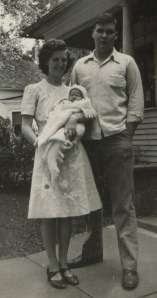
Cecilia and Radney grew up in the same southeast corner of town, if we consider 17 and 18 grown up. She lived a block from the railroad where her father worked as a boiler maker’s helper in the roundhouse. This was the Polish neighborhood where she attended St. Stanislaus Catholic church with masses in Latin and Polish, and went to the Catholic school. He lived on the outskirts of town, on the few acres his father farmed, along with being an inspection supervisor at Motor Shaft. Radney played football at the public high school he attended. His family didn’t go to church, until this incident led his mother to religion at the Baptist church.
They met at the soda fountain at Johnson’s Drug Store. Cecilia worked there after she graduated from 8th grade, as high as Catholic education went for girls of her station in their town in 1940. She scooped ice cream behind the counter and Radney would stop there to have a soda on his long walk home from high school. It seems she (being a normal 17 year old girl) wanted love, and he (being a normal 16 year old boy) wanted sex. She fell in love and he got lucky. Sometime in adulthood I realized that they got married in February and I was born in August. He dropped out of high school so he could support his new family but was drafted into the army soon after I was born. We moved into to her parent’s home, then his parent’s home.
I don’t know anything about their wedding. When I would ask about her growing up years, my mother would get a strange look on her face, as if to ask why I would expect her to think about things that happened so long ago. Maybe her mind wouldn’t let her reach back into those years, maybe she thought it irrelevant. I knitted together a piece of detail from here and a piece of detail from there; not from stories they could have told, but public facts, printed on things like birth certificates and marriage licenses. Maybe that is why I longed to read what was written in that black book, to examine the personal side and analyze how it happened to me.
The family never talked about that year but it must have been a tough one. In 1943 a 17 year old Catholic girl didn’t date a 16 year old non-Catholic boy. Everyone knew Catholics were to marry Catholics. And to get pregnant and have to get married was unthinkable. Neighbors whispered and counted on their fingers. Oh, the shame that was heaped upon them. My chest tightens when I think about the conversations that took place when my grandparents were told, and when siblings found out. Did the Polish speaking parents and the English speaking parents meet to discuss options? Who planned the wedding and what was it like? Did they really love each other; did either feel trapped?
============
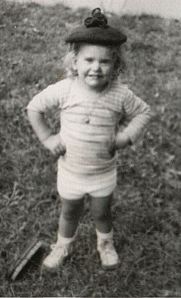
At some point I learned shame. They didn’t sit me down and teach it to me; I learned it through osmosis. Shame was so much a part of my being that I couldn’t name it until some thirty years later. People said I was a shy child, but shame can look like shyness when worn by a child. Those who know shame understand the hung head and the hiding behind trees instead of joining in the play. They didn’t know they were teaching me shame. My grandmas and aunts and cousins taught me their love as I lived among them, and my parents taught me their shame. For the first half of my life, the shame was stronger than the love.
They were good enough parents, they worked hard to provide for us and we had fun times as I was growing up. But early on when I was four and my father returned from the army and my mother became pregnant again, it tore open some wound in him. He took it out on us. If she wouldn’t have gotten pregnant, if I wouldn’t have been born, he wouldn’t have been trapped. I heard the screaming and hateful words; I felt the bruised and bloody body. He did unspeakable things and it was my fault. I learned to hang my head and hide, so no one would see my shame.
===============
Have you noticed when we carry something, like shame, for a long time, it becomes how we think about ourselves? We are what it is. I remember when I realized my name didn’t have to be Shame. It wasn’t a light bulb going off, but a gradual reprogramming in how my neurons fire. I began to realize that I wasn’t responsible for my own conception. Everyone else knew it and I knew other people weren’t able to conceive themselves, but I had to realize it about myself. It wasn’t my fault I was conceived. It wasn’t my shame so I could come out of hiding.
My place in the world became brighter and lighter, but my relationship with my parents is still murky. I gave up the anger at being hurt and not being protected, and I had a relationship with both until they died. But something is still missing. We couldn’t talk about it so I never heard their remorse or told them I forgave them. When I was leaving after my last two visits with my dying mother, when we both knew it could be the last visit, my mother stared deep within my eyes for several minutes. I waited for her to ask what she needed to know; I wanted to tell her I forgave her for what happened. I was stuck between wanting resolution, but also fearful that the memories of the incidents were so deeply buried in her that I would be opening a Pandora’s box when she was dying and I was leaving. I hugged her and told her she had been a good mother. She said she hoped so.
===================
How complex our minds are, that balance adult concerns on top of childhood memories and decisions. When I thought like a child, I believed my parents loved me because they told me so. But I also learned to fear love. I remember being at Grandma’s Baptist Sunday School when I was maybe 5. We were lined up in two rows and were led in singing “Jesus loves me, this I know. For the Bible tells me so. I am weak and he is strong…” I couldn’t sing it; I was mute. If my parent could love me and hurt me, I didn’t want any part of accepting the love of the even stronger Jesus.
After my mother’s death, I asked her husband if he knew where the black diary would be. He looked hard and wasn’t able to find it. She must have burned her words. I was heartbroken because I was hoping to know her better and maybe learn that she really did want me and love me. I was hoping her words would help me in my mental exercises of sorting out childhood decisions using my adult reasoning.
I was on my own to figure it out, but that is okay. I don’t feel bitterness toward my parents because I believe they loved me as best they could. But I have also decided I don’t need to let them define if I am loveable. I know who I am and know I belong at the table.
PATRICIA BAILEY (A New Day: Living Life Almost Gracefully) ~ I retired from doing things I loved; teaching university students, directing a university major that was growing and meeting the learning needs of both traditional age and returning students, and helping people heal as a mental health therapist. In retirement I have found new and renewed activities that I love; photography, blogging, traveling, and quilting. It is important for me to have a purpose for my living, and my photography and blogging fulfill my need to touch and enrich the lives of others in a way that is healing and to help people grow and develop. Along the way I am drawing on the knowledge gained from getting a Masters in Social Work and a Ph.D. in Clinical Psychology. I am also continuing to learn about myself as I am writing and about the world as I view it through my lens. You can visit my blog at http://imissmetoo.me/
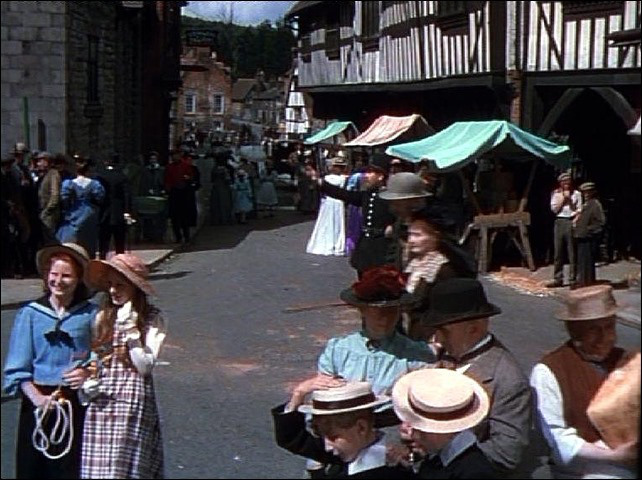
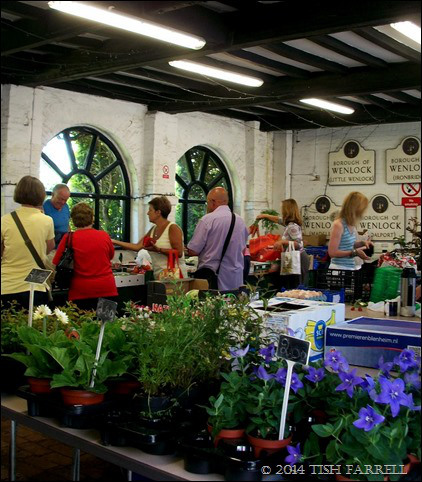
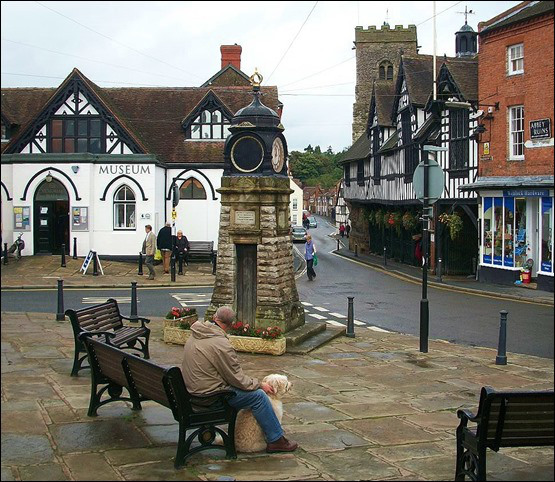
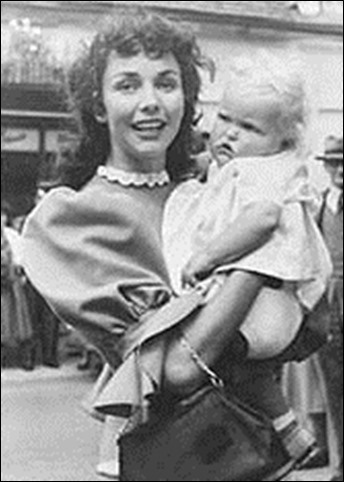
It’s hard to imagine, but in 1949 Hollywood descended on my little home town of Much Wenlock. Both its locations and inhabitants featured in David O. Selznick’s screen version of Mary Webb’s 1917 novel, Gone to Earth. The film’s star, Oscar-winner Jennifer Jones, certainly looks the part, and in this respect she well conjures the book’s central character, the untamed but doomed spirit that is Shropshire lass, Hazel Woodus.
As an American, Jones of course had to receive specialist drilling in the Shropshire dialect, a form of speech which these days is scarcely heard, but would have been the norm during Webb’s childhood. She writes it very clearly in the book’s dialogue, and Jones makes a good stab at it, but it perhaps sounds overdone to modern ears. People in England do not speak like this any more.
Mary Webb herself spent her adolescence in Much Wenlock, and for the rest of her too-short life lived in various parts of rural Shropshire. She knew country ways intimately. Her writing is rooted always in the landscapes of her own growing up – the upland wilds and rugged long-gone lead-mining and peasant farming communities, the small market towns. But although she observes the hardship and poverty with a keen eye, she has tended to be dismissed as a writer of the romantic and rustic, her work parodied in Stella Gibbons’ Cold Comfort Farm.
In her day, though, she had some very well known literary admirers including Rebecca West and John Buchan (Thirty-Nine Steps). I think her novels deserve a rediscovery. Her themes are still relevant today: male attitudes to women being one of them; human cruelty and wilful destructiveness for another.
In Gone to Earth, the central character, Hazel Woodus, is eighteen, motherless, and living in an isolated cottage with her coffin-making, bee-keeping father, Abel. Her only companion is a tame fox, Foxy, and her only guidance in life is dubiously received from her dead mother’s book of gypsy spells.
Two men want her: the Baptist Minister who marries her and tries to protect what he sees as her innocent spirit, and the fox-hunting landowner who wants only bodily possession. Hazel herself is torn between respectable conformity and her growing sexual awareness. And if I tell you that the term ‘gone to earth’ is the huntsman’s cry when a fox goes underground to escape the hounds, you will know that the story does not end well.
In other senses the book’s plot may be purely allegorical. Above all, it is about the pointless destruction of natural beauty and freedom. Webb was writing it at a time when three of her younger brothers were fighting in the World War 1 trenches.
Much Wenlock 1949 in outside and inside the medieval Guildhall: scenes from Gone to Earth, director Michael Powell
The making of the film did not run altogether smoothly, and there are perhaps some parallels between Hazel as an object of male possession and control , and the position of the film’s star, Jennifer Jones. She had had an affair with the executive producer, David O. Selznik, and by 1949 they were married. He wanted Gone to Earth to be solely a showcase for her, and he did not think the film’s makers, the fabulous storytelling team of director Michael Powell, and screenwriter, Emeric Pressburger, (The Red Shoes, The Life and Death of Colonel Blimp) had done her justice. He even took them to court for not producing what was in the script. He lost the case, but he still had the right to make an alternative version.
The upshot was that for the 1952 American release, renamed The Wild Heart , he chopped all the scenes that did not make the most of Jones, had new scenes shot, and to make sense of the makeover added a commentary by Joseph Cotton. The film was not well received, and so did not serve his purpose. Only recently has the original Powell and Pressburger version been fully restored.
Hazel goes to the Devil’s Chair
For more on Mary Webb:
“This year’s discovery has been Mary Webb, author of Gone to Earth. She is a genius, and I shouldn’t mind wagering that she is going to be the most distinguished writer of our generation.” — Rebecca West, review of Gone to Earth in the Times Literary Supplement, August 30, 1917
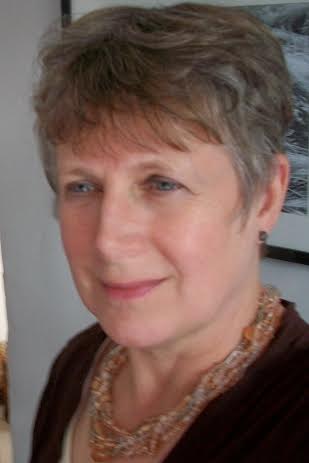
TISH FARRELL (Writer on the Edge) ~ is an award-winning English writer of fiction and non-fiction for young adults. In the 1990s, after a career in Museum Education, she went to live in Kenya, East Africa. It was here that she began writing for the African Children’s Literature market. An anthropologist by training, she was dismayed at the lack of contemporary fiction that reflected young Africans’ lives in their increasingly urbanised world.
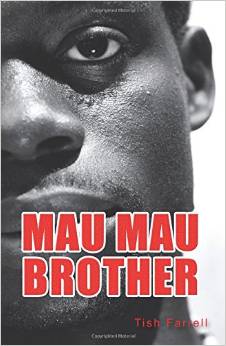
Her first short novel, Jessicah the Mountain Slayer, about a Nairobi street girl, and a picture book Flame Tree Market were published by Zimbabwe Publishing House, Zimbabwe and Phoenix Publishing, Kenya. Both books won awards at the 1996 Zimbabwe International Book Fair and have remained in print in both countries ever since. In the United States her short fiction has appeared in the multi-award winning Cricket and Cicada Magazines. Now living back in England, she writes novelised short stories for reluctant teen readers for Ransom Publishing. The most recent title, Mau Mau Brother, tells the story of the 1950s Kenya uprising from the viewpoint of a Kikuyu boy. She has also just published a Kindle novella e-book, Losing Kui. This new edition was originally published by Cicada Magazine and is suitable for adults and young adults alike. Go here for more about her Books
Tish blogs about Africa, the ancient Shropshire town of Much Wenlock where she lives, writing, and much else besides at: http://tishfarrell.wordpress.com/
Both Beguine Again (all week) and The Bardo Group blog ( Terri’s Sunday post 9/15 and Michael Watson’s post on 9/20) will feature related topics leading up to the largest global demonstration for climate change in history. This demonstration is scheduled for Sept 21. We’ve provided details on it in our last Bardo News (http://wp.me/p1gLT0-3i3) and today we share a post from Beguine Again.
This poem was written by Noris Roberts, a Venezuelan poet educated in Commercial Law at the Universidad Santa Maria in Caracas. Her collection The Mirror of the Soul was published in limited edition with proceeds going to a healthcare foundation for at-risk children. You will find her complete bio HERE.
Yesterday on our partner blog writers Ruth, Terri, Chrysty, Donna and James shared their memories of the 9/11 tragedy. You may want to read what they each have to say and to add your own voice there as well.
Mad dogs and Englishmen go out in the noonday sun. And so do we. It was over a hundred degrees, and the sun blazed down from a cloudless sky. The plaza was nearly deserted as we approached Batalha Monastery, and I was wilting. Still, it’s a UNESCO World Heritage Site, and we couldn’t miss it.
Batalha Monastery, the ‘Monastery of Battle’, was begun by King Joao I to commemorate his victory of the Portuguese over the Castilians in the Battle of Aljubarrota in 1385.
I was glad I came.
In the cloisters, time stands still. The view hadn’t changed in six centuries.
Inside the church the stained glass softened the harsh sunlight.
A dramatic tomb for King Joao and Queen Phillipa of Lancaster depicted the royal couple with joined hands, symbolizing the alliance between Portugal and England. Surrounding bays contained the tombs of their four younger sons. I’d already seen so many tombs that week, and couldn’t muster the energy to snap a shot, although I was moved to photograph the stillness of the Royal Cloister.
I found the symmetry soothing.
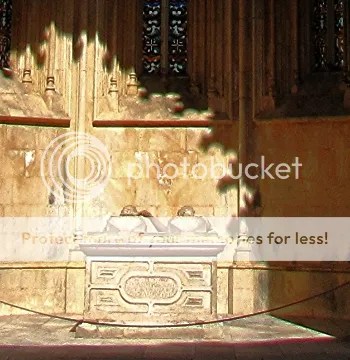
And then I stepped into The Unfinished Chapel, where rests the tomb of their eldest son, King Duarte and his wife, Leonor of Aragon. Their final resting place was less monumental, and still uncompleted, without even a roof. Their chapel too was designed to house the tombs of their descendants, but that hadn’t happened either. Duarte and Leonor were its sole occupants.
Duarte’s story was also less remarkable than his dad’s. His reign was short, troubled, and plagued by poor choices. He preferred writing to war, and was likely better at it. He began The Art of Riding on Every Saddle, “…in accordance with the saying that writing books is an endless task, which I do for my own relaxation and entertainment…I am going to write…with the objective of improving the riding skills of those who decide to read my writings in good will…”
That book, like his chapel, was also unfinished. Duarte died young, swept away by the plague, leaving his wife to mourn. From that day on, she signed her name “the sad queen.” She lived only a few more years, her short regency also plagued with conflict. Sadly, she died in exile. But she rests beside her husband.
Their tomb, their accomplishments, and their lives might have been less glorious than those of their victorious parents. But their unfinished tomb is open to the sun and the breeze, the infinite sky. The sad queen and her husband, in gentle and loving repose, seem less a statement of diplomatic alliance than a forever snapshot of a loving couple, still tenderly holding hands after all these years.
I think I’d rather be remembered for my pen than my sword, and would rather be successful in love than in war, or even in my writing.
Still, plague notwithstanding, I’m going to finish my damn book.
All words and images copyright 2013 Naomi Baltuck
NAOMI BALTUCK ~ is a Contributing Editor and Resident Storyteller here at Bardo. She is a world-traveler and an award-winning writer, photographer, and story-teller whose works of fiction and nonfiction are available through Amazon HERE. Naomi presents her wonderful photo-stories – always interesting and rich with meaning and humor – at Writing Between the Lines, Life from the Writer’s POV. She also conducts workshops such as Peace Porridge (multicultural stories to promote cooperation, goodwill, and peaceful coexistence), Whispers in the Graveyard (a spellbinding array of haunting and mysterious stories), Tandem Tales, Traveling Light Around the World, and others. For more on her programs visit Naomi Baltuck.com
STATUS ON MERGINGBeguine Again and our collective, The Bardo Group, continue with sharing of ideas and some modifications to site links already in progress. At this point the intention is to continue with daily posts. The official transition date is October 1st. On Saturday, October 4, Terri Stewart will post a more complete status report. Jamie Dedes will remain as a part of the core team and as poetry liaison.
We move forward with 100,000 Poets, Musicians and Artists for Change. However, we have streamlined the plan given the weight of work that is now upon us. We won’t be able to publish a book this year – a dream for next year maybe – but we’ll still have daily post/s and in the spirit of the occasion, we invite readers to link in their own relevent work to the posts via Mister Linky or in the comments sections starting September 27 and through October 3 inclusive. Shortly after the event close, we’ll collect links into a Page like the one we did for Poets Against War, 2013 Collection HERE.
The Bardo Group chosen area of concern for this year’s event is Peace and Justice.
The founders of 100,000 Poets, Musicians and Artists for Change are enthusiastically rolling forward. Founders Michael Rothenberg, poet and editor of Big Bridge Press and zine, and Terri Carrion, poet, writer and associate editor and visual designer of Big Bridge Press and zine, have pages set up for all participating organizations. THE BARDO GROUP event page is HERE. We take this opportunity to thank Michael and Terri for their vision and their work.
Michael and Terri have written:
“The first order of change is for poets, writers, musicians, artists, activists to get together to create and perform, educate and demonstrate, simultaneously, with other communities around the world. This will change how we see our local community and the global community. We have all become incredibly alienated in recent years. We hardly know our neighbors down the street let alone our creative allies who live and share our concerns in other countries. We need to feel this kind of global solidarity. It will be empowering.” MORE
PEOPLE’S CLIMATE MARCH (HERE) The largest global demonstration for climate action in history is scheduled for September 21. In solidarity, Beguine Again will post spiritual practice relevant to the issues.
(c) 2014 Jamie Dedes
More than 100 organizations are taking part in an online recruitment drive to sign people up for the demonstration. In the first hours of the push, thousands of new sign-ups have already begun to flow in.
ThePeople’s Climate March is expected to be the largest demonstration for climate action in history. The march takes place just two days before world leaders gather for an emergency Climate Summit at the United Nations. Marchers are demanding leaders go beyond rhetoric and commit to bold action at the summit.
More than 750 organizations around the world are supporting the People’s Climate March, from the largest transit workers union in New York City to a coalition of buddhist monks.
In total, the groups represent roughly 100 million people worldwide.
The scale of organizing for the march now rivals that of a major electoral campaign, with thousands of volunteers, daily phone-banks and canvasses in NYC, and a major online operation to turn out marchers. Updates from the field include:
Trains and hundreds of buses will be bringing people from across the country for the march. Including a dedicated train from San Francisco to New York, a dedicated train from D.C. to New York, and buses from multiple points outside of New York.
More than 45 labor unions have signed onto the march, pledging to turn out members in New York City and from surrounding areas.
Connecticut alone has over 40 different groups confirmed to attend.
Renowned artist Shepard Fairey, whose Obama Hope poster has become world famous, has donated a poster design for the march.
At a warehouse in Brooklyn, artists are creating giant sculptures, floats, and banners for the march.
The global campaigning group Avaaz has secured 10% of the subway ads in NYC for the month before the march. The ads were chosen after a poster design contest that netted over 400 entries worldwide. Groups are planning a major student recruitment push for college campuses as classes resume in September.
In New Delhi, thousands will take over the streets on September 20 to demand a renewable energy revolution.
In Australia, organizers are expecting hundreds of individual events to take place across the country, including a major march in Melbourne.
In London environment organisations and faith groups are combining forces to create a historic march through the city to the steps of Parliament.
In Berlin three parallel marches will combine forces in a colourful festival.
Events are already being planned in Ghana, Kenya, DRC, Nigeria, and Guinea, along with a major march in Johannesburg.
In Paris, local groups will create the “Paris Marche pour le Climat,” with parades, marches, and bicycle rides planned across the bridges of the Seinne.
Reports are also coming in of large mobilizations planned in: Kathmandu, Rio, Sao Paulo, Jakarta, Dublin, Manila, Seoul, Mumbai and Istanbul.
Organizers are confident that the sheer scale and diversity of the People’s Climate March events, from the headline demonstration in New York City to the simultaneous events worldwide, will show politicians that there is a massive, energized movement demanding immediate action to address the climate crisis.
In New York City, the message will be difficult to ignore: marchers have come to an agreement with the NYPD for the march to flow directly through the middle of Manhattan. The march will begin at Columbus Circle at 11:30am on Sunday, proceed over on 59th Street to 6th Avenue, down 6th Avenue to 42nd Street, then right on 42nd Street to 11th Avenue. The route passes by some of New York City’s most famous landmarks, from Rockefeller Center to Times Square.
The march and the Climate Summit in New York mark the beginning of a busy 18 months of crucial international negotiations. Climate negotiators will head to Lima, Peru, in December 2014 to make progress towards a global climate deal. Then, in September 2015 world leaders will meet back in New York to adopt the Sustainable Development Goals, the global post-2015 development agenda. Three months later, the world will gather in Paris to try and sign a new international climate treaty.
BLOGGERS AND WEBSITE OWNERS don’t forget that September 10 is Internet Slowdown. This is all about NetNutrality. Our site host, WordPress, is participating.
White foam rides the churning
river and a Red-Shouldered Hawk
cries out as he drifts overhead;
a meadow vole takes cover.
In an ancient, towering pine,
lies an enormous aerie, home
to a Bald Eagle couple and their
two fledglings who take turns
flapping wildly, strengthening
their wings before take-off.
A feeding herd of White-Tailed
deer wander calm through the
open forest, several fawns
leap and kick in play and sometimes
bleat for their mothers when they
wander too far.
The armor-plated armadillo can be seen
snuffling through low brush and dirt
searching for grubs, worms and beetles.
Berries, nuts and seeds are the choice
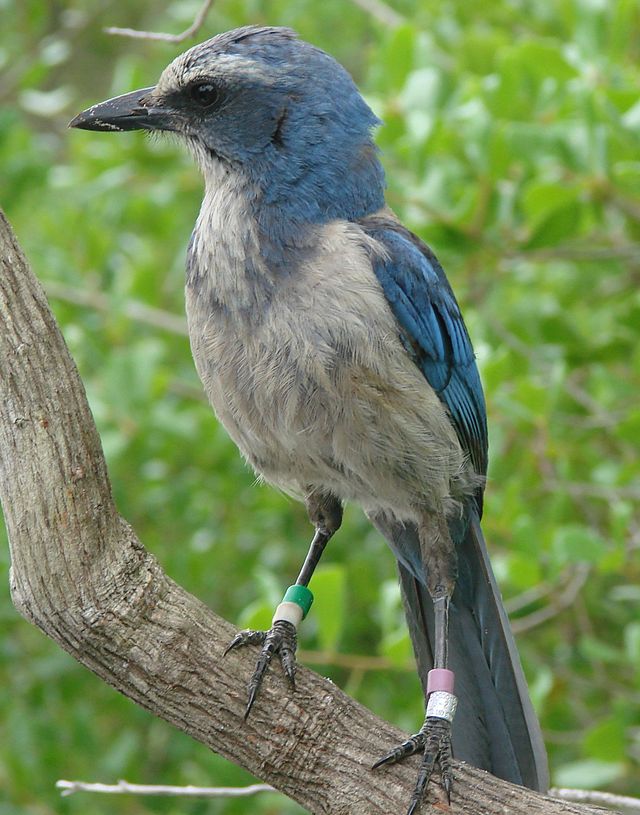
of food for the Florida Scrub Jay seen
flitting through the low, spindly oaks,
and hiding in the scrub when feeling shy.
Their lives lived in extended-family colonies
helps assure them survival even while
their habitat is being threatened.
A dirt colored and plain patterned
garter snakes through the underbrush
before coming to rest in a sunny patch
on the forest’s floor…taking time to
absorb some warmth before moving on;
a gopher turtle stirs from his day’s nap.
All the animals hear when the humans
approach and they watch with
curiosity and then fear as monstrous
machines can be heard revving their
engines preparing once again for
their encroaching.
GAYLE WALTERS ROSE (Bodhirose’s Blog) ~ has contributed to The Bardo Group blog several times since its founding in 2011. Gayle has actively blogged since 2010, writing about family life, things of the spirit, and her ashram-life experiences. In this relatively short time, her sincerity and authenticity has earned her quite a large and loyal following. Gayle is a regular participant in d’Verse Poets Pub. This poem was written in response to Victoria’s Wilderness Week writing prompt posted on Wednesday.
Published on Mar 18, 2013
Welcome to the Wilderness Society!! Our valued staff and members share their stories about the Wilderness Society and their reasons for protecting the Australian environment and wilderness.
“What we are doing to the forests of the world is but a mirror reflection of what we are doing to ourselves and to one another.” Mahatma Gandhi (1869-1948), leader of Indian Nationalism and promoter of nonviolent civil disobedience
I came of age with Eliot Porter. Not literally of course. Rather, my adolescence and young adulthood were accompanied by his books and photos. He taught me how to look. Even now, his photographs influence my writing and visual work.
A few weeks ago we were in Downeast Maine, north of Bar Harbor. Every few days we drove south, down Penobscot County way. Eliot Porter spent much time in the Penobscot region, as well as out West. Out West, his photos were panoramic. Downeast, they were more intimate, capturing a brook, leaf, or pod of berries. If memory serves me, his iconic book and homage to Thoreau, In Wilderness is the Preservation of the Earth, drew heavily from his Penobscot experience.
People tend to think of wilderness as vast tracks of untouched ecosystems. Yet in our time, there are few such places. Climate change and other forms of pollution reach the farthermost corners of the earth. Here, in North America, fossil fuel mining takes place in the midst of former wildlands. Our population has grown so large that we fill the back country with people on many weekends.
The elders taught me to treasure wilderness, and to remember there is another wilderness, the one that lies within each of us. Those vast spaces can be imposing, even terrible, in their beauty and harshness. I was taught there is another danger in focusing on the wilderness inside us: we may ignore the needs of the Planet that supports us, and the innumerable beings that accompany us. To successfully journey into wilderness requires forethought and balance.
For many, the inner wilderness seems most inaccessible, even dangerous. There are daemons within, and sea monsters, waiting to devour us. As shamans everywhere have long known, there is also the ever present threat of madness. Yet there is also the promise of renewal.
Shamans journey into this wilderness to seek aid for others, to return souls to their owners, and to accompany the dead to the other world. They travel for visions of the future, to learn where game will be tomorrow, and to correct imbalances in the world, imbalances most often created by people. Sometimes shamans travel and fail to return home; this is a always a risk.
When Europeans arrived in the Americas, they brought imbalance to our people in the form of illness, alcohol, and social chaos. Faced with this, the shamans and Medicine people sought cures in the inner and the everyday worlds. They were resourceful and connected to the spirits of things, and were often successful in finding ways to heal those afflicted. Yet, eventually, the sheer volume on illness overwhelmed many of our cultures, killing great numbers of healers as they cared for others. Much knowledge was lost in those dark days.
Downeast, Eliot Porter focused on the small, the everyday. He reminded us that wilderness is a matter of scale and attention, that we can find wilderness wherever we are. We can, in turn, look closely at the minutia of the world around us, journey deep into the forest, or turn inward. Sometimes we do all these, simultaneously. Such moments form a sort of vision quest.
Eliot Porter taught me that as we look through the camera’s lens, we sharpen our attention, and open to the magic of the unexpected. Perhaps, for just a moment, we discover ourselves reflected in the world around us, and are returned to primal wholeness and balance. In such moments we may know that we are the salmon swimming home to reproduce and die, the leaves settling into the litter, preparing to nurture the next generation, or the eagle that flies above the world, capturing visions of wholeness. Then we may understand that wilderness is indeed the preservation of the world, and of the soul.
MICHAEL WATSON, M.A., Ph.D., LCMHC (Dreaming the World) ~ is a contributing editor to Into the Bardo, an essayist and a practitioner of the Shamanic arts, psychotherapist, educator and artist of Native American and European descent. He lives and works in Burlington, Vermont, where he teaches in undergraduate and graduate programs at Burlington College,. He was once Dean of Students there. Recently Michael has been teaching in India and Hong Kong. His experiences are documented on his blog. In childhood he had polio, an event that taught him much about challenge, struggle, isolation, and healing.

 JAMIE DEDES (The Poet by Day)~ I started blogging shortly after I retired as a way to maintain my sanity and to stay connected to the arts and the artful despite being mostly homebound. My Facebook pages are: Jamie Dedes (Arts and Humanities) and Simply Living, Living Simply.





















 The BeZine