Volume 9 sustainABILITY & Ukraine Peace Issue 1

Volume 9 sustainABILITY & Ukraine Peace Issue 1
Volume 9 Spring 2022 Issue 1

sustainABILITY
—with a special section—
Ukraine Peace
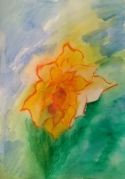
Cover art Orange Flowers
Water Color
©2021 Miroslava Panayotova
Welcome to the Spring Issue of The BeZine centered on SustainABILITY with a special section on Peace for Ukraine. Authors, artists, and creatives from around the world have come together here to shine lights on our common home, this spinning globe we all inhabit.
It seems every day brings a new story of climate change and its impact on our world so it can, at times, feel hopeless to even try to attempt change. Yet humans have a long history of changing things long thought intractable. That is why I love this season of the BeZine, with its focus on SustainABILITY. We ARE able and that vision of ability grows with the dreamers, the writers, the painters, and the poets.
This past month has hit us hard, however. Putin has invaded Ukraine, so hopelessness, heartbreak, horror, and hate fill our news, our conversations, and our hearts. War makes everything harder, including efforts at sustainability. Here in our special section, voices rise in community with our neighbors to speak up for our common humanity. We hold hope for a peace that respects all human lives, dignities, and freedoms.
May Peace prevail on Earth.
—Chrysty Darby Hendrick, Associate Editor
Your Portfolio Archive currently has no entries. You can start creating them on your dashboard.


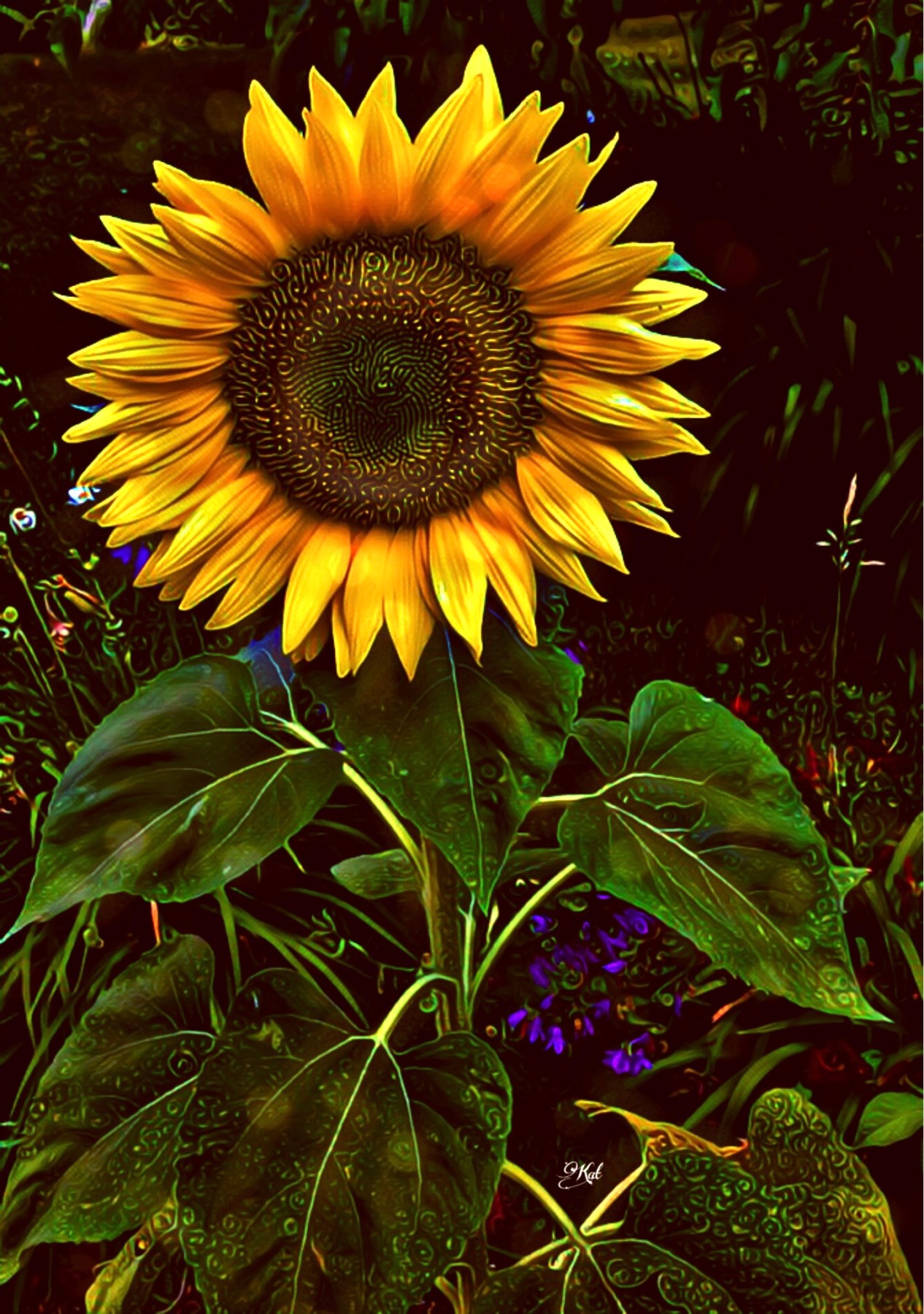
Art: Sunflower, Kat Patton ©2022

The world has gone mad. Again.
And again voices incite—then hoarse leaders
pretend to have been polite. They did not shout
fear and hatred to explosive tension, to a thin-
wire stretched, first sounding a note then cracking,
snapping in two, each piece twisted. The world goes
mad. Again. The leaders call for calm, like arsonists
who work in the fire department. The fires burn
in the streets at night. The checkpoints flow
with blood and tears. And most of us just want
to go to work, have coffee with friends, teach
our children something other than this craziness
in a world gone mad. Again. And most of us want
to turn away and not see the burning, the smoke,
the arsonists lining up toy soldiers at borders
ready to pounce, to attack, to burn. Again.
—Michael Dickel ©2014
Analysis of “Again” written in 2015 by Vivian Eden in Haaretz:
Poem of the Week Recycled Violence: The World Has Gone Mad Again.

I don’t think that I need to explain about Ukraine, and why I titled this Special Section “Ukraine Peace.” There are some who may raise legitimate questions about the focus on Europe, with so many countries at war in Africa, Asia, the Middle East. There are some who raise legitimate questions about supporting the US in battling Russia, given the undeniable history of and current aggressions world wide (and supporting other countries as they invade neighbors). So I will repeat below a version of the blog post that announced this special section and called for submissions.
Even with all of the tensions and warnings leading up to it, Russia’s all-out invasion of Ukraine on February 24, 2022, shocked the world. This violation of international law and Ukraine’s sovereignty could easily expand to a broader war. This puts progressives, as I think myself to be, in a position of wondering how do we wage peace? Is there a path to peace?
I don’t know. As I write this, the war continues in its third week. The images of the invasion invade our consciousness and my conscience. How do we wage peace?
Whatever the path to peace may be, the path for social justice would not allow for accepting Russia’s war on Ukraine. However, I also am aware that Western Imperialism has acted just as viciously in its own interests, and that the US and the West continue to promote wars in their interests.
Could a world-wide strike be the path, opposed to all war and demanding peace? Is such a thing possible even? How do we follow Gandhi’s path of non-violence and quickly grow it to a global scale? I can’t imagine that it could be done in time to help the people in Ukraine.
History provides warnings about where this invasion could lead. In fact, Putin followed a playbook used in 1939. One of the demands Hitler presented for negotiation just before the invasion of Poland was “safeguarding the German minority in Poland.” Putin said in his speech announcing the invasion that its “goal is to protect people who have been abused by the genocide of the Kyiv regime for eight years.” By dawn of 24 February 2022, the Russian army attacked Ukraine with a blitzkrieg, aiming for military targets. The blitzkrieg strategy was first used pre-dawn of September 1, 1939, starting the invasion of Poland. The USSR joined Germany in attacking Poland on 17 September of that year.
How do we protect peace and simultaneously prevent further expansion through military force?
And who to stand behind for justice? It is not as though the U.S. does not use military force, directly and indirectly. The shadows of Vietnam, Irag, Libya, and Afghanistan loom over this battle. Can we trust the US and NATO to do the right thing?
CUNY Professor Peter Beinart offers an apt quote from 1943 to frame his argument that this time, we need to support the US, even progressives who rightly attack the US for its hypocrisy and war-mongering:
In 1943, the Hungarian-born journalist Arthur Koestler wrote: “In this war we are fighting against a total lie in the name of a half-truth.” That’s a good motto for American progressives to adopt in the wake of Russia’s full-scale invasion of Ukraine.
CUNY Professor Peter Beinart, “Russia speaks total lies. That doesn’t diminish America’s half-truths” in The Guardian
Beinart acknowledges the lies of the U.S.: Saying the US stands with Ukraine because America is committed to democracy and the “rules-based international order” is at best a half-truth. The US helps dictatorships like Saudi Arabia and the United Arab Emirates commit war crimes in Yemen, employs economic sanctions that deny people from Iran to Venezuela to Syria life-saving medicines, rips up international agreements like the Iran nuclear deal and Paris climate accords, and threatens the international criminal court if it investigates the US or Israel.
And then he goes on to explain the connection to the 1943 quote:
But this hypocrisy wouldn’t have fazed Koestler, because it’s nothing new. In 1943, the alliance that fought Hitler was led by a British prime minister who championed imperialism, an American president who presided over racial apartheid, and Joseph Stalin. Koestler’s point wasn’t that the US or Britain, let alone the USSR, were virtuous in general. It was that they were virtuous relative to Nazi Germany in the specific circumstances of the second world war, and that these sinful governments were the only ones with the geopolitical heft to stop a totalitarian takeover of Europe.
These extended quotes give the overall argument. Beinart continues to develop it with a focus on the invasion of Ukraine. He points out that there are times when Russia had been on the relatively virtuous side and the US not, with examples. And times when the US has been relatively virtuous, and Russia not. In the end, for this case, we have to think clearly and make a choice.
As Beinart writes: “But Koestler’s point was that progressives can puncture America’s pretensions to universal virtue while still recognizing that it is sometimes one of the few instruments available to combat evil.”
Peter Beinart’s essay is worth reading in full here.
While I do not support much of what the U.S. does, in this situation, I agree with Beinart that it is, relative to Putin’s invasion, the more virtuous side to support.
However, I still really want to find a non-violent path to peace for all. I recognize that, today, this seems an impossibly distant goal. The non-violent path to peace probably won’t be reached in my lifetime. Sadly, it has been made more distant, seemingly less possible, with this invasion.
And ever more urgent with the use of cluster bombs, vacuum bombs, and threats of chemical weapons or even nuclear weapons.
The creative works in the follow pages of the Special Section, Ukraine Peace, support peace, humanity, and Ukraine in this historical moment. The response to the call that an earlier version of these words made for work came with intensity, sorrow, love, and hope. We have art, poems, prose submissions. We have videos of two powerful readings done on Zoom with poets from the US and from Ukraine reading. We have videos of traditional Ukrainian music.
All of this work supports Ukraine and strives for peace. I encourage you to read and share this outflowing of creativity pouring out to support people and put out into the world declarations for peace.
My heart, thoughts, and good will goes out to the peoples of both Russia and Ukraine who are caught between the anvil and the hammer. May peace return,
May Peace Prevail on Earth.
Readings updated: 21 March 2022
©2022 Michael Dickel, except for quotes
All rights reserved
I am worn out from groaning.
People: mother, father, baby, child,
toddler, student, woman, man.
The grandmother who yells
In Russian at the young soldier
To tuck sunflowers in his front pocket
Because when he dies his body will sort
Out into new blooms on the land
Of Ukraine, that the yellow suns
Will redeem themselves, breaking
Through shrapnel and Molotov
Cocktail remnants, and disappear,
like cloth, the children’s cancer ward
bombed out, at its corner seams.
the teenager named Kira,
Waiting with her conure parrot for three
Days in line to get into Poland
Those underground like the sunflower
Seeds, hiding from the night afraid
And implosions of fear they cannot
Show to their children as they clutch
Lego backpacks to chests and look
At the blue for signs of sky and yellow
For the wheat fields. We are kind,
we are peaceful. We will feed you hot tea,
the Kyiv men say, we will help you to get home.
Nightmare slumber, boyhood, February,
Winter, imagining, omen, flying sleep.

©2022 Millicent Borges Accardi
All rights reserved
…is a Portuguese-American writer, author of four poetry collections, most recently Through a Grainy Landscape (New Meridian Arts 2021). Among her awards are fellowships from the National Endowment for the Arts, Fulbright, CantoMundo, California Arts Council, Foundation for Contemporary Arts (Covid grant), Yaddo, Fundação Luso-Americana (Portugal), and the Barbara Deming Foundation, “Money for Women.” She lives in Southern California, in the hippie enclave of Topanga Canyon.
Tonight bears in its wings the dirge of a thing clattering
the world in its teeth.

Shrapnel & bombs ricochet that way & this way, shelling
cities into rubble.

& people scamper for safety, force themselves into the mouth
of another country because their birthplace has become

a lapping fire. Reminds me of Afghans thronging the bodies
of planes in Kabul after Taliban takeover. Whenever war news

grip me before the TV screen, I reach for the brink of silence.
Tonight, I'm at the brink of silence. Tonight, I hear soft moans

in Kyiv. This night, sighs run deep in Kharkiv. A Ukrainian
woman hurls her baby into arms, running for the borders,

afraid to look at the things bombs have eaten halfway,
afraid of turning into a pillar of ruin. Tonight, my lines
reek of bloods, my hand is too heavy to continue this poem.
Come & see bloods stroke the skin of ego. Come & see bloods

oil the wheels of politics. Come, come & see blood murals on the walls
of Kherson. Every night, after switching between Aljeezera & BBC

like a pendulum, I borrow new names to numb my pains. Now, I'm
running out of names. I think of the journeys the people of Ukraine

are unwilling to make. I think of the split gap between beauty & ruins.
Each night, after the war correspondent's voice weans off my ears,

I run my palm over my skin & collect into a soulful soliloquy
of bloodied flesh & things smouldering. Tonight, a breaking news

about this war lingers over my TV screen. & the reporter says it
with a certain weight in her voice as if she were drowning. I watch

a woman sated with the burden for home says to a Russian
soldier, Take these seeds so sunflowers grow when you die

here. I clasp my palms in prayers, clogged words rippling down
my throat: Peace for Ukraine, for Russia, for everyone running.
©2022 Adesina Ajala
All rights reserved

…a Nigerian writer, poet & medical doctor, is currently in the 2022 Cohort of the Global Arts in Medicine Fellowship. His poem, “A dirge of Broken Things” wins the 2020/2021 Poetic Wednesdays Initiative Contest. He also win the Ayamba LitCast Essay Contest with his piece, “Daffodils and the Promise of Rebirth” in 2021. His works appear in Afritondo, Mbari, Nantygreens, The Red Letter Journal, The Nigeria Review and elsewhere.
Can you imagine being forced to give up all your participation and activity in poetry, storytelling, music, art and oral histories; even your connections and hence enjoyment of these forms of culture … by the imposition of an external aggressive, authoritarian and violent regime? A regime that will insist on imposing their own strict values, that could barely be described as cultural? Gone from your life. For a long time, possibly for the rest of your life.
Are we about to see these very same inhuman restrictions being imposed again? Restrictions that the old Soviet regime stamped out for seventy years in all those Eastern European countries that were freed by the breakup of the Soviet Union in 1989.
The Ukraine, a country that voted clearly and decisively for its own sovereignty within two years of the break up of the old Soviet Union, is now the object of an invasion that was clearly planned strategy, which is an unmitigated disaster. When, in 2014, the Russians moved their armed forces into and claimed that part of Ukraine, Crimea, which has always been a strategically important peninsula, a southern bridgehead, it was clear that this was a part of that strategy, which has been on the cards of a dictatorial leadership. They are now bombing, shelling and attacking what is effectively an independent, democratic European country on three fronts and it is clear that they will stop at nothing to get their way, even to the extent of threatening Europe as a whole.
Several years ago, I attended a workshop run by one of the top Georgian Male a cappella choirs, who were touring the UK. At some point in the evening we learned that, during the seventy years of Soviet dominance, their art of story telling through their folk and cultural traditions was not allowed by the authorities. Only through clandestine meetings, at risk of banishment, did they manage to keep their songs and their stories alive and it took several years after the break up of thee Soviet Union, to get back to the level of performance they and now we can enjoy.
Just as Georgia kept their stories alive through song, dance and oral history, so too does the Ukraine. Miklos Both founded the Polyphony Project, for which, over a period of four years, he travelled around Ukraine, to visit 100 villages. He managed to record over 2,000 songs for which he has created a digital archive. This represents such an important piece of work.
For anyone in any country, oral histories, whether spoken, sung or danced, as well as their visual art, are an absolutely vital part of preserving the truth of a culture, a country or a system of believe, as they come from the mouths and minds of those people who are the culture, who are the stories, who are their histories unabridged by those despotic dictatorships and empire builders, who would erase what doesn’t fit with their own version of the truth.
May I invite you to watch this brief five minute example of how this can be done …
In my searches I also found this popular Ukrainian band playing an NPR Tiny Desk concert back in 2015. Their sound, their voicing and infectious rhythms and performance are joyous and very uplifting. Their vocal sound is particularly poignant and very characteristic of those regions of Eastern Europe …
You’ve got to love the hats!
©2022 John Anstie
All rights reserved
Who gives the order to fire
and who aims the gun
and who is the target
and whose life is stolen
and who weeps with regret for what is lost
and who will raise a flag of truce to stop the insanity
and who will be the first to utter the word: peace?

Was it frightened by the sound
of rockets falling?

Did it run away
to hide in the nearest
bomb shelter?

Is it huddled with the
children in the dark
space under the rubble?

Is it hiding from war,
from anger and rage,
unwilling to risk
returning until
the fighting stops?

Is it caught in this endless
tug-of-war, each side claiming
ancient injustices, bruises, rebuffs?

Is it burrowing deeper into
the safe room or shelter
to avoid the conflict?

Or is it missing in action,
protecting a body
concealed in the
rubble?

Or carried
on a stretcher
into what’s left of a
hospital?

Or maybe it’s weeping
over each life lost,
unable to keep count—
Arab, Israeli—each life
lost a precious life,
irreplaceable.
©2022 Bruce Black
All rights reserved
is the author of Writing Yoga (Rodmell Press/Shambhala) and editorial director of The Jewish Writing Project. He received his BA from Columbia University and his MFA from Vermont College. His poems and personal narratives have appeared in Soul-Lit, Poetry Super Highway, Atherton Review, Elephant Journal, Blue Lyra Review, Tiferet Journal, Hevria, Poetica, Jewthink, The Jewish Literary Journal, Mindbodygreen, Chicken Soup for the Soul, and elsewhere. He lives in Sarasota, FL.
An assimilated dart,
Unsustained long-standing insurgencies,
the sequelae of ambience & peculiarity in holds of dynamism,
Seeping & entrenched; an unrest of sustenance,
Stability has a rare affluence on significant truces left in the dark,
Peace can only stay when there's a joint act of benevolence.
The air that surrounds an apneic state of no riots,
Breathless & proportionate the heaps of unsettled upheavals.
Revolts of unfairness in a time of undeserving merciless acts,
Divulged & presented in a predominant maneuver,
It hits like a collective pulse of pain,
It hits with an error of silence,
It hits with tentative overlooked & unconcerned shuns,

It hits with a creeping creed of pain,
It hits like the past,
Yields with no dividends,
The packs of life.
A time to wage peace from obscurities,
an ousted onset of the past.
©2022 Benedicta Boamah
All rights reserved
…is a skilled nursing officer in emergency cardiovascular care which is provided for short term contracts in various prestigious organisations. Benedicta writes poetry during her leisure periods. I was born in Bloemfontein, Free State, though a Ghanaian, and completed my degree program as a professional nurse in Garden City University College in Kumasi, Ghana.I’m the fourth and last child and as it stands my parents are retired lecturers. Currently, I have a personal blog on WordPress and a partner organisation that deals in emergency courses and live webinars. I have an inner passion to write daily from the heart in making a difference as a poet in an outstanding literary world.
Daughter of a broken arm,
legs drove the wheels,
shot down at the speed
of a black jeep.

The evening moved to make things
square. Details in bags and rustling bills.

Our nation is ready
to give his last shirt.

Vladimir’s cathedral and walking
on subway cars with dull drawling.

A guy cleaned paws off my shoulder,
walked to the exit of transition,
he graduated with grief in half,
three classes.

But all this being said, the flowers.

Poem ©2022 Debbi Brody
All rights reserved

…is an avid attendee and leader of poetry workshops. She has been published in numerous national and regional journals, magazines and anthologies of note. She judges poetry contests around the nation. Debbi’s strong voice ranges from narrative to lyric, short to lengthy, grief filled to joyous, inner to outer landscapes and politics. The deep influences of the surrealist, modernist and beat poets sing through her collections of clear, tough, tender and fantastical poems. She is the author of three chapbooks as well as two full length poetry collections. In Everything, Birds, is her second full length collection published by Village Books Press, (OKC, OK 2015)and was awarded an inaugural Margaret Randall Book Prize in Poetry. Her newest chapbook is Walking the Arroyo (2020-Cyberwit Books).
Country people say when a hummingbird
flies in at your window it brings a love
message to someone in your home. Unheard
Love quivers against the ceiling, ‘til love

stunned and exhausted, unless caught, released,
is found dead in rooms little used, entered
unperceived. Outside love defends cities
of nectar flowers when found invaded.

Increases intensity and the speed
of its song to ward off intruders. Knocked
Down it revives and returns to succeed,
Keep its territory, invaders stopped.

Bold and fearless tiny love makes very
Good battle when it is necessary.

      Extrapolated from a passage in “Rural Hours” by Susan Fennimore Cooper

Amongst the ruins where some are cut down.
Sunflowers grow in their soil, where others
fall, Chamomile grows. In between fired rounds
We harvest the dead, as oilseed croppers.

Make tea from our enemies, helps us sleep.
Carve sunflowers into wood furniture,
weave them into girls celebration wreaths.
They protect us from evil, provide cures.

Bullets, missiles and bombs are seeds blasted
Into one another. Skin is good earth.
Violent kernels kill targets planted
in soil amongst ruins that hold their worth.

Victims of war always nation’s flowers.
Memorialise in time’s quiet hours.
©2021 Paul Brookes
All rights reserved
…is a shop asst. Lives in a cat house full of teddy bears. First play performed at The Gulbenkian Theatre, Hull. His chapbooks include The Fabulous Invention Of Barnsley, (Dearne Community Arts, 1993). A World Where and She Needs That Edge (Nixes Mate Press, 2017, 2018) The Spermbot Blues (OpPRESS, 2017), Please Take Change (Cyberwit.net, 2018), As Folk Over Yonder ( Afterworld Books, 2019). He is a contributing writer of Literati Magazine and Editor of Wombwell Rainbow Interviews, book reviews and challenges. Had work broadcast on BBC Radio 3 The Verb and, videos of his Self Isolation sonnet sequence featured by Barnsley Museums and Hear My Voice Barnsley. He also does photography commissions. Most recent is a poetry collaboration with artworker Jane Cornwell: “Wonderland in Alice, plus other ways of seeing”, (JCStudio Press, 2021)
In the Kremlin the guards were monsters of the kind
of secrecy that flattens souls,
an enormous place for hiding spies and jewels
where the air rang of old czars and killings.
It was as though i too was masked and silenced
there in that killing quiet.
That killing quiet.
I tried to imagine a blond czarina playing cards,
being able to sing her songs in that pernicious silence,
those halls staggered large and long everywhere,
Lenin outside preserved forever, what a deadly fear
and the polite waiting lines
all too silent
and I played Bartok and B.B. King voraciously
loud to obliterate that crippling politeness.
We lived in the war pasting coupons
page after page in the war our parents
subdued for us, banned in a loud quiet.
banning feeling in themselves
keeping the lights bright. We lived in a war
bleeding alone, for there was no tv
to see. Night radio muffled. The war hit our hearts,
what else? We ate polite weeklong pot roasts

And knew something was missing. It was fear
that the world would not be here, nor we,
that the rituals would crash like Alice
fell through, fell to newwhere-land

Oh, where will we go when we pass
into you? Will our hearts even start?
Who will keep this ritual life going
with all the killing and darkness?

Anne Frank at least she said, and Joan of Arc withstood.
And we all targets geographical and physical
And we exposed and frightened, having
to put a good face on this evil which threatened all
those war days and witch-hunt days and
always in our ever oppositional living

And now again as the long days pass casting evil
Again I wander-wonder alone what I’ll do when
Life turns into a living bomb cast and I’ll have no
Pot-roast or pretense. Writing my
Globetrotting weapon and disguise.
In out and all about. In rife absurdity.
Calm the bombs and silence the mad.
Let’s feel clear water and soft words all
Green, clad in long love and trust beyond bloodshed
Not hope  but a sudden heartening.

Voice is an old cliche I’m
Not proud to say that closer
It’s just all getting tighter
Any way I see mushrooms
I see that angular nose
Spelling the world and time falling:
War cries upon us again harder
Takes it onto us harder.
We’ve watched all this before
Now let us speak
peace surer & surer
Let no dictator bite the
Worlds chestnuts out and
eat their way in. Stand up and plunder their bones harder
And harder harder till our cliches stick true
Stones unto bones unto trinkets
there was a time I ain’t gonna
study war no more bones
no more shocks
Stones onto my big heart
bones unto war
no more and like death
stones us tight into our years

We have forgotten there was a time
We locked hands and remembered
Those bones
those overtones of war
And now there are three wars
Anyway
Where has all the young love gone
Stones unto bones unto trinkets.

Poems make  a shape
they take like magic
in a Finnish prayer
they reach eternity
where we’re all marching
for peace, for each other,
our feet preaching peaceful.
©2022 Linda Chown
All rights reserved

…is a writer born in Berkeley who has been socially aware all her life. Years in Franco’s Spain only taught her more about group action and collaboration. Professor of American and teaching World literatures teach her how to live and love. Intensity is her middle name.
"after the End and the beginning" Wislawa Syzmborska

We need to do something about all the lost limbs.
Would somebody please volunteer to search
for all those lost legs, arms, faces?
We’re all thirsty, yes, but does anybody know
where we can find a brook, a creek that
doesn’t have our floating cousins?

Yes, yes, we need a morgue, but first
we must find a few dogs to tell us
who is beneath the stones.

We know Gertrude and Maurice and maybe
Alfonse, maybe more, all have to be found.
Bandages, surely someone has some bandages.

We want to rebuild. Does anyone have a ladder?
Let’s leave God out of this for awhile.
Let’s start in the square, and slowly remove

what was thrown down from the sky.
Who knows how to get a weather report?
Will there be good weather for tomorrow?

Yes, that’s a good idea, but we can always
talk, there’s always a lot of time for talk.
We’ve got such a mess.

Brooms. Everybody, find all the brooms.
Can anyone send a letter, we need to let
someone know this has happened.

Tomorrow we can start burning our families.
Surely someone will see the smoke.
Surely someone will come.
                  From At the End of War (DeWitt Clinton, Kelsay Books 2018)
                  This appeared in the March 2019 Waging Peace issue of The BeZine.
                  Reprinted now at the request of the poet.
©2018 DeWitt Clinton
All rights reserved

…taught English, Creative Writing, and World of Ideas courses for over 30 years at the University of Wisconsin—Whitewater. His earlier collections of poetry include The Conquistador Dog Texts, The Coyot. Inca Texts, (New Rivers Press), At the End of the War (Kelsay Books, 2018) and By A Lake Near A Moon: Fishing with the Chinese Masters (Is A Rose Press, 2020). A fifth poetry collection, Hello There, is due out soon from Word Tech Communications in Cincinnati.
I buy sunflowers today
fuzzy  faces
canary  yellow  petals

stand them  one by one
sturdy stalks
in an azure vase

7000 miles away   tanks
roll across Ukrainian borders
trying to wipe them off the map

grandmothers   aunts
fathers   sons
throw their bodies   against bully armor

hearts forged   in resistance
Zelenskyy takes off his suit and puts on battle fatigues,
stands in the streets, talks with his troops.

And when his fellow patriots can’t see him, literally,
he makes videos—calls to soldiers from every

continent to join freedom’s fight. “We are
all here, protecting our independence, our country,

the free world. This night will be difficult, but dawn
will come.” And it arrives, morning after morning,

despite tracers slicing the pitch black, despite
gutting of homes, hospitals, schools, & markets, despite

bombarding of Kherson, Kharkiv, Kyiv, Mariupol, &
Melitopol, despite screams & slaughter of civilians.

Then Russia turns its fire on Zaporizhzhia—home to
Europe’s largest nuclear plant, six reactors. Flaming

shells like falling stars cut into darkness. A huge orange
globe lights up the sky, exploding beside a car park.

Smoke billows. Radiation knows no borders. “We will not
lay down our weapons. Our weapons are our truth.”

Poems and photograph ©2022 Chella Courington
All rights reserved
…(she/her) is a writer and teacher whose poetry and fiction appear or are forthcoming in numerous anthologies and journals including DMQ Review, The Los Angeles Review, and Anti-Heroin Chic. She was raised in the Appalachian south and now lives in California. Her recent microchaps of poetry are Good Trouble, Origami Poems Project, and Hell Hath, Maverick Duck Press.
                    These fragments I have shored against my ruins
                    Why then Ile fit you. Hieronymo's mad againe.
                    Datta. Dayadhvam. Damyata.

				                    Shantih    shantih    shantih
                                                                              —The Wasteland, T. S. Eliot

Rubble of war hangs from wilted rebar,
a child’s trainer swinging from broken branches,
shredded bits of clothing flagged by the wind,
broken rock, handfuls of dust—alarming Tarot
cards overturned in Gaza, Yemen, Afghanistan,

Iraq, Libya, Nigeria, Rwanda, Sudan, Myanmar,
Serbia, Croatia, Slovenia, Syria, Chechnya, Crimea,
now all of Ukraine invaded. War, empty and desolate
as the sea, wave upon wave of never-ending beachheads—
a martial canon of cannons, missiles, bombs, machine-

-gun repetition rat-a-tat-tats punctuating a thumping bass
rhythm from dawn to dusk and all night long. In a quiet
moment ghostly shadows slide out from shelters,
from behind brick and debris of smoking burial mounds.
They shuffle through the desolation, remains of their proud

homeland, survivors moving to the defensive periphery
for a final stand—neither living nor dead, they had sought
spring hyacinths, not hellish fires. A patient enemy, death
always triumphs, the king of entropy—slimy-bellied rats,
bloody bodies, and bleached bones its reaped subjects.

The young, once living, now dead. The still living, dying.
At the edge of the wasteland three shacks crumble to dust
under the weight of hope and repeated failures of peace:
A shanty of quiet resignation, a shanty of determination,
a shanty of fear released, once lined up against ruin,

			                    dark lightning, and silent thunder.
This poem points to T. S. Eliot’s The Wasteland and to Eliot’s further sources. Follow the links from Eliot quotes and allusions above to the original lines and to annotations: The Waste Land :: T. S. Eliot Original content from that site is licensed under a Creative Commons Attribution-ShareAlike 4.0 International License (CC BY-SA 4.0).
Poem ©2022 Michael Dickel
All rights reserved
Rockets roar behind me
as I train my spyglass
upon more wondrous thoughts
Beyond wayward Pluto
lie systems much like ours
to which my spirit flees

As viral fears are replaced with
the mad threat of nuclear war
my eye searches fondly upward
a queen bee looking for a nest
My heart cries to Andromeda
and nearby Alpha Centauri
with an innocent naked plea
— I am weary please let me rest

An imperial tsar
rises blazingly in the east
©2022 TS S. Fulk
All rights reserved

…lives with his wife and three children in Örebro, Sweden, working as an English teacher and textbook author. He is an active musician playing the bass trombone, the Appalachian mountain dulcimer and the Swedish bumblebee dulcimer (hummel). His works have been (will be) published by The Ekphrastic Review, The Button Eye Review, Perennial Press and Wingless Dreamer.
“An hour to evacuate? But you said we would have a day!”
Just then the vegetable garden blew up.
That’s how my father told the story of how Oma, my mother’s mother, learned she needed to flee Latvia forever. As he told the story, I could picture Oma saying her lines in her Latvian German-accented English. “What’s this? You said we would have a day to pack!”
As I look at the photos of Ukrainians fleeing the Russian invasion…I see adults stoically walking in huge, slow lines, pulling a single bag that contains the only possessions they now own.
Papa told the story as slapstick. As a child, I’d pictured a Benny Hill clip: Serious man knocks on door. Startled housewife replies. Bomb showers dirt everywhere but leaves people unharmed. Faces emerge, blackened by smoke, with eyes wide in surprise. Two adults and five kids scramble around the house at double speed packing silverware. Papa’s voice was bemused when he told the tale. When Oma referred to the story, her tone was one of wonder and humor.
The real story was that this wasn’t the first time my family had left Latvia, but it was the last time, and the most frightening. In 1942, the Russians and the Germans signed a secret non-aggression pact. As part of the pact, Germany agreed that they would withdraw from the Baltic states and cede them to Russia, which meant that all German citizens were relocated to Germany by the German government.
Although my mother’s family had lived in Latvia for 300 years, they were still considered German citizens, much like the “English” nobility in Ireland. Oma, Opa, the nanny, and four children moved to a cushy apartment in Berlin. Oma was pregnant with my mother at the time, so my mother was born in Berlin instead of Riga like her older siblings. Her parents optimistically named her Viktoria: victory. I wonder how she felt growing up with that name, in a country that was not victorious. I wonder if she felt different being born away from her mother’s homeland.
Eventually Germany abandoned the non-aggression pact and invaded Russia. The Third Reich invited Baltic Germans to go back to their homes. Many of the families were understandably wary and left most of their possessions in Germany, but my grandparents had faith in the Third Reich and moved all their things back to Riga.
Opa may have been a staunch German, but he also had his ear to the ground; through his business as an oil broker between several countries, he knew Russia might invade again. As Germany became more desperate for troops, he was drafted and so was his seventeen-year-old eldest son. Opa asked a seagoing tugboat captain to look out for the rest of his family. Oma was told she would be given a day’s notice if the Russians invaded far enough that the family needed to flee.
After the garden blew up, Oma and the nanny gathered up the five remaining children and a single full place setting of the family silver—which I imagine included such items as a salad fork, an oyster fork, a butter knife, a soup spoon. The sea captain got them all on a boat to Poland, and from there they took a train to Hamburg. In a suburb of Hamburg, Opa’s sister reluctantly welcomed seven more people to her tiny apartment above the family delicatessen.

As an adult, I reexamined that story I grew up with about the bomb in the vegetable garden.
I have a vegetable garden. I’ve enjoyed the time I spent there, pulling weeds, feeling the earth crumble in my hands, drinking in the smell of the wet tomato vines. My husband and I have a house we have lived in for almost two decades. Before my father died last year, he lived in a house he’d owned for more than forty years in the city he grew up in, a city I still think of as home. In our houses, we have accumulated decades of family objects. I have items owned and used by my father’s grandmother.
I try to imagine opening the door to have my husband’s drinking buddy tell me I need to abandon my house—the place my children, I, my parents, and their ancestors back three hundred years grew up in. Then, when I babble out some confused question, I see the garden I’ve tended with my children explode and rain down on me. My tomatoes, my land, my house, my safety, my identity, my heritage, all gone.
Oma and her children must have screamed in terror when that bomb hit. Their ears may have still been ringing as they scrambled to pack. I doubt my grandmother had fully accepted that they would need to leave, so I’m guessing the nanny had to sweep in, probably carrying toddler Vicky (my mother) on her hip, and bark orders to snap the children out of their shock. I certainly hope they packed more than those few silver forks, knives, and spoons.
I can only guess why that single set of silver was so important to Oma: To prove that they were still titled Latvians, who knew how to use all those specialized pieces of cutlery. To remind the children who they were and where they came from. To provide some sense of normality. To sell later. Silver cutlery is heavy. I wonder if each of them carried a piece or two, or if anyone lost a piece. I don’t know what happened to that place setting, if any pieces are left; I’ve never seen it.
The details of the journey from Riga to Hamburg are not included in the funny family story. Papa told me the journey “wasn’t that bad.” Of course, he wasn’t there; Vicky, the woman he later married, was two years old at the time. Papa explained that Vicky’s family was traveling behind the Russian front the whole time, nowhere near the fighting. The trains were running. Papa had always been fascinated by wars, especially World War II, and I know he read a lot about what was happening in Germany and near the Russian front. But Papa was not able to imagine being a toddler in this situation or traveling with one.
The bomb itself, and my mother’s family’s reaction to it, must have been traumatic. Then they fled home, never to return. Little Viktoria left behind her bed, most or all of her stuffed animals and blankets and toys, and all the places she’d learned to walk and talk. Her whole family was terrified. The adult women weren’t just afraid of bombs and bullets, either—they had heard stories of what Russian troops would do to German women and girls.
I doubt my mother was toilet-trained at that age. In those days, diapers were cloth. I’m sure it wasn’t long before she was soiled, and they had few or no ways to keep her clean and dry. I wonder if any of them had access to bathrooms with running water. Perhaps they had enough food, or perhaps not. Perhaps any food to be had was unreasonably expensive.
I wonder what they saw on that journey, what they heard, what they smelled. I’m sure they saw other bomb craters and broken buildings. Perhaps they saw starving cats and dogs, rats feasting on garbage, bombs dropping, wounded people, dead bodies, or even more horrifying things.
Papa told me that Mama always felt afraid when she smelled coal smoke, the smoke that came from a train like the one they rode from Poland to Germany. This made me wonder if she also saw and smelled burning buildings. England’s Royal Air Force was bombing Germany mercilessly by this time.
In present-day Europe, the journey from Riga, by boat to Poland, then by train to Hamburg, would take several hours, maybe most of a day. I believe their journey took at least a week, if not several weeks. To a child of two, that stretch of time would have felt permanent, a country of its own. Perhaps the older children told her stories of what their aunt’s store in Hamburg would look like, and what goodies they would find at the delicatessen.
Or perhaps the whole family was quiet, exhausted, dirty, speechless. Most likely, the adults themselves couldn’t form words. They had lost their home, their country, their whole livelihood. They were alive and physically unharmed. They had seen things no one should have to see. They were still together. What words could possibly capture how they felt?

As I look at the photos of Ukrainians fleeing the Russian invasion that appear on my phone, I see people dressed in coats like the one I wear in the winter, pulling wheeled suitcases like the ones I use, as they leave apartment buildings that once looked like those in my city before the bombs destroyed them. I see children trying to smile for the camera through their confusion and shock. I see adults stoically walking in huge, slow lines, pulling a single bag that contains the only possessions they now own.
I wasn’t there when my mother left her native land, never to return. But I feel in my gut what that exile did to her. None of the members of my family ever really belonged to a country again. They scattered across the planet, citizens of seven different nations. Latvia always haunted them—a place they no longer belonged, that no longer existed except in their memory.
I want the Ukrainians to be safe. I want them to have food, and clothing, and shelter, and communities that welcome them. But what I really want is for them to be able to go back home, to the land where they belong, and to be safe there. Because even if our country and other countries welcome them with open arms, we can never replace what was taken away.
©2022 Vera Shanti Giles
All rights reserved

…grew up reading everything she could get her hands on and listening to her father tell stories about history. When she’s not answering her 10-year-old son’s endless questions, she’s writing creative nonfiction, editing the work of others, or laughing with her husband at the antics of their two cats.
The streets are empty,
the sun is hiding behind the smoke
of dozens of explosions,
the morning next to the afternoon
cry after witnessing the chaos.

There are angels,
singing songs of love,
so loud, so powerful,
in all languages,
across the world.

These angels are poets,
through their art
they are begging for peace.

A child asked,
what is happening, sir?
The adult replied,
we are fighting
for our freedom,
heaven and ground
are the battlefields.
Child, share our story,
we die today,
as free people.
It is happening again,
this land is at war,
people are moving,
seeking shelter.

Elders fire guns,
women stand to fight,
families say goodbye,
I understand their causes
and I admire their decisions.

Freedom is expensive these days,
acquiring it demands
rumbling sky,
shooting guns,
and becoming a soldier.

Here I am, next to
thousands of human beings,
hoisting the white flag,
calling for peace.
©2022 Adriana Claudia Rocha Gómez
All rights reserved
…was born in Bolivia, she is a psychologist by profession. She is passionate about languages, poetry, photography and the psychology of education. Her love for letters began in 2019. Since then she has been writing her feelings in different literary spaces in Latin America, Spain and India.



 The BeZine