Posted in General Interest, interNational Poetry Month, Poems/Poetry

Unicorn Diasporic Birdwatching | Gili Haimovich

Unicorn

latent love
contrived happiness
kindness that can’t be helped
excluded from my own language

how can one be mad at a unicorn
for its rarity?
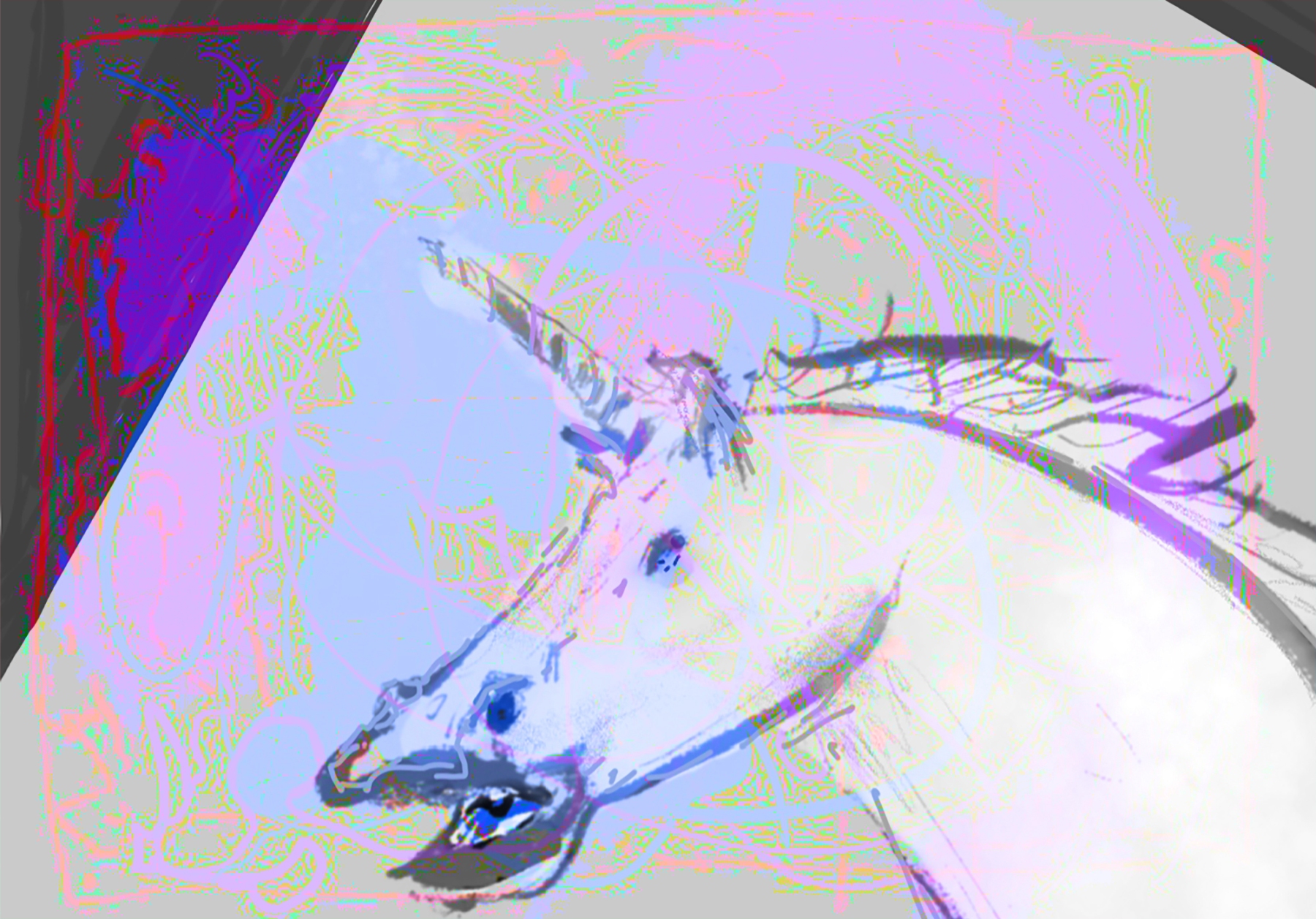
Unicorn 3
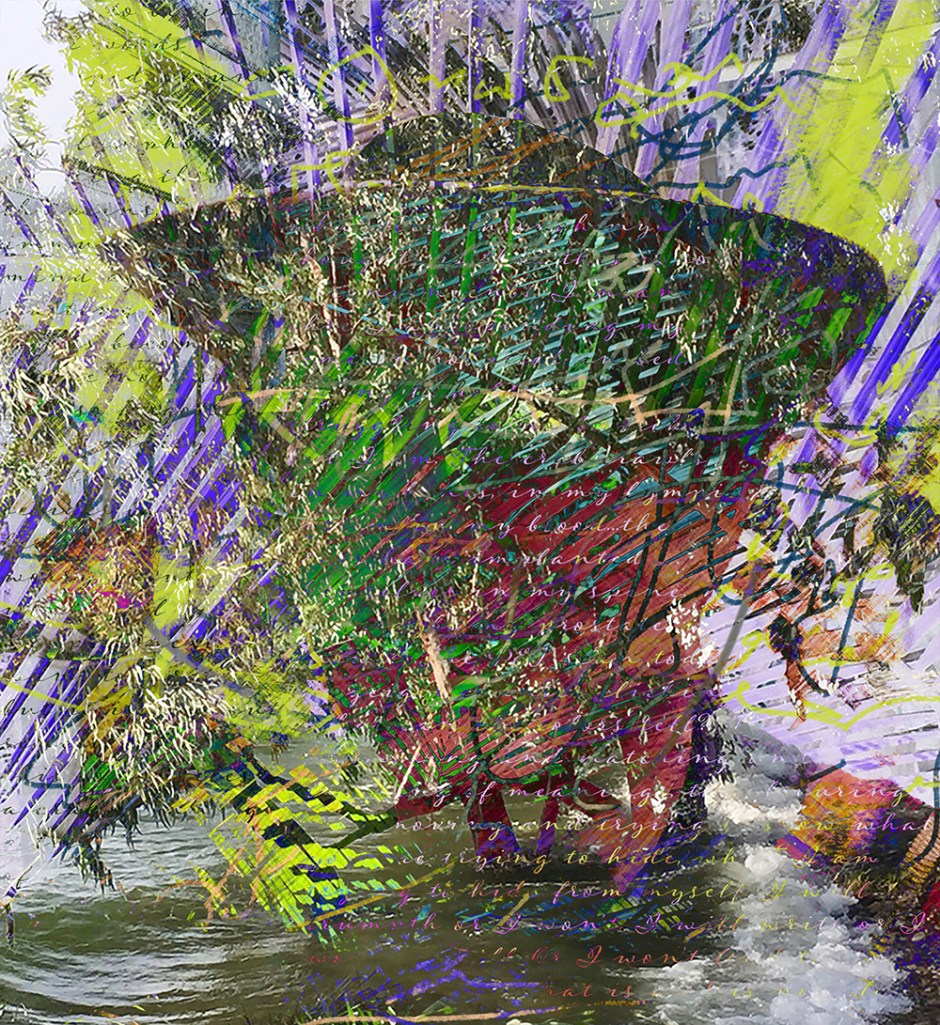
Digital art ©2023 Michael Dickel

Diasporic Nostalgia

We don’t feel shame when
we share memories
of when being in love was a novelty.
We’re nostalgic once a year
and hug a bit more often.
When we do reminisce
it’s not due to our deserted country
but because of the calendar
showing us one of our anniversaries.
Recently we started to hug a bit more frequently
and it is because of our frantic deserted country.
We love like we forgot it ever had a beginning.
and we continue to love like it will have no end.
We acknowledge eventually we’ll die
and discuss, almost negotiate,
how many marks we want to leave behind us.
We’re sick and merry, healthy and sad, we’re sad 
     and sick and merry and married.

Yes, we do like better
who we are
but not enough
not to the degree we’d want you to stare at it.

Birdwatching

Our world begged for existence.
We carried our valor secretly
no witnesses for our triumphs
for overcoming another day.
Not being able to save even ourselves,
we dropped on the bed
as if we’d lost a battle.

In the mornings we melted back
from sleeping like rocks
into floating bodies in a void.
We watched the birds
from our square-foot lawn and cherished
not just their movement –
their gift of coming from different worlds –
but our own growing ability,
while standing up, standing still
to notice them.

Foliage

Written before the Jewish New Year’s Eve of
the year 5782,
 2022 by the Gregorian calendar
I want to write something with the word foliage
but need a better language than this one,
one that will allow it to breathe in a poem
and won’t be florid.
Perhaps in Estonian
where it’s possible to love quietly
and to hate
and then grief.
Perhaps there,
where it’s okay to die every winter and remain naked.
Where it’s really unknown where a sentence will end.
Where you can breathe deeply
all the way down to bring foliage,
or even autumn’s fall, on the body,
but not rain like the desert here pleads for.
Where you can secrete miracles
without desecrating respect,
with no void to cross over forty years of desert
and then what?
Me, reduced of the desert’s wandering,
at the age of a girl starting the second grade.
May she have an ameliorated year,
a year that saturates, sprouts,
a year in which twigs are ignited into buds,
a preceding year before the winters of her life
that will bless her with the fluttering foliage of clear breath,
a sweet one,
a breath,
no more than an exhale of fresh breath that will ease
the severance every end brings

Mainland

Armored by slumber
I cross the flaming oceans
of the un-dared dreams.
Only the ones I didn’t dream
have been fulfilled.

Like a prime number
I am a core
in search for oneness.
Unable to divide into any other kernels
I multiply and withdraw
like waves coming and going — 
a pendulum movement
between the coarse golden ash of sand
to the silver moon-color of the waves.

Within their foam dissolving beauty
hides repetitive abandonment.
Roar at the winter
with nothing
to be hindered by.

The sand is just another foam
in a different consistency
engulfs, embraces
and yet forsakes as well,
but in slower motion.

Now I’m hushing oceans
into the fall of dusk,
searching ways
to turn into an islet
so there’s less of me
needing to be loved.

©2023 Gili Haimovich
All rights reserved
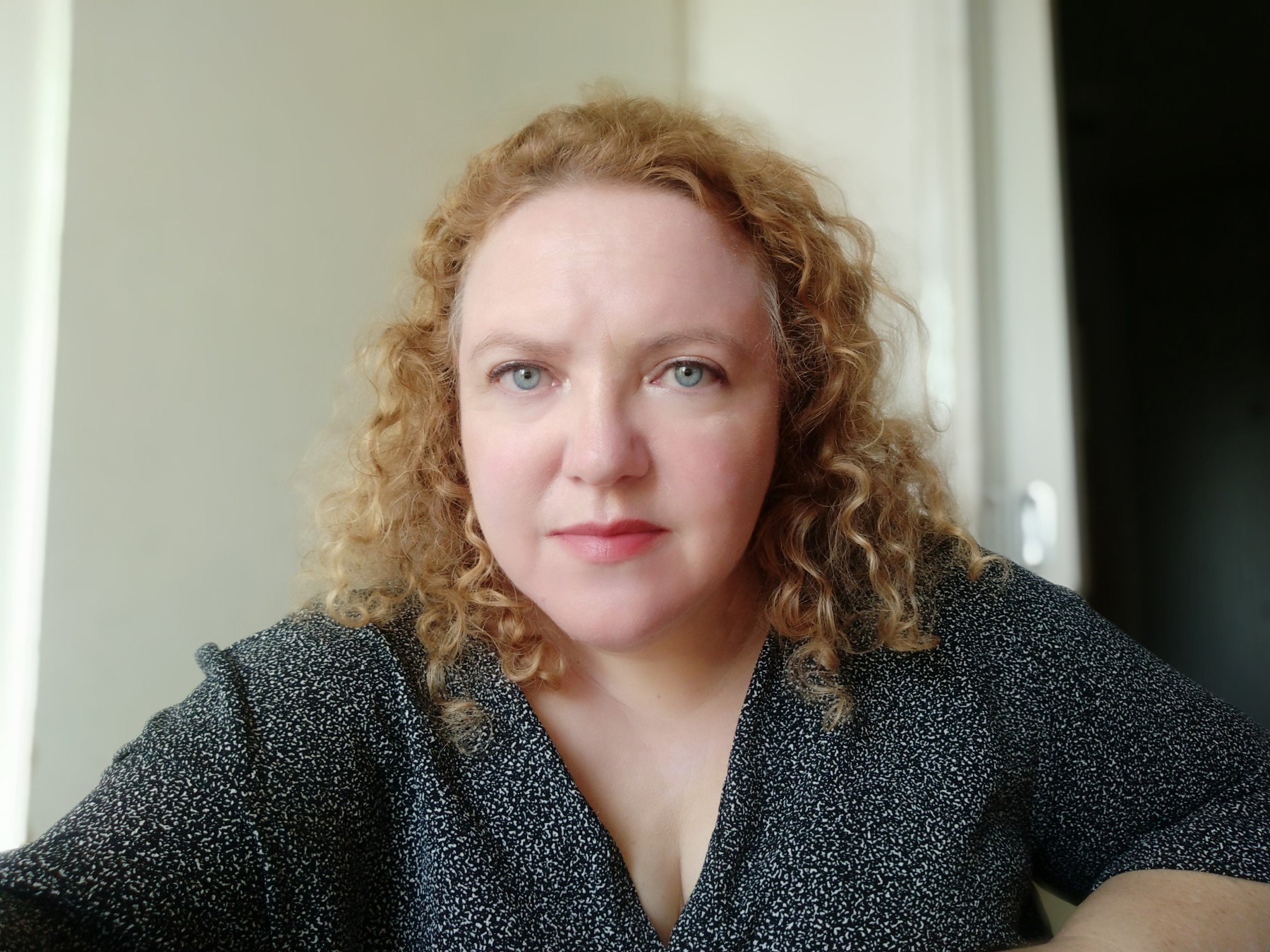

Gili Haimovich

…is a prizewinning bilingual Israeli poet with a Canadian background. She is the author of ten poetry books, four in English and six in Hebrew as well as a multilingual book of her poem ‘Note’. She was awarded prizes for best foreign poet at the international Italian poetry competitions I colori dell’anima (2020) and Ossi di Seppia (2019), a grant for excellency by the Ministry of Culture of Israel (2015) a fellowship residency at the International Writers’ Workshop Hong Kong (2021) and more, including several grants for her Hebrew books from The Pais Committee for Arts and Culture, The Acum Association of Authors and The Goldberg Grant  for Culture and Literature. She has full length books translated into French, Serbian and Estonian and more are forthcoming. Her poems are translated into 33 languages and featured worldwide in numerous anthologies and journals. Gili participates in festivals and literary events across the globe such as in Canada, France, Mexico, Italy, India, Romania, Hong Kong, Taiwan, Kosovo, Chile, Kenya, Mongolia and more. Gili also engages in photography and poetry translation as well as facilitating groups and individuals in creative writing in Israel, Canada and more.


The 2023 (Inter)National Poetry Month BeZine Blog Bash
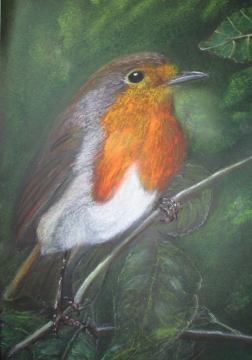
Pastel of European Robin perched on a small branch by Tom Higgins ©2021
Art: European Robin, pastels, ©2021 Tom Higgins
Posted in General Interest, interNational Poetry Month, Poems/Poetry, poetry

Assuage with pen ye troubadours | Lorraine Caputo

Assuagement

I had awakened
my hand aching
from words yet
to be expressed

& foretelling
an all-day rain
that spilled into
the courtyard
outside my door

It felt like an 
autumn day,
dried palm fronds
blown groundward
by the wind

This all-night rain
continues to flow
across the patio
outside my door

Assuage with pen ye troubadours
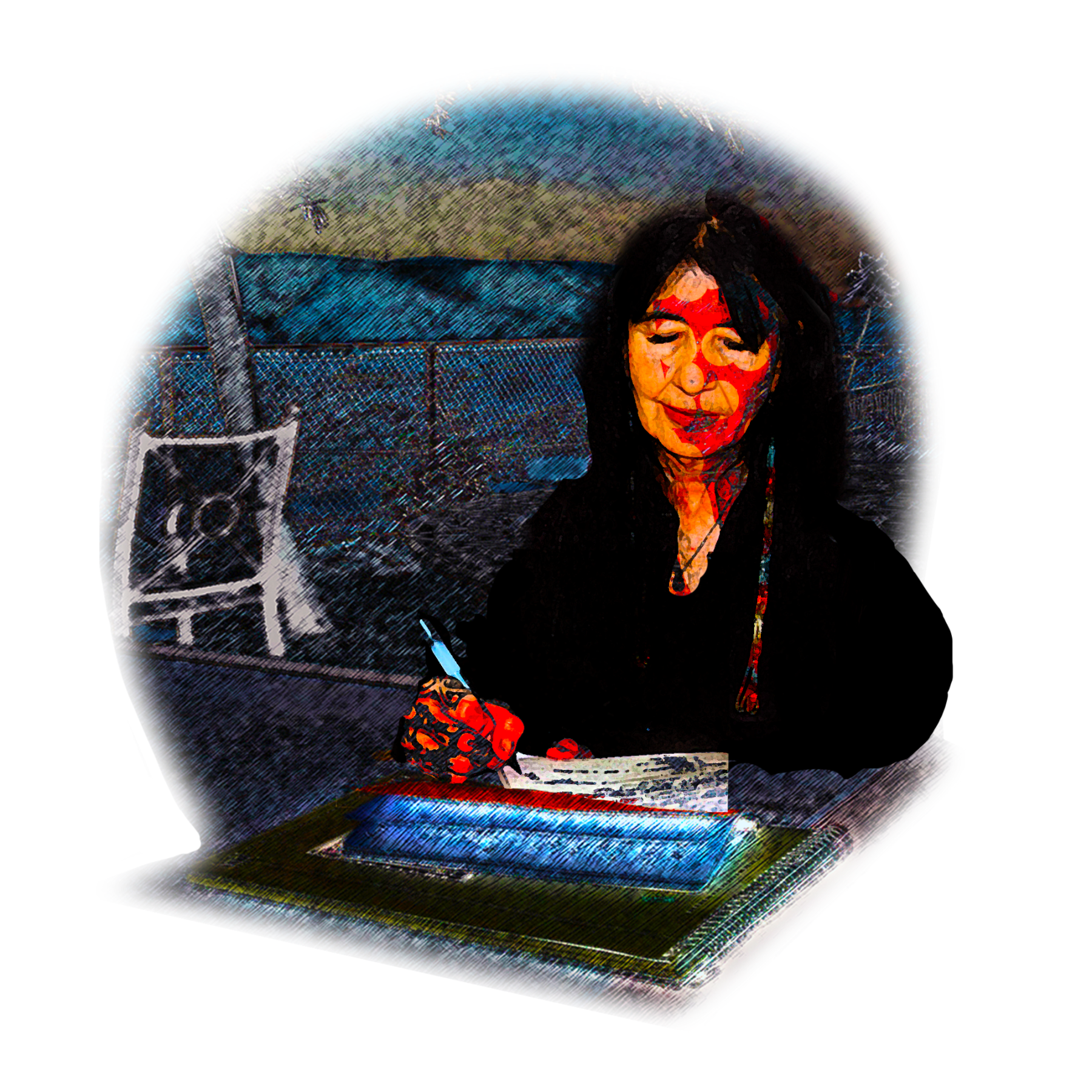
Digital landscape with Joy Harjo, from photographs
©2023 Michael Dickel

With Pen

With pen 
in hand, I write
one thought…after one thought
creating images, music
with these words, rhythmic scribbles on this page…
clearing my soul of memories
that eat away at my
peace…write, write, sing
with pen

Troubadours

Like mediaeval troubadours
we are keeping vigil
in these hours,
I awaiting the matins
& ye reciting your lauds.

Through this silence
your poem sails
to me…

& another…

Ay,
I write,
So you’re having one of those
middle-of-the-night visits
by the Muses


I drift away
to other sites.…


& when I return,
four more messages
from your keyboard-pen
on screen-vellum glowing
in the darkness.
I read them,
stepping a bit further
back in time
with each.

You are right, you
understand, you
overstand as well,
says the third…
& the fourth
a laud
for me, for us
poets who own the Moon.…

I spill my tears to ye,
Oh brother wandering
troubadour,
careful not to
short-circuit
my pen.


There are those who envy
my travelling-writing life,
errant through these
southern tropics, verdant
jungles, snowy
towering heights, breathless
seas—

& there is I who envy
your life, devoted troubadour, the
World Poet,
traversing continents, across
seas,
able to survive
with your words
created like prayers,
lauds & laments
prickling the souls, the
hearts, the minds.…


How, I do not know.…
I want to ask ye,
brother troubadour,
How do ye do it?

…but I don’t…


I don’t want to stop,
I confess to ye,
my matins arriving
with the dawn’s twilight,
hours before yours. . . .
I want to continue
to do this work the
Creator has given me to do
in this lifetime
(the same as ye…
we, troubadours
of this XXIst century…)
I want to continue a-wandering
& a-writing, performing
like our mediaeval brethren.

But, nay, they who
I entertain don’t want
to pay, to tip even,
nor a bed nor a meal. . . .

I want to ask ye,
there in the land
from which I am exiled,
ye, a strange stranger in a strange land,
How…?
Can ye teach me?

©2023 Lorraine Caputo
All rights reserved


Lorraine Caputo…

…is poet-translator-travel writer who has works appearing in over 400 journals worldwide and 23 collections of poetry–including the upcoming In the Jaguar Valley (dancing girl press, 2022) and Caribbean Interludes (Origami Poems Project, 2022). Her writing has been nominated for the Best of the Net. She journeys through Latin America, listening to the voices of the pueblos and Earth.

Latin American Wanderer


The 2023 (Inter)National Poetry Month BeZine Blog Bash

Pastel of European Robin perched on a small branch by Tom Higgins ©2021
Art: European Robin, pastels, ©2021 Tom Higgins
Posted in General Interest, interNational Poetry Month, poem, poetry, Writing

The Joke | Faruk Buzhala

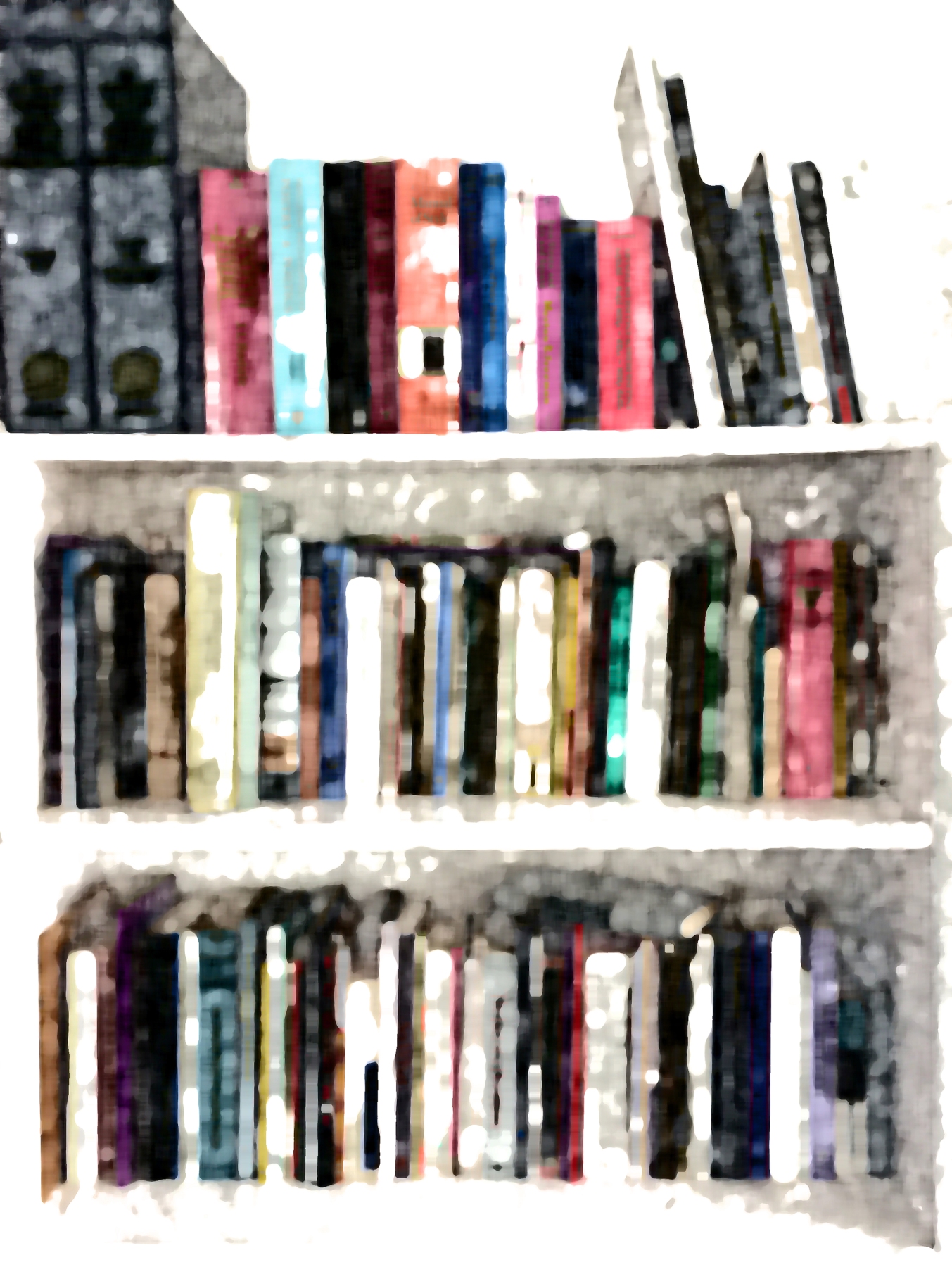
Books, a lot of books
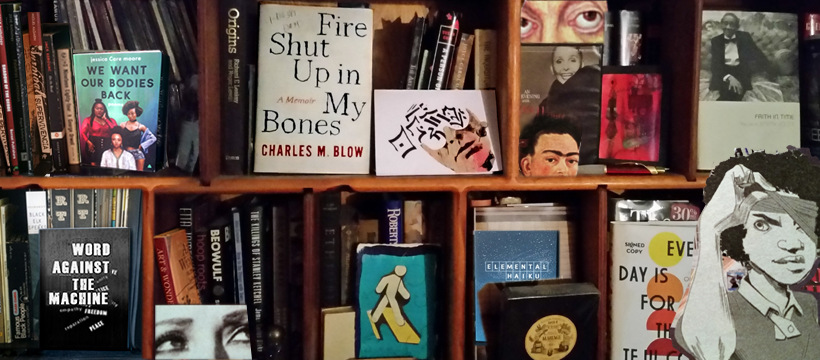
Digital landscape from photo ©2023 Michael Dickel
To waste time on books while you have a lot of other tasks to do,
To read, incessantly to read, in order to gain knowledge and finally see
That time is gone, lost among the writings of the dead
Who never invented the art of being happy!

I stand in front of the shelves with hundreds of books by well-known authors
 who dealt with the portraits of controversial people,
 people with vices, and various bad habits! 
Was it worthwhile to immortalize these figures
who gave examples and examples from human relationships
and made us take life served according to their imaginative way?

Books, a lot of books.
So many books and so little time to read them. (I do not remember who said that!)

I look at the bookshelf, 
It catches my eye and I read the titles:
The Financier,
Red and Black, 
Father Goriot, 
The Blind, 
The Grass,
Tips for Life,
The Diary of the Year of the Plague, 
The Devils,
The Divine Comedy,
Night,
Farewell to Arms,
Praise of Madness, 
Love in the Time of Cholera, 
Don Quixote of La Mancha,
The most beautiful of the worlds, etc., etc.
So much time lost in writing, so little time wasted in reading!

Wow, how many written books are on the shelves, covered by the dust of time?
How many manuscripts are waiting to come to light and be published?
Will they all survive time?

It has become a trend to publish books,
If there is nothing left to do write your autobiography,
because others then will read it
and will learn from you
how life is lived the way you lived it!

What, do you need knowledge? 
When you learn it from experience 
and copy-paste to others
without knowing that the meaning of all knowledge
lies in the books!

I stand in front of bookshelves and am filled with bitterness,
I knock them all down, I throw them away from the apartment,
I gather them up and spray them with gasoline,
Then I burn them.
I warm myself in the fire coming out of the books;
Eternal fire, the fire of the gods, Universal fire that disperses ether.
I think of the library of Alexandria, The Name of the Rose, Fahrenheit 451,
The fire with which burned at the stake Giordano Bruno,
the fire in which whole cities burned, 
the fire that burned and burned whole mountains, fire, fire, fire.

P.S.
I went through a spiritual crisis one more time!
I look at the books that stand on the shelves and
I’m glad they are still there!
I look at them one by one, reading the titles gradually 
until my eyes stop on one of them
as I read, letter by letter: T – H – E   J – O – K – E
Confused, I say to myself: Hey, this writer is still alive!

©2023 Faruk Buzhala
All rights reserved

Faruk Buzhala…

…is a well-known poet from Ferizaj, Kosovo, writing in his mother-tongue, Albanian. He was born in 9 March 1968 in Pristina. He is the former manager and leader of “De Rada,” a literary association, from 2012 until 2018, and also the representative of Kosovo to the 100 TPC organization. In addition to poems, he also writes short stories, essays, literary reviews, traveltales, etc. Faruk Buzhala is an organizer and manager of many events in Ferizaj. His poems have been translated to English, Italian, Spanish, French, German, Croatian and Chinese, and are published in anthologies. .


The 2023 (Inter)National Poetry Month BeZine Blog Bash

Pastel of European Robin perched on a small branch by Tom Higgins ©2021
Art: European Robin, pastels, ©2021 Tom Higgins

Posted in General Interest, interNational Poetry Month, Poems/Poetry, poetry

Democracy | Michael Dickel

Note: If you’re viewing with a phone, we recommend landscape (sideways) for a better effect.


Turn this page

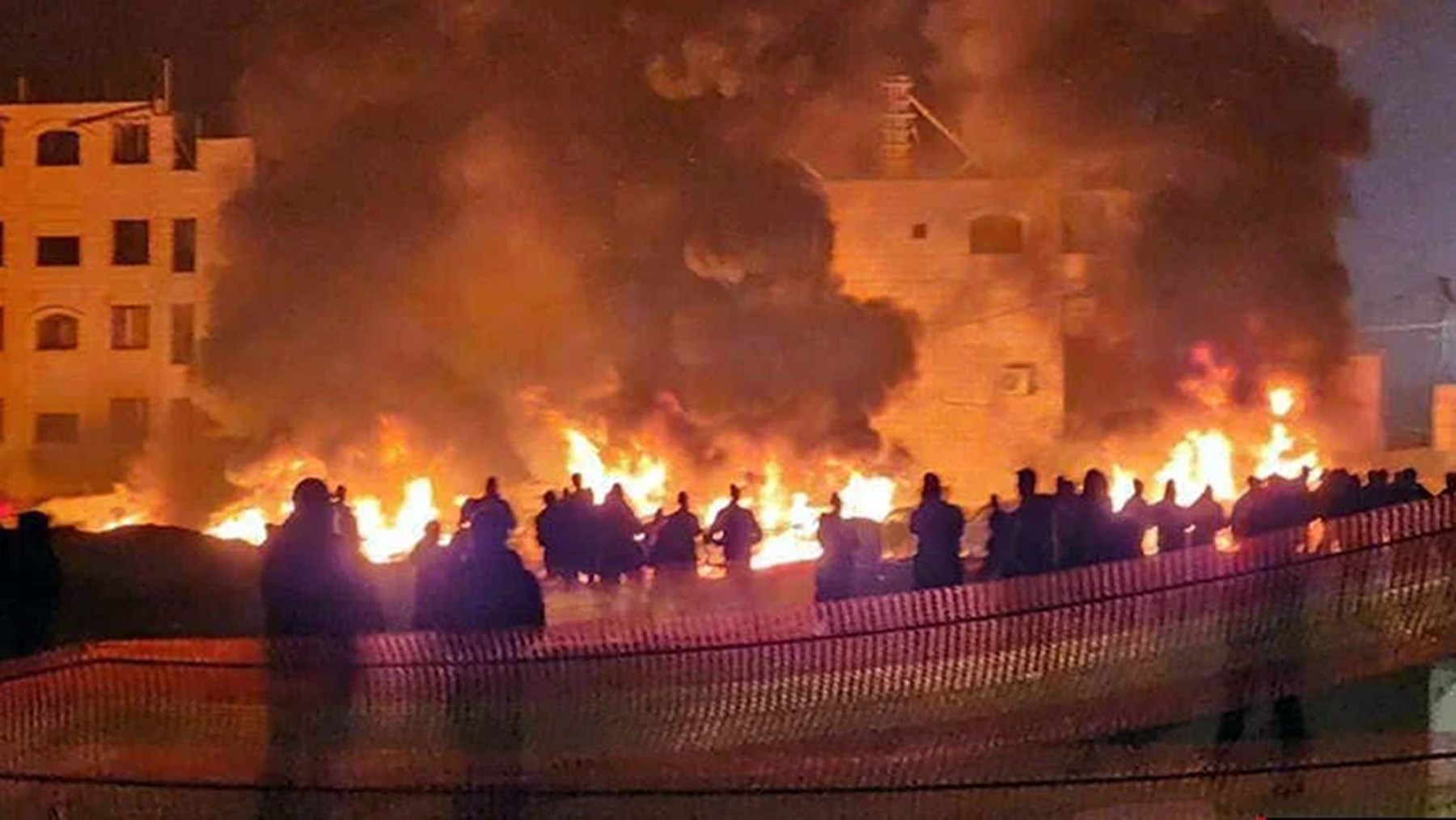
We smell the fish of state rotting from the Prime Minister.
He says he desires to throw fists against the protestors
who march for democracy; he falsely accuses them
of his own crime, this thief who fears his own guilt.

Theocrats, fascists, racists, misogynists, homophobes at his side,
pushing down the pillars that get in their way, bulldozing
the framework that holds the ceiling above our heads,
believing the columns are enemies and that their beliefs

alone can hold up the roof stones with fear and hate.
But the stones of justice will fall, and we will all struggle
to survive the unholy earthquake this evil will bring.
Yet they call us the enemies of democracy, we who cry

out to stop the bulldozers. They call us the inciters of violence,
while they remain blind to the repercussions of their rage,
the ground groaning in Huwara. We smell the smoke rising
from violent waves unleashed by the unholy desire to rule over.

Who will stop them? Who will turn this page before history
buries our book in rubble? Who will turn the page? Who…?

Huwara photos from YNet, “Palestinians wake up to mass
damage after settler riot in Huwara
,” 27 Feb. 2023 ©2023 YNet
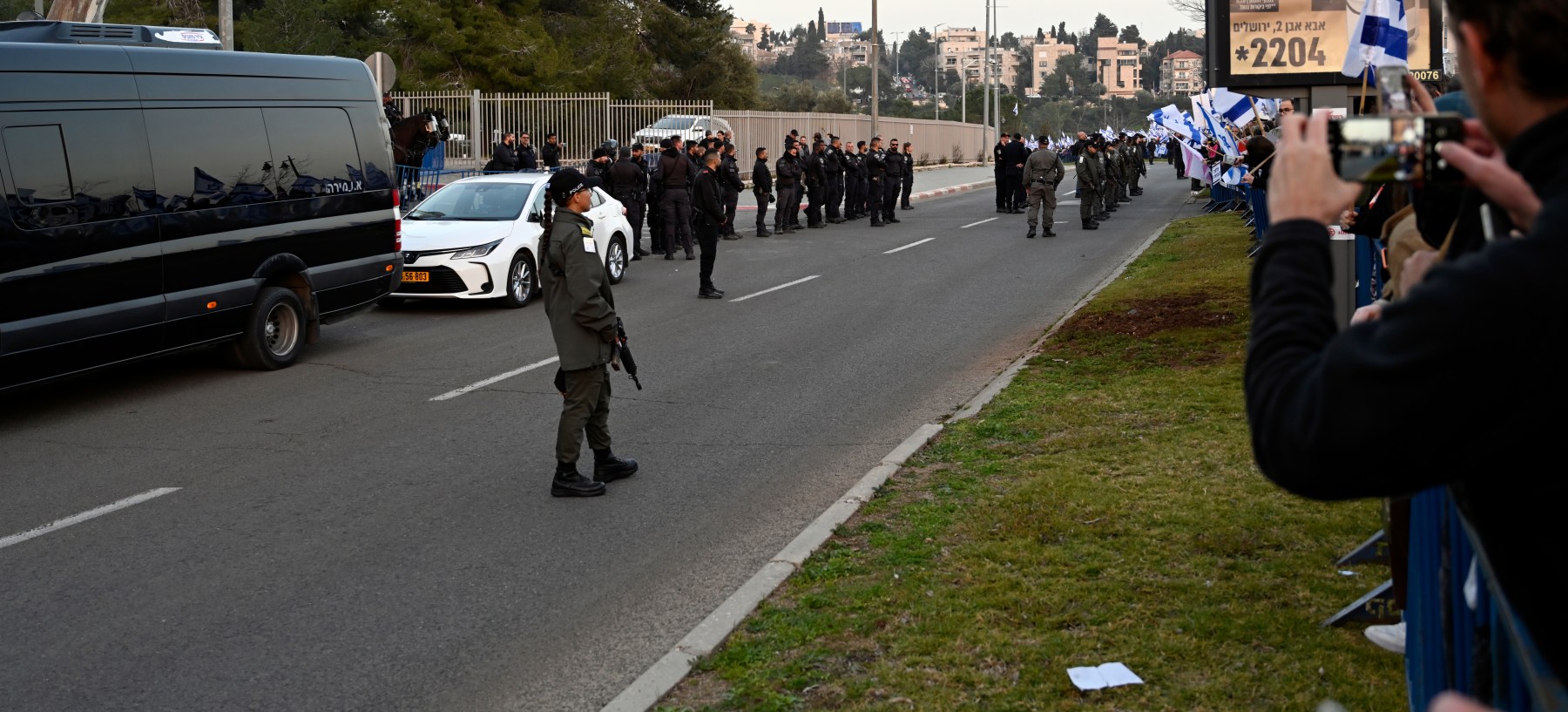
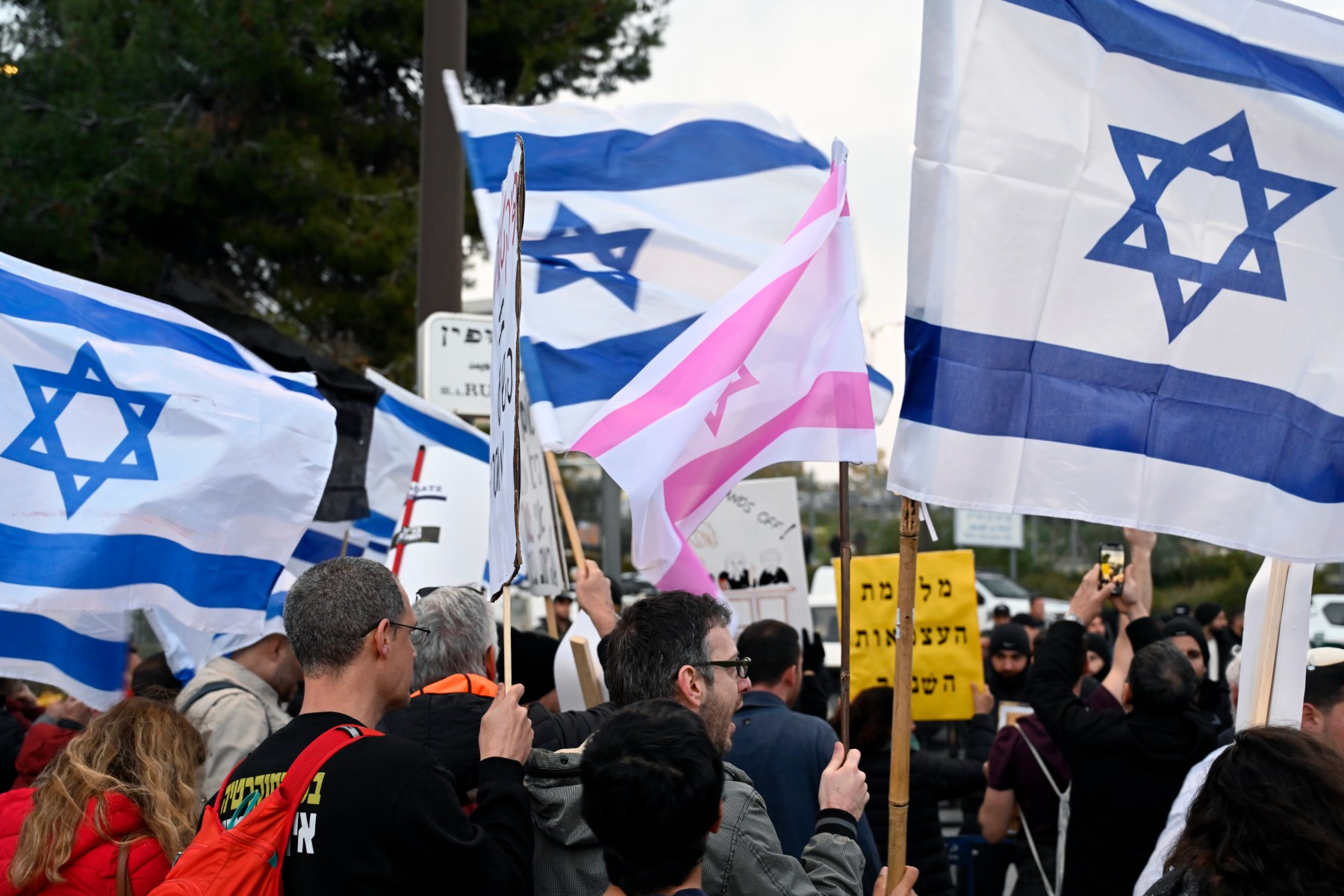
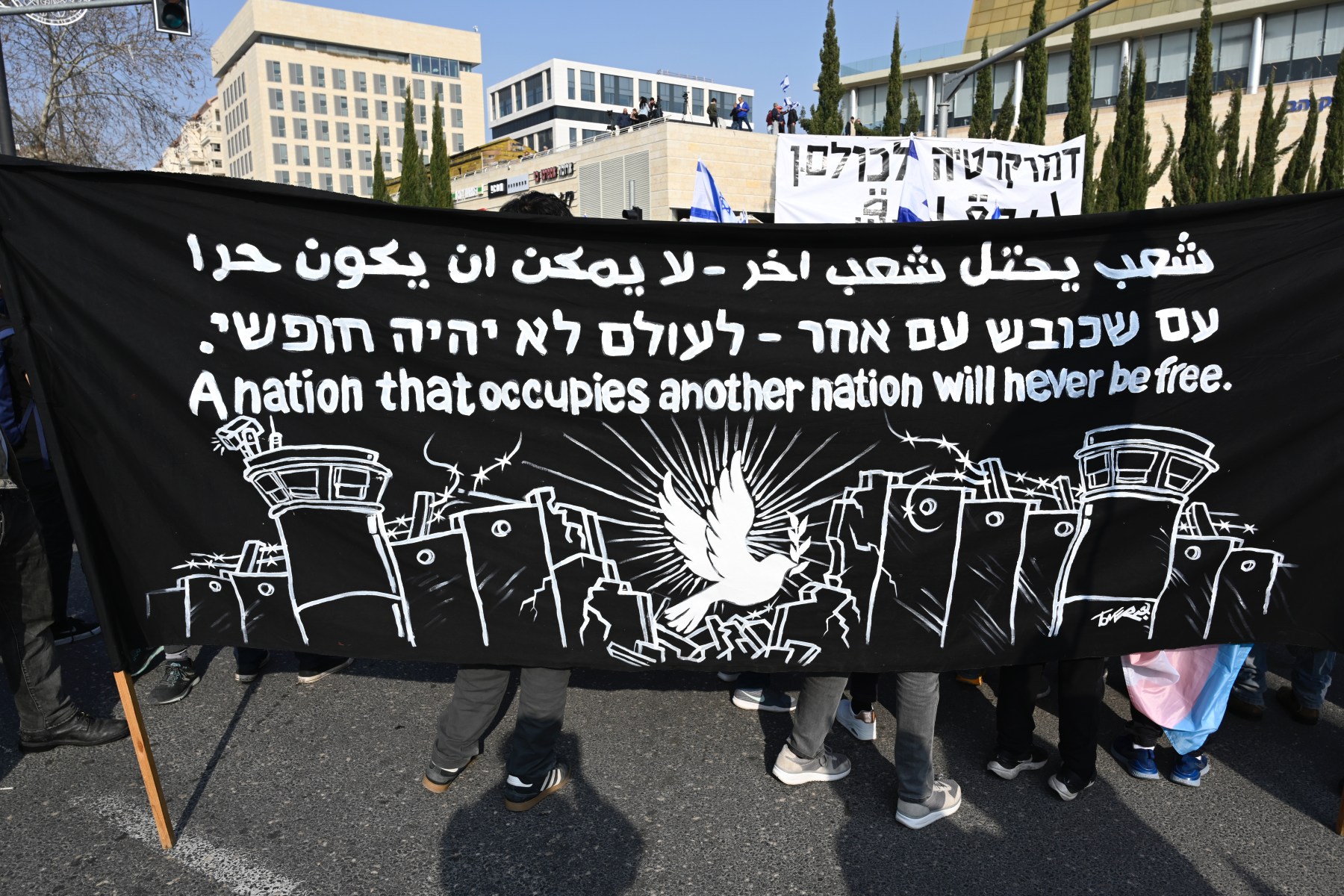
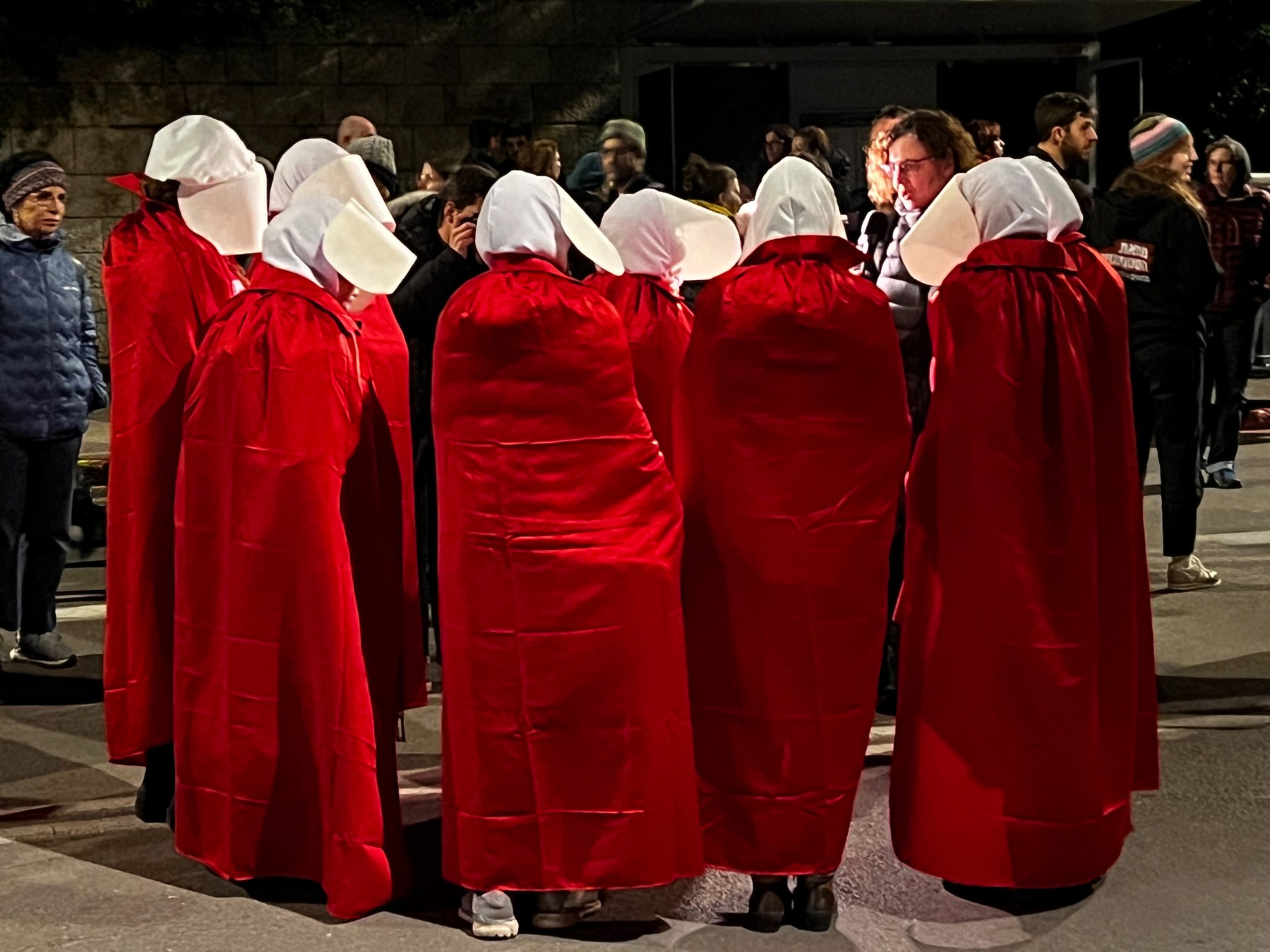
Photos of Jerusalem protests 13 Feb, 18 Feb, and 20 Feb 2023 ©2023 Michael Dickel

The Writers Read Resistance Literature
in the Public Space
The Day of Struggle | Wednesday | 1.3 | 11:00
Jerusalem  Sigmund | Haifa 1 19 HaNasi St.
Tel Aviv  Kaplan St. 6 | Be’er Sheva  Writers Park
For 15 weeks now, Israeli’s have mounted regular protests against the government’s proposed “judicial reforms,” which many call a “judicial coup,” meaning an attempt to overthrow judicial oversight of the government. Rather than accept the tension of checks and balances, the government wants to appoint the judges by assuring they have a default majority membership on the appointments committee. They want to be able to overturn a High Court ruling (the equivalent of the Supreme Court) with a 50% plus one vote—less than 51% of the Knesset (legislature). They want to change the Basic Laws (the closest thing Israel has to a Constitution) so that the High Court cannot make rulings about government appointments or policies. 
With these and other proposals, the administration (which is not separate from the Knesset) would would be able to do as it pleases, even if it violated the Basic Laws or other laws. I took the photos that I took accompanying this poem at a few of these protests, which I have been participating in regularly.

And I read this poem as part of the protests at a “poetry protest” organized by the Democratic Cultural Forum. We were at a sidewalk café near Prime Minister Netanyahu's residence in Jerusalem, 1 March, 2023. Most of the other poets read in Hebrew, their own or other's work. A few read other's poems in English. I read my English-language poem. The poster to the right gives the title of the event, “The Writers Read Resistance Literature in the Public Sphere.” The event was held simultaneously in the cities of Jerusalem, Haifa, Tel Aviv, and Be'er Sheva. 
—MYDickel

©2023 Michael Dickel (except where otherwise noted for news photos)
All rights reserved


The 2023 (Inter)National Poetry Month BeZine Blog Bash

Pastel of European Robin perched on a small branch by Tom Higgins ©2021
Art: European Robin, pastels, ©2021 Tom Higgins
Posted in General Interest, interNational Poetry Month, Poems/Poetry, poetry

(Inter)National Poetry Month

April is the cruellest month, breeding
Lilacs out of the dead land, mixing
Memory and desire, stirring
Dull roots with spring rain.

T.S. Eliot, The Wasteland

Poetry month is coming! Dust off your pens, pencils, or 🪶 feathers, and write ✍️ some poems!

European Robin
Pastel, ©2021 Tom Higgins
(Inter)National Poetry Month is a time to celebrate poets and their craft—in the U.S. and worldwide. It is a wonderful opportunity to celebrate your expressiveness or your pure charm, to delight and to show the importance of sharing thoughts, activities, nature, pain, joy—the descriptive words go on and on…

Poetry is a special oration that reminds us of the important role of poets and their poetry in our cultures.  

“Poetry helps us appreciate the world around us and empathize with one another. Typically, we think of poetry as boring and nerdy but this month allows us to change our perspectives and look upon poetry as a rhythmic art of expressing one’s love and thoughts.”

National Today
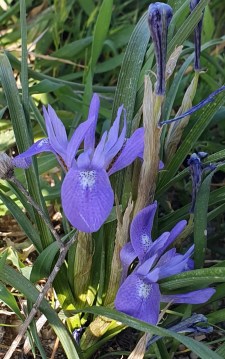
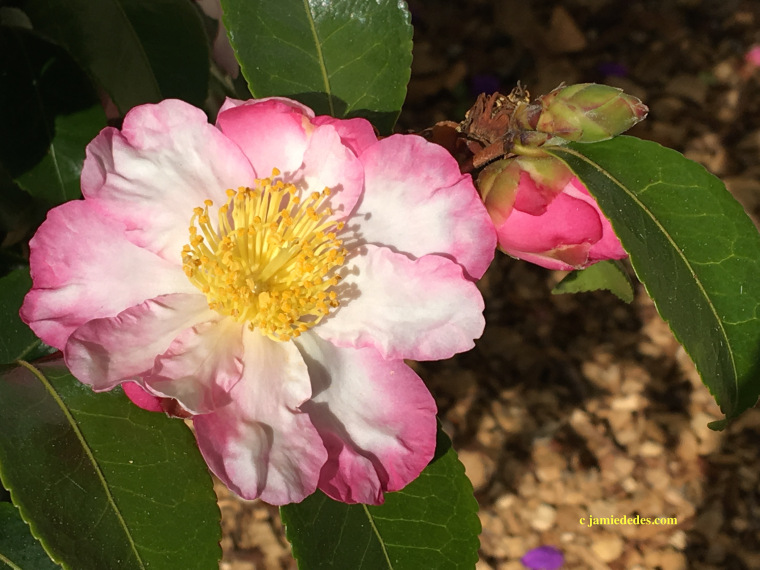
Wild Iris, Jerusalem, Israel
Photograph ©2023 Michael Dickel

The spring winds of April are coming fast on the streams of March’s melting snow. We are looking to catch those elusive poems blowing in the wind to share with many. So…April comes quickly and blows by swiftly.

We invite you to join us and express yourself. Share a poetic expression of yourself, your life, and experiences. We want to hear from you! 🫵🏽


How to submit.


there it goes

the wind has sticky fingers
it likes to play with us
upon a hillside lingers
to grab our papers thus 

off we go, running to fetch
our work we don’t want to lose 
running fast i try to catch
my paper which chose to cruise

like a dove upon the wind
free of the earth's restraints
i should have thought and pinned-it
i’m losing it oh good saints

oh wind you won this race today
against the likes of me
for tomorrow oh do not dismay
for i’ll wear sneakers you see!

©2023 jsburl
All rights reserved


How to Submit

Review these submission guidelines. NOTE: In addition to what is written in the guidelines, for the April Inter(National) Poetry Month submissions, please put: April Poetry Blog in the subject line of your email.

While it is mentioned in the guidelines, we remind you to send the poetry in a single file, up to 3 poems for this call for poetry. Include a bio either at the end of the poetry file or in a separate file. You may include a few links to prior publications. Please include any social media links you want us to share below your bio. If you are including a headshot photo, include it as a separate, hi-resolution JPG file (please not a thumbnail size).


Posted in interNational Poetry Month, poem, poetry, Poets/Writers, Video

The Book of Lumenations — Interview with Adeena Karasick

Introduction to Eicha—Adeena Karasick

Particularly speaking to this “Covid moment,” Eicha (איכה) comprises 5 videopoems which takes as its jumping off point, the Biblical Eicha, The Book of Lamentations, which laments the destruction of Jerusalem and through reflection, deflection, refraction and the fracturing of language, homophonically re-situates the original text to the horrors and hope of the present moment. Tracking through “the city” as a desolate weeping widow overcome with misery, and moving through desolation, ruin, prayer, and recovery, it explores ways that in rupture, there is rapture.

As transpoesis it acts not only (in General Semanticist terms) as a “time binder” but through a luminous, voluminous threading of light, it highlights how darkness is a form of light, how text itself is, in essence, black light on white light, and thus opens up new ways of seeing and the cyclic nature of meaning and being.

Text written and performed by Karasick and comprises the first section of her forthcoming book, Ærotomania: The Book of Lumenations. The music is composed and performed by world renowned Grammy Award winning composer, trumpet player and Klezmer giant, Frank London. Eicha I includes Vispo by Jim Andrews and Daniel f. Bradley with Titles by Italian filmmaker Igor Imhoff. Eicha II and III, music by Frank London and video by Igor Imhoff. Eicha IV and V are still under construction and will be launched for Tisha B’Av.


Eicha I–III

Text written and performed by Adeena Karasick
Music Composed and performed by Frank London
Eicha I: The Book of Lumenations
Adeena Karasick ©2021
Music composed and performed by Frank London
Vispo by Jim Andrews and Daniel f. Bradley
Titles by Italian filmmaker Igor Imhoff

Eicha II: The Book of Lumenations
Adeena Karasick ©2021
Music Composed and Performed by Frank London
Video by Igor Imhoff

Eicha II: The Book of Lumenations
Adeena Karasick ©2021
Music Composed and Performed by Frank London
Video by Igor Imhoff

Adeena Karasick—Interview

Michael Dickel: Your theoretical frame for this work takes us from The Book of Lamentations to General Semantics developed in the 20th C. to the present moment of pandemic. What intrigues me about this is something I have thought about for some time. Before I heard of Alfred Korzybski, I had begun to think that cultural products—specifically but not only visual arts, music / dance, and writing—formed a sort of socio-cultural DNA. The “stories” or “meanings” they convey shape socio-cultural formations much as DNA shapes life forms, but outside of the body of course. And as such, they are apparently uniquely human. This is how I understand Korzybski’s “time-binding.”

In this framework-metaphor-analogy, would you agree that “reflection, deflection, refraction and the fracturing of language” could resemble RNA / DNA dividing and recombining? Perhaps I’m asking if your work introduces and “recombines” the DNA of light (luminosity, lumen) into the sorrow of loss and darkness (lamentation)? Or is the case completely different?

Adeena Karasick: So many interesting questions, Michael. First, if we think about “time binding as a kind of recognizing of pattern recognition—how cycles emerge in conjunction with the zeitgeist, aesthetic and political and social orders of the day and bound by semantic environments and spacetime contingencies to a past which is ever  re-articulated in an ever contemporaneous present; as Korzybski might say, by abstracting nutrients, growing subsystems, which over time re-orient the narrative, language, “meaning” —  in this way it is in a sense a recombination (or in Abulafian terms, a permutation and recombination), restaged into something new.

So, yes between the layering, the looming of the lament and the lumen i’m interested in illuminating the way the present re-presented through an ever-shifting past pinned to a future that is ever-fracturing; how darkness and light are always already embedded in one another – and we see this through our very rituals. For example, on Tish B’Av, when we read the Book of Lamentations which mourns the destruction of Jerusalem, it’s followed by the kinnot, the liturgical dirges that lament the loss of the 1st Temple, the 2nd Temple, reminded of all the other major calamities, the murder of the Ten Martyrs, medieval massacres, the Holocaust. Everything gets bound in these cycles of language of time of repetition and reproduction a simulacric spiraling that bleeds into the prescience of this very moment. A moment that itself (due in part to the weight of cultural memory) fractured and re-reflected, deflected, where limerence lamentation and lumenation emanate: When life gives you laments make limnade ; )

MD:  A liminal moment. Your discussion of darkness being a form of light, or the light in the dark, reminds me of Carl Jüng and also of Robert Bly’s A Little Book of the Human Shadow. Both of course metaphorically could be seen as responses to the concept of yetzer hara (יצר הרע). However, the quantum optician Arthur Zajonc perhaps more literally addresses this light in the dark idea in his book, Catching the Light: The Entwined History of Light and Mind.

Zajonc points out that the night on Earth is not an absence of light. The sun’s light is still in the sky, as can be seen by its reflection from the moon. He describes a demonstration he uses to show this of a box that has a vacuum inside—no dust, nothing. The inside is all painted flat black that is totally non-reflecting. There is an eyehole on one side to look into. There is also a light that shines from a side 90-degrees to that. And a mirror or flat object inside that is black on the back but can be rotated. The box looks “dark,” that is pitch-black, until the object is revolved and reflects the light. Then it is clear there was light in the box all along.

It seems that what you are doing is showing us that the dark / night / shadow always contains light. That darkness or shadow provide the contrast and form to reflected light. And that the light we see, as Zajonc points out, is only the reflected light. Even the sky reflects dust to become blue.
With this other, different framework-metaphor-analogy, does this seem a reasonable way to understand your hybrid title, “Lumenations”, which of course plays homophonically with illuminations…?

AK: So important particularly in these troubled times to shift the perspective, change the channel, shift the diorama, “peepholes, eyestreams” and recognize the light in the darkness; to revel in the white space, between the letters, the long silences, the emptiness, the shudders / shutters, suspensions and remember that as in the Zohar, the darkness contains the light.  Or the absence contains the presence – thinking about maybe Heidegger’s translation of Heraclitus preserved by Hippolytus (which i quote in another section of The Book of Lumenations), that even in the presencing of all things present, itself remains concealed from being present, “not as presence presently absent or an absence absently present but as the absent present that continually withdraws in the spectacle of its present absence”[i] Acknowledging how it’s so important to complicate these dichotomies, uncover its fabrication, and analyze the violence this initiates and sustains.
And like the flash of primordial letters clothed in the nothingness of being enshrouded in the disquiet of dissembling – letters, like desire itself, embodies all that is to come; comes and keeps coming in an ever-arriving future. So yes, it’s both a reflection defection, deflection, confection ; ) playing with ways all is simulacric and thereby produces a kind of co-sanguinity mirroring how like in the 2nd C. Sefer Yetzirah (Book of Creation), primordial creation is ever re-created through the articulation of each letter – which contains all the future within it[ii]

MD:  Now, how does all of this fit in your thinking with the Time of Coronavirus / “Covid moment” we find ourselves living in?

AK: Well, we’re living in dark times. And in many ways like the word COVID itself which homophonically can be transliterated in Hebrew as Kavod כבוד, which (as you know), means glory, honor and respect; ie when we congratulate someone we say Kol HaKavod, ‘all the honour’ (Good job!), or close a letter with the word V’Kavod (‘with respect’) Yet — ironically, COVID kaved is also “heavy. And throughout Exodus, the presence of God in the tabernacle is symbolised by the word ‘Kavod’ ((which is also represented by a cloud!)) So, like The Book of Lamentations itself which is mired in darkness, heaviness and cloudiness – a masking of the light, like you mentioned earlier, with reference to Zajonc, it’s so important especially now to recalibrate how we see, what we see; displace our usual systems of spectrality. Through this homophonic translation, this transpoeisis, it displaces a sense of language belonging to a particular moment but marked by chasms, folds,  paradoxes, turbulence and desire, highlights the Other in language, coveting and foregrounding its caveats.


[i]. Elliot R. Wolfson, Heidegger and Kabbalah: Hidden Gnosis and the Path of Poiesis, Indiana University Press, 2019, p.5.

[ii]. See Sefer Yetzirah, 2:2. Wesier Edition, Trans. Aryeh Kaplan, San Francisco, 1997.


©2021 Adeena Karasick and The BeZine
All rights reserved


The BeZine Spring

Posted in Art, interNational Poetry Month, poem, poetry

Somewhere a Whirring Fan

                         “With this beginning, the unknown concealed one created
                           the palace. This palace is called אלוהים (Elohim), God.
                           The secret is: בראשית ברא אלוהים (Bereshit bara Elohim),
                           With beginning, _______ created God (Genesis 1:1).”
Zohar (I:15a)
                         “…She knows that her beloved is searching for her;
                          so what does she do?  She opens the portal to her
                          hidden room [in the palace] slightly and reveals
                          her face for a moment, and then hides it again.”
Zohar  (II.99a)
 Somewhere, a whirring fan
 in an open window spins
 possibilities into threads.
 I heard a rumor that the
 Oleander flowers shed
 their pink and white grace
 for poisonous reason.
 A car slinks down traces
 of a melted tar road.

You like to stand by the window,
 and want him to see you there,
 behind a curtain. He doesn’t
 know you or you him. He walks
 the span of street, infrequently
 catching a glimpse of blue
 eyes, a reflection in cracks
 of the cotton-hued skies.

The crow calls from a tree.
 Another day, green parrots
 screech louder than the
 traffic flees. The heat lays
 like a corpse upon our city.
 Bougainvillea bracts spot
 gardens with false hope,
 colorful arrays of forgotten
 pain turned to sweet honey.

He forgets you, though you
 never meet. And you, also,
 forget—window, curtains,
 the desire for a stranger's
 glad glance. Someone wants
 this to be autobiography, a
 short recollection of moments
 actually lived. That person never
 dreamed, does not exist anymore.

 And I never existed because I
 don’t stop dreaming. Poetry, like
 a god, provides code for an image,
 keying it to suggest a revelation-lode
 from your past. You want it to be
 my past. Parrots screech.
 A crow calls. A beautiful Other
 by the window waits. This all
 happens to you while I write

 these scenes tangled in dreams,
 whirring fans—the poem unable
 to light any form, your reading,
 this page; unable to discover more
 than bare wisps of  meaning in the
 vibrations of words—your song longing
 for someone in the infinite void. Wanting
 a mortal to read you into this, to see you
 alive, you seek a new beginning—genesis.
Asemic Writing Crab / Self-portrait
©2021 Michael Dickel

Note: Zohar refers to The Book of Splendor, one of the main texts of Kabbalah. Translations are from Daniel Matt’s work.

Somewhere a Whirring Fan is from Michael Dickel’s collection, Nothing Remembers.


©2019 Michael Dickel
All rights reserved


The BeZine Spring

Posted in Book/Magazine Reviews, General Interest, Writing

Poetry Chef Michael Dickel brews a Mindblower, concocts ugly- allusions with beautiful- imagery on rough pleats of old political denims.

TIME OF THE POET REPUBLIC's avatartimeofthepoetrepublic

The resistance poet in Poetry Chef Michael Dickel wields his frying spoon with that amazing verve of a militant word-master and that astounding zeal of a chronicler cum griot cum protest poet. He fries and roasts the 6th January American political gaffe into a beautiful poetry gourmet ( fusion of visual arts , graphics and poetry) as perpetuated by the tyrant and autocratic regime of Donald Trump at Capitol Hill . Archaisms and political corruption that has since plunged the once all powerful America into the status of a Banana Republichovel , a war mongering nation and a military state on record as lecturing several countries across the globe on ethos of non-violent elections, freedom of expressions , human rights and democracy . Dr.Dickel uses powerful grim visual imagery , sorry historical allusions exposing the stark nudity of a system that have thrived on punishing other nations through perpetuation…

View original post 1,108 more words

Posted in 100TPC, The BeZine

SUNNYSIDE UP: Meditation on “The BeZine” from the edge eternity!

One Lifetime After Another

one day, you’ll see, i’ll come back to hobnob
with ravens, to fly with the crows at the moment
of apple blossoms and the scent of magnolia ~
look for me winging among the white geese
in their practical formation, migrating to be here,
to keep house for you by the river …

i’ll be home in time for the bees in their slow heavy
search for nectar, when the grass unfurls, nib tipped ~
you’ll sense me as soft and fresh as a rose,
as gentle as a breeze of butterfly wings . . .

i’ll return to honor daisies in the depths of innocence,
i’ll be the raindrops rising dew-like on your brow ~
you’ll see me sliding happily down a comely jacaranda,
as feral as the wind circling the crape myrtle, you’ll
find me waiting, a small gray dove in the dovecot,
loving you, one lifetime after another.

– Jamie Dedes


I was diagnosed with interstitial lung disease twenty-one years ago. I was given two years to live. Thanks to loving family support and excellent state-of-the-art medical care, I’m still alive and kicking. As the disease continues its progression, however, my activities have become increasing constrained. Over the past two years I’ve slowed down dramatically. I am holding the Zine back from fulfilling its wide promise. I find it hard to keep up with obligations and to honor my own ambitions and the prodigious talents and boundless ideas of my colleagues. The long-standing lung issues have evolved into respiratory and heart failure. Other challenges to productivity have popped their disconcerting heads. These include pulmonary hypertension and a rare blood cancer, uncurable but manageable. There is, however, good news.

I’ve had years none of us expected I’d have, years to enjoy my family, my friends, lots of music, reading and writing. I got to see my world-class son married. I’ve been able to spend time getting to know my beautiful multi-talented daughter-in-law and to visit with my cousin Dan when he came home to the States after years of living abroad. Daniel (now Fr. Daniel S. Sormani, C.S.Sp) and I grew up together. He is more like a brother to me than a cousin. Ultimately, I had the pleasure of forming an arts for peace community.

I began blogging in 2008 (The Poet by Day) and in 2011 I founded Into the Bardo with San Francisco Bay Area Poet Ann Emerson and Rob Rossel, a therapist and nature writer. Ann had a rare bone cancer and Rob faced cardiovascular problems. Our intention was to chronical living with dying. My friends preceded me into the bardo after just three years. I had to ponder what to do next.


The Original Zine Team Partners

This post is dedicated to them.

Ann Emerson, San Francisco Bay Area Poet

Therapist and Nature Writer, Rob Rossell


I decided to broaden the scope of the blog, to create a platform for the global expression of peaceable minds, diverse perspectives and cultural understanding. This was a conscious effort to create a virtual space where we could find the commonalities across borders and learn that our differences are so often benign, not threatening. I found talented high-minded folks and a team slowly emerged. We grew from three members to twelve and a subscription base of a few hundred to one that is over 20,000.

We expanded our outreach joining with Washington State Methodist Minister, the Rev. Terri Stewart, and Beguine Again, our sister site. We became a larger presence via Twitter (thanks to Terri Stewart), a Facebook Page (The Bardo Group Bequines), and two Facebook Groups: The BeZine 100TPC (that is, 100,000 Poets and Friends for Change) and The BeZine Arts and Humanities Page. The idea behind the former is to share good news, the “best practices” that are happening all over the world and can be inspiration for initiatives in other areas. The idea behind the arts and humanities page is to give people a place to share the wide range of arts we all engage with or practice and to underscore the fact that “The BeZine” is not just or even primarily a poetry site. We welcome and encourage all types of creative expression.

I have led this effort since 2011 as manager, editor, and recruiter, but it is now time for me to bequeath this grace-filled platform into the hands of the rest of The Zine Team. Some of the support we get from team-members is quiet. You may not be aware of these stalwart and mostly behind-the-scene visionaries. Hence here is a list of the Zine team members.

John Anstie
Naomi Baltuck
Anjum Wasim Dar
Michael Dickel (Now Managing Editor, 100TPC Master of Ceremonies)
Priscilla Gallaso (has moved on but not until after making significant contributions)
Ruth Jewel
Chrysty Darby Hendrick
Joseph Hesch
Charles W. Martin
Lana Phillips
Corina Ravenscraft
Terri Stewart (Cloaked Monk, Zine Canoness, Beguine Again founder)
Kella Hanna Wayne
Michael Watson

WHAT WOULD HAVE BEEN MY NEXT SUGGESTED BIG EFFORT?: The BeZine Educational Blog-Radio Shows:

  • Team-member Naomi Baltuck is our resident storyteller and also works for LBGTQ understanding and rights. She’d be the perfect person to do a show and introduce other storytellers to our audience and perhaps provide guidance and encouragement for those whose ambitions include this art.
  • Team-member and the Zine’s Canoness, the Rev. Terri Stewart, initiated and runs a program for incarcerated youth. She could bring more information to us on these children and perhaps encourage the start-up of other efforts elsewhere in the U.S. and wherever in the world youth incarceration needs addressing.
  • Team-member John Anstie is a singer and poet. Music is important to him. He works with the Sheffield Music Hub as a volunteer. He’s a bass singer in Fox Valley Voices and Hallmark of Harmony. If he was amenable to the idea, I’d like to see him bring together a small panel of musicians and composers to discuss the place of music in our lives.
  • Corina Ravenscraft works in several areas that engage, but animal rights is certainly of key importance as is art as avocation. If willing, she’d do beautifully with a couple such shows. (By the way, Corina’s running the Zine banner art contest this year. Check it out. Info HERE. Cash awards.)
  • Michael Dickel, a poet, writer, artist and educator teaches English and poetry. I’d love to see him do a show on poetry writing, especially one providing youth guidance.
  • There are so many people for whom English is not a first language but who love writing in English. Anjum Wasim Dar is the perfect person to interview and discuss the rewards and challenges of such should she choose to do so. Many of the Zine’s contributing writers have this in common with her.
  • Who better than Mbizo Chirasha to draw together other writers and poets for a discussion of the new colonialism of Africa?
  • And who better to handle a panel discussion on surviving life with disabilities and chronic illness than Kella Hanna-Wayne?
  • Many of our contributors run organizations that are working for the good in their communities: clothing closets, food banks, soup kitchens, after-school programs, boys-and-girls club activities and on and on. So much good is being done.

And how about a Zine anthology? The sales might help with the maintenance of this site and its activities as well as promoting and acknowledging our talented contributors.

I’d have loved to be involved in helping to bring such work to the fore. What do you think? Share your thoughts and preferences in the comments section below. Enthusiasm is encouragement. Maybe the team will decide to move forward on these ideas. It’s up to them, of course. They probably have some other and better ideas themselves. One way or another, whatever The Zine Team decides to do, it will be magnificent. Guaranteed.

With love from the edge of eternity,
Jamie Dedes
The BeZine Founding Editor, Editor Emerita

Posted in 100,000 Poets, Musicians, Artists and Activists for Change, 100TPC

100TPC Save the Date for 10th Anniversary Global Event

100TPC History

In September 2011, Michael Rothenberg and Terri Carrion saw their idea and month of work come to fruition—the first 100 Thousand Poets for Change (100TPC) worldwide poetry events, held on the last Saturday in September. Little could they imagine back then that it would continue and grow for the next ten years! This year will mark the Tenth Anniversary of 100 Thousand Poets for Change—a global movement still coordinated by Michael and Terri, but with a life of its own. Musicians, artists, and even Mimes have joined in.

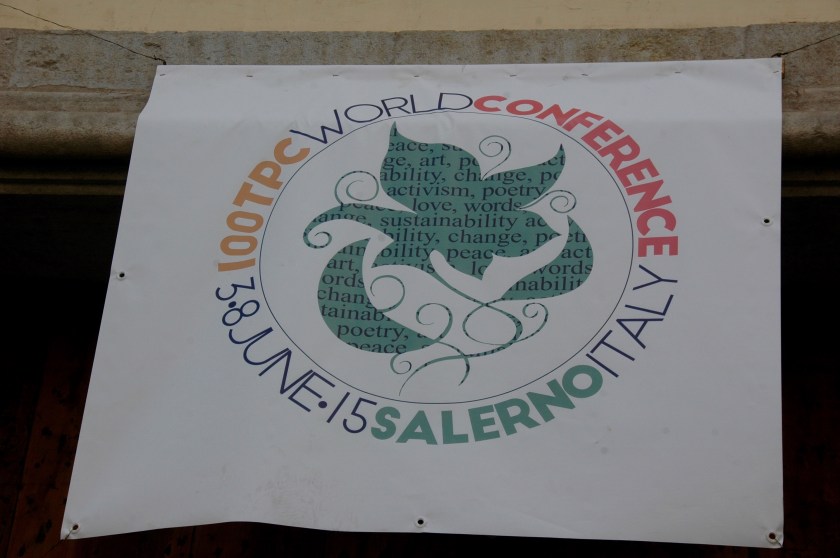
The organization has over the years focused on three general areas globally: Peace, Sustainability, and Social Justice. Around the world, organizers and groups focus on these issues as they fit in local contexts plus other local issues that require attention to bring about positive change. In 2015, Michael and Terri worked with 100TPC organizers in Italy to put together the 100TPC World Conference in Salerno, Italy.

100TPC World Conference Banner

How it Works

Each year activists, writers, artists, musicians, dancers, mimes gather in events to promote positive change. The content is up to the local organizers and participants. Generally, there is a focus on the three global themes: peace, sustainability, and social justice. We at The BeZine work with these three themes in the context of spirituality (religious or non-religious).

The official date for 100TPC each year is the last Saturday in September. Some local organizers do events near to the official date rather than on it, most often to avoid conflicts. (For example, if a date falls on a religious holiday that would prevent people from attending.) However, there are now 100TPC events, fundraisers, online readings year round. And there will be several Zoom readings this summer organized around the world, during this Time of Coronavirus. 

Depending on local and global conditions of the pandemic, there may be many more online events this year than in the past. In the past few years, The BeZine has moved to quarterly issues that focus on the three global 100TPC areas and added, for our “local” context, an issue on spirituality (and activism). In this way, each of our quarterly issues has become a sort of 100TPC publication event!

The BeZine and 100TPC

Jamie Dedes, our founding editor and editor-in-chief emerita, has been involved with 100TPC since almost the beginning. I started with 100TPC in 2013, organizing an event year and each year since events in Jerusalem or with Karen Alkalay-Gut in Tel Aviv. I also participated in the 100TPC World Conference in Salerno, Italy in 2015. I joined The BeZine team that same year, and have co-hosted our virtual event since 2015. This year will be my sixth year organizing with The BeZine, and my seventh year with 100TPC.

The BeZine, in its Bardo Group incarnation, ran a series of blog posts, “Poets Against War, Poets for Peace,” in September 2013 (Bardo News: Poets Against War, Poets for Peace). By 2014, The Bardo Group held its first online virtual poetry event as part of 100TPC (READY, SET, GO … The backstory on 100,000 Poets for Change …. The BeZine has held an online event each year since. Originally aimed for the home-bound who wanted to participate, our 100TPC virtual event has grown into a worldwide, inclusive 100TPC event.

Save the Date for this Year!

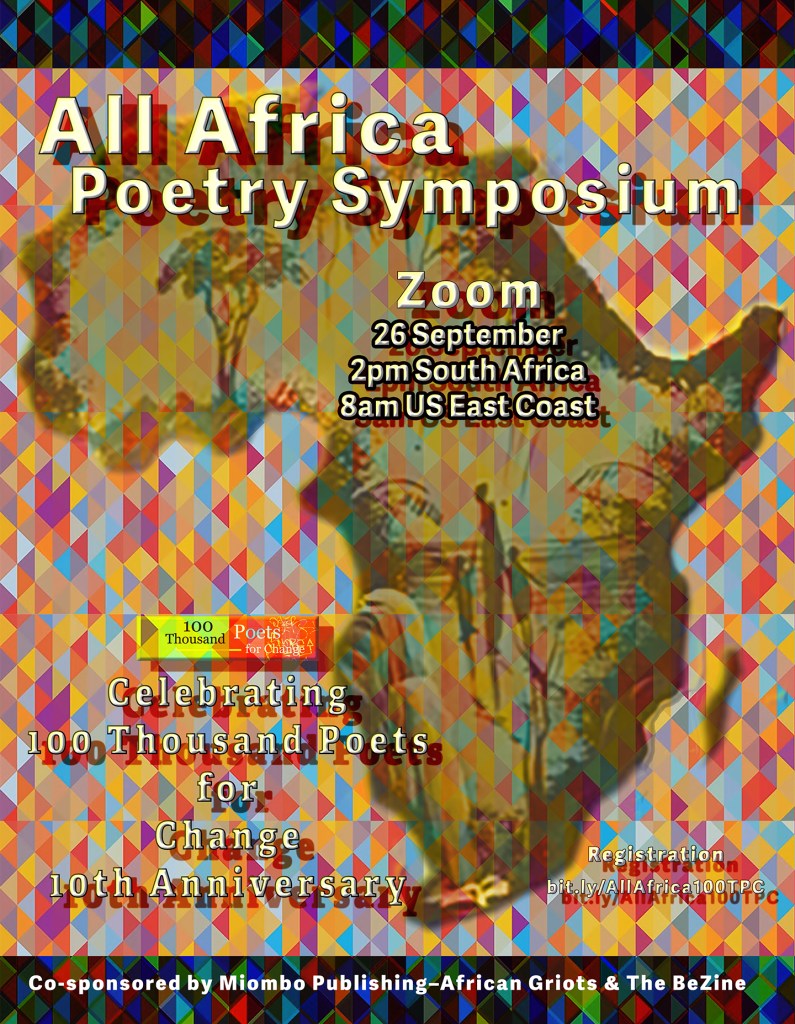
We will hold our annual online 100TPC at The BeZine again this year, on the “official” date for 100TPC: 26 September, 2020. So, save that date! In addition, we will be co-sponsoring All Africa Poetry Symposium in Celebration of 100 Thousand Poets for Change 10-Year Anniversary at 8 AM US East Coast, early afternoon in the Africa time zones. Read more here (including times in Africa). With this new mix of live-stream poetry, we hope to provide an exciting 100TPC virtual BeZine event. We plan to live-stream in The BeZine Facebook groups and on YouTube…stay tuned for more information.

Saturday, 26 September, 2020!


A Ten-Year Anniversary Anthology of Essays

This year, 100TPC has decided to embark on an anthology of essays to mark the ten-year history, covering organizing experiences, local iterations, impressions (of organizers, participants, audience members…), the Salerno conference, and the associated initiative Michael and Terri began a few years ago, Read a Poem to a Child.

Readers, contributors, and team-members of The BeZine may be interested in contributing to this effort, either from the perspective of The BeZine, or from their own experiences with 100TPC locally. Anyone with a perspective on 100TPC, please consider submitting.

See the call for submissions
Posted in 100,000 Poets, Musicians, Artists and Activists for Change, 100TPC, Event/s

All Africa Poetry Symposium in Celebration of 100 Thousand Poets for Change 10-Year Anniversary

Saturday, 26 September 2020 at:

  • 3 PM (Jerusalem, Kenya
  • 2 PM (Botswana, Egypt, South Africa, Zambia, Zimbabwe)
  • 1 PM (Nigeria)
  • 12 Noon (Sierra Leone)
  • 8 AM (US-East Coast)

You are welcome to attend and we look forward to presenting an exciting, dynamic and vibrant Poetry Symposium, where Africa speaks of itself through poetry.

The 100 Thousand Poets for Change Movement was founded 10 years ago by Editors, Poets, and internationally acclaimed Artists Michael Rothenberg and Terri Carrion —in order to speak change, to speak truth—against racial injustice, wars, poverty, corruption, the demise of human rights and smothering of human freedoms. The movements speaks through literary arts activism and social change-activism arts.

The Poetry Fête is co-hosted by African Griots and The BeZine in coordination with 100 Thousand Poets for Change. Poets in this All Africa Poetry Celebration are from Sierra Leone, Kenya, Nigeria, South Africa, Botswana, Zambia, Egypt, and Zimbabwe. Co-host and Emcee, Mbizo Chirasha, has worked tirelessly with 100 Thousand Poets for Change since its inception a decade ago, through literary arts projects GirlChildCreativity Project and the Zimbabwe We Want Poetry Campaign. Internationally renowned Jerusalem-based poet and The BeZine editor Michael Dickel will co-host the streaming events and attempt to wrangle the technology. This mega event will be streamed lived on several digital platforms.

Registration link.

ALUTA CONTINUA

Mbizo CHIRASHA-Resident Coordinator

Those interested in joining the Zoom audience for this event can follow this link, where you can register to receive an email to the Zoom event. (The link will be emailed shortly before the event.)

Posted in Art, poem, Poems/Poetry

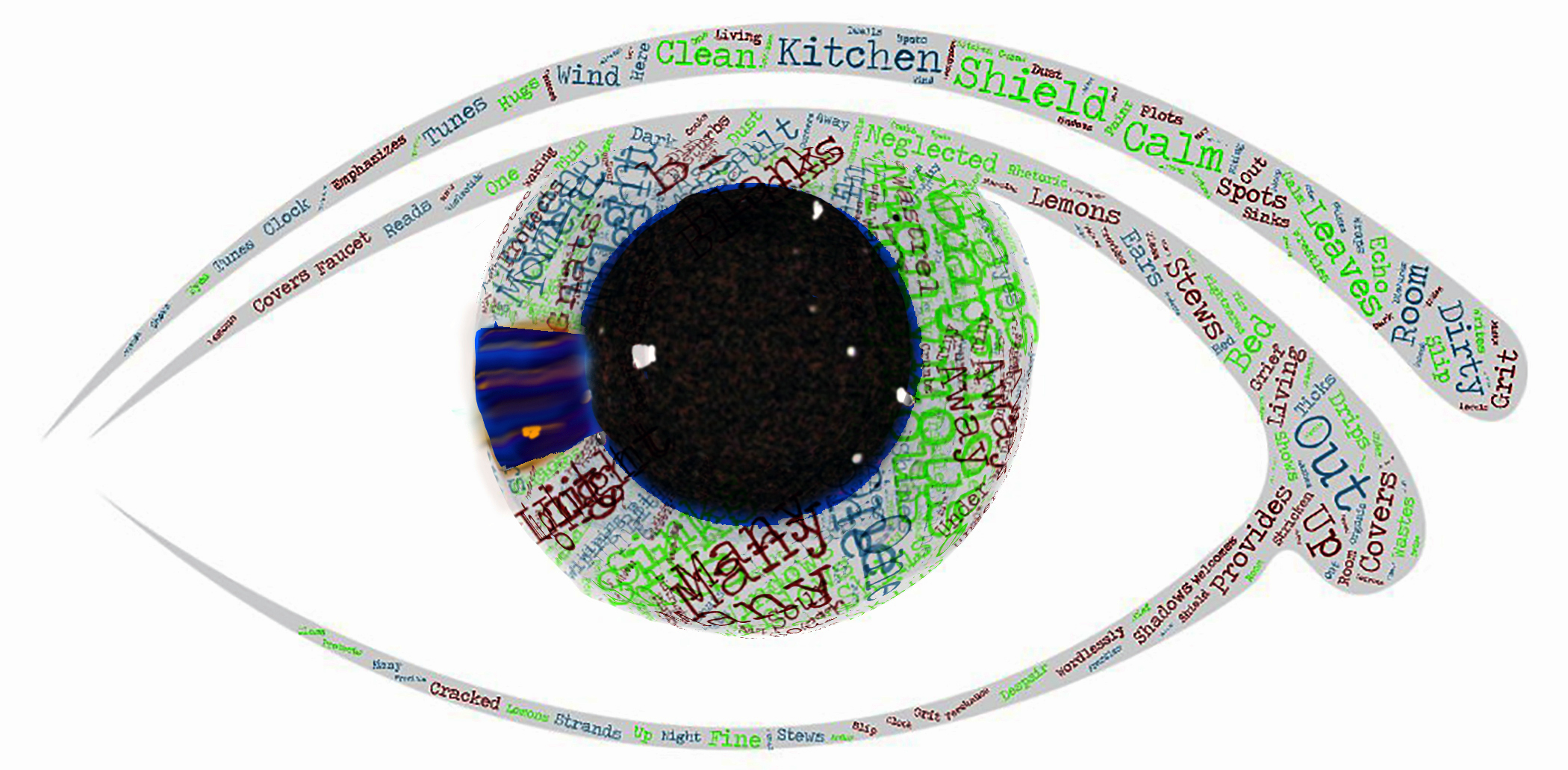
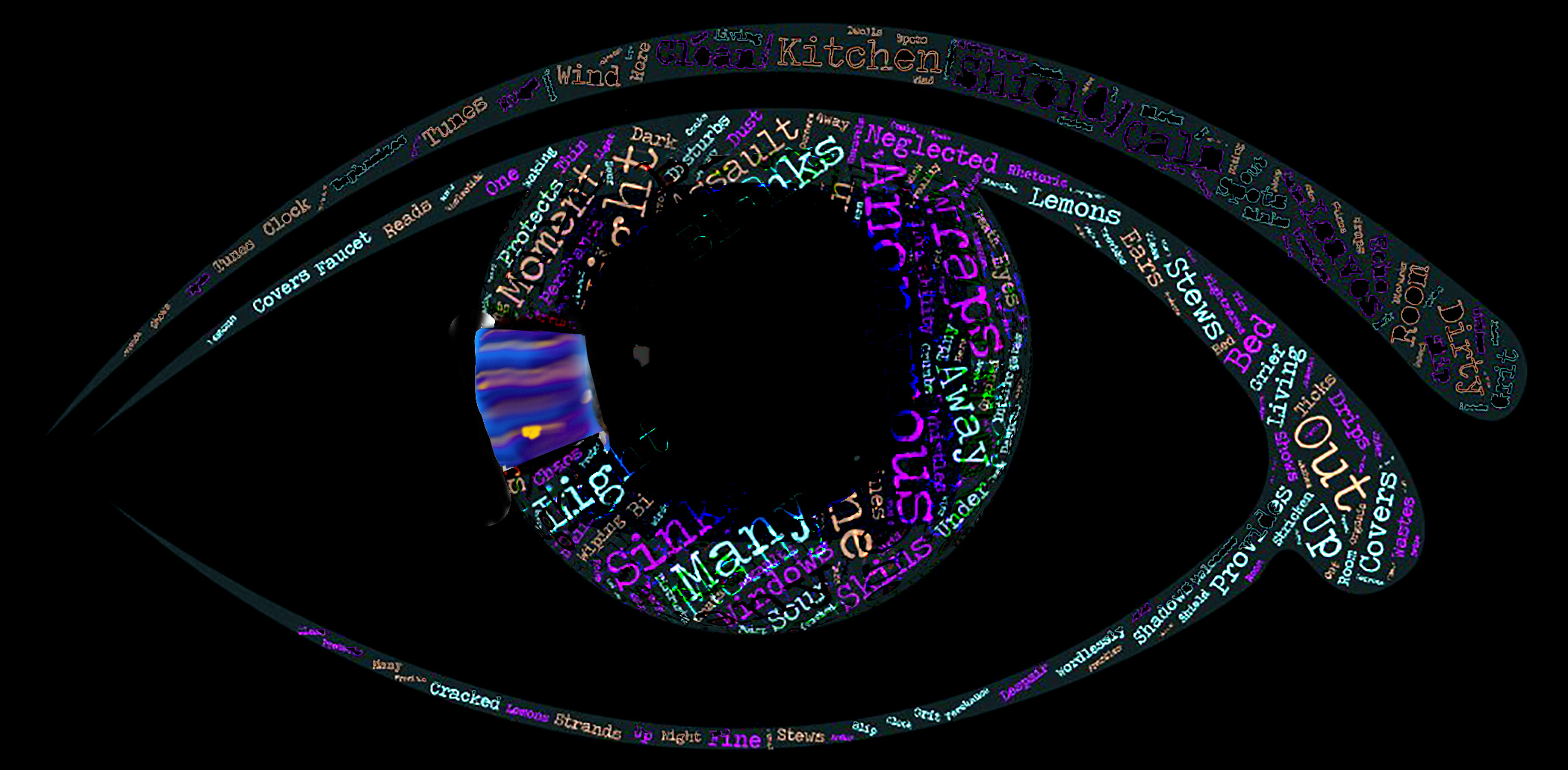
Five X Two, poem and digital art by Michael Dickel

Five X Two

Who blanks out one moment
sinks away from assault of light
covers provides thin shield—

but the night wraps me anonymously
protects me from dirty living-room windows
skins garlic in neglected kitchen corners.

What leaves biting gnats disturbs
perchance calm invisibility shines spots
interrogates shadows under the bed—

but the night emphasizes this
anonymously wiping glass clean
cooks up stews of sour lemons.

When whistles wastrel wind-
tunes wordlessly lifts dust grit
wastes faucet drips clock ticks—

but the night dampens eyes
anonymous echo in ears grief
wraps too many stricken.

Where sleep wrestles waking
nightmares slip into streaming
irreality shows cracked in paint—

but the night welcomes chaos
distrusts rhetoric hugs anonymous
crumbs like fine-grained death.

Why dwells here in this dark
so many tiny organic strands
unravels nucleotide secrets—

but the night reads novels
critiques plots of anonymous despair
writes poetry for morning trash.


©2020 Michael Dickel (Poetry and digital artwork). All rights reserved.


Michael Dickel’s writing and art appear in print and online. His poetry won the international Reuben Rose Poetry Award and has been translated into several languages. His most recent book, Nothing Remembers, came out in 2019 (Finishing Line Press) and received 3rd place for poetry in the Feathered Quill Book Awards–2020. He is Co-Managing Editor of The BeZine.


Posted in 100,000 Poets, Musicians, Artists and Activists for Change, Michael Dickel, Peace & Justice, The BeZine

SAVE THE DATE: 100,000 Poets (and Allies) for Change, September 26, 2020; Call for Submissions to 100TPC Anthology

“When we speak we are afraid our words will not be heard or welcomed. But when we are silent, we are still afraid. So it is better to speak.” Audre Lorde


SEPTEMBER 26, 2020

SAVE THE DATE

It’s twelve years since I started using poetry for activism, involving myself first with Sam Hamell‘s Poets Against the War. Almost ten years have passed since poet, publisher, musician and artist, Michael Rothenberg, and editor, artist, graphic designer, and translator Terri Carrion, co-founded 100,000 Poets for Change (100TPC) to which I am seriously devoted.

Through the decade our 100TPC poet-activist numbers have grown. We’ve expanded to include allies. These creatives from around the world share the values of peace, sustainability, and social justice. They speak out against corruption, cruelty, tyranny, and suppression through poetry, story, music, mime, art and photography, sometimes at personal risk.

INVITATION

If you’ve been involved before, please note the date and participate again. If you haven’t participated in 100TPC, we invite you to become a part of this worthy worldwide initiative.

By “we” I mean:

  • Michael Rothenberg and Terri Carrion, founders and organizers of Global 100TPC;
  • Regional organizers for 100TPC (connect with yours via the 100TPC.org blog roll or contact Michael Rothenberg to set up your own event), and
  • The Bardo Group, publishers of The BeZine and hosts of The BeZine Virtual 100TPC.


THE BeZINE

~ Be inspired . . . Be creative . . . Be peace . . . Be ~

VIRTUAL 100TPC

Our banner was designed by Zine team member Corina Ravenscraft (Dragon’s Dreams)

The second year I invited poetry against war was 2011. I put up a post on Into the Bardo (the name of the site before it became The BeZine) and invited folks to share their poems in the comments section. That was the last year for Sam Hamill’s Poets Against the War and the first year for Michael and Terri’s 100,000 Poets for Change.

Since 2012, we (The Bardo Group) have hosted an annual virtual event on the fourth Saturday of September in concert with Global 100TPC. My thought for going virtual was that there were many others who, like me, are home bound but want to have their say, want to stand for peace, sustainability and social justice. Soon Michael Dickel (Meta/ Phor(e) /Play) joined our team and a new tradition was born. Michael became our Master of Ceremonies.

This year – whether your are homebound or not – we invite you to join with us via The BeZine Virtual 100TPC on September 26.  Complete instructions for sharing your work will be included in the post that day.  Between us, Michael Dickel and I keep the event running for twenty-four hours or so. Mark your calendars.

Watch for more info here  on these initiatives and . . .

Upcoming:

  • Call for Submissions to the September 15, 2020 issue of The BeZine, which is a prelude to 100TPC;
  • The Poet by Day 100TPC Wednesday Writing Prompt, September 16, hosted by Michael Dickel; and
  • A contest (the heart-child of Zine team member, Corina Ravenscraft) to find the best The BeZine 2021 header for our Facebook Discussion Page.

In the spirit of love (respect) and community and
on behalf of The Bardo Group,
Jamie Dedes, Founding Editor and
now Co-Manager Editor with Michael Dickel


100 THOUSAND POETS FOR CHANGE: Ten years of evolution (2011-2020)
VOL 1: The Memoir

CALL FOR SUBMISSIONS

From Michael Rothenberg and Terri Carrion

In the tenth year anniversary of the movement, we are excited to invite all ​past and present 100TPC organizers and/or participants, to submit a three page ​essay to be considered for inclusion in ​the book ​100 THOUSAND POETS FOR CHANGE [100TPC]: Ten years of evolution (2011-2020),​ which will be published on a date to be announced.

This book will tell the story of 100TPC from the perspective of the poets who have been a part of creating and sustaining it. Through ​our personal essays, the reader will learn not only about the individual stories of the hundreds of poets-organizers from all corners, reflecting on the social and cultural effects of such poetic actions, but it will also offer an enriched summary and an organized way to learn about this grassroots movement and its impact on the history of poetry. It can also be thought of as a guidebook and manual, for future generations interested in the strategy of activists engaged in manifesting positive change–peace, justice and sustainability.

THEMES:

You can submit a ​maximum of two essays,​ only one (1) per theme. Be sure to send each essay in a ​separate e​mail (see details below).

1. FOUNDATIONAL EXPERIENCES.​ First experiences as organizer/ poet/ artist/ audience with ​100,000 Poets for Change.​
2. LOCAL EXPERIENCES.​ Experiences seen as a whole, after these ten years. Reflect on your achievements, or whatever you have witnessed, good and bad. You can choose to write about success or disappointments, benefits and limitations, even if you were not an organizer/participant consistently for the past ten years.
3. IMPRESSIONS​: Reflections and stories on the philosophy, ideas and spirit propelling the movement. How has this movement informed your poetics?
4. SALERNO.​ If you participated in the 2015 Salerno conference, you can choose to write about it, as a whole experience, and/or highlighting a specific story or aspects of the conference.
5. READ A POEM TO A CHILD.​ If you have been part of the Read a Poem to a Child initiative, you can also choose to write about that.

Submission deadline:​ December 1, 2020

Format guidelines​: Word document, Times New Roman, Font 12, Double Spaced.

Maximum 750 words.

Language​: If you are not an English speaking writer, please send your text in its original language along with the best possible English translation (three pages max, each). At this point, the project will only include the English version, but we’re studying alternatives to the issue of language, and world accessibility.
Bio & Photos:​ Please send a fifty word Bio as a Word doc. attachment. Also, and this is optional, you can attach three-to-five good quality images (jpg) related to your essay, and/or the events you organized in your community. Include photo caption and credits. Do not send bio photos. We want exceptional images that offer a glimpse either of the themes or aspects we’ve mentioned above, the collective drive, or the audience reaction.

Please send your submissions and/or any questions to: ​10yr100tpcbook@gmail.com In the email’s Subject Matter​, please write your essay’s t​heme.

Posted in April 2020 Poetry Month, COVID-19/Pandemic, interNational Poetry Month, International Poetry Month April 2020, Pandemic/ COVID-19, poem, Poems/Poetry, poetry

Before Corona by Mike Stone

Once, a long time ago,
Before Corona,
People sat together
Talking in soft voices
That only they could hear
Heads almost touching.

People held hands
While walking along
A riverbank
At sunset.
Sometimes people
Held each other so close
They could feel each other’s bodies
Underneath their clothes.
Sometimes they kissed
Tasting each other’s mouths.
Sometimes
They pleasured each other.

And sometimes
There were the accidental touches
On crowded trains or buses or planes
That you each savored privately
Arms brushing against arms,
Hand touching hand
While passing a cup of coffee
To someone,
A head heavy with sleep
Leaning against you
Long hair spilling across your shoulder.

These were the times before Corona
That we lived for,
That we couldn’t imagine
Having to do without,
That we thought would go on forever.

April 22, 2020

©2020 Mike Stone
from “The Hoopoe’s Call”

Before and After
Time of Coronavirus
Digital Landscape from Photographs
Photographs ©2007
Michael and Aviva Dekel
Artwork ©2020
Michael Dickel

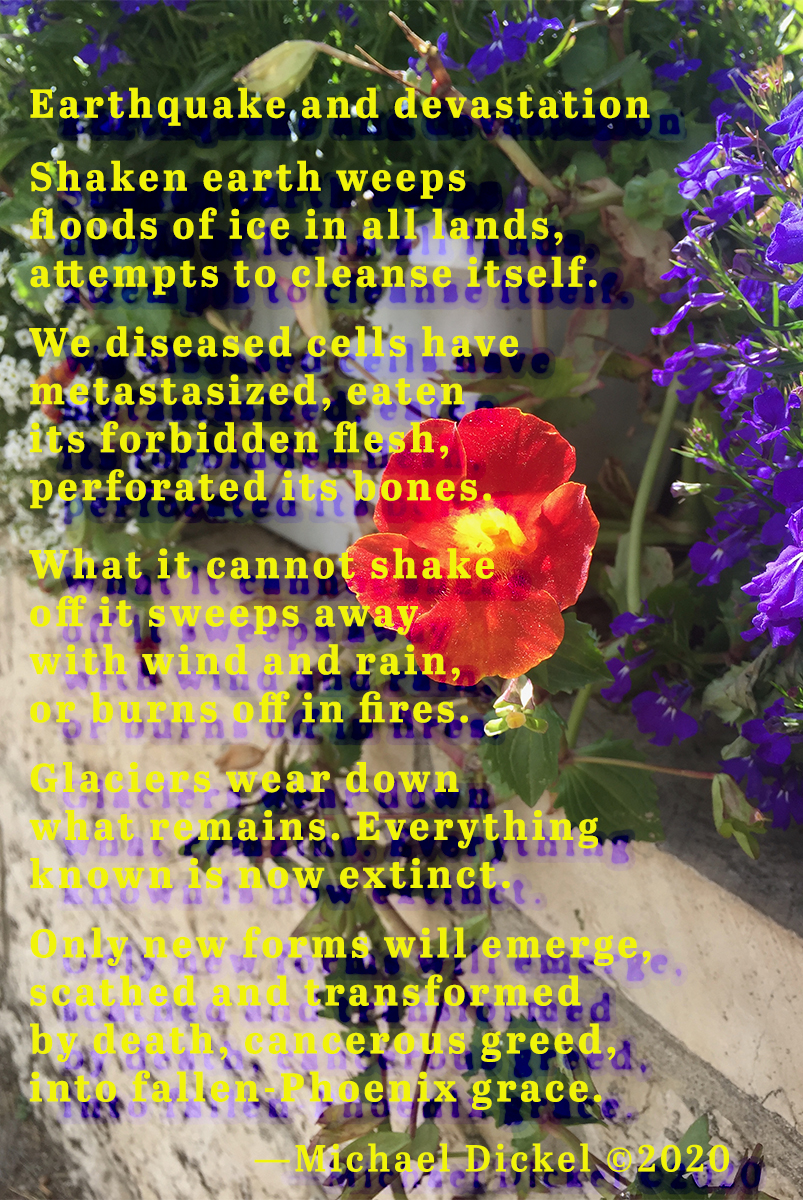
Earthquake and Devastation by Michael Dickel

The poem Earthquake and Devastation as graphic art, with a photo of flowers in the background.
Poem, photo, and art
©Michael Dickel

Earthquake and devastation

Shaken earth weeps
floods of ice in all lands,
attempts to cleanse itself.

We diseased cells have
metastasized, eaten
its forbidden flesh,
perforated its bones.

What it cannot shake
off it sweeps away
with wind and rain,
or burns off in fires.

Glaciers wear down
what remains. Everything
known is now extinct.

Only new forms will emerge,
scathed and transformed
by death, cancerous greed,
into fallen-Phoenix grace.

©Michael Dickel

An earlier version of this poem appeared in The BeZine, Summer 2018. It is part of a selected and new poems collection with the working title, Necropolis. It is presented here as a metaphor for the pandemic.

MICHAEL DICKEL, co-managing editor of The BeZine, has writing and art in print and online in many venues. His poetry has won the international Reuben Rose Poetry Award  and been translated into several languages. His latest collection of poetry Nothing Remembers, came out in 2019 from Finishing Line Press, and received 3rd place for poetry in the Feathered Quill Book Awards–2020. A poetry chap book, Breakfast at the End of Capitalism, came out in 2017; The Palm Reading after The Toad’s Garden, a flash fiction collection, came out in 2016. Previous books: War Surrounds Us (2014), Midwest / Mid-East (2012), and The World Behind It, Chaos… (2009). He co-edited Voices Israel Volume 36, was managing editor for arc-23 and -24, and is a past-chair of the Israel Association of Writers in English. With producer / director David Fisher, he received a U.S.A. National Endowment of Humanities documentary-film development grant. He currently is a lecturer at David Yellin Academic College of Education, Jerusalem, Israel.

Posted in Disability, disability/illness, General Interest, Illness/life-threatening illness

HaEtz HaChaim

Michael Dickel's avatarMeta/ Phor(e) /Play

Kiddush on the Solstice

 Down the hall from
 my hospital room
 a man’s voice sings
 the blessing for Shabbat
 wine.
 
             I see out
 my door
 what’s left
 of thin hair
 a pink hospital gown
 hands holding
 the wall
 as an old woman
 peers round the corner.

 When the man
 finishes
 she stumbles
 back to bed.

                      —Michael Dickel
                                       21 June 2019


HaEtz HaChaim 1–7
Digital Asemic-Writing Landscapes
from Photographs and Digital Painting
©2019 Michael Dickel


View original post

Posted in disability/illness, General Interest, healing, Illness/life-threatening illness

Triptych—Space

Neil Armstrong Goes for a Walk

Uncle John’s airedale watches the moon
with me as we walk. The man up there
does not excite a dog’s sense of smell.

John doesn’t understand
how I freed myself from the tv.
This is more exciting than sex, he says.
A man just walked on the moon.

The moonlight outside lacks magic
for him. Meanwhile, every possibility
sparkles on its river of quantum waves.

My Son’s Space

My son wants to find a planet
hotter than ours, but cooling rapidly.
We will trade places with the goldilocks
aliens so each of us finds a just-right home.

This is how he solves problems—missile attacks,
the climate crisis, poverty. He invents solutions,
builds models, gives all the energy and love
he has to liquid possibilities of rescue.

Hearing I have lymphoma doesn’t dissolve his glittering
resolve. He sits, quiet. Then he says, I will find a cure.

Originally appeared in: Black Bough Poetry, 20 July 2019, Issue 2, Broadside 36

The Flea Market

Artists painting river stones
at a flea market table yielded
pet rocks as Apollo reached the moon.
Mine had the moon lander.
I carried that promise of technology
with me until I turned from space.

Now, washed by dust and light from
other galaxies, my smooth head reflects
a chemotherapy travelogue. I retune
to technopoly and drifting planets.

A slightly different version appeared in: Black Bough, 20 July 2019, Issue 2, Broadside 9


Bio

Michael Dickel is a contributing editor for The BeZine. He writes on- & off-line & edits his blogZine, Meta/ Phor(e) /Play. His most recent poetry book, Nothing Remembers, came out from Finishing Line Press in September, 2019. He lives, writes, and teaches in Jerusalem.

Poems and recordings ©2019 Michael Dickel.


Posted in General Interest

Moshe’s House in Space, flash fiction and photography by Michael Dickel, artwork by Moshe Dickel

Author’s note: Sometimes, our children tell us things that they see or know, and we don’t have faith in our children’s senses. This is speculative fiction about climate change that suggests the children might yet show us a way, even if it is too late for us. This flash fiction appeared in The BeZine July 15, 2016. A somewhat different version of it originally appeared on Fragments of Michael Dickel (now called Meta/ Phor(e) /Play).
Ark-2 Digital Art from photos and sidewalk chalk Ark-2
Digital Art from photos and sidewalk chalk (photographed)
©2014 Michael Dickel

Moshe’s House in Space

Before, no sand swept through, no water splashed—a beach at driving distance, yes, but a long, long walk away. Before the three-year old’s stories, which I only half listened to: he was born in clouds before dinosaurs were alive; he died; “But now,” he said, “I’m becoming alive again.”

I thought a story he told me one morning came from his dreams.

He knew a dinosaur, he told me, with bright blue feathers in the day. At night it turned wooly and gray, to keep warm. The dinosaur had a name, Pollaydowen.

I thought, what an amazing imagination my three-year old son has, what colorful dreams.

He had other stories, about his house in space and all of the animals that lived there with him, a farm he had at this house. He went on and on with details—listing every animal we saw at the zoo, on farm visits, in books, on videos, on the internet; listing all of the plants and flowers he had heard of; listing creatures great and small in his lakes and seas.

How did he know all of them?

He insisted we should visit his house in space.

Then changes came suddenly, not slowly, as even the most pessimistic predictions had held. One day, news report said the sea covered beaches even at the lowest tides. The next week, waves washed across roads. Houses washed away. Whole neighborhoods of people could barely evacuate before the surf swallowed the land and their belongings.

The water washed sand over everything. The ozone layer shredded. Paint bubbled and peeled on cars, houses, government buildings. Everything and everyone aged.

Soon, sand dunes blew across the road in front of our house. The house looked like fifty years of neglect had settled in on it over the past few weeks.

That last day, my wife and I heard my son speaking in his room. And we heard another voice.

We went in. A bright blue flash turned toward us.

“We have to go,” my three-year old calmly explained, “now.”

“These sands end time here, the last to flow through the hour-glass,” the blue lizard-creature, Pollaydowen, added.

As we left the house, we trekked through hills of sand.

We returned once, to see what had happened.

I left this note for you who might find it, scratched in the walls, just in case anyone remains. We have an ark.

Photo ©2014 Michael Dickel